
Đề thi học kì 1 Tiếng Anh 10
Đề cương ôn tập học kì 1 Tiếng Anh 10 - Global Success
A. NỘI DUNG ÔN TẬP
I. Từ vựng
Unit 1. Family life
+ Từ và cụm từ liên quan đến đời sống gia đình
Unit 2. Humans and the environment
+ Từ và cụm từ liên quan đến các hoạt động của con người và môi trường
Unit 3. Music
+ Từ và cụm từ liên quan đến âm nhạc
Unit 4. For a better community
+ Từ và cụm từ liên quan đến sự phát triển cộng đồng
Unit 5. Inventions
+ Từ và cụm từ liên quan đến các phát minh
II. Ngữ âm
1. /br/, /kr/, /tr/, /kl/, /pr/, /pl/, /gr/
2. Trọng âm từ có 2 âm tiết
3. Trọng âm từ có 2 âm tiết có cách viết giống nhau
4. Trọng âm danh từ có 3 âm tiết
III. Ngữ pháp
1. Thì hiện tại đơn & hiện tại tiếp diễn
2. wil & be going to
3. Câu bị động
4. Câu ghép
5. V-ing/ to V/ động từ nguyên thể
6. Thì quá khứ đơn và quá khứ tiếp diễn với when và while
7. Thì hiện tại hoàn thành
B. BÀI TẬP
I. Từ vựng
Unit 1
Choose the best answers to complete the sentences.
1. She does two jobs at the same time as she is the main _________ of the family.
A. breadwinner B. homemaker C. housewife D. bread maker
2. She’s such a good wife. She’s _________ her husband through difficult times.
A. taught B. left C. supported D. provided
3. It’s not easy for some tenth-graders to get into high school _________.
A. works B. routines C. times D. responsibilities
4. Jim’s main _________ in his home is to keep the house clean.
A. right B. honour C. part D. responsibility
5. Family _________ are important because they teach children what is right or wrong in life.
A. bonds B.values C. holidays D. connections
6. Doing housework brings great _________ to children as it helps them develop necessary life skills.
A. benefits B. hard work C. results D. practices
7. He’s a man of strong _________. He always fights for what is right and you can rely on him.
A. health B. character C. hands D. influence
8. When all members of the family share housework, the family _________ will become stronger.
A. joys B. happiness C. life D. bonds
Đáp án:
|
1. A |
2. C |
3. B |
4. D |
|
5. B |
6. A |
7. B |
8. D |
Unit 2
Complete the following sentences with the words / phrases from the box.
|
organic energy adopt awareness set up eco-friendly litter protect |
1. More and more people _________ a green lifestyle, which is good for themselves and the environment.
2. _________ farming is better for the environment because it doesn't use harmful chemicals.
3. The club hopes to raise public _________ of the environmental issues.
4. Students are reminded not to drop _________in the street.
5. Bamboo is considered to be one of the most_________ building materials.
6. A way to save _________ is to reduce the amount of electricity used at home.
7. Simple actions like putting rubbish in the bin can help to _________ the environment.
8. The club was _________to encourage people to recycle more.
Đáp án:
|
1. adopt |
2. Organic |
3. awareness |
4. litter |
|
5. eco-friendly |
6. energy |
7. protect |
8. set up |
Unit 3
Complete the sentences using the correct form of the words in brackets.
1. There are many (talent) _______ participants in this show.
2. We are really looking forward to her (perform) _______ this Sunday.
3. She dreams of becoming a famous rock (sing) _______.
4. The piano is a great (music) _______ instrument for beginners.
5. I love reading books about famous (art) _______.
6. My friend and I were so (excite) _______ to go to the Youth Music Festival.
7. She decided to make an audio (record) _______ for her first song.
8. Everybody can send text messages or vote online to choose the (win) _______ of the show.
Đáp án:
|
1. talented |
2. performance |
3. singer |
4. musical |
|
5. artists |
6. excited |
7. recording |
8. winner |
Unit 4
Complete the sentences using the correct forms of the words in the box.
|
benefit community donation remote development generous volunteer donate |
1. We need more________ for our community development projects. Are you interested?
2. Our volunteer club received large________ from the students and their parents.
3. When teenagers do volunteer work, they gain numerous________.
4. My brother is very________, He usually donates half of his pocket money to charity.
5. This charity group raises money to build more schools in the________ areas.
6. Doing volunteer work is also an opportunity for career________.
7. To build a better ________everyone needs to join hands.
8. Besides________money, there are other ways you can do to help people in need.
Đáp án:
|
1. volunteers |
2. donations |
3. benefits |
4. generous |
|
5. remote |
6. development |
7. community |
8. donating |
Unit 5
Choose the correct word to complete each sentence.
1. Be careful when using electrical equipment / experiment.
2. Many people do not support experiments / laboratories on animals.
3. The scientists carry out important research in the laboratory / equipment.
4. You should install this hardware / software on your smartphone. It helps to make your photos more beautiful.
5. You can store thousands of songs on this experiment /device.
6. I think this is a hardware / software problem. The computer screen is broken.
7. A robot vacuum cleaner is a helpless / helpful device in your home. It makes housework less tiring.
8. The uses of Artificial / Robot Intelligence are very diverse.
Đáp án:
|
1. equipment |
2. experiments |
3. laboratory |
4. software |
|
5. device |
6. hardware |
7. helpful |
8. Artificial |
II. Ngữ âm
Choose the best answers (A, B, C or D) to indicate the correct consonant blends to complete the sentences.
1. Her tired_______ ain cannot deal with that problem.
A. /tr/ B. /pl/ C. /gr/ D. /br/
2. Be careful when crossing the train_______ ack.
A. /kr/ B. /kl/ C. /tr/ D. /pr/
Choose the correct letter (A, B, C or D) to indicate the word that differs from the other three in the position of primary stress.
3. A. singer B. compose C. common D. programme
4. A. favour B. enjoy C. reveal D. perform
5. A. invention B. Internet C. benefit D. telephone
6. A. increase (n) B. present (adj) C. decrease (v) D. object (n)
7. A. charity B. volunteer C. holiday D. memory
8. A. advantage B. computer C. century D. attention
Đáp án:
|
1. D |
2. C |
3. B |
4. A |
|
5. A |
6. C |
7. B |
8. C |
III. Ngữ pháp
Exercise 1
Complete the sentences using the correct present simple or present continuous forms of the verbs in brackets.
1. Nick and Dave (visit) _________ their parents twice a month.
2. You can’t talk my grandfather now. He (watch) _________ the evening news.
3. I can’t shop for groceries today. The local shops (not open) _________ on Sunday.
4. Lan sometimes (meet) _________ her friends after school.
5. Be quite! My younger brother (study) _________ for his exam.
6. Chris (look) _________ stressed, because he (look) _________ for a new job.
7. Anna often (walk) _________ to work, but her husband (drive) _________ her to her office this morning.
8. What _________ you (cook) _________? The food (smell) _________ so good!
Đáp án:
|
1. visit |
2. is watching |
3. do not open |
4. meets |
|
5. is studying |
6. looks – is looking |
7. walks – is driving |
8. are you cooking - smells |
Exercise 2
Complete the sentences with the correct form of will or be going to.
1. A: Oh no! I’ve left my money at home
B: Again? OK. I _________ pay for the dinner.
2. The weather forecast is good for the next few days. It_________ be warm and sunny.
3. I think the final match _________ be very exciting.
4. They’ve already decided on their next summer holiday. They _________do a tour of the country.
5. I hope you _________ visit me in my home one day.
6. I can’t come to the party tomorrow. I _________ study for my exams.
7. A: It’s very hot in here.
B: I_________turn on the air conditioner
8. I and my friends _________see a movie after class. Would you like to join us?
Đáp án:
|
1. will |
2. is going to |
3. will |
4. are going to |
|
5. will |
6. am going to |
7. will |
8. are going to |
Exercise 3
Choose the best answers to complete the sentences.
1. I'm afraid you_________ for an interview.
A. didn't select B. haven't selected C. were not selected D. were not selecting
2. Her first novel_________ into English last year.
A. translated B. was translated C. was translating D. translate
3. Their suitcases are packed. They_________ to the southern part of the country for their holiday.
A. will travel B. travelled C. are going to travel D. was travelling
4. My brother_________ a set of toys for his 7th birthday.
A. was given B. gave C. was giving D. give
5. Are you thirsty? I_________you a glass of water.
A. will get B. am going to get C. have given D. gave
6. This book _________in the classroom yesterday.
A. was left B. was leaving C. leaves D. left
7. A documentary about the wildlife_________ on TV tonight.
A. show B. will show C. showed D. is going to be shown
8. She is buying some sugar and flour. She _________a cake this evening.
A. is going to make B. makes C. made D. has made
Đáp án:
|
1. C |
2. B |
3. C |
4. A |
|
5. A |
6. A |
7. D |
8. A |
Exercise 4
Circle the correct verb form to complete each sentence.
1. Mai agreed buy / to buy my old laptop.
2. His teacher made him apologise / to apologise for his bad behaviour.
3. They decided going / to go to the live concert.
4. I'd love to visit / visit Paris one day.
5. His parents didn't let him go / to go to music school.
6. We managed find / to find their first album on social media.
7. I saw her cross / to cross the street.
8. I heard him to open / open the window last night.
9. Dad promised take / to take us to the circus on Sunday.
10. He really wants learn / to learn to play a musical instrument this summer.
Đáp án:
|
1. to buy |
2. apologise |
3. to go |
4. to visit |
5. go |
|
6. to find |
7. cross |
8. open |
9. to take |
10. to learn |
Exercise 5
Make compound sentences using the conjunctions in brackets.
1. I'd like to go to the party. I'm too busy. (but)
2. It was sunny. Lan took an umbrella. (so)
3. Anna is an amazing dancer. Her parents are proud of her. (and)
4. You can vote online for your favourite singer. You can send text messages. (or)
5. Lisa went shopping yesterday. She didn't buy anything. (but)
6. John's parents own a restaurant. Sometimes he helps in the kitchen at weekends. (and)
7. Go inside. You will catch a cold. (or)
8. Rita is a good drummer. She will probably be invited to join the band (so)
Đáp án:
1. I'd like to go to the party, but I'm too busy.
2. It was sunny, so Lan took an umbrella.
3. Anna is an amazing dancer, and her parents are proud of her.
4. You can vote online for your favourite singer, or you can send text messages.
5. Lisa went shopping yesterday, but she didn't buy anything.
6. John's parents own a restaurant, and sometimes he helps in the kitchen at weekends.
7. Go inside or you will catch a cold.
8. Rita is a good drummer, so she will probably be invited to join the band.
Exercise 6
Choose the best answers to complete the sentences.
1. While we________ information for our presentation last month, we discovered that lots of people in our neighbourhood needed help.
A. were collecting B. are collecting C. collect D. collected
2. When we visited Mrs Lan this morning, she ________her lunch.
A. is preparing B. was preparing C. has prepared D. prepares
3. She told us her life story while we________ her tidy the house.
A. are helping B. have helped C. were helping D. help
4. While we were cleaning her kitchen, we________ a knock at the door. It was another old lady who lived next door.
A. are hearing B. were hearing C. hear D. heard
5. We________ to help old people clean their houses while we were talking to them later that day.
A. are deciding B. were deciding C. decided D. decide
6. While we ________ at the food bank, we met an old friend.
A. were helping B. are helping C. help D. helped
7. An old lady came to us and asked for help while we________ at the bus stop.
A. are waiting B. have waited C. were waiting D. wait
8. When we came to the local orphanage, all the children there________ their dinner.
A. are having B. were having C. have had D. have
Đáp án:
|
1. A |
2. B |
3. C |
4. D |
|
5. C |
6. A |
7. C |
8. B |
Exercise 7
Choose the best answers to complete the sentences.
1. The door and the window are open. I think someone________ into our house!
A. breaks B. broke C. has broken D. will break
2. Jane________ Chinese, but she quitted because it was too difficult.
A. studies B. studied C. has studied D. will study
3. Dave ________ Chinese for six years now. He likes it.
A. studies B. studied C. has studied D. will study
4. We have worked here ________ 2002
A. for B. since C. In D. to
5. The company ________ a new kind of smartphone. It looks fantastic!
A. just introduces B. just introduced C. has just introducedD. will just introduce
6. Hoa is not coming to class today. She ________ back to her hometown
A. goes B. go C. has gone D. will go
7. She has had this smartphone________ 10 years.
A. for B. since C. from D. in
8. This is a delicious cake, but we have________ had a big dinner and feel very full.
A. only B. just C. since D. for
Đáp án:
|
1. C |
2. B |
3. C |
4. B |
|
5. C |
6. C |
7. A |
8. B |
Exercise 8
Complete the sentences using the correct forms of the verbs in brackets.
1. Avoid (charge) ________the device for too long. It may overheat and break down.
2. It's very convenient(look) ________ up a new word on a smartphone when learning English.
3. Computers allow us (store) ________ a lot of information.
4. Robots help us (do) ________ difficult or dangerous tasks.
5. (Carry) ________ a laptop around is easy because it is often very light and small.
6. I decided (give) ________ my old laptop to my younger brother.
7. Some people hate (use) ________ technology.
8. My friends enjoy (learn) ________ English on their smart devices.
Đáp án:
|
1. charging |
2. to look |
3. to store |
4. do/ to do |
|
5. To carry/ Carrying |
6. to give |
7. using/ to use |
8. learning |
-----------------THE END-----------------
Đề thi học kì 1 Tiếng Anh 10 Global Success - Đề số 1
Đề bài
LISTENING
Listen to two volunteers, Karen and Martin. Listen and choose the correct answer.
1. What kind of voluntary work does Karen do?
A. caring for the elderly
B. caring for babies
C. caring for homeless people
2. What kind of voluntary work does Martin do?
A. caring for babies
B. caring for the elderly
C. working on a farm
3. When does Karen work?
A. weekends
B. weekdays
C. when she has free time
4. When does Martin work?
A. two times a week
B. three times a week
C. when he has free time
5. Why does Karen do volunteering?
A. She’s passionate about the environment
B. She wants to study farming and agriculture
C. She wants to impress people
PHONETICS
Find the word which has a different sound in the part underlined.
6.
A. value
B. father
C. practice
D. laptop
7.
A. interviewed
B. washed
C. helped
D. grouped
Choose the word which has a different stress pattern from the others.
8.
A. access
B. donate
C. device
D. install
9.
A. confidence
B. donation
C. computer
D. invention
USE OF ENGLISH
Choose the best answer A, B, C or D to complete the sentences.
10. Last summer, while I _________ the shopping mall, I ______________ an advertisement for volunteers.
A. am going to /see
B. went/saw
C. was going to/saw
D. go to/see
11. I find participating in ______________ activities very interesting.
A. volunteer
B. volunteering
C. voluntarily
D. volunteerism
12. They sell ____________ items which they do by themselves to raise money for the local orphanage and homeless old people.
A. man-made
B. handmade
C. machine-made
D. manufactured
13. Each month, we _______________ the donations to the community centre.
A. take
B. have
C. raise
D. create
14. Volunteers help _____________ free meal to the poor.
A. deliver
B. delivering
C. delivers
D. delivered
15. You can participate in a local ______________ group to clean up the street or volunteer at nursing home.
A. environment
B. environmentally
C. environmental
D. environmentalist
16. Save the Children ______ in the United Kingdom since 1919.
A. has set up
B. was set up
C. has been set up
D. set up
17. The organisation makes sure that poor children have access ________ education.
A. in
B. on
C. for
D. to
18. They are ___________ projects which create more chances for children in remote areas to go to school.
A. take up
B. working on
C. set on
D. hold on
19. ______________________ is an organization that tries to achieve social or political aims but is not controlled by a government.
A. government organization
B. non-government organization
C. non-governmental organization
D. governmental organization
20. I’m writing to apply __________ a volunteer position at the local centre of community development.
A. to
B. for
C. in
D. on
Mark the letter A, B, C, or D to indicate the word(s) CLOSEST in meaning to the underlined word(s) in each of the following sentences.
21. The school is difficult to get to because it is located in a remote area.
A. mountainous
B. isolated
C. rural
D. approachable
22. The school has organised various volunteering activities to encourage students to take part in.
A. resembling
B. same
C. numerous
D. connected
Mark the letter A, B, C, or D to indicate the word(s) OPPOSITE in meaning to the underlined word(s) in each of the following sentences.
23.The project will benefit the local community as a whole.
A. contribute to
B. promote
C. hinder
D. assist
24. Thank you for your donation. It was very generous of you.
A. mean
B. selfish
C. unkind
D. open-handed
Make the correct form.
25. I hope Toby is enjoying the summer. He (go) __________________ for six weeks
26. When we (walk) ______________ by the river, we (hear) _______________ a shout.
27. She knows Marid very well. She (be) __________ there lots of times since she moved to Spain
Choose the correct word or phrase.
28. The football match wasn't very good at the beginning, but it got more exciting/excited towards the end.
29. Why do you always look so boring/bored? Is your life really so boring/bored?
30. I felt helpful/helpless in the face of all these rules and regulations.
READING COMPREHENSION
Choose the word or phrase among A, B, C or D that best fits the blank space in the following passage.
Mr. Brown and some (31) _____________ are on a very dirty beach now. Today they are ready to (32) ___________ the beach a clean and beautiful place again. After listening to Mr. Brown's instructions, they are divided into three groups. Group 1 needs to walk along the beach. Group 2 should check the sand, (33) _____________ group 3 has to check among the rocks. Garbage must be put into plastic bags, and the bags will be collected by Mr. Brown. He will take the bags to the to garbage (34) _____________. They all are (35) _______________ to work hard to refresh this area.
31.
A. voluntary
B. volunteers
C. volunteering
D. volunteer
32.
A. make
B. get
C. do
D. change
33.
A. so
B. but
C. although
D. and
34.
A. dump
B. yard
C. area
D. place
35.
A. exciting
B. interesting
C. eager
D. bored
Read the text and choose the best answer.
Each nation has many people who voluntarily take care of others. For example, many high school and college students in the United States often spend many hours as volunteers in hospitals, orphanages or homes for the aged. They read books to the people in these places. Sometimes the students just visit them, play games with them or listen to their problems.
Other young volunteers work in the homes of sick or old people. They clean up their houses, do their shopping or mow their lawns. For boys who no longer have fathers, there is a voluntary organization called Big Brothers. College students take these boys to baseball games and help them to get to know things that boys usually learn from their fathers.
Some high school students take part in helping disadvantaged or handicapped children. They give care and comfort to them and help them to overcome their difficulties. Young college and university students participate in helping the people who have suffered badly in wars or natural disasters. During summer vacations, they volunteer to work in remote or mountainous areas to provide education for children.
Each city has a number of clubs where boys and girls can go to play games. Some of these clubs organise short trips to the mountains, beaches or other places of interest. Most of these clubs use a lot of high schools and college students as volunteers because they are young enough to understand the problems of younger boys and girls
Volunteers believe that some of the happiest people in the world are those who help to bring happiness to others.
36. Volunteers usually help those who are sick or old in their homes by _______________.
A. mowing the lawns, doing shopping and cleaning up their houses
B. cooking, sewing or washing their clothes
C. telling them stories, and singing and dancing for them
D. taking them to baseball games.
37. Big Brothers is _________________________.
A. the name of a club
B. a home for children
C. the name of a film
D. an organization for boys who no longer have fathers
38. Most of the boys' and girls' club use many high school and college students as volunteers because they _________________.
A. have a lot of free time
B. can understand the problems of younger boys and girls.
C. know how to do the work
D. are good at playing game
39. Volunteers believe that _____________.
A. in order to make others happy, they have to be unhappy
B. the happiest people are those who make themselves happy
C. the happiest people are those who are young and healthy
D. bringing happiness to others makes them the happiest people
40. The best title for the passage is______________.
A. Taking Care of Others
B. Voluntary Work in the United States.
C. Volunteers: The Happiest People in the World
D. Helping Old and Sick People in the United States
WRITING
Rewrite the following sentences, using the suggestions.
41. I was walking home when it started to rain.
While I _________________________________
42. She was telling me about her party when she started to laugh loudly.
She started _____________________________
43. The last time I cooked was 3 years ago.
I ______________________________________
44. When did you buy that bag?
How ___________________________________
45. She began living in Da Nang when she was a child.
She ____________________________________
----- HẾT -----
Đáp án
HƯỚNG DẪN GIẢI
Thực hiện: Ban chuyên môn trithuchub.com
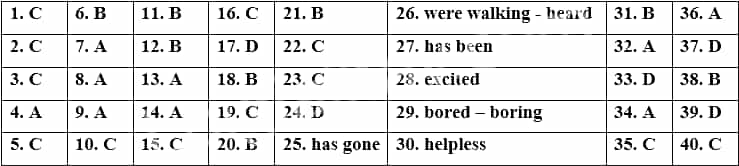

41. was walking home, it started to rain
42. to laugh loudly while she was telling me about her party
43. haven’t cooked for 3 years
44. long have you bought that bag
45. has lived in Da Nang since she was a child
HƯỚNG DẪN GIẢI CHI TIẾT
Transcript
I = Interviewer K = Karen M = Martin
I: Welcome to The World of Work. Today we have two young people in the studio. They are going to talk to us about voluntary work. Welcome to the show, Martin and Karen.
M&K: Thank you.
I: Karen, let’s start with you. What kind of voluntary work do you do?
K: I visit elderly people in their homes. There are people in my town who don’t have any family. Some of them have a dog or cat, but often they feel lonely and unhappy. I spend time with them and most of the time they just want to talk.
I: That’s great, Karen. And what about you, Martin? What does your voluntary work involve?
M: I work on an organic farm.
I: What exactly do you do on the farm?
M: I do lots of different jobs. I plant trees and vegetables. I feed the pigs and chickens. I collect the eggs from the chickens and I sometimes cook lunch for all the other volunteers. It’s a big farm, and there are fifteen volunteers.
I: How many hours do you work, Karen?
K: I’m a student and I have a busy social life. I don’t have much free time especially at the weekend, so I do two or three hours during a week.
M: I do quite a lot. I go every Saturday and Sunday. We start very early in the morning and finish at about 7 o’clock in the evening. It’s very hard work, and I feel tired at the end of the day. But I don’t mind because I love being on the farm.
I: What sort of people volunteer?
K: Fantastic people! No. Um, volunteers are caring people. Of course a lot of people are caring, but volunteers are more likely to do something about it.
I: So why do you do this voluntary work, Martin?
M: I am passionate about the environment, and I’m interested in responsible farming. I believe that organic farming is very important for the future. I also like working in a team. I learn important life skills and I’m more confident than before. Also, I want to study farming and agriculture so this is good experience.
I: What about you, Karen?
K: Well, there are problems in my community and I want to help. There’s also a selfish reason for doing it – it impresses people and I like that.
I: Thank you Karen, thank you Martin. Now, unemployment is unfortunately ...
Tạm dịch:
I: Chào mừng đến với Thế giới công việc. Hôm nay chúng ta có hai người trẻ trong phòng thu. Họ sẽ nói chuyện với chúng ta về công việc tình nguyện. Chào mừng đến với chương trình, Martin và Karen.
M&K: Cảm ơn.
I: Karen, chúng ta hãy bắt đầu với bạn. Bạn làm công việc tình nguyện nào?
K: Tôi đến thăm những người già tại nhà của họ. Có những người ở thị trấn của tôi không có gia đình. Một số người trong số họ nuôi chó hoặc mèo, nhưng họ thường cảm thấy cô đơn và không vui. Tôi dành thời gian cho họ và hầu hết thời gian họ chỉ muốn trò chuyện.
I: Tuyệt lắm, Karen. Còn bạn thì sao, Martin? Công việc tình nguyện của bạn bao gồm những gì?
M: Tôi làm việc tại một trang trại hữu cơ.
I: Chính xác là bạn làm gì ở trang trại?
M: Tôi làm nhiều công việc khác nhau. Tôi trồng cây và rau. Tôi cho lợn và gà ăn. Tôi thu thập trứng từ gà và đôi khi nấu bữa trưa cho tất cả những người tình nguyện khác. Đó là một trang trại lớn và có mười lăm người tình nguyện.
I: Bạn làm việc bao nhiêu giờ, Karen?
K: Tôi là sinh viên và tôi có cuộc sống xã hội bận rộn. Tôi không có nhiều thời gian rảnh, đặc biệt là vào cuối tuần, vì vậy tôi dành hai hoặc ba giờ mỗi tuần.
M: Tôi làm khá nhiều. Tôi đến vào mỗi thứ Bảy và Chủ Nhật. Chúng tôi bắt đầu rất sớm vào buổi sáng và kết thúc vào khoảng 7 giờ tối. Công việc rất vất vả và tôi cảm thấy mệt mỏi vào cuối ngày. Nhưng tôi không bận tâm vì tôi thích ở trang trại.
I: Những người tình nguyện như thế nào?
K: Những người tuyệt vời! Không. Ừm, những người tình nguyện là những người quan tâm. Tất nhiên là có rất nhiều người quan tâm, nhưng những người tình nguyện có nhiều khả năng sẽ làm điều gì đó về vấn đề này.
I: Vậy tại sao bạn lại làm công việc tình nguyện này, Martin?
M: Tôi đam mê môi trường và tôi quan tâm đến việc canh tác có trách nhiệm. Tôi tin rằng canh tác hữu cơ rất quan trọng cho tương lai. Tôi cũng thích làm việc theo nhóm. Tôi học được các kỹ năng sống quan trọng và tôi tự tin hơn trước. Ngoài ra, tôi muốn học về nông nghiệp và nông nghiệp nên đây là một trải nghiệm tốt.
I: Còn bạn thì sao, Karen?
K: Vâng, cộng đồng của tôi có vấn đề và tôi muốn giúp đỡ. Cũng có một lý do ích kỷ để làm điều đó – nó gây ấn tượng với mọi người và tôi thích điều đó.
I: Cảm ơn Karen, cảm ơn Martin. Bây giờ, thật không may là tình trạng thất nghiệp ...
1. C
Kiến thức: Nghe-hiểu chi tiết
Giải thích:
Martin làm tình nguyện viên gì?
A. chăm sóc người già
B. chăm sóc trẻ sơ sinh
C. chăm sóc người vô gia cư
Thông tin: I work in a soup kitchen for homeless people
(Tôi làm việc trong một bếp súp cho những người vô gia cư)
Chọn C.
2. C
Kiến thức: Nghe-hiểu chi tiết
Giải thích:
Martin làm tình nguyện viên gì?
A. chăm sóc trẻ sơ sinh
B. chăm sóc người già
C. làm việc trên trang trại
Thông tin: I work on an organic farm.
(Tôi làm việc trong một trang trại hữu cơ.)
Chọn C.
3. C
Kiến thức: Nghe-hiểu chi tiết
Giải thích:
Karen làm việc khi nào?
A. cuối tuần
B. các ngày trong tuần
C. khi cô ấy có thời gian rảnh
Thông tin: I’m a student and I have a lot of work at the moment. I don’t have much free time, so I do two or three hours a week.
(Tôi là một sinh viên và tôi có rất nhiều việc vào lúc này. Tôi không có nhiều thời gian rảnh, vì vậy tôi làm hai hoặc ba giờ một tuần.)
Chọn C.
4. A
Kiến thức: Nghe-hiểu chi tiết
Giải thích:
Martin làm việc khi nào?
A. hai lần một tuần
B. ba lần một tuần
C. khi anh ấy có thời gian rảnh
Thông tin: I do quite a lot. I go every Saturday and Sunday
(Tôi làm khá nhiều. Tôi đi vào thứ bảy và chủ nhật hàng tuần)
Chọn A.
5. C
Kiến thức: Nghe-hiểu chi tiết
Giải thích:
Tại sao Karen làm tình nguyện?
A. Cô ấy đam mê môi trường
B. Cô ấy muốn học nông nghiệp và nông nghiệp
C. Cô ấy muốn gây ấn tượng với mọi người
Thông tin: There’s also a selfish reason for doing it – it impresses people and I like that.
(Cũng có một lý do ích kỷ để làm điều đó - nó gây ấn tượng với mọi người và tôi thích điều đó.)
Chọn C.
6. B
Kiến thức: Phát âm “a”
Giải thích:
A. value /ˈvæljuː/
B. father /ˈfɑːðə(r)/
C. practice /ˈpræktɪs/
D. laptop /ˈlæptɒp/
Phương án B có phần gạch chân đọc là /ɑː/, còn lại đọc là /æ/.
Chọn B.
7. A
Kiến thức: Phát âm “ed”
Giải thích:
A. interviewed /ˈɪntəvjuːd/
B. washed /wɒʃt/
C. helped /helpt/
D. grouped /ɡruːpt/
Phương án A có phần gạch chân đọc là /d/, còn lại đọc là /t/.
Chọn A.
8. A
Kiến thức: Trọng âm từ 2 âm tiết
Giải thích:
A. access (n/v) /ˈækses/
B. donate /dəʊˈneɪt/
C. device /dɪˈvaɪs/
D. install /ɪnˈstɔːl/
Phương án A có trọng âm rơi vào 1, còn lại rơi vào 2.
Chọn A.
9. A
Kiến thức: Trọng âm từ 3 âm tiết
Giải thích:
A. confidence /ˈkɒnfɪdəns/
B. donation /dəʊˈneɪʃn/
C. computer /kəmˈpjuːtə(r)/
D. invention /ɪnˈvenʃn/
Phương án A có trọng âm rơi vào 1, còn lại rơi vào 2.
Chọn A.
10. C
Kiến thức: Thì của động từ
Giải thích: While + S+ V (past continuous), S + V (past simple)
=> dùng để diễn tả hành động đang xảy ra thì hành động khác xen vào
Tạm dịch: Mùa hè năm ngoái, trong khi tôi.
Chọn C.
11. B
Kiến thức: Từ loại
Giải thích:
A. volunteer (n/v) tình nguyện viên, tình nguyện làm gì
B. volunteering (adj) làm công việc liên quan đến tình nguyện
C. voluntarily (adv) có liên quan đến tình nguyện
D. volunteerism (n) chủ nghĩa tình nguyện
Chỗ trống cần điền là tính từ theo cấu trúc: adj + n
Volunteering/voluntary activity: hoạt động thiện nguyện
Tạm dịch: Tôi cảm thấy tham gia các hoạt động thiện nguyện rất thú vị.
Chọn B.
12. B
Kiến thức: Sự lựa chọn từ
Giải thích:
A. man-made (adj) nhân tạo
B. handmade (adj) làm thủ công, làm bằng tay
C. machine-made (adj) làm bằng máy
D. manufactured (adj) làm máy móc hóa
Tạm dịch: Họ bán các đồ vật lằm bằng tay mà họ tự làm để gây quỹ cho trại trẻ mồ côi địa phương và người già vô gia cư.
Chọn B.
13. A
Kiến thức: Sự kết hợp từ
Giải thích: take/give the donation to sb: quyên góp từ thiện đến ai
Tạm dịch: Mỗi tháng, chúng tôi quyên góp cho trung tâm cộng đồng.
Chọn A.
14. A
Kiến thức: Dạng của động từ
Giải thích: help (to) do sth: giúp việc gì
Tạm dịch: Các tình nguyện viên giúp đưa bữa ăn miễn phí tới người nghèo.
Chọn A.
15. C
Kiến thức: Từ loại
Giải thích:
A. environment (n) môi trường
B. environmentally (adv) thuộc về môi trường
C. environmental (adv) thuộc về môi trường
D. environmentalist (n) nhà môi trường học
Chỗ trống cần điền là tính từ theo cấu trúc: adj + n
Tạm dịch: Bạn có thể tham gia vào một nhóm môi trường địa phương để dọn dẹp đường phố hoặc làm tình nguyện viên tại viện dưỡng lão.
Chọn C.
16. C
Kiến thức: Thì của động từ
Giải thích:
Since + mốc thời gian quá khứ => dấu hiệu thì hiện tại hoàn thành => loại B,D
Tạm dịch: Tổ chức “Save the Children” được thành lập ở Vương Quốc Anh từ năm 1919.
Chọn C.
17. D
Kiến thức: Giới từ
Giải thích: have access to sth: tiếp cận với cái gì
Tạm dịch: Tổ chức đảm bảo rằng trẻ em nghèo được tiếp cận với giáo dục.
Chọn D.
18. B
Kiến thức: Cụm động từ
Giải thích:
A. take up: chiếm (không gian), bắt đầu (sở thích mới)
B. working on: làm, thực hiện
C. set on: tấn công bất ngờ
D. hold on: giữ (ở nguyên vị trí)
Tạm dịch: Họ đang thực hiện những dự án cái mà tạo nhiều cơ hội hơn cho trẻ em vùng sâu, vùng xa được đến trường.
Chọn B.
19. C
Kiến thức: Sự lựa chọn từ
Giải thích:
non-governmental organization: tổ chức phi chính phủ (NGO)
Tạm dịch: Tổ chức phi chính phủ là một tổ chức cố gắng đạt được các mục tiêu chính trị hoặc xã hội nhưng không bị kiểm soát bởi chính phủ.
Chọn C.
20. B
Kiến thức: Giới từ
Giải thích:
Apply for + vị trí công việc: ứng tuyển vị trí gì
Apply to + tổ chức/trường học: xin vào
Tạm dịch: Tôi viết thư này để ứng tuyển vào vị trí tình nguyện viên tại trung tâm phát triển cộng đồng địa phương.
Chọn B.
21. B
Kiến thức: Từ đồng nghĩa
Giải thích:
remote (adj) xa xôi, hẻo lánh
A. mountainous (adj) thuộc về vùng núi
B. isolated (adj) bị cô lập
C. rural (adj) thuộc về nông thôn
D. approachable (adj) dê tiếp cận
Tạm dịch: Trường khó đến vì nằm ở vùng sâu, vùng xa.
Chọn B.
22. C
Kiến thức: Từ đồng nghĩa
Giải thích:
various (adj): đa dạng
A. resembling (adj) giống
B. same (adj) giống
C. numerous (adj) nhiều
D. connected (adj) được kết nối
Tạm dịch: Nhà trường đã tổ chức nhiều hoạt động tình nguyện khác nhau để khuyến khích sinh viên tham gia.
Chọn C.
23. A
Kiến thức: Từ trái nghĩa
Giải thích:
benefit (v): mang lại lợi ích
A. contribute to: góp phần, đóng góp
B. promote (v) thúc đẩy
C. hinder (v) ngăn cản
D. assist (v) hỗ trợ
Tạm dịch: Dự án sẽ mang lại lợi ích chung cho cộng đồng địa phương.
Chọn C.
24. D
Kiến thức: Từ trái nghĩa
Giải thích:
generous (adj): hào phóng
A. mean (adj) ích kỉ
B. selfish (adj) ích kỉ
C. unkind (adj) không tử tế
D. open-handed (adj) hào phóng
Tạm dịch: Cảm ơn tặng phẩm của bạn. Bạn thật hào phóng.
Chọn D.
25. has gone
Kiến thức: Thì của động từ
Giải thích:
For + khoảng thời gian => dấu hiệu thì hiện tại hoàn thành
Tạm dịch: Tôi hi vọng Toby đang tận hưởng kì nghỉ hè. Anh ấy đã đi khoảng 6 tuần rồi.
Chọn has gone.
26. were walking - heard
Kiến thức: Thì của động từ
Giải thích: When + S1 + V (past continuous), S2 + V (past simple)
Tạm dịch: Khi chúng tôi đang đi bộ dọc bờ sông, chúng tôi nghe thấy tiếng hét.
Chọn were walking - heard.
27. has been
Kiến thức: Thì của động từ
Giải thích: S + V (present perfect) since + S + V (past simple)
Tạm dịch: Cô ấy biết Marid rất rõ. Cô ấy đã đến đó nhiều lần kể từ khi cô ấy chuyển đến Tâu Ban Nha.
Chọn has been.
28. excited
Kiến thức: Tính từ đuôi ed/ing
Giải thích:
exciting (adj ) gây ra cảm giác hào hứng, hấp dẫn
excited (adj) cảm thấy hào hứngn hấp dẫn
Chủ thể của tính từ: The football match
=> trận đấu gây cảm giác hào hứng, hâp dẫn => chọn “excited”
Chọn excited.
29. bored – boring
Kiến thức: Tính từ đuôi ed/ing
Giải thích:
boring (adj) gây cảm giác nhàm chán
bored (adj) cảm thấy chán
Chủ thể của tính từ: you
=> dùng tính từ đuôi “ed” để mô tả cảm xúc của người
Chủ thể của tính từ: your life
=> dùng tính từ đuôi “ing” mang ý nghĩa: cuộc sống gây ra sự nhàm chán
Tạm dịch: Sao bạn lúc nào cũng chán nản vậy.
Chọn bored – boring.
30. helpless
Kiến thức: Tính từ đuôi ed/ing
Giải thích:
Helpful (adj) có ích >< helpless (adj) vô ích, vô dụng, bất lực
Tạm dịch: Tôi cảm thấy bất lực khi đối mặt với tất cả các quy tắc và quy định này.
Chọn helpless.
31. B
Kiến thức: Từ loại
Giải thích:
A. voluntary (adj) liên quan đến tình nguyện
B. volunteers (n) tình nguyện viên
C. volunteering (adj) liên quan đến tình nguyện
D. volunteer (n) tình nguyện viên
Some + danh từ số nhiều => loại D, A, C
Thông tin: Mr. Brown and some volunteers are on a very dirty beach now.
(Ông Brown và một số tình nguyện viên hiện đang ở trên một bãi biển rất bẩn.)
Chọn B.
32. A
Kiến thức: Sự kết hợp từ
Giải thích: make + O + adj: khiến cho
Thông tin: Today they are ready to make the beach a clean and beautiful place again.
(Hôm nay họ đã sẵn sàng để làm cho bãi biển sạch đẹp trở lại.)
Chọn A.
33. D
Kiến thức: Từ nối
Giải thích:
A. so: vì vậy
B. but: nhưng
C. although: mặc dù
D. and: và
Thông tin: Group 1 needs to walk along the beach. Group 2 should check the sand, and group 3 has to check among the rocks.
(Nhóm 1 cần đi bộ dọc theo bãi biển. Nhóm 2 phải kiểm tra cát, và nhóm 3 phải kiểm tra giữa các tảng đá.)
Chọn D.
34. A
Kiến thức: Sự kết hợp từ
Giải thích: garbage dump: bãi rác
Thông tin: He will take the bags to the to garbage dump
(Anh ấy sẽ mang những chiếc túi đến bãi rác)
Chọn A.
35. C
Kiến thức: Sự lựa chọn từ
Giải thích:
A. exciting (adj) gây cảm giác hào hứng
B. interesting (adj) gây cảm giác thú vị
C. eager (adj) khao khát
D. bored (adj) cảm thấy buồn chán
Thông tin: They all are eager to work hard to refresh this area.
(Tất cả đều mong muốn làm việc chăm chỉ để làm mới khu vực này.)
Chọn C.
Dịch bài đọc:
Ông Brown và một số tình nguyện viên hiện đang ở trên một bãi biển rất bẩn. Hôm nay họ đã sẵn sàng để làm cho bãi biển sạch đẹp trở lại. Sau khi nghe ông Brown hướng dẫn, họ được chia thành ba nhóm. Nhóm 1 cần đi bộ dọc theo bãi biển. Nhóm 2 phải kiểm tra cát, và nhóm 3 phải kiểm tra giữa các tảng đá. Rác thải phải cho vào túi ni lông, và túi sẽ được ông Brown thu gom. Anh ta sẽ mang những chiếc túi đến bãi rác. Tất cả đều hăng hái làm việc chăm chỉ để làm mới khu vực này.
36. A
Kiến thức: Đọc hiểu chi tiết
Giải thích:
Các tình nguyện viên thường giúp đỡ những người ốm đau hoặc già yếu trong nhà của họ trước _______________
A. cắt cỏ, mua sắm và dọn dẹp nhà cửa
B. nấu ăn, may vá hoặc giặt quần áo của họ
C. kể cho họ nghe những câu chuyện, và hát và nhảy cho họ nghe
D. đưa họ đến các trận đấu bóng chày.
Thông tin: Other young volunteers work in the homes of sick or old people. They clean up their houses, do their shopping or mow their lawns.
(Những tình nguyện viên trẻ tuổi khác làm việc tại nhà của những người già hoặc bệnh tật. Họ dọn dẹp nhà cửa, mua sắm hoặc cắt cỏ.)
Chọn A.
37. D
Kiến thức: Đọc hiểu chi tiết
Giải thích:
Big Brothers is _________________________
A. tên của một câu lạc bộ
B. một ngôi nhà cho trẻ em
C. tên của một bộ phim
D. một tổ chức dành cho những cậu bé không còn cha
Thông tin: For boys who no longer have fathers, there is a voluntary organization called Big Brothers.
(Đối với những cậu bé không còn cha, có một tổ chức tự nguyện mang tên Big Brothers.)
Chọn D.
38. B
Kiến thức: Đọc hiểu chi tiết
Giải thích:
Hầu hết các câu lạc bộ nam và nữ sử dụng nhiều học sinh trung học và đại học làm tình nguyện viên vì họ _________________
A. có nhiều thời gian rảnh
B. có thể hiểu các vấn đề của trẻ em trai và trẻ em gái.
C. biết cách thực hiện công việc
D. chơi game giỏi
Thông tin: Most of these clubs use a lot of high schools and college students as volunteers because they are young enough to understand the problems of younger boys and girls
(Hầu hết các câu lạc bộ này sử dụng rất nhiều học sinh trung học và đại học làm tình nguyện viên vì họ đủ trẻ để hiểu các vấn đề của trẻ em trai và trẻ em gái.)
Chọn B.
39. D
Kiến thức: Đọc hiểu chi tiết
Giải thích:
Các tình nguyện viên tin rằng _____________
A. để làm cho người khác hạnh phúc, họ phải không hạnh phúc
B. những người hạnh phúc nhất là những người làm cho mình hạnh phúc
C. những người hạnh phúc nhất là những người trẻ và khỏe mạnh
D. mang lại hạnh phúc cho người khác khiến họ trở thành những người hạnh phúc nhất
Thông tin: Volunteers believe that some of the happiest people in the world are those who help to bring happiness to others.
(Các tình nguyện viên tin rằng một số người hạnh phúc nhất trên thế giới là những người giúp mang lại hạnh phúc cho người khác.)
Chọn D.
40. C
Kiến thức: Đọc hiểu chi tiết
Giải thích:
Tiêu đề hay nhất cho đoạn văn là______________
A. Chăm sóc người khác
B. Làm việc tình nguyện tại Hoa Kỳ.
C. Tình nguyện viên: Những người hạnh phúc nhất trên thế giới
D. Giúp đỡ người già và bệnh tật ở Hoa Kỳ
Thông tin:
Each nation has many people who voluntarily take care of others
(Mỗi quốc gia có nhiều người tự nguyện chăm sóc người khác)
Volunteers believe that some of the happiest people in the world are those who help to bring happiness to others.
(Các tình nguyện viên tin rằng một số người hạnh phúc nhất trên thế giới là những người giúp mang lại hạnh phúc cho người khác.)
Chọn C.
Dịch bài đọc:
Mỗi quốc gia đều có nhiều người tự nguyện chăm sóc người khác. Ví dụ, nhiều học sinh trung học và đại học ở Hoa Kỳ thường dành nhiều giờ làm tình nguyện viên trong bệnh viện, trại trẻ mồ côi hoặc nhà cho người già. Họ đọc sách cho người dân ở những nơi này. Đôi khi các học sinh chỉ đến thăm họ, chơi trò chơi với họ hoặc lắng nghe các vấn đề của họ.
Những tình nguyện viên trẻ tuổi khác làm việc tại nhà của những người già hoặc bệnh tật. Họ dọn dẹp nhà cửa, mua sắm hoặc cắt cỏ. Đối với những cậu bé không còn cha, có một tổ chức tự nguyện mang tên Big Brothers. Các sinh viên đại học đưa những cậu bé này đến các trận đấu bóng chày và giúp họ làm quen với những điều mà các cậu bé thường học hỏi từ cha của mình.
Một số học sinh trung học tham gia giúp đỡ trẻ em có hoàn cảnh khó khăn hoặc khuyết tật. Họ quan tâm, an ủi họ và giúp họ vượt qua khó khăn. Thanh niên sinh viên đại học, cao đẳng tham gia giúp đỡ đồng bào bị thiệt hại nặng nề trong chiến tranh, thiên tai. Trong các kỳ nghỉ hè, họ tình nguyện làm việc ở các vùng sâu vùng xa hoặc miền núi để giáo dục cho trẻ em.
Mỗi thành phố có một số câu lạc bộ, nơi các chàng trai và cô gái có thể đến chơi trò chơi. Một số câu lạc bộ tổ chức các chuyến đi ngắn ngày đến núi, bãi biển hoặc các địa điểm tham quan khác. Hầu hết các câu lạc bộ này sử dụng rất nhiều học sinh trung học và đại học làm tình nguyện viên vì họ đủ trẻ để hiểu các vấn đề của trẻ em trai và trẻ em gái.
Các tình nguyện viên tin rằng một số người hạnh phúc nhất trên thế giới là những người giúp mang lại hạnh phúc cho người khác.
41.
Kiến thức: Kết hợp câu dùng ‘while”
Giải thích: While + S + V (past continuous), S + V(past simple)
Tạm dịch: Tôi đang đi bộ về nhà thì trời bắt đầu mưa
Chọn was walking home, it started to rain.
42.
Kiến thức: Kết hợp câu dùng ‘while”
Giải thích: While + S + V (past continuous), S + V(past simple)
Tạm dịch: Cô ấy đang kể cho tôi nghe về bữa tiệc của cô ấy thì cô ấy bắt đầu cười lớn
Chọn to laugh loudly while she was telling me about her party.
43.
Kiến thức: Thì hiện tại hoàn thành
Giải thích:
The last time + S + V (past simple) + was + khoảng thời gian + ago
= S + hasn’t/haven’t + Ved/V3 + for + khoảng thời gian
Tạm dịch: Lần cuối cùng tôi nấu là 3 năm trước.
Chọn haven’t cooked for 3 years.
44.
Kiến thức: Thì hiện tại hoàn thành
Giải thích:
When + did + S + V(bare)? = How long + has/have + S + Ved/V3?
Tạm dịch: Bạn mua chiếc túi đó khi nào?
Chọn long have you bought that bag.
45.
Kiến thức: Thì hiện tại hoàn thành
Giải thích:
S + begin/start + Ving + when + S + Ved/V2
= S + has/have + Ved/V3 + since + S + V (past simple)
Tạm dịch: Cô bắt đầu sống ở Đà Nẵng khi còn nhỏ.
Chọn has lived in Da nang since she was a child.
Đề thi học kì 1 Tiếng Anh 10 Global Success - Đề số 2
Đề bài
LISTENING
What are these things used for? Circle the correct information.
1. People use these to block the sun / insects.
2. People use this to eat / cook spaghetti.
3. Cats use these to clean the floor / exercise.
4. People use this to exercise / sit on the train.
5. People use this to seal / open letters.
PHONETICS
Find the word which has a different sound in the part underlined.
6.
A. cheerful
B. charge
C. change
D. chef
7.
A. smartphone
B. hardware
C. warming
D. participate
Choose the word which has a different stress pattern from the others.
8.
A. access
B. donate
C. device
D. install
9.
A. orphanage
B. various
C. volunteer
D. processor
USE OF ENGLISH
Choose the best answer A, B, C or D to complete the sentences.
10. I’ve decided to live in abroad. I ______________ to Korea next year.
A. will move to
B. move to
C. am going to move to
D. shall move to
11. Technological inventions __________ our lives in the last 20 years.
A. changed
B. have changed
C. was changed
D. have been changed
12. _______________ apps allow students to communicate and learn at the same time.
A. education
B. educationing
C. educational
D. educated
13. It is hard for the elderly ____________ a foreign language.
A. learn
B. learning
C. to learning
D. to learn
14. She avoids ________ out in the sun because she doesn’t want her skin to look bad.
A. to go
B. going
C. to going
D. go
15. They made us _________ while they checked our documents.
A. wait
B. to wait
C. waiting
D. to waiting
16. ____________ regularly helps you lose weight effectively.
A. Exercise
B. Exercising
C. To exercise
D. To exercising
17. We can now ________ instantly with people on the other side of the world.
A. speak
B. talk
C. communicate
D. exchange
18. Alexander Fleming penicillin – an ___________________ important antibiotic – in 1928.
A. invented
B. discovered
C. collected
D. found
19. Someone has made a big ______________to the school. We’ve got enough money now to buy some new computers.
A. solution
B. decision
C. donation
D. chance
20. Volunteers work in different conditions, so they must be ____________ to changing situations.
A. adapt
B. adapted
C. adapting
D. adaptable
Mark the letter A, B, C, or D to indicate the word(s) CLOSEST in meaning to the underlined word(s) in each of the following sentences.
21. NASA is running a project on using 3D printers to make food in space.
A. is analysing
B. is organising
C. is planning
D. is finding
22. Lack of water is a permanent problem in this country.
A. a problem that is always there
B. a problem that is sometimes there
C. a new problem
D. a problem that no one cares about it
Mark the letter A, B, C, or D to indicate the word(s) OPPOSITE in meaning to the underlined word(s) in each of the following sentences.
23. Digital music files can be stored on your computer.
A. saved
B. accumulated
C. packed
D. dispersed
24. The screen will display the username in the top right-hand corner.
A. illustrate
B. present
C. conceal
D. publish
Make the correct form.
25. The flat (not/clean) ____________ yet and it looks very dirty.
26. (Thomas Edison/invent) ______________________ the first light bulb?
27. In my city rubbish (not/collect) ___________ on Sundays.
Choose the correct word or phrase.
28. My grandma’s stories are always interested/interesting.
29. I read a shocked/shocking report about smoking.
30. I was so annoyed/annoying about your comment.
READING COMPREHENSION
Choose the word or phrase among A, B, C or D that best fits the blank space in the following passage.
What are the basic skills that (31)________ child starting school should learn? For many centuries the obvious answer was: reading, writing and arithmetic. Quite recently computer classes (ICT) have been made an obligatory part of national curriculums to teach students how to use basic programmes. These days, (32)________, more and more countries are starting to realise that to succeed in the twenty-first century pupils should be able to create their own software.
In fact, some schools in the UK are planning to get rid of ICT lessons and replace them (33)________ programming classes that would involve building websites, designing games and mobile phone apps. They hope that today’s generation of children, who are already familiar with using smartphones and practically living in the world of social media, will soon become the designers of the future.
Education authorities have no problem convincing students’ parents that (34)________ skills are important. A recent survey shows that 94 percent of them believe that computer skills are (35)________ for the job market. Examples of British teenagers who have managed to sell their apps to big corporations also help make the decision easy. After all, who wouldn’t want their child to become a millionaire?
31.
A. some
B. all
C. any
D. many
32.
A. although
B. however
C. despite
D. therefore
33.
A. for
B. with
C. from
D. to
34.
A. so
B. such
C. this
D. some
35.
A. essential
B. unnecessary
C. modern
D. new
Read the text and decide if the following statements are true or false.
Surveys show that kids are addicted to their smart phones and other mobile devices. So if it seems as if teenagers are spending a lot of time connected to their screens, that's because they are. About a quarter of their day to be exact.
The average teen between 13 and 18 spends about nine hours a day consuming media - and that is outside of their school and homework. Kids aged 8 to 12, or teens, are spending about six hours in front of the screens. They are watching shows, playing games, connecting on social media and listening to music - sometimes all at the same time.
Multitasking is the new normal when it comes to homework time. Most teens listen to music while doing their homework, but many also watch TV (51%) and text (60%). Being asked teenagers say they don't think it is a problem and don't believe it has any impact on the quality of their work.
However, there is evidence that suggests multitasking makes it harder to retain information and that you might perform more poorly on the tasks you are doing.
Another fact surveys find is that it seems kids spend more time consuming media than connecting with their parents and even their teachers.
36. Surveys show that people are addicted to their smartphones and other mobile devices.
37. The average teen between 13 and 18 spends about 8 hours a day consuming media
38. Kids aged 8 to 12, or teens, are spending about 6 hours in front of the screens.
39. Most teens watch TV while doing their homework.
40. There is evidence that suggests multitasking makes it easier to retain information.
WRITING
Rewrite the following sentences, using the suggestions.
41. I sat down to read a magazine and Dylan came in.
While I _____________________________________
42. Jane tries not to watch Tommy race in competitions because she gets nervous.
Jane avoids _________________________________
43. Mary would like to play golf, but she hasn’t got enough money to buy all the equipment.
Mary would like to play golf, but she can’t __________
44. It was so embarrassing – my face was completely red!
I was so ___________________________________
45. They haven’t shown this film in Cannes.
This film ____________________________________
----- HẾT -----
Đáp án
HƯỚNG DẪN GIẢI
Thực hiện: Ban chuyên môn trithuchub.com

41. was sitting down to read a magazine, Dylan came in.
42. watching Tommy race in competitions because she gets nervous.
43. afford to buy all the equipment
44. embarrased – my face was completely red!
45. hasn't been shown in Cannes
HƯỚNG DẪN GIẢI CHI TIẾT
Transcript:
Conversation 1
Store clerk: Good afternoon. May I help you?
Woman: Yes, I’m going camping and I need something to keep the insects away.
Store clerk: How about these? They’re new. They’re insect guards.
Woman: Really? I’ve never seen anything like them before.
Store clerk: You can use them to keep insects off you – flies, mosquitoes, any insect.
Woman: These will keep insects off me? How?
Store clerk: They cover you, you know, like a net. They’re very light and easy to use. You put one on each hand, each foot, and over your head. The insects can’t bite you.
Woman: Right. Actually, I think I just want some bug spray.
Conversation 2
Man: What’s this?
Woman: It’s an electric spaghetti fork.
Man: An electric spaghetti fork?
Woman: Yes, you use it to eat spaghetti. You just put it in the spaghetti. Then you turn it on. [motor buzzes]
Woman: See how the fork moves in a circle. It pulls the spaghetti around the fork.
Man: Does this really help you eat spaghetti?
Woman: Yes, it does. And it’s fun. You should buy one.
Man: Well, thanks anyway, but I don’t think I need any help eating spaghetti.
Conversation 3
Store clerk: OK. You’ve got cat food and a brush. Anything else for your cat?
Man: I don’t think so.
Store clerk: Have you seen our new cat mop?
Man: Uh … no.
Store clerk: Oh, it’s the cutest thing. You can use it to have your cat clean the floor.
Man: I don’t think my cat wants to clean the floor.
Store clerk: Oh, he has no choice. You put these shoes on the cat. On the bottom of each one, there’s a little mop. As the cat runs, he cleans the floor.
Man: Well, I could use some help. Why not?
Conversation 4
Woman: Look at what I bought!
Man: It looks like a child’s swing. What’s it for?
Woman: You know how crowded the train is in the morning?
Man: Sure.
Woman: Well, you use this to sit on the train.
Man: Use it to sit on the train? How?
Woman: When you can’t find a seat, you just hang it on those luggage bars above the seats. It’s made of cloth so it’s easy to carry.
Man: I don’t get it.
Woman: When there are no seats on the train, you can sit on this. Put the hooks over the luggage bars. It makes a little scat.
Man: Ah, I get it! Hey, that sounds great. Where did you buy it?
Conversation 5
Man: Do you want to see something?
Woman: Sure. What?
Man: Look at this.
Woman: What is it?
Man: It’s an electric letter opener. I can use it to open letters!
Woman: What?
Man: An electric letter opener. Watch. [motor buzzes] It only takes two seconds.
Woman: Well, how long does it take you with a knife?
Man: Yeah, but this is electric.
Woman: Hmm … I think I’ll keep using a regular knife.
1. insects
Kiến thức: Nghe-hiểu chi tiết
Thông tin: You can use them to keep insects off you – flies, mosquitoes, any insect.
(Bạn có thể sử dụng chúng để ngăn chặn côn trùng - ruồi, muỗi, bất kỳ loại côn trùng nào.)
Chọn insects.
2. eat
Kiến thức: Nghe-hiểu chi tiết
Thông tin: Yes, you use it to eat spaghetti. You just put it in the spaghetti. Then you turn it on.
(Có, bạn dùng nó để ăn spaghetti. Bạn chỉ cần cho nó vào mì Ý. Sau đó, bạn bật nó lên.)
Chọn eat.
3. clean
Kiến thức: Nghe-hiểu chi tiết
Thông tin: You can use it to have your cat clean the floor.
(Bạn có thể sử dụng nó để yêu cầu mèo dọn dẹp sàn nhà.)
Chọn clean.
4. sit
Kiến thức: Nghe-hiểu chi tiết
Thông tin: Well, you use this to sit on the train.
(Chà, bạn dùng cái này để ngồi trên tàu.)
Chọn sit.
5. open
Kiến thức: Nghe-hiểu chi tiết
Thông tin: It’s an electric letter opener. I can use it to open letters!
(Đó là một công cụ mở thư điện. Tôi có thể sử dụng nó để mở thư!)
Chọn open.
6. D
Kiến thức: Phát âm “ch”
Giải thích:
A. cheerful /ˈtʃɪəfl/
B. charge /tʃɑːdʒ/
C. change /tʃeɪndʒ/
D. chef /ʃef/
Phương án D có phần gạch chân đọc là /tʃ/, còn lại đọc là /ʃ/.
Chọn D.
7. C
Kiến thức: Phát âm “ar”
Giải thích:
A. smartphone /ˈsmɑːtfəʊn/
B. hardware /ˈhɑːdweə(r)/
C. warming /ˈwɔːmɪŋ/
D. participate /pɑːˈtɪsɪpeɪt/
Phương án C có phần gạch chân đọc là /ɔː/, còn lại đọc là /ɑː/.
Chọn C.
8. A
Kiến thức: Trọng âm từ 2 âm tiết
Giải thích:
A. access (n/v) /ˈækses/
B. donate /dəʊˈneɪt/
C. device /dɪˈvaɪs/
D. install /ɪnˈstɔːl/
Phương án A có trọng âm rơi vào 1, còn lại rơi vào 2.
Chọn A.
9. C
Kiến thức: Trọng âm từ 2 âm tiết
Giải thích:
A. orphanage /ˈɔːfənɪdʒ/
B. various ˈveəriəs/
C. volunteer /ˌvɒlənˈtɪə(r)/
D. processor /ˈprəʊsesə(r)/
Phương án C có trọng âm rơi vào 3, còn lại rơi vào 1.
Chọn C.
10. C
Kiến thức: Thì của động từ
Giải thích: Dùng thì tương lai gần để diễn tả dự định/kế hoạch
Tạm dịch: Tôi đã quyết định sống ở nước ngoài. Tôi sẽ chuyển tới Hàn Quốc vào năm tới.
Chọn C.
11. B
Kiến thức: Thì của động từ
Giải thích: in the last 20 years => dấu hiệu nhận biết thì hiện tại hoàn thành => loại A,C
Dựa vào nghĩa => dùng cấu trúc chủ động => loại D
Tạm dịch: Các phát minh công nghệ đã thay đổi cuộc sống của chúng ta trong 20 năm qua.
Chọn B.
12. C
Kiến thức: Từ loại
Giải thích:
A. education (n) nền giáo dục
B. educationing (Ving) giáo dục
C. educational (adj) mang tính giáo dục
D. educated (adj) có học thức
Tạm dịch: Các ứng dụng giáo dục cho phép học sinh giao tiếp và học hỏi cùng một lúc.
Chọn C.
13. D
Kiến thức: Dạng của động từ
Giải thích: Cấu trúc: It + to be + adj + (for sb) + to-V
Tạm dịch: Việc học ngoại ngữ là khó khăn với người lớn tuổi.
Chọn D.
14. B
Kiến thức: Dạng của động từ
Giải thích: avoid doing sth: tránh làm gì
Tạm dịch: Cô ấy tránh đi ra ngoài dưới trời nắng vì không muốn làn da của mình xấu đi.
Chọn B.
15. A
Kiến thức: Dạng của động từ
Giải thích: make sb do sth: khiến ai đó làm gì
Tạm dịch: Họ bảo chúng tôi đợi trong khi họ kiểm tra tài liệu của chúng tôi.
Chọn A.
16. B
Kiến thức: Dạng của động từ
Giải thích: Danh động từ đứng đầu câu làm chủ ngữ
Tạm dịch: Việc tập thể dục thường xuyên giúp bạn giảm cân hiệu quả.
Chọn B.
17. C
Kiến thức: Sự kết hợp từ
Giải thích: communicate with sb: giao tiếp với ai
Tạm dịch: Hiện tại chúng ta có thể giao tiếp ngay lập tức với người ở bên kia địa cầu.
Chọn C.
18. B
Kiến thức: Sự lựa chọn từ
Giải thích:
A. invented (V-ed) được phát minh
B. discovered (V-ed) được tìm ra (thông qua việc phát minh)
C. collected (V-ed) được thu thập, sưu tập
D. found (V-ed) được tìm thấy
Tạm dịch: Alexander Fleming penicillin - một kháng sinh quan trọng được tìm ra - vào năm 1928.
Chọn B.
19. C
Kiến thức: Sự lựa chọn từ
Giải thích:
A. solution (n) giải pháp
B. decision (n) quyết định
C. donation (n) sự quyên góp
D. chance (n) cơ hội
Tạm dịch: Ai đó đã tạo ra quyên góp nhiều cho trường. Hiện chúng tôi đã có đủ tiền để mua một số máy tính mới.
Chọn C.
20. D
Kiến thức: Từ loại
Giải thích:
A. adapt (v) thích nghi
B. adapted (v-ed) thích nghi
C. adapting (v-ing) thích nghi
D. adaptable (adj) có thể thích nghi, thích ứng
Chỗ trống cần điền là tính từ theo cấu trúc: be + adj
Tạm dịch: Tình nguyện viên làm việc trong các điều kiện khác nhau, vì vậy họ phải thích nghi để thay đổi các tình huống.
Chọn D.
21. B
Kiến thức: Từ đồng nghĩa
Giải thích: run/ organise a project: thực hiện dự án
Tạm dịch: NASA đang thực hiện một dự án sử dụng máy in 3D để làm thức ăn trong không gian.
Chọn B.
22. A
Kiến thức: Từ đồng nghĩa
Giải thích:
permanent problem: vấn đề nan giải ( đã tồn tại từ lâu và chưa giải quyết được)
A. một vấn đề luôn tồn tại
B. một vấn đề đôi khi có
C. một vấn đề mới
D. một vấn đề mà không ai quan tâm đến nó
Tạm dịch: Thiếu nước là một vấn đề thường trực ở đất nước này.
Chọn A.
23. D
Kiến thức: Từ trái nghĩa
Giải thích:
be stored (v) được lưu trữ = save/accumlate/pack
dispersed (v) được phân phát, được phân bổ
Tạm dịch: Các tệp nhạc kỹ thuật số có thể được lưu trữ trên máy tính của bạn.
Chọn D.
24. C
Kiến thức: Từ trái nghĩa
Giải thích:
display (v) hiển thị, trưng bày
A. illustrate (v) minh họa
B. present (v) trình bày
C. conceal (v) che giấu
D. publish (v) công khai
Tạm dịch: Màn hình sẽ hiển thị tên người dùng ở góc trên cùng bên phải.
Chọn C.
25. hasn’t been cleaned
Kiến thức: Cấu trúc bị động
Giải thích: Dùng thì hiện tại hoàn thành để diễn tả sự việc đã xảy ra và để lại kết quả ở hiện tại
Dựa vào nghĩa => dùng cấu trúc bị động
=> cấu trúc: has/have + (not) + been + Ved/V3
Tạm dịch: Căn hộ vẫn chưa được lau sạch và trông nó khá bẩn
Chọn hasn’t been cleaned.
26. Did Thomas Edison invent
Kiến thức: Thì của động từ
Giải thích: Dùng thì quá khứ đơn với các sự kiện lịch sử đã xảy ra, không còn liên quan đến hiện tại
Tạm dịch: Thomas Edition là người phát mình ra chiếc bóng đèn đầu tiên phải không?
Chọn Did Thomas Edison invent.
27. isn’t collected
Kiến thức: Cấu trúc bị động
Giải thích:
on Sundays => dấu hiệu thì hiện tại đơn
Dựa vào nghĩa => Dùng cấu trúc bị động
=> cấu trúc: is/am/are + (not) + Ved/V3
Chọn isn’t collected.
28. interesting
Kiến thức: Tính từ đuôi ed/ing
Giải thích:
interested (adj) cảm thấy thú vị, hứng thú
interesting (adj) gây cảm giác thú vị
=> Dựa vào nghĩa: câu chuyện mang lại sự thú vị => chọn “interesting”
Tạm dịch: Những câu chuyện của bà tôi lúc nào cũng thú vị.
Chọn interesting.
29. shocking
Kiến thức: Tính từ đuôi ed/ing
Giải thích:
shocked (adj) cảm thấy bất ngờ
shocking (adj) gây bất ngờ
=> Dựa vào nghĩa: bản báo cáo gây sự bất ngờ cho chủ thể “I” => chọn “shocking”
Tạm dịch: Tôi đã đọc một báo cáo gây bất ngờ về việc hút thuốc.
Chọn shocking.
30. annoyed
Kiến thức: Tính từ đuôi ed/ing
Giải thích:
annoyed (adj) cảm thấy bực bội, khó chịu
annoying (adj) gây cảm giác khó chịu
=> Dựa vào nghĩa: Chủ thể “I” cảm thấy khó chịu về lời nhận xét về mình => chọn “annoyed”
Tạm dịch: Tôi đã cảm thấy rất khó chụy về lời nhận xét của bạn.
Chọn annoyed.
31. C
Kiến thức: Lượng từ
Giải thích: any + danh tuừ số ít trong câu khẳng định mang nghĩa “bất kì”
Thông tin: What are the basic skills that any child starting school should learn?
(Những kỹ năng cơ bản mà bất kỳ đứa trẻ nào bắt đầu đi học cũng nên học?)
Chọn C.
32. B
Kiến thức: Từ nối
Giải thích:
A. although: mặc dù ( cấu trúc: although SV,SV)
B. however: tuy nhiên
C. despite mặc dù ( cấu trúc: despite + N/Ving, SV)
D. therefore vì vậy
Thông tin: Quite recently computer classes (ICT) have been made an obligatory part of national curriculums to teach students how to use basic programmes.These days, however, more and more countries are starting to realise that to succeed in the twenty-first century pupils should be able to create their own software.
(Gần đây, các lớp học về máy tính (CNTT-TT) đã trở thành một phần bắt buộc trong các chương trình giảng dạy quốc gia để dạy học sinh cách sử dụng các chương trình cơ bản. có thể tạo phần mềm của riêng họ.)
Chọn B.
33. B
Kiến thức: Giới từ
Giải thích: replace sth with sth: thay thế cái gì bằng cái gì
Thông tin: In fact, some schools in the UK are planning to get rid of ICT lessons and replace them with programming classes that would involve building websites, designing games and mobile phone apps.
(Trên thực tế, một số trường học ở Anh đang có kế hoạch loại bỏ các bài học về CNTT-TT và thay thế bằng các lớp học lập trình liên quan đến việc xây dựng trang web, thiết kế trò chơi và ứng dụng điện thoại di động.)
Chọn B.
34. B
Kiến thức: Sự kết hợp từ
Giải thích: such + N: như vậy
Thông tin: Education authorities have no problem convincing students’ parents that such skills are important.
(Các cơ quan quản lý giáo dục không gặp khó khăn gì khi thuyết phục cha mẹ học sinh rằng những kỹ năng đó là quan trọng)
Chọn B.
35. A
Kiến thức: Sự lựa chọn từ
Giải thích:
A. essential (adj) cần thiết
B. unnecessary (adj) sự không cần thiết
C. modern (adj) hiện đại
D. new (adj) mới
Thông tin: A recent survey shows that 94 percent of them believe that computer skills are essential for the job market
(Một cuộc khảo sát gần đây cho thấy 94% trong số họ tin rằng kỹ năng máy tính là cần thiết cho thị trường việc làm)
Chọn A.
Dịch bài đọc:
Những kỹ năng cơ bản mà bất kỳ đứa trẻ nào bắt đầu đi học cũng nên học? Trong nhiều thế kỷ, câu trả lời hiển nhiên là: đọc, viết và số học. Gần đây, các lớp học về máy tính (ICT) đã được đưa vào chương trình giảng dạy quốc gia bắt buộc để dạy học sinh cách sử dụng các chương trình cơ bản. Tuy nhiên, ngày nay, ngày càng nhiều quốc gia bắt đầu nhận ra rằng để thành công ở thế kỷ XXI, học sinh phải có khả năng tạo ra phần mềm của riêng mình.
Trên thực tế, một số trường học ở Anh đang có kế hoạch loại bỏ các bài học về CNTT-TT và thay thế bằng các lớp học lập trình liên quan đến việc xây dựng trang web, thiết kế trò chơi và ứng dụng điện thoại di động. Họ hy vọng rằng thế hệ trẻ em ngày nay, những người đã quen với việc sử dụng điện thoại thông minh và thực tế sống trong thế giới truyền thông xã hội, sẽ sớm trở thành những nhà thiết kế của tương lai.
Các cơ quan quản lý giáo dục không gặp khó khăn gì khi thuyết phục cha mẹ học sinh rằng những kỹ năng đó là quan trọng. Một cuộc khảo sát gần đây cho thấy 94% trong số họ tin rằng kỹ năng máy tính là điều cần thiết cho thị trường việc làm. Ví dụ về thanh thiếu niên Anh đã quản lý để bán ứng dụng của họ cho các tập đoàn lớn cũng giúp đưa ra quyết định dễ dàng. Rốt cuộc, ai lại không muốn con mình trở thành triệu phú?
36. F
Kiến thức: Đọc hiểu chi tiết
Thông tin: Surveys show that kids are addicted to their smart phones and other mobile devices.
(Các cuộc khảo sát cho thấy trẻ em nghiện điện thoại thông minh và các thiết bị di động khác.)
Chọn F.
37. F
Kiến thức: Đọc hiểu chi tiết
Thông tin: The average teen between 13 and 18 spends about nine hours a day consuming media - and that is outside of their school and homework
(Thanh thiếu niên trung bình từ 13 đến 18 dành khoảng chín giờ mỗi ngày để sử dụng phương tiện truyền thông - và đó là bên ngoài trường học và bài tập về nhà của họ)
Chọn F.
38. T
Kiến thức: Đọc hiểu chi tiết
Thông tin: Kids aged 8 to 12, or teens, are spending about six hours in front of the screens.
(Trẻ em từ 8 đến 12 tuổi hoặc thanh thiếu niên dành khoảng sáu giờ trước màn hình.)
Chọn T.
39. T
Kiến thức: Đọc hiểu chi tiết
Thông tin: Most teens listen to music while doing their homework, but many also watch TV (51%) and text (60%).
(Hầu hết thanh thiếu niên nghe nhạc trong khi làm bài tập, nhưng nhiều người cũng xem TV (51%) và nhắn tin (60%).)
Chọn T.
40. F
Kiến thức: Đọc hiểu chi tiết
Thông tin: However, there is evidence that suggests multitasking makes it harder to retain information and that you might perform more poorly on the tasks you are doing.
(Tuy nhiên, có bằng chứng cho thấy đa nhiệm khiến việc lưu giữ thông tin trở nên khó khăn hơn và bạn có thể thực hiện kém hơn các công việc đang làm.)
Chọn F.
Dịch bài đọc:
Các cuộc khảo sát cho thấy trẻ em nghiện điện thoại thông minh và các thiết bị di động khác. Vì vậy, nếu có vẻ như thanh thiếu niên đang dành nhiều thời gian để kết nối với màn hình của họ, thì đó là bởi vì họ là như vậy. Chính xác là khoảng một phần tư ngày của họ.
Thanh thiếu niên trung bình từ 13 đến 18 dành khoảng chín giờ mỗi ngày để sử dụng phương tiện truyền thông - và đó là bên ngoài trường học và bài tập về nhà của họ. Trẻ em từ 8 đến 12 tuổi hoặc thanh thiếu niên dành khoảng sáu giờ trước màn hình. Họ đang xem chương trình, chơi trò chơi, kết nối trên mạng xã hội và nghe nhạc - đôi khi tất cả cùng một lúc.
Đa nhiệm là điều bình thường mới khi nói đến thời gian làm bài tập. Hầu hết thanh thiếu niên nghe nhạc trong khi làm bài tập, nhưng nhiều người cũng xem TV (51%) và nhắn tin (60%). Khi được hỏi, thanh thiếu niên nói rằng họ không nghĩ đó là vấn đề và không tin rằng nó có bất kỳ ảnh hưởng nào đến chất lượng công việc của họ.
Tuy nhiên, có bằng chứng cho thấy đa nhiệm khiến việc lưu giữ thông tin trở nên khó khăn hơn và bạn có thể thực hiện kém hơn các công việc đang làm.
Một cuộc khảo sát thực tế khác cho thấy có vẻ như trẻ em dành nhiều thời gian cho phương tiện truyền thông hơn là kết nối với cha mẹ và thậm chí cả giáo viên của chúng.
41.
Kiến thức: Mệnh đề “while”
Giải thích: While/When+ S + V(past continous), S + V (past simple)
Tạm dịch: Tôi ngồi xuống để đọc tạp chí và Dylan bước vào.
Chọn was sitting down to read a magazine, Dylan came in.
42.
Kiến thức: Cấu trúc “avoid”
Giải thích: avoid doing sth: tránh làm gì
Tạm dịch: Jane cố gắng không xem Tommy chạy đua trong các cuộc thi vì cô ấy cảm thấy lo lắng.
Chọn watching Tommy race in competitions because she gets nervous.
43.
Kiến thức: Cấu trúc tương đương
Giải thích: not enough money to do sth = can’t afford to do sth
Tạm dịch: Mary muốn chơi gôn, nhưng cô ấy không có đủ tiền để mua tất cả các thiết bị.
Chọn afford to buy all the equipment.
44.
Kiến thức: Tính từ đuôi ed/ing
Giải thích:
embarrased (adj) cảm thấy xấu hổ
embarrasing (adj) gây xấu hổ
Tạm dịch: Thật là xấu hổ - mặt tôi đỏ bừng!
Chọn embarrased – my face was completely red!
45.
Kiến thức: Cấu trúc bị động
Giải thích:
Cấu trúc CĐ: S + has/have (not)+ Ved/V3 + O
Cấu trúc BĐ: O + has/have (not) + been + Ved/V3 + (by S)
Tạm dịch: Họ chưa chiếu bộ phim này ở Cannes.
Chọn hasn't been shown in Cannes.
Đề thi học kì 1 Tiếng Anh 10 Global Success - Đề số 3
Đề bài
LISTENING
Listen and decide whether the statement is True (T) or False (F).
1. There are four people doing the project with Pauline.
2. Pauline thinks it’s not difficult to clean up the park.
3. After picking up the rubbish, Pauline will plant pink roses if the weather’s nice.
4. Jack and his friend are going to help recycle old clothes on the Environment Day project.
5. Pauline’s mom and sister haven’t gone to the recycling center before.
PHONETICS
Find the word which has a different sound in the part underlined.
6.
A. comment
B. energy
C. media
D. chemical
7.
A. computer
B. confused
C. remote
D. control
Choose the word which has a different stress pattern from the others.
8.
A. remote
B. involved
C. global
D. confused
9.
A. laboratory
B. application
C. experiment
D. refillable
USE OF ENGLISH
Choose the best answer A, B, C or D to complete the sentences.
10. He recommended ___________ the book before seeing the movie.
A. not reading
B. not to read
C. not read
D. do not read
11. My uncle continued __________ although the doctor advise him ______________ the habit several times.
A. smoking/to quit
B. to smoke/quit
C. smoke/quitting
D. for smoking/of quitting
12. The teacher expect Mary ___________ harder. She gave her a lot of homework ___________.
A. studied/do
B. studying/done
C. study/doing
D. to study/to do
13. I’m sorry I cannot hear what you _____________ because everybody ___________ so loudly.
A. are saying/will talk
B. were saying/has talked
C. have just said/is talking
D. said/was talking
14. What ________when the accident ____________?
A. have you been doing/occurs
B. are you doing/will occur
C. will you be doing/has occurs
D. were you doing/occurred
15. Usually, Mr.Pile ___________ us Physics but today he ___________ ill so Mrs.Young __________us.
A. teaches/is/is teaching
B. has taught/is/teaches
C. is teaching/has been/teaches
D. taught/was/was teaching
16. I _________ the same car for more than ten years. I ____________ about buying a new one.
A. have had/am thinking
B. will have/think
C. had/will think
D. am going to have/was thinking
17. The visitors complained about the heat, _________ they continued to play golf.
A. because
B. and
C. yet
D. since
18. John thought he had a good chance to get the job, _______________ his father was the manager’s friend.
A. since
B. though
C. as
D. for
19. It is important to protect landscapes from the harmful effects of ______ pollution.
A. environment
B. environmentalist
C. environmentalism
D. environmental
20. He looked at the picture ___________ without saying a word.
A. attentive
B. attention
C. attentively
D. attentiveness
Mark the letter A, B, C, or D to indicate the word(s) CLOSEST in meaning to the underlined word(s) in each of the following sentences.
21. Drake can’t stand buying unimportant things.
A. doesn’t mind buying
B. doesn’t want to buy
C. can’t afford to buy
D. is willing to buy
22. Agnes is crazy about sports cars.
A. useless at
B. obsessed with
C. afraid of
D. sad at
Mark the letter A, B, C, or D to indicate the word(s) OPPOSITE in meaning to the underlined word(s) in each of the following sentences.
23. 14% of primate species are highly endangered.
A. at risk
B. abundant
C. threatened
D. in danger
24. I know that if I start watching a soap opera I immediately become hopelessly addicted.
A. indifferent
B. used to
C. attached
D. hooked
Find and correct the mistake in each sentence.
25. I’ve been looking forward to see you again since we last met.
26. We spent an interested holiday in Ha Long Bay last summer.
27. The food that my mother is cooking in the kitchen is smelling delicious.
28. He is one of the most interested people we have ever known and talked to.
29. I’d like buying a new dictionary but I don’t have enough money.
30. Sarah has been working for the company from 1992.
READING COMPREHENSION
Choose the word or phrase among A, B, C or D that best fits the blank space in the following passage.
There are various types of pollution in the world. The most (31) ____________one is air pollution. It is caused mostly by factories which exclude smoke. This smoke pollutes the atmosphere (32) ____________ dust and cinder which can cause various types of diseases like lung cancer, heart failure and sinus infection when inhaled. Carbon monoxide from exhaust pipes of vehicles is also very dangerous and can cause instant death when inhaled in (33) ____________ amount.
Water pollution is the pollution that occurs in rivers, seas, oceans, lakes and other waterways. Water pollution is normally caused by the (34)_________ of waste like garbage and feces. The marine life in these waters will be affected. Some the toxic extracts of the poisonous sea creatures perish while others store the toxic extracts of the poisonous waste in their fat glands. When human beings eat these creatures, they will either fall ill or die. In Japan alone, every year, thousands of people suffer (35) _________ strange diseases due to mercury poisoning. Others either lose their mental capacity or meet their deaths.
31.
A. widespread
B. extensive
C. exceeding
D. intensive
32.
A. through
B. with
C. in
D. on
33.
A. varying
B. unlimited
C. exceeding
D. excessive
34.
A. pouring
B. storing
C. dumping
D. throwing
35.
A. by
B. from
C. through
D. of
Read the passage below and choose the correct answer A,B,C or D.
ELEKTRON TO ELECTRIC
The first discovery of electricity is over 2,600 years old. Does that surprise you? Of course, there were no lights, telephones, refrigerators, radios, motion pictures, or television sets that long ago. In fact, all of these modern conveniences are of such recent development that you might well wonder how electricity could be any older than Thomas Edison's development of the first practical electric light bulb in 1879.
The word electricity comes from the Greek word meaning amber, which is elektron. The fossilized sap of a pine tree, amber looks much like a hard lump of honey. In 600 B.C., a Greek philosopher named Thales rubbed a piece of amber against his sleeve to shine it. Much to his interest, he found that the rubbed amber attracted small bits of lint, feathers, and dried leaves. This property of attraction was a strange characteristic which he thought only amber had. Today, our word electricity still goes back to Thales' early discovery about amber.
More than two thousand years after Thales, an English physician discovered that other substances also had this characteristic of electricity. From then on, more and more men added to the knowledge of electricity. They set off the many developments and discoveries which have brought about our electrical era of today.
36. While not directly stated, it may be inferred from the article that _________________.
A. amber is the only substance that can be magnetized
B. electricity is a recent discovery
C. Thomas Edison really invented electricity
D. facts may be observed long before they are put to practical use
37. This article as a whole tells us _____________.
A. about electricity
B. about amber
C. about the curiosity of an ancient Greek philosopher
D. about Thomas Edison
38. Which device was the first practical application of electricity?
A. the refrigerator
B. the radio
C. the electric bulb
D. the telephone
39. Elektron is ____________________________________.
A. the ability to generate electricity of amber
B. the property of attraction of amber
C. the strange characteristic of amber
D. the Greek word meaning amber
40. Which sentence is NOT true?
A. The name electricity comes from the Greek word for amber.
B. Amber is the fresh sap that runs out of pine trees.
C. Many, many men added to the discoveries of electricity.
D. Thales was a Greek philosopher who lived in ancient times.
WRITING
Rewrite the following sentences, using the suggestions.
41. It’s ages since I last saw a Hollywood film.
I ____________________________________
42. I felt that it had been a mistake to write to him.
I regretted ____________________________
43. Is it all right if I come to club with you tonight?
Would you mind ________________________?
44. You don’t have to finish the work by Saturday.
It isn’t necessary _______________________
45. She’s always nervous when she takes an exam.
Taking ________________________________
----- HẾT -----
Đáp án
HƯỚNG DẪN GIẢI
Thực hiện: Ban chuyên môn trithuchub.com
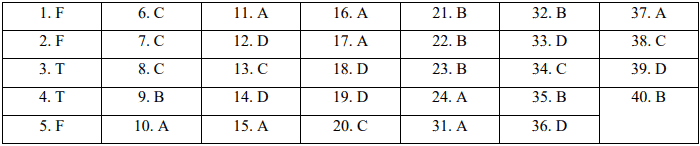
25. to see => seeing
26. interested => interesting
27. is smelling => smells
28. interested => interesting
29. buying => to buy
30. from => since
41. haven’t seen a Hollywood film for ages.
42. writing to him
43. if I came to club with you tonight?
44. for you to finish the work by Saturday.
45. an exam always makes her nervous
HƯỚNG DẪN GIẢI CHI TIẾT
Transcript
Jack: Hi, Pauline. What's your project for Environment Day. Where are you going on Thursday?
Pauline: I'm going to the park on Environment Day.
Jack: Who's doing the project with you?
Pauline: Lauren, Mike and Susan.
Jack: What are you going to do at the park?
Pauline: We're going to clean it up. We're going to pick up all the bottles on the ground.
Jack: Don't you think that'll be difficult?
Pauline: I'm sure it won't be easy. People leave a lot of rubbish at the weekend, and I'm sure it'll take a long time to clean up everything.
Jack: What are you going to do after you pick up all the rubbish and throw it all out?
Pauline: We'll probably take the paper and bottles from the park to the recycling centre, but if the weather's nice, we'll plant some flowers first - probably some pink roses. If it rains, we'll go directly to the recycling centre.
Jack: Oh, then maybe I'll see you at the recycling centre. Charles and I are going there. That's our Environment Day project.
Pauline: What are you going to do there?
Jack: Someone donated a lot of old clothes. We're going to help them recycle them. Why are you laughing, Pauline?
Pauline: The old clothes are probably my sisters' clothes.
Jack: Really?
Pauline: Yes. They had a lot of clothes in their cupboards and they never wore them. So my mum suggested that they take them all to the recycling centre. She drove my sisters and all their old clothes to the recycling centre - twice! There wasn't enough room in the car for everything.
Jack: According to my teacher, there are about 15 boxes of clothes at the centre. Those can't all be your sisters' clothes, can they?
Pauline: Oh yes, they can! You don't know my sisters, Jack!
1. F
Kiến thức: Nghe-hiểu chi tiết
Thông tin:
Jack: Who's doing the project with you?
(Ai đang làm dự án với bạn?)
Pauline: Lauren, Mike and Susan.
(Lauren, Mike và Susan.)
Chọn F.
2. F
Kiến thức: Nghe-hiểu chi tiết
Thông tin: I'm sure it won't be easy. People leave a lot of rubbish at the weekend, and I'm sure it'll take a long time to clean up everything.
(Tôi chắc rằng nó sẽ không dễ dàng. Mọi người để lại rất nhiều rác vào cuối tuần, và tôi chắc rằng sẽ mất nhiều thời gian để dọn dẹp mọi thứ.)
Chọn F.
3. T
Kiến thức: Nghe-hiểu chi tiết
Thông tin: We'll probably take the paper and bottles from the park to the recycling centre, but if the weather's nice, we'll plant some flowers first - probably some pink roses
(Chúng tôi có thể sẽ mang giấy và chai từ công viên đến trung tâm tái chế, nhưng nếu thời tiết đẹp, chúng tôi sẽ trồng một số hoa trước - có thể là một số hoa hồng màu hồng)
Chọn T.
4. T
Kiến thức: Nghe-hiểu chi tiết
Thông tin: Someone donated a lot of old clothes. We're going to help them recycle them.
(Có người tặng rất nhiều quần áo cũ. Chúng tôi sẽ giúp họ tái chế chúng.)
Chọn T.
5. F
Kiến thức: Nghe-hiểu chi tiết
Thông tin: She drove my sisters and all their old clothes to the recycling centre - twice!
(Bà ấy chở chị em tôi và tất cả quần áo cũ của họ đến trung tâm tái chế - hai lần!)
Chọn F.
6. C
Kiến thức: Phát âm “e”
Giải thích:
A. comment (n/v)/ˈkɒment/
B. energy /ˈenədʒi/
C. media /ˈmiːdiə/
D. chemical /ˈkemɪkl/
Phương án C có phần gạch chân đọc là /i:/, còn lại đọc là /e/.
Chọn C.
7. C
Kiến thức: Phát âm “ge”
Giải thích:
A. computer /kəmˈpjuːtə(r)/
B. confused /kənˈfjuːzd/
C. remote /rɪˈməʊt/
D. control /kənˈtrəʊl/
Phương án C có phần gạch chân đọc là /əʊ/, còn lại đọc là /ə/.
Chọn C.
8. C
Kiến thức: Trọng âm từ 2 âm tiết
Giải thích:
A. remote /rɪˈməʊt/
B. involved /ɪnˈvɒlvd/
C. global /ˈɡləʊbl/
D. confused /kənˈfjuːzd/
Phương án C có trọng âm rơi vào 1, còn lại rơi vào 2.
Chọn C.
9. B
Kiến thức: Trọng âm từ đa âm tiết
Giải thích:
A. laboratory /ləˈbɒrətri/
B. application /ˌæplɪˈkeɪʃn/
C. experiment /ɪkˈsperɪmənt/
D. refillable /ˌriːˈfɪləbl/
Phương án B có trọng âm rơi vào 3, còn lại rơi vào 2.
Chọn B.
10. A
Kiến thức: Dạng của động từ
Giải thích: recommend doing sth: gợi ý/khuyên làm gì
Tạm dịch: Anh ấy đã khuyên không đọc sách trước khi xem phim.
Chọn A.
11. A
Kiến thức: Dạng của động từ
Giải thích:
continue to do/doing sth: tiếp tục làm gì
advise sb to do sth: khuyên ai làm gì
Tạm dịch: Chú tôi tiếp tục hút thuốc mặc dù bác sĩ khuyên ông bỏ thói quen nhiều lần.
Chọn A.
12. D
Kiến thức: Dạng của động từ
Giải thích:
Expect sb to do sth: mong đợi ai làm gì
Dùng “to-V” để chỉ mục đích
Tạm dịch: Giáo viên mong Mary học hành chăm chỉ hơn. Cô ấy gửi cho Mary nhiều bài tập về nhà để làm.
Chọn D.
13. C
Kiến thức: Thì của động từ
Giải thích:
Dùng thì hiện tại hoàn thành để diễn tả hành động vừa mới xảy ra với động từ “say”
Dùng thì hiện tại tiếp diễn để diễn tả hành dộng đang xảy ra tại thời điểm nói với động từ “talk”
Tạm dịch: Tôi xin lỗi, tôi không thể nghe thấy những gì bạn vừa nói bởi vì mọi người đang nói quá lớn.
Chọn C.
14. D
Kiến thức: Thì của động từ
Giải thích: S + V (past continous) when + S + V (past simple)
=> Hành động đang xảy ra thì hành động khác xen vào
Tạm dịch: Bạn đang làm gì lúc tai nạn xảy ra.
Chọn D.
15. A
Kiến thức: Thì của động từ
Giải thích: Dùng thì hiện tại đơn với sự việc xảy ra mang tính cố định và dùng thì hiện tại tiếp diễn với sự việc xảy ra mang tính tạm thời
Tạm dịch: Bình thường thì thầy Pile dạy môn vật lý cho bọn tôi nhưng hôm nay thầy ốm nên cô Young đang dạy chúng tôi.
Chọn A.
16. A
Kiến thức: Thì của động từ
Giải thích:
for more than ten years (for + khoàng thời gian) => dấu hiệu nhận biết thì hiện tại hoàn thành
Dùng dạng tiếp diễn với động từ “think” khi từ này mang nghĩa “ cân nhắc”
Tạm dịch: Tôi đã sử dụng một chiếc xe ô tô khoảng 10 năm. Tôi đang cân nhắc về việc mua một cái mới.
Chọn A.
17. A
Kiến thức: Từ nối
Giải thích:
A. because: bởi vì
B. and: và
C. yet: nhưng = but
D. since: bởi vì
Tạm dịch: Các du khách phàn nàn về việc thời tiết nóng nhưng họ vẫn tiếp tục chơi gôn.
Chọn C
18. D
Kiến thức: Từ nối
Giải thích:
A. since + S + V: bởi vì (không có dấu phẩy phía trước)
B. though + S+ V: mặc dù
C. as + S + V: bởi vì (không có dấu phẩy phía trước)
D. for + S +V (có dấu phẩy phía trước)
Tạm dịch: John nghĩ rằng anh ấy có cơ hội tốt để có được công việc, bởi vì cha anh ấy là bạn của người quản lý.
Chọn D.
19. D
Kiến thức: Từ loại
Giải thích:
A. environment (n) môi trường
B. environmentalist (n) nhà môi trường học
C. environmentalism (n) chủ nghĩa môi trường
D. environmental (adj) thuộc về môi trường
Chỗ trống cần điền là tính từ theo cấu trúc: adj + n
Tạm dịch: Điều quan trọng là phải bảo vệ cảnh quan khỏi tác hại của ô nhiễm môi trường.
Chọn D.
20. C
Kiến thức: Từ loại
Giải thích:
A. attentive (adj) chú ý
B. attention (n) sự chú ý
C. attentively (adv) một cách chú ý, tập trung
D. attentiveness (n) sự chăm chú
Chỗ trống cần điền là trạng từ theo cấu trúc: v + adv
Tạm dịch: Anh ấy nhìn bức ảnh chăm chú mà không nói lời nào.
Chọn C.
21. B
Kiến thức: Từ đồng nghĩa
Giải thích: can’t stand doing = hate doing sth: không thích làm gì
A. không ngại mua
B. không muốn mua
C. không có khả năng mua
D. sẵn sàng mua
Tạm dịch: Drake không thích mua những thứ không quan trọng.
Chọn B.
22. B
Kiến thức: Từ đồng nghĩa
Giải thích: be crazy about sth: phát cuồng cái gì
A. useless at: vô dụng
B. obsessed with: ám ảnh với
C. afraid of: e sợ
D. sad at: buồn
Tạm dịch: Agnes phát cuồng vì xe thể thao.
Chọn B.
23. B
Kiến thức: Từ trái nghĩa
Giải thích:
endangered (adj) tuyệt chủng (cạn kiệt về số lượng)
A. at risk: có nguy cơ
B. abundant: dồi dào (về số lượng)
C. threatened: bị đe dọa
D. in danger: gặp nguy hiểm
Tạm dịch: 14% các loài linh trưởng có nguy cơ tuyệt chủng cao.
Chọn B.
24. A
Kiến thức: Từ trái nghĩa
Giải thích:
be/become/get addicted to sth >< be indifferent to sth: thờ ơ với cái gì
Tạm dịch: Tôi biết rằng nếu tôi bắt đầu xem soap opera, tôi ngay lập tức trở nên nghiện một cách vô vọng.
Chọn A.
25.
Kiến thức: Dạng của động từ
Giải thích:
Sửa: to see => seeing
Be looking forward to doing sth: mong đợi điều gì
Tạm dịch: Tôi đã rất mong được gặp lại bạn kể từ lần cuối chúng ta gặp nhau.
Chọn to see => seeing.
26.
Kiến thức: Tính từ đuôi ed/ing
Giải thích:
Sửa: interested => interesting
Interested (adj) cảm thấy hứng thú, thú vị
Interesting (adj) gây hứng thú, thú vị
Tạm dịch: Chúng tôi đã trải qua một kỳ nghỉ thú vị ở Vịnh Hạ Long vào mùa hè.
Chọn interested => interesting.
27.
Kiến thức: Thì của động từ
Giải thích:
Sửa: is smelling => smells
Không dùng thì hiện tại tiếp diễn với động từ “smell” khi động từ này mang nghĩa “có mùi”
Tạm dịch: Thức ăn mẹ nấu trong bếp thơm ngon.
Chọn is smelling => smells.
28.
Kiến thức: Tính từ đuôi ed/ing
Giải thích:
Sửa: interested => interesting
Interested (adj) cảm thấy hứng thú, thú vị
Interesting (adj) gây hứng thú, thú vị
Tạm dịch: Anh ấy là một trong những người thú vị nhất mà chúng tôi từng biết và nói chuyện.
Chọn interested => interesting.
29.
Kiến thức: Dạng của động từ
Giải thích: would like to do sth = want to do sth: muốn làm gì
Tạm dịch: Tôi muốn mua một cuốn từ điển mới nhưng tôi không có đủ tiền.
Chọn buying => to buy.
30.
Kiến thức: Giời từ
Giải thích: since + mốc thời gian trong thì hiện tại hoàn thành/hiện tại hoàn thành tiếp diễn
Tạm dịch: Sarah đã làm việc cho compay từ năm 1992.
Chọn from => since.
31. A
Kiến thức: Sự lựa chọn từ
Giải thích:
A. widespread (adj) phổ biến rộng rãi (nhiều người biết đến/xảy ra ở nhiều nơi)
B. extensive (adj) sâu rộng
C. exceeding (adj) vượt quá
D. intensive (adj) cường độ mạnh
Thông tin: The most widespread one is air pollution.
(Dạng phổ biến nhất là ô nhiễm không khí.)
Chọn A.
32. B
Kiến thức: Giới từ
Giải thích: pollute sth by/with sth: làm ô nhiễm cái gì từ cái gì
Thông tin: This smoke pollutes the atmosphere with dust and cinder which can cause various types of diseases like lung cancer, heart failure and sinus infection when inhaled
(Khói này làm ô nhiễm bầu không khí với bụi và cặn bẩn có thể gây ra nhiều loại bệnh khác nhau như ung thư phổi, suy tim và nhiễm trùng xoang khi hít phải)
Chọn B.
33. D
Kiến thức: Sự lựa chọn từ
Giải thích:
A. varying (V-ing) thay đổi
B. unlimited (adj) vô hạn
C. exceeding (V-ing) vượt quá
D. excessive (adj) lớn, quá
Thông tin: Carbon monoxide from exhaust pipes of vehicles is also very dangerous and can cause instant death when inhaled in excessive amount.
(Khí carbon monoxide từ ống xả của xe cũng rất nguy hiểm và có thể gây chết người ngay lập tức khi hít phải lượng quá nhiều.)
Chọn D.
34. C
Kiến thức: Sự kết hợp từ
Giải thích: dump waste: xả chất thải
Thông tin: Water pollution is normally caused by the dumping of waste like garbage and feces.
(Ô nhiễm nước thông thường là do đổ chất thải như rác và phân.)
Chọn C.
35. B
Kiến thức: Giới từ
Giải thích: suffer from: chịu đựng
Thông tin: In Japan alone, every year, thousands of people suffer from strange diseases due to mercury poisoning.
(Chỉ riêng tại Nhật Bản, mỗi năm có hàng nghìn người mắc bệnh lạ do nhiễm độc thủy ngân.)
Chọn B.
Dịch bài đọc:
Có nhiều loại ô nhiễm trên thế giới. Một trong những phổ biến nhất là ô nhiễm không khí. Nguyên nhân chủ yếu là do các nhà máy loại trừ khói. Khói này gây ô nhiễm bầu không khí với bụi và cặn bẩn có thể gây ra nhiều loại bệnh khác nhau như ung thư phổi, suy tim và nhiễm trùng xoang khi hít phải. Khí carbon monoxide từ ống xả của xe cũng rất nguy hiểm và có thể gây chết người ngay lập tức khi hít phải lượng quá nhiều.
Ô nhiễm nước là ô nhiễm xảy ra ở sông, biển, đại dương, hồ và các tuyến đường thủy khác. Ô nhiễm nước thường do việc đổ chất thải như rác và phân. Các sinh vật biển ở những vùng biển này sẽ bị ảnh hưởng. Một số chất chiết xuất độc hại của các sinh vật biển độc bị chết trong khi những chất khác lại lưu giữ chất độc của chất thải độc trong tuyến mỡ của chúng. Khi con người ăn những sinh vật này, họ sẽ bị ốm hoặc chết. Chỉ riêng tại Nhật Bản, mỗi năm có hàng nghìn người mắc bệnh lạ do nhiễm độc thủy ngân. Những người khác hoặc mất trí lực hoặc gặp cái chết của họ
36. D
Kiến thức: Đọc hiểu suy luận
Giải thích:
Mặc dù không được nêu trực tiếp, nó có thể được suy ra từ bài báo rằng _________________
A. hổ phách là chất duy nhất có thể nhiễm từ
B. điện là một khám phá gần đây
C. Thomas Edison thực sự phát minh ra điện
D. các sự kiện có thể được quan sát rất lâu trước khi chúng được đưa vào sử dụng thực tế
Thông tin: In fact, all of these modern conveniences are of such recent development that you might well wonder how electricity could be any older than Thomas Edison's development of the first practical electric light bulb in 1879
(Trên thực tế, tất cả những tiện nghi hiện đại này đều mới phát triển đến mức bạn có thể tự hỏi làm thế nào mà điện có thể lâu đời hơn sự phát triển của Thomas Edison về bóng đèn điện thực tế đầu tiên vào năm 1879)
Chọn D.
37. A
Kiến thức: Đọc hiểu ý chính
Giải thích:
Toàn bộ bài báo này cho chúng ta biết _____________
A. về điện
B. về hổ phách
C. về sự tò mò của một nhà triết học Hy Lạp cổ đại
D. về Thomas Edison
Thông tin:
The first discovery of electricity is over 2,600 years old.
(Phát hiện đầu tiên về điện đã hơn 2.600 năm tuổi.)
The word electricity comes from the Greek word meaning amber, which is electron
(Từ điện bắt nguồn từ tiếng Hy Lạp có nghĩa là hổ phách, là electron)
More than two thousand years after Thales, an English physician discovered that other substances also had this characteristic of electricity
(Hơn hai nghìn năm sau Thales, một bác sĩ người Anh đã phát hiện ra rằng các chất khác cũng có đặc tính điện này)
Chọn A.
38. C
Kiến thức: Đọc hiểu chi tiết
Giải thích:
Thiết bị nào là ứng dụng thực tế đầu tiên của điện?
A. tủ lạnh
B. radio
C. bóng điện
D. điện thoại
Thông tin: In fact, all of these modern conveniences are of such recent development that you might well wonder how electricity could be any older than Thomas Edison's development of the first practical electric light bulb in 1879
(Trên thực tế, tất cả những tiện nghi hiện đại này đều mới phát triển đến mức bạn có thể tự hỏi làm thế nào mà điện có thể lâu đời hơn sự phát triển của Thomas Edison về bóng đèn điện thực tế đầu tiên vào năm 1879)
Chọn C.
39. D
Kiến thức: Đọc hiểu chi tiết
Giải thích:
Elektron là ____________________________________
A. khả năng tạo ra điện của hổ phách
B. tính chất thu hút của hổ phách
C. đặc tính kỳ lạ của hổ phách
D. từ tiếng Hy Lạp có nghĩa là hổ phách
Thông tin: The word electricity comes from the Greek word meaning amber, which is elektron.
(Từ điện bắt nguồn từ tiếng Hy Lạp có nghĩa là hổ phách, là electron)
Chọn D.
40. B
Kiến thức: Đọc hiểu chi tiết
Giải thích:
Câu nào không đúng?
A. Tên gọi điện bắt nguồn từ tiếng Hy Lạp có nghĩa là hổ phách.
B. Hổ phách là nhựa cây tươi chảy ra từ cây tùng.
C. Nhiều, nhiều người đã thêm vào khám phá ra điện.
D. Thales là nhà triết học người Hy Lạp sống ở thời cổ đại.
Thông tin: The fossilized sap of a pine tree, amber looks much like a hard lump of honey.
(Có người cho rằng hồ phách giống nhựa cây thông hóa thạch nhưng hổ phách trông giống như một cục mật ong cứng.)
Chọn B.
Dịch bài đọc:
ELEKTRON ĐỂ ĐIỆN
Phát hiện đầu tiên về điện đã hơn 2.600 năm tuổi. Nó có làm bạn ngạc nhiên không? Tất nhiên, không có đèn, điện thoại, tủ lạnh, radio, phim ảnh hay máy thu hình từ lâu. Trên thực tế, tất cả những tiện nghi hiện đại này đều mới phát triển đến mức bạn có thể tự hỏi làm thế nào mà điện có thể lâu đời hơn sự phát triển của Thomas Edison về bóng đèn điện thực tế đầu tiên vào năm 1879.
Từ điện bắt nguồn từ tiếng Hy Lạp có nghĩa là hổ phách, là elektron. Nhựa cây thông hóa thạch, màu hổ phách trông giống như một cục mật ong cứng. Vào năm 600 trước Công nguyên, một nhà triết học người Hy Lạp tên là Thales đã chà một miếng hổ phách vào tay áo của mình để làm sáng nó. Phần lớn sự quan tâm của ông, ông nhận thấy rằng hổ phách được chà xát sẽ thu hút các mảnh nhỏ của xơ vải, lông và lá khô. Đặc tính hấp dẫn này là một đặc tính kỳ lạ mà ông nghĩ rằng chỉ hổ phách mới có. Ngày nay, từ điện của chúng ta vẫn quay trở lại với khám phá ban đầu của Thales về hổ phách.
Hơn hai nghìn năm sau Thales, một bác sĩ người Anh đã phát hiện ra rằng các chất khác cũng có đặc tính này của điện. Từ đó, ngày càng có nhiều nam giới bổ sung thêm kiến thức về điện. Họ đã đặt ra nhiều phát triển và khám phá đã mang lại kỷ nguyên điện của chúng ta ngày nay.
41.
Kiến thức: Cấu trúc tương đương
Giải thích:
It’s ages + since + S + last + Ved/V2
= S + hasn’t/haven’t + Ved/V3 + for + ages
Tạm dịch: Đã nhiều tuổi kể từ lần cuối tôi xem một bộ phim Hollywood
Chọn haven’t seen a Hollywood film for ages.
42.
Kiến thức: Cấu trúc tương đương
Giải thích: regret doing sth: hối hận vì đã làm gì
Tạm dịch: Tôi cảm thấy rằng thật là một sai lầm khi viết thư cho anh ấy
Chọn writing to him.
43.
Kiến thức: Cấu trúc tương đương
Giải thích: Would you mind if + S+ V (past simple): có phiền không nếu như ….
Tạm dịch: Có ổn không nếu tôi đến câu lạc bộ với bạn tối nay?
Chọn if I came to club with you tonight?
44.
Kiến thức: Cấu trúc tương đương
Giải thích: don’t have to do sth = It isn’t necessary (for sb) to do sth: không cần thiết phải làm gì
Tạm dịch: Bạn không cần phải hoàn thành công việc trước thứ Bảy
Chọn for you to finish the work by Saturday.
45.
Kiến thức: Cấu trúc tương đương
Giải thích: make sb + adj: khiến ai đó như thế nào
Tạm dịch: Cô ấy luôn lo lắng khi đi thi
Chọn an exam always makes her nervous.
Đề thi học kì 1 Tiếng Anh 10 Global Success - Đề số 4
Đề bài
I. Choose the word that has main stress placed differently from the others.
1.
A. overspent
B. achievement
C. environment
D. movement
2.
A. congestion
B. organization
C. application
D. communication
II. Choose the word whose underlined part is pronounced differently from that of the others words.
3.
A. incredible
B. advertisement
C. successful
D. audience
4.
A. priority
B. ability
C. community
D. voluntary
III. Mark the letter A, B, C, or D on your answer sheet to indicate the word or phrase that is CLOSEST in meaning to the underlined part in each of the following questions.
5. Volunteers become more concerned and aware of the problems facing the world.
A. obvious
B. worry
C. bored
D. worried
6. Her exceptional ability is known widely as she has won a lot of prizes in many different contests.
A. talent
B. passion
C. admiration
D. apparence
IV. Mark the letter A, B, C, or D on your answer sheet to indicate the word or phrase that is OPPOSITE in meaning to the underlined part in each of the following questions.
7. When you do something good for others, you will find your life hopeful.
A. meaningless
B. hopeless
C. harmful
D. meaningful
8. Ralph Nader was the most prominent leader of the U.S consumer protection movement.
A. casual
B. significant
C. ordinary
D. outstanding
V. Choose the word or phrase A, B, C or D that best completes each sentence below.
9. The final contestants perform on the stage to a television audience.
A. lively
B. likely
C. life
D. live
10. I've been in this city for a long time. I here sixteen years ago.
A. have come
B. was coming
C. came
D. had come
11. His performance was so boring that it made me____________.
A. to disappoint
B. disappointing
C. disappointed
D. disappoint
12. Last night my favorite program __________ by a special news bulletin.
A. interrupted
B. was interrupted
C. were interrupted
D. is interrupted
13. Volunteers for Peace Child Center (VPV) is a __________, non-governmental organization that was founded in 2005 to provide help and education to people in both urban and rural Viet Nam.
A. profit
B. profitable
C. non-profit
D. non-profitable
14. The father typically works outside the home while the mother is __________ domestic duties such as homemaking and raising children.
A. suitable for
B. capable of
C. responsible for
D. aware of
15. He spends most of his time on teaching career. He is a __________ teacher.
A. contributed
B. dedicated
C. caring
D. willing
16. My husband and I both go out to work so we share the .
A. happiness
B. household chores
C. responsibility
D. employment
17. She does work for the Red Cross of her school.
A. voluntarism
B. voluntary
C. voluntarily
D. volunteerism
Choose one underlined word or phrase A, B, C, or D that needs correcting.
18. Disadvantaged children are looking forward to us visiting them soon.
A. are looking
B. us
C. them
D. soon
19. Volunteer work is a great way to gain experienced in a broad range of fields.
A. volunteer work
B. to gain
C. experienced
D. of fields
20. Roles in homemaking and breadwinning can share by family members.
A. roles
B. homemaking
C. can share
D. members
21. A tablet PC is used for surfing the web, sending emails, making phone calls and listen to music.
A. calls
B. A
C. is used for
D. listen
VII. Rewrite each of the following sentences in such a way that it means exactly the same as the original one.
22. Daisy doesn’t intend to go to university after leaving school.
=> Daisy has……………………………………………………
23. They have never seen that film before.
=> This is the first ……………………………………………..
VII. Make the meaningful sentence, using the given words below.
24. While/ Mary /listen/music, / mother /phone/ her.
=> ………………………………………………………………
25. The teacher /not /allow/ us/ use /dictionary /during /test.
=> ………………………………………………………………
VIII. Read the text and choose the correct answer A, B, C, or D.
Chen likes to get his news from the paper. Lemma turns on the television to find out what's going on in the world. Eve subscribes to more magazines than she can keep track of, whereas Kobi chooses to listen to radio talk shows that cover issues thoroughly to tap into what's going on in the world. All these people are touched by the media.
What is the media? What constitutes the media? The media consists of all the ways that news and information is distributed to a mass audience. The media covers everything from hard news, which is investigative reporting to stories that are purely entertaining, such as whether your favorite movie star was on the "Best Dressed/ Worst Dresser list. Whether in print or broadcast on TV, the stories are the product of the reporting of many journalists who write the stories, and editors who give out the assignments, assess the quality of the writing and research, and make the decisions about where and when the stories run.
The news has immediate impact. The Internet puts global news onto the personal computer on your desk. Almost all browsers have links to up-to-the-minute news stories from various news services. You can get constant news updates from a variety of sources via your personal computer, providing you with the most up-to-date and in-depth coverage.
26. According to the writer, __________________
A. people's life can be changed by the media.
B. newspapers, magazines, televisions, radios are all the mass media.
C. people can only get news from the paper.
D. radio talk shows cover thorough issues.
27. According to the passage, the media __________________________
A. spreads not only news but also entertainment to audiences.
B. investigates news reports that will be covered.
C. only distributes hard news to people.
D. consists of news and information all over the world.
28. Which one of the following is not a responsibility of editors?
A. Judge the writings and researches.
B. Assign tasks.
C. Write reports on the stories.
D. Decide when and where tile stories run.
29. The word 'browsers' in line 15 refers to __________________________
A. programs used by computers for doing particular jobs.
B. people who look for information on the Internet.
C. people who design the Web.
D. computer programs that allow users to look at and search through information on the Internet.
30. An advantage of Internet news reports is that _______________________
A. they can be constantly updated.
B. they link news from various news services.
C. they provide a variety of information.
D. they can be put onto the personal computer.
IX. Choose the correct option A, B, C, or D for each gap.
Television now plays such a (an) (31) _____ role in so many people’s life that it is essential for us to decide whether it is good or bad. First of all, television is not only the convenient source of (32) _____, but also a rather cheap one. For a family of four, for example, it is more convenient (33) _____ cheaper to sit comfortably at home than to go out. There is no transport to arrange. They don’t have to pay (34) ____ expensive seats at the theater or in the cinema. All they have to do is to press a button, and they can see plays and films of every kind, not to mention political discussion and the latest exciting football matches. Some people, however, say that this is just where the danger is. The TV viewer needs to do (35) ____. He does not need to use his legs.
31.
A. necessary
B. important
C. detrimental
D. main
32.
A. entertainment
B. music
C. films
D. culture
33.
A. as long as
B. as well as
C. as good as
D. as soon as
34.
A. on
B. in
C. for
D. with
35.
A. one thing
B. everything
C. nothing
D. something
X. Listen again and decide whether the following statements are true (T) or false (F).
36. This is the first International Youth Music Festival.
37. The organisers have finished preparations for the festival.
38. Last year, the festival was held on the beach.
39. They are selling tickets for the festival at the park gates.
40. The country park is far from the town centre.
_____________THE END_____________
Đáp án
HƯỚNG DẪN GIẢI
Thực hiện: Ban Chuyên môn trithuchub.com

22. Daisy has no intention of going to university after leaving school.
23. This is the first time they have seen that film.
24. While Mary was listening to music, her mother phoned her.
25. The teacher doesn’t allow us to use dictionary during the test.
HƯỚNG DẪN GIẢI CHI TIẾT
1. A
Kiến thức: Phát âm “-ent”
Giải thích:
A. overspent /oʊvərˈspent/
B. achievement /əˈtʃiːvmənt/
C. environment /ɪnˈvaɪrənmənt/
D. movement /ˈmuːvmənt/
Phần gạch chân đáp án A phát âm là /ent/, còn lại là /ənt/.
Chọn A
2. A
Kiến thức: Phát âm “-tion”
Giải thích:
A. congestion /kənˈdʒestʃən/
B. organization /ɔːrɡənəˈzeɪʃn/
C. application /æplɪˈkeɪʃn/
D. communication /kəmjuːnɪˈkeɪʃn/
Phần gạch chân đáp án A phát âm là /tʃən/, còn lại là /ʃn/.
Chọn A
3. D
Kiến thức: Trọng âm từ có 3, 4 âm tiết
Giải thích:
A. incredible /ɪnˈkredəbl/
B. advertisement /ədˈvɜːtɪsmənt/
C. successful /səkˈsesfl/
D. audience /ˈɔːdiəns/
Trọng âm đáp án D rơi vào âm tiết thứ nhất, còn lại là âm thứ hai.
Chọn D
4. D
Kiến thức: Trọng âm từ có 4 âm tiết
Giải thích:
A. priority /praɪˈɔːrəti/
B. ability /əˈbɪləti/
C. community /kəˈmjuːnəti/
D. voluntary /ˈvɑːlənteri/
Trọng âm đáp án D rơi vào âm tiết thứ nhất, còn lại là âm thứ hai.
Chọn D
5. D
Kiến thức: Từ đồng nghĩa
Giải thích:
concerned (adj): lo lắng, quan tâm/ có liên quan
A. obvious (adj): rõ ràng, hiển nhiên
B. worry (v): làm cho lo lắng, quấy rầy, làm khó chịu
C. bored (adj): chán nản, mệt mỏi
D. worried (adj): lo lắng, lo nghĩ
=> concerned = worried
Volunteers become more concerned and aware of the problems facing the world.
(Tình nguyện viên trở nên quan tâm hơn và nhận thức được các vấn đề mà thế giới phải đối mặt.)
Chọn D
6. A
Kiến thức: Từ đồng nghĩa
Giải thích:
exceptional ability: khả năng đặc biệt
A. talent (n): tài năng, năng khiếu
B. passion (n): sự say mê, niềm đam mê
C. admiration (n): sự khâm phục, sự thán phục
D. appearance (n): diện mạo, bề ngoài, sự xuất hiện
=> exceptional ability = talent
Her exceptional ability is known widely as she has won a lot of prizes in many different contests.
(Tài năng của cô được biết đến rộng rãi vì cô ấy đã giành được rất nhiều giải thưởng trong nhiều cuộc thi khác nhau.)
Chọn A
7. B
Kiến thức: Từ trái nghĩa
Giải thích:
hopeful (adj): hy vọng, đầy hy vọng
A. meaningless (adj): vô nghĩa
B. hopeless (adj): không hy vọng, thất vọng, tuyệt vọng
C. harmful (adj): gây hại, có hại
D. meaningful (adj): đầy ý nghĩa, có ý nghĩa
=> hopeful >< hopeless
When you do something good for others, you will find your life hopeful.
(Khi bạn làm điều gì đó tốt cho người khác, bạn sẽ thấy cuộc sống của mình đầy hy vọng.)
Chọn B
8. C
Kiến thức: Từ trái nghĩa
Giải thích:
prominent (adj): nổi bật, dễ thấy, xuất chúng, lỗi lạc
A. casual (adj): bình thường, tình cờ, tùy tiện
B. significant (adj): quan trọng, đáng kể, đầy ý nghĩa
C. ordinary (adj): thông thường, tầm thường
D. outstanding (adj): nổi bật, đáng chú ý
=> prominent >< ordinary
Ralph Nader was the most prominent leader of the U.S consumer protection movement.
(Ralph Nader là nhà lãnh đạo nổi bật nhất của cuộc vận động bảo vệ người tiêu dùng Hoa Kỳ.)
Chọn C
9. D
Kiến thức: Từ vựng, từ loại
Giải thích:
lively (adj): sống động
likely (adj): có vẻ như/ có khả năng
life (n): cuộc sống, cuộc đời
live (adv): trực tiếp
Sau động từ “perform” cần trạng từ.
The final contestants perform live on the stage to a television audience.
(Các thí sinh cuối cùng biểu diễn trực tiếp trên sân khấu trước khán giả truyền hình.)
Chọn D
10. C
Kiến thức: Thì quá khứ đơn
Giải thích:
Thì quá khứ đơn dùng để diễn tả hành động, sự vật xác định trong quá khứ hoặc vừa mới kết thúc.
Công thức chung: S + Ved/V2
Dấu hiệu: “sixteen years ago” (mười sáu năm trước)
I've been in this city for a long time. I came here sixteen years ago.
(Tôi đã ở thành phố này trong một khoảng thời gian dài. Tôi đến đây mười sáu năm trước.)
Chọn C
11. C
Kiến thức: Tính từ
Giải thích:
Cấu trúc: make + O + adj (làm ai cảm thấy như thế nào)
disappoint (v): làm ai đó thất vọng
disappointed (adj): bị làm cho thất vọng
His performance was so boring that it made me disappointed.
(Màn trình diễn của anh ấy quá nhàm chán đến nỗi làm tôi thất vọng.)
Chọn C
12. B
Kiến thức: Câu bị động
Giải thích:
Cấu trúc câu bị động thì quá khứ đơn: S (số ít) + was Ved/P2 (+ by O)
last night: tối qua => dấu hiệu nhận biết thì quá khứ đơn
Last night my favorite program was interrupted by a special news bulletin.
(Đêm qua chương trình yêu thích của tôi đã bị gián đoạn bởi một bản tin đặc biệt.)
Chọn B
13. C
Kiến thức: Từ vựng, từ loại
Giải thích:
Sau mạo từ “a” và trước danh từ “organization” đã có một tính từ ngăn cách bằng dấu phẩy nên chỗ trống cần một tính từ nữa.
profit (n): lợi nhuận
profitable (adj) : có lợi nhuận
non-profit (adj) : phi lợi nhuận
non-profitable => không tồn tại từ này
Volunteers for Peace Child Center (VPV) is a non-profit, non-governmental organization that was founded in 2005 to provide help and education to people in both urban and rural Viet Nam.
(Trung tâm tình nguyện vì trẻ em vì hòa bình (VPV) là một tổ chức phi lợi nhuận, phi chính phủ, được thành lập vào năm 2005 để giúp đỡ và giáo dục cho người dân ở cả thành thị và nông thôn Việt Nam.)
Chọn C
14. C
Kiến thức: Từ vựng
Giải thích:
A. suitable for: thích hợp, phù hợp
B. capable of: có thể, có khả năng
C. responsible for: chịu trách nhiệm, có trách nhiệm
D. aware of: nhận thức, nhận biết
The father typically works outside the home while the mother is responsible for domestic duties such as homemaking and raising children.
(Người cha thường làm việc bên ngoài nhà trong khi người mẹ chịu trách nhiệm cho các công việc trong nhà như nội trợ và nuôi con.)
Chọn C
15. B
Kiến thức: Từ vựng
Giải thích:
A. contributed (adj): đóng góp, góp phần
B. dedicated (adj): tận tụy, tận tâm
C. caring (adj): chu đáo
D. willing (adj): sẵn sàng, bằng lòng, vui lòng
He spends most of his time on teaching career. He is a dedicated teacher.
(Ông ấy dành phần lớn thời gian cho sự nghiệp giảng dạy. Ông là một giáo viên tận tâm.)
Chọn B
16. B
Kiến thức: Từ vựng
Giải thích:
A. happiness (n): niềm vui, hạnh phúc
B. household chores (n): việc nhà
C. responsibility (n): trách nhiệm
D. employment (n): sự tuyển dụng
My husband and I both go out to work so we share the household chores.
(Chồng tôi và tôi đều ra ngoài đi làm vì vậy chúng tôi cùng chia sẻ việc nhà.)
Chọn B
17. B
Kiến thức: Từ loại
Giải thích:
Trước danh từ “work” cần tính từ.
A. voluntarism = D. volunteerism (n): nguyên tắc hoạt động tình nguyện
B. voluntary (adj): mang tính tình nguyện
C. voluntarily (adv): một cách tình nguyện
She does voluntary work for the Red Cross of her school.
(Cô ấy làm công tác tình nguyện cho Hội chữ thập đỏ sau giờ học.)
Chọn B
18. C
Kiến thức: V-ing
Giải thích:
Cấu trúc: look forward to + O + V-ing (mong chờ ai làm việc gì)
Sửa: bỏ “them”.
Disadvantaged children are looking forward to us visiting soon.
(Các trẻ em khuyết tật đang mong chờ chúng tôi đến thăm sớm.)
Chọn C
19. C
Kiến thức: Từ loại
Giải thích:
Cấu trúc: gain something (đạt được cái gì) => sau “gain” phải là danh từ.
Sửa: experienced (adj): có kinh nghiệm => experience (n): kinh nghiệm
Volunteer work is a great way to gain experience in a broad range of fields.
(Công việc tình nguyện là một cách tuyệt vời để tích lũy kinh nghiệm trong nhiều lĩnh vực.)
Chọn C
20. C
Kiến thức: Câu bị động
Giải thích:
Câu bị động với động từ khuyết thiếu: S + can + be + Ved/PII + by O.
Sửa: can share => can be shared
Roles in homemaking and breadwinning can be shared by family members.
(Vai trò của công việc nội trợ và làm trụ cột gia đình có thể được chia sẻ bởi các thành viên trong gia đình.)
Chọn C
21. D
Kiến thức: Cấu trúc song hành
Giải thích:
Các cụm từ nối với nhau bằng liên từ “and” sẽ có cùng dạng và cùng loại: surfing – sending – making
Sửa: listen => listening
A tablet PC is used for surfing the web, sending emails, making phone calls and listening to music.
(Một chiếc máy tính bảng được sử dụng để lướt web, gửi email, gọi điện thoại và nghe nhạc.)
Chọn D
22.
Kiến thức: Cụm từ đồng nghĩa
Giải thích: don’t/ doesn’t intend to V = have/ has no intention of Ving: không có ý định làm gì
Daisy doesn’t intend to go to university after leaving school.
(Daisy không có ý định đi học đại học sau khi ra trường.)
Đáp án: Daisy has no intention of going to university after leaving school.
23.
Kiến thức: Thì hiện tại hoàn thành
Giải thích:
Cấu trúc: S + have/has + never + Ved/ P2 + before (... chưa bao giờ...trước đây)
= This is the first time + S + have/has + Ved/ P2 (Đây là lần đầu tiên...)
They have never seen that film before.
(Họ chưa bao giờ xem bộ phim đó trước đây.)
Đáp án: This is the first time they have seen that film.
(Đây là lần đầu tiên họ xem bộ phim đó.)
24.
Kiến thức: Thì quá khứ đơn – quá khứ tiếp diễn
Giải thích:
Thì quá khứ tiếp diễn dùng để diễn tả một hành động đang xảy ra trong quá khứ (listen) thì hành động khác xen vào – thì quá khứ đơn (phone).
Cấu trúc: While + S1 + was/ were V-ing, S2 + Ved/ V2 (Trong khi... thì...)
Đáp án: While Mary was listening to music, her mother phoned her.
(Trong khi Mary đang nghe nhạc, mẹ cô ấy đã gọi điện cho cô.)
25.
Kiến thức: V-ing/to V
Giải thích:
allow sb to V: cho phép ai làm gì
Thì hiện tại đơn dạng phủ định: S (số ít) + doesn’t + V(nguyên thể)
Đáp án: The teacher doesn’t allow us to use the dictionary during the test.
(Giáo viên không cho phép chúng tôi sử dụng từ điển trong bài kiểm tra.)
26. B
Kiến thức: Đọc hiểu
Giải thích:
Theo người viết, __________________
A. cuộc sống của mọi người có thể được thay đổi bởi các phương tiện truyền thông.
B. báo, tạp chí, tivi, radio đều là phương tiện thông tin đại chúng.
C. mọi người chỉ có thể nhận được tin tức từ tờ báo.
D. chương trình nói chuyện trên đài phát thanh bao gồm các vấn đề cẩn thận.
Thông tin: Chen likes to get his news from the paper. Lemma turns on the television to find out what's going on in the world. Eve subscribes to more magazines than she can keep track of, whereas Kobi chooses to listen to radio talk shows that cover issues thoroughly to tap into what's going on in the world. All these people are touched by the media.
Tạm dịch: Chen thích lấy tin tức từ báo. Lemma đề bật tivi để tìm hiểu những gì đang xảy ra trên thế giới. Eve đặt mua nhiều tạp chí hơn để cô có thể theo dõi thông tin, trong khi Kobi chọn nghe các chương trình trò chuyện trên đài phát thanh bao gồm những vấn đề để khai thác những gì đang diễn ra trên thế giới một cách cẩn thận. Tất cả những người này chịu tác động bởi truyền thông.
Chọn B
27. A
Kiến thức: Đọc hiểu
Giải thích:
Theo đoạn văn, các phương tiện truyền thông ______________
A. lan truyền không chỉ tin tức mà còn có thông tin giải trí cho khán giả.
B. điều tra các báo cáo tin tức sẽ được theo dõi để lấy tin tức.
C. chỉ phân phối tin nóng cho mọi người.
D. bao gồm tin tức và thông tin trên toàn thế giới.
Thông tin: The media consists of ail the ways that news and information is distributed to a mass audience. The media covers everything from hard news, which is investigative reporting to stories that are purely entertaining, such as whether your favorite movie star was on the "Best Dressed/ Worst Dresser” list.
Tạm dịch: Các phương tiện truyền thông bao gồm tất cả các cách mà tin tức và thông tin được phân phối cho khán giả đại chúng. Các phương tiện truyền thông bao gồm tất cả mọi thứ từ tin nóng, điều mà là những báo cáo điều tra cho các câu chuyện hoàn toàn mang tính giải trí, chẳng hạn như liệu ngôi sao điện ảnh yêu thích của bạn có nằm trong danh sách "Trang phục đẹp nhất / Mặc xấu nhất”.
Chọn A
28. C
Kiến thức: Đọc hiểu
Giải thích:
Một trong những điều sau đây không phải là trách nhiệm của biên tập viên?
A. Đánh giá các bài viết và nghiên cứu.
B. Phân công nhiệm vụ.
C. Viết báo cáo về những câu chuyện.
D. Quyết định khi nào và nơi câu chuyện được viết.
Thông tin: Whether in print or broadcast on TV, the stories are the product of the reporting of many journalists who write the stories, and editors who give out the assignments, assess the quality of the writing and research, and make the decisions about where and when the stories run.
Tạm dịch: Liệu được in hay phát trên TV, các câu chuyện đều là sản phẩm báo cáo của nhiều nhà báo viết truyện và biên tập viên đưa ra các nhận xét, đánh giá chất lượng của bài viết và nghiên cứu, và đưa ra quyết định về việc câu chuyện được viết ở đâu và khi nào.
Chọn C
29. D
Kiến thức: Đọc hiểu
Giải thích:
Từ “browsers” trong dòng 15 đề cập đến ________________
A. các chương trình được sử dụng bởi máy tính để làm các công việc cụ thể.
B. những người tìm kiếm thông tin trên Internet.
C. những người thiết kế trang Web.
D. các chương trình máy tính cho phép người dùng xem và tìm kiếm thông qua thông tin trên Internet.
Thông tin: Almost all browsers have links to up-to-the-minute news stories from various news services. You can get constant news updates from a variety of sources via your personal computer, providing you with the most up-to-date and in-depth coverage.
Tạm dịch: Hầu hết tất cả các trình duyệt đều có liên kết đến các câu chuyện mới, tin tức mới nhất từ các dịch vụ tin tức khác nhau. Bạn có thể nhận được cập nhật tin tức liên tục từ nhiều nguồn khác nhau thông qua máy tính cá nhân của bạn, cung cấp cho bạn phạm tin tức mới và chuyên sâu nhất.
Chọn D
30. A
Kiến thức: Đọc hiểu
Giải thích:
Một lợi thế của các bản tin trên Internet là _____________
A. chúng có thể được cập nhật liên tục.
B. chúng liên kết tin tức từ các dịch vụ tin tức khác nhau.
C. chúng cung cấp nhiều thông tin.
D. chúng có thể được đưa vào máy tính cá nhân.
Thông tin: Almost all browsers have links to up-to-the-minute news stories from various news services.
Tạm dịch: Hầu hết tất cả các trình duyệt đều có liên kết đến các câu chuyện mới, tin tức mới nhất từ các dịch vụ tin tức khác nhau.
Chọn A
Dịch bài đọc:
Chen thích lấy tin tức từ báo. Lemma mở tivi để tìm hiểu những gì đang xảy ra trên thế giới. Eve đặt mua nhiều tạp chí hơn để cô có thể theo dõi thông tin, trong khi Kobi chọn nghe các chương trình trò chuyện trên đài phát thanh bao gồm những vấn đề để khai thác những gì đang diễn ra trên thế giới một cách cẩn thận. Tất cả những người này chịu tác động bởi truyền thông.
Phương tiện truyền thông là gì? Những gì cấu thành các phương tiện truyền thông? Các phương tiện truyền thông bao gồm tất cả các cách mà tin tức và thông tin được phân phối cho khán giả đại chúng. Các phương tiện truyền thông bao gồm tất cả mọi thứ từ tin nóng, điều mà là những báo cáo điều tra cho các câu chuyện hoàn toàn mang tính giải trí, chẳng hạn như liệu ngôi sao điện ảnh yêu thích của bạn có nằm trong danh sách "Trang phục đẹp nhất / Mặc xấu nhất”. Liệu được in hay phát trên TV, các câu chuyện đều là sản phẩm báo cáo của nhiều nhà báo viết truyện và biên tập viên đưa ra các nhận xét, đánh giá chất lượng của bài viết và nghiên cứu, và đưa ra quyết định về việc câu chuyện được viết ở đâu và khi nào.
Tin tức có ảnh hưởng ngay lập tức. Internet đưa tin tức toàn cầu đến máy tính cá nhân trên bàn của bạn. Hầu hết tất cả các trình duyệt đều có liên kết đến các câu chuyện, tin tức mới nhất từ các dịch vụ tin tức khác nhau. Bạn có thể nhận được cập nhật tin tức liên tục từ nhiều nguồn khác nhau thông qua máy tính cá nhân của bạn, cung cấp cho bạn tin tức mới và chuyên sâu nhất.
31. B
Kiến thức: Từ vựng
Giải thích:
A. necessary (adj): cần thiết, thiết yếu
B. important (adj): quan trọng, hệ trọng
=> play an important role: đóng một vai trò quan trọng
C. detrimental(adj): có hại, bất lợi cho
D. main (n): chính, chủ yếu
Television now plays such a (an) (31) important role in so many people’s life that it is essential for us to decide whether it is good or bad.
Tạm dịch: Vô tuyến truyền hình bây giờ đóng một vai trò quan trọng trong cuộc sống của nhiều người mà điều thật cần thiết với chúng ta là quyết định xem liệu nó tốt hay xấu.
Chọn B
32. A
Kiến thức: Từ vựng
Giải thích:
A. entertainment (n): giải trí, sự vui chơi
B. music (n): nhạc, âm nhạc
C. films (n): phim, phim ảnh
D. culture (n): văn hóa, văn minh
First of all, television is not only the convenient source of (32) entertainment, but also a rather cheap one.
Tạm dịch: Trước hết, truyền hình không chỉ là nguồn giải trí tiện lợi mà nó còn khá rẻ.
Chọn A
33. B
Kiến thức: Từ vựng
Giải thích:
A. as long as: miễn là, miễn như
B. as well as: cũng như, thêm vào đó
C. as good as: gần như
D. as soon as: ngay sau khi
For a family of four, for example, it is more convenient (33) as well as cheaper to sit comfortably at home than to go out.
Tạm dịch: Ví dụ, đối với một gia đình bốn người, sẽ thuận tiện hơn cũng như rẻ hơn khi thoải mái ngồi ở nhà hơn là đi ra ngoài.
Chọn B
34. C
Kiến thức: Giới từ
Giải thích:
A. on: trên, ở trên
B. in: ở, tại, trong
C. for: thay cho, dành cho, để, với mục đích
D. with: với, cùng
They don’t have to pay (34) for expensive seats at the theater or in the cinema.
Tạm dịch: Họ không phải trả tiền cho những chỗ ngồi đắt tiền tại nhà hát hoặc trong rạp chiếu phim.
Chọn C
35. C
Kiến thức: Từ vựng
Giải thích:
A. one thing: một điều
B. everything: mọi vât, tất cả mọi thứ
C. nothing: không cái gì, không điều gì
D. something: một điều gì đó, cái gì đó
The TV viewer needs to do (35) nothing.
Tạm dịch: Người xem TV không cần phải làm gì.
Chọn C
Bài đọc hoàn chỉnh:
Television now plays such a (an) (31) important role in so many people’s life that it is essential for us to decide whether it is good or bad. First of all, television is not only the convenient source of (32) entertainment, but also a rather cheap one. For a family of four, for example, it is more convenient (33) as well as cheaper to sit comfortably at home than to go out. There is no transport to arrange. They don’t have to pay (34) for expensive seats at the theater or in the cinema. All they have to do is to press a button, and they can see plays and films of every kind, not to mention political discussion and the latest exciting football matches. Some people, however, say that this is just where the danger is. The TV viewer needs to do (35) nothing. He does not need to use his legs.
Dịch bài đọc:
Vô tuyến truyền hình bây giờ đóng một vai trò quan trọng trong cuộc sống của nhiều người mà điều thật cần thiết với chúng ta là quyết định xem liệu nó tốt hay xấu. Trước hết, truyền hình không chỉ là nguồn giải trí tiện lợi mà nó còn khá rẻ. Ví dụ, đối với một gia đình bốn người, sẽ thuận tiện hơn cũng như rẻ hơn khi thoải mái ngồi ở nhà hơn là đi ra ngoài. Không có thay đổi để sắp xếp chỗ. Họ không phải trả tiền cho những chỗ ngồi đắt tiền tại nhà hát hoặc trong rạp chiếu phim. Tất cả những gì họ phải làm là nhấn một nút, và họ có thể xem các vở kịch và phim đủ thể loại, chưa kể đến họ có thể thảo luận về chính trị và các trận bóng đá hấp dẫn mới nhất. Tuy nhiên, một số người nói rằng đây chỉ là nơi nguy hiểm. Người xem TV không cần phải làm gì. Anh ta không cần phải sử dụng đôi chân của mình.
36. F
Kiến thức: Nghe hiểu
Giải thích:
This is the first International Youth Music Festival.
(Đây là Liên hoan Âm nhạc Thiếu niên Quốc tế đầu tiên.)
Thông tin: Hi, this is Tam at the site of the second International Youth Music Festival.
(Xin chào, đây là Tâm tại địa điểm của Liên hoan âm nhạc trẻ quốc tế lần thứ hai.)
Chọn F.
37. F
Kiến thức: Nghe hiểu
Giải thích:
The organisers have finished preparations for the festival.
(Ban tổ chức đã chuẩn bị xong cho lễ hội.)
Thông tin: We're still setting up the main stage and there's still a lot to do, but we want to get it ready by tomorrow so that the bands can start to practise.
(Chúng tôi vẫn đang dựng sân khấu chính và còn nhiều việc phải làm, nhưng chúng tôi muốn chuẩn bị sẵn sàng vào ngày mai để các ban nhạc có thể bắt đầu luyện tập.)
Chọn F.
38. T
Kiến thức: Nghe hiểu
Giải thích:
Last year, the festival was held on the beach.
(Năm ngoái, lễ hội được tổ chức trên bãi biển.)
Thông tin: Well, last year the festival was on the beach and it was free of charge.
(À, năm ngoái lễ hội ở trên bãi biển và nó miễn phí.)
Chọn T.
39. F
Kiến thức: Nghe hiểu
Giải thích:
They are selling tickets for the festival at the park gates.
(Họ đang bán vé cho lễ hội ở cổng công viên.)
Thông tin: This year we have sold the tickets in advance so that we know how many people are coming.
(Năm nay chúng tôi đã bán vé trước để biết có bao nhiêu người đến.)
Chọn F.
40. T
Kiến thức: Nghe hiểu
Giải thích:
The country park is far from the town centre.
(Công viên nước cách xa trung tâm thị trấn.)
Thông tin:
Tam: Why the country park? Isn't it a bit too far from the town centre?
(Tại sao lại là công viên nước? Nó hơi quá xa trung tâm thị trấn không phải sao?)
Jack: Yeah, that's why we've chosen it.
(Vâng, đó là lý do tại sao chúng tôi đã chọn nó.)
Chọn T.
Bài nghe:
Tam: Hi, this is Tam at the site of the second International Youth Music Festival. There are just two days to go before the festival opens on Sunday. As you can hear in the background it's very busy here. I'm with Jack, one of the festival organisers. So, Jack, how's it all going?
Jack: Hi, we're very busy. We're still setting up the main stage and there's still a lot to do, but we want to get it ready by tomorrow so that the bands can start to practise.
Tam: I heard that there are some changes to the festival this year. Can you tell us about them?
Jack: Well, last year the festival was on the beach and it was free of charge. We didn't know it would be so popular and we had problems with overcrowding. This year we have sold the tickets in advance so that we know how many people are coming. What's more important, we've decided to move the festival to this country park.
Tam: Why the country park? Isn't it a bit too far from the town centre?
Jack: Yeah, that's why we've chosen it. This location is better for everybody because ...
Tạm dịch:
Tâm: Xin chào, đây là Tâm tại địa điểm của Liên hoan âm nhạc trẻ quốc tế lần thứ hai. Chỉ còn hai ngày nữa là lễ hội sẽ khai mạc vào Chủ nhật. Như bạn có thể nghe thấy ở đây rất nhộn nhịp. Tôi đi cùng Jack, một trong những người tổ chức lễ hội. Jack, mọi thứ thế nào rồi?
Jack: Xin chào, chúng tôi rất bận. Chúng tôi vẫn đang dựng sân khấu chính và còn nhiều việc phải làm, nhưng chúng tôi muốn chuẩn bị sẵn sàng vào ngày mai để các ban nhạc có thể bắt đầu luyện tập.
Tâm: Tôi nghe nói rằng lễ hội năm nay có một số thay đổi. Bạn có thể cho chúng tôi biết về chúng không?
Jack: À, năm ngoái lễ hội ở trên bãi biển và nó miễn phí. Chúng tôi không biết nó sẽ phổ biến đến vậy và chúng tôi gặp vấn đề với tình trạng quá tải. Năm nay chúng tôi đã bán vé trước để biết có bao nhiêu người đến. Điều quan trọng hơn, chúng tôi đã quyết định chuyển lễ hội đến công viên nước này.
Tâm: Tại sao lại là công viên nước? Nó hơi quá xa trung tâm thị trấn không phải sao?
Jack: Vâng, đó là lý do tại sao chúng tôi đã chọn nó. Vị trí này tốt hơn cho mọi người vì ...
Đề thi học kì 1 Tiếng Anh 10 Global Success - Đề số 5
Đề bài
I. Listen and fill in each blank with one word.
Imagine living in a house where everything is controlled from a (1) _________. The doors and windows open and close not with (2) _________, but with your (3) _________commands. The lights turn on when you enter the room, and then turn off as you leave. The (4) _________rings when someone breaks into your house, and the (5) _________are immediately informed and on their way. You can even control your house (6) _________, lights, and devices from a mobile phone when you are (7) _________from home. That is what we call a smart home. And that's how (8) _________can make our life at home more enjoyable and comfortable than ever.
II. Mark the letter A, B, C, or D on your answer sheet to indicate the word whose underlined part differs from the other three in pronunciation in each of the following questions.
9.
A. belong
B. strong
C. among
D. long
10.
A. kisses
B. watches
C. rides
D. boxes
III. Mark the letter A, B, C, or D on your answer sheet to indicate the word that differs from the other three in the position of primary stress in each of the following questions.
11.
A. benefit
B. composer
C. audience
D. breadwinner
12.
A. acupuncture
B. advertisement
C. announcement
D. community
IV. Mark the letter A, B, C, or D on your answer sheet to indicate the correct answer to each of the following questions.
13. While we __________ football, it suddenly began to rain
A. played
B. are playing
C. were playing
D. have played
14. Being the breadwinner of the family, __________.
A. she works hard to provide for her children
B. she looks after her children carefully
C. she is very sociable
D. she cooks the meal everyday
15. Sad movies always make her __________.
A. to cry
B. crying
C. cried
D. cry
16. Look at the clouds! I think it __________ .
A. will rain
B. rains
C. is going to rain
D. is raining
17. It is convenient for you to read__________ when you travel.
A. laptops
B. e-books
C. computers
D. printers
18. The song was especially _________ for the wedding.
A. created
B. compiled
C. composed
D. invented
19. At present we are ______ an anti-drug campaign.
A. setting up
B. carrying out
C. taking part in
D. joining with
20. Each nation has many people who _______take care of others.
A. volunteer
B. volunteered
C. voluntary
D. voluntarily
V. Mark the letter A, B, C, or D on your answer sheet to indicate the word(s) CLOSEST in meaning to the underlined word(s) in each of the following questions.
21. How do you divide household chores in your family?
A. take out
B. split
C. solve
D. deliver
22. People are now raising money for flood victims.
A. paying
B. collecting
C. making
D. sending
VI. Mark the letter A, B, C, or D on your answer sheet to indicate the word(s) OPPOSITE in meaning to the underlined word(s) in each of the following questions.
23. If we don’t do something good for others, we can feel that our life is boring.
A. interesting
B. important
C. clear
D. different
24. Incredible! It seems you know a lot of English songs.
A. believable
B. unbelievable
C. sociable
D. capable
VII. Mark the letter A, B, C, or D on your answer sheet to indicate the underlined part that needs correction in each of the following questions.
25. Three days ago, Mary ask her teacher to give her some advice.
A. days
B. ask
C. to give
D. advice
26. What does “An apple a day keeps the doctor out” mean?
A. does
B. keeps
C. out
D. mean
VIII. Read the following passage and mark the letter A, B, C, or D on your answer sheet to indicate the correct word or phrase that best fits each of the numbered blanks.
The most obvious advantage of living green is that it helps reduce environmental pollution. This is done by (27) _________ the 3Rs. The first R means choosing products very carefully to reduce waste as much as possible. Reusing involves the repeated use of items. The third R is about separating materials that can be recycled and later used for a new purpose.
There are also (28) _________ benefits to living green. Reducing the use of energy and water can help save money on household bills. Furthermore, reusing products and materials is another way to make saving. It helps save on production costs (29) _________ creating new products wastes materials and is expensive. Recycled products also last longer than new ones, making them a better and more eco-friendly option.
Lastly, going green offers health benefits. It reduces air pollutants by making the air we breathe cleaner and healthier. This means fewer diseases and doctor's appointments. Another way (30) _________ your health is to purchase organic foods and green products for your household. They don't use harmful chemicals that can (31) _________ health issues. In turn, you are also supporting responsible farming methods that protect the environment.
27.
A. practising
B. doing
C. making
D. following
28.
A. economy
B. economic
C. economical
D. economics
29.
A. so
B. but
C. although
D. since
30.
A. improve
B. to improve
C. improving
D. improved
31.
A. lead to
B. result from
C. begin with
D. aim at
IX. Read the following text and decide if the following statements are true (T) or false (F) about Nelson Mandela.
Nelson Mandela was born in a small village in South Africa. He grew up in a poor family, and he was the first child in the family to go to school. He became interested in politics and was forced to leave his first university for protesting.
At that time, South Africa suffering from apartheid, which meant that the black and white residents of South Africa were separated from each other. People had to carry identity cards with their race on it. Black and white people were not allowed to get married to each other.
Mandela witnessed all this and decided to fight against it. He joined a rebel group which attacked government and military targets. He was arrested in 1962 and put into prison for the next 27 years.
During these 27 years, Nelson Mandela lived in a prison cell on a small island. He had to work very hard like other prisoners. It was such a horrible life for a great man.
However, when he was in prison, people began to find out more about his struggles for democracy and justice. When he was released in 1990, he was a worldwide hero. He continued to fight against the ruling government. Eventually, in 1994 his struggles were successful, and Nelson Mandela became the first democratically elected president of South Africa. Apartheid no longer exists.
32. Nelson Mandela was born and grown up in a rich family.
33. He was forced to leave his first university because he was a lazy student.
34. Black and white people of South Africa were not equal in the past.
35. Nelson Mandela was arrested in 1962 because he attacked his neighbours.
36. Nelson Mandela became the President of South Africa in 1994.
X. Rewrite the sentences as directed.
37. Would you mind helping me with the shopping? (Can)
........................................................................
38. Although she has a beautiful voice, her performance is not skillful. (but)
........................................................................
39. The doctor said, “You shouldn’t skip breakfast, Linda.” (advised)
.........................................................................
40. They believe that yoga provides people with several invaluable health benefits. (provide)
..........................................................................
_________THE END_________
Đáp án
HƯỚNG DẪN GIẢI
Thực hiện: Ban Chuyên môn trithuchub.com

37. Can you please help me with the shopping?
38. She has a beautiful voice, but her performance is not skillful.
39. The doctor advised Linda not to skip breakfast.
40. Yoga is believed to provide people with several invaluable health benefits.
HƯỚNG DẪN GIẢI CHI TIẾT
Bài nghe:
Imagine living in a house where everything is controlled from a distance. The doors and windows open and close not with keys, but with your voice commands. The lights turn on when you enter the room, and then turn off as you leave. The alarm rings when someone breaks into your house, and the police are immediately informed and on their way. You can even control your house temperature, lights, and devices from a mobile phone when you are far from home. That is what we call a smart home. And that's how technology can make our life at home more enjoyable and comfortable than ever.
Tạm dịch:
Hãy tưởng tượng bạn sống trong một căn nhà nơi mà mọi thứ được điều khiển từ xa. Những cánh cửa ra vào và cửa sổ đóng và mở không phải với chìa khóa, mà với những yêu cầu bằng giọng nói của bạn. Những chiếc đèn sáng lên khi bạn bước vào phòng, và tắt đi khi bạn rời khỏi. Những chiếc chuông báo động kêu lên khi có ai đó đột nhập vào ngôi nhà của bạn, cảnh sát ngay lập tức được thông báo và lên đường. Bạn thậm chí có thể kiểm soát cả nhiệt độ trong căn nhà, ánh sáng, và cả những thiết bị khác qua điện thoại di động khi bạn xa nhà. Đó là những gì mà chúng ta gọi là một ngôi nhà thông minh. Và đó cũng là những gì mà công nghệ có thể khiến cho cuộc sống tại gia của chúng ta trổ nên thú vị và dễ chịu hơn bao giờ hết.
1. distance
Kiến thức: Nghe hiểu
Giải thích:
distance (n): khoảng cách => from a distance: từ xa
Imagine living in a house where everything is controlled from a (1) distance.
(Hãy tưởng tượng bạn sống trong một căn nhà nơi mà mọi thứ được điều khiển từ xa.)
Đáp án: distance
2. keys
Kiến thức: Nghe hiểu
Giải thích:
keys (n): chìa khóa
The doors and windows open and close not with (2) keys,
(Những cánh cửa ra vào và cửa sổ đóng và mở không phải với chìa khóa)
Đáp án: keys
3. voice
Kiến thức: Nghe hiểu
Giải thích:
voice (n): giọng nói => voice commands: những mệnh lệnh bằng giọng nói
The doors and windows open and close not with keys, but with your (3) voice commands.
(Những cánh cửa ra vào và cửa sổ đóng và mở không phải với chìa khóa, mà với những yêu cầu bằng giọng nói của bạn.)
Đáp án: voice
4. alarm
Kiến thức: Nghe hiểu
Giải thích:
alarm (n): chuông báo động
The (4) alarm rings when someone breaks into your house,
(Những chiếc chuông báo động kêu lên khi có ai đó đột nhập vào ngôi nhà của bạn,)
Đáp án: alarm
5. police
Kiến thức: Nghe hiểu
Giải thích:
police (n): cảnh sát
The alarm rings when someone breaks into your house, and the (5) police are immediately informed and on their way.
(Những chiếc chuông báo động kêu lên khi có ai đó đột nhập vào ngôi nhà của bạn, cảnh sát ngay lập tức được thông báo và lên đường.)
Đáp án: police
6. temperature
Kiến thức: Nghe hiểu
Giải thích:
temperature (n): nhiệt độ
You can even control your house (6) temperature, lights,
(Bạn có thể thậm chí điều khiển nhiệt độ trong nhà, đèn,)
Đáp án: temperature
7. far
Kiến thức: Nghe hiểu
Giải thích:
far (adj): xa => far from home: xa nhà
You can even control your house temperature, lights, and devices from a mobile phone when you are (7) far from home.
(Bạn thậm chí có thể kiểm soát cả nhiệt độ trong căn nhà, ánh sáng, và cả những thiết bị khác qua điện thoại di động khi bạn xa nhà.)
Đáp án: far
8. technology
Kiến thức: Nghe hiểu
Giải thích:
technology (n): công nghệ
And that's how (8) technology can make our life at home more enjoyable and comfortable than ever.
(Và đó cũng là những gì mà công nghệ có thể khiến cho cuộc sống tại gia của chúng ta trổ nên thú vị và dễ chịu hơn bao giờ hết.)
Đáp án: technology
9. C
Kiến thức: Cách phát âm “-o”
Giải thích:
belong /bɪˈlɒŋ/
strong /strɒŋ/
among /əˈmʌŋ/
long /lɒŋ/
Phần gạch chân của đáp án C được phát âm là /ʌ/, còn lại phát âm là /ɒ/.
Chọn C
10. C
Kiến thức: Cách phát âm “-es”
Giải thích:
Phát âm là /s/ Khi từ có tận cùng bằng các phụ âm vô thanh: /θ/, /p/, /k/, /f/, /t/.
Phát âm là /ɪz/ Khi từ có tận cùng là các âm: /s/, /z/, /ʃ/, /tʃ/, /ʒ/, /dʒ/.
Phát âm là /z/ Khi các từ có tận cùng là nguyên âm và các phụ âm hữu thanh còn lại.
kisses /kɪsɪz/
watches / wɒtʃɪz/
rides /raɪdz/
boxes /bɒksɪz/
Phần gạch chân của đáp án C được phát âm là /z/, còn lại phát âm là /ɪz/.
Chọn C
11. B
Kiến thức: Trọng âm từ có 2, 3 âm tiết
Giải thích:
benefit /ˈbenɪfɪt/
composer /kəmˈpəʊzə(r)/
audience /ˈɔːdiəns/
breadwinner /ˈbredwɪnə(r)/
Đáp án B có trọng âm rơi vào âm tiết thứ 2, còn lại rơi vào âm tiết thứ 1.
Chọn B
12. A
Kiến thức: Trọng âm từ có 3, 4 âm tiết
Giải thích:
acupuncture /ˈækjupʌŋktʃə(r)/
advertisement /ədˈvɜːtɪsmənt/
announcement /əˈnaʊnsmənt/
community /kəˈmjuːnəti/
Đáp án A có trọng âm rơi vào âm tiết thứ 1, còn lại rơi vào âm tiết thứ 2.
Chọn A
13. C
Kiến thức: Thì quá khứ tiếp diễn
Giải thích:
Thì quá khứ tiếp diễn dùng để diễn tả một hành động đang xảy ra thì một hành động khác xen vào. Hành động đang xảy ra chia thì quá khứ tiếp diễn, hành động xen vào chia thì quá khứ đơn.
Công thức: While + S1 + was / were + V_ing, S2 + Ved/V2
=> While we were playing football, it suddenly began to rain
(Trong khi chúng tôi đang đá bóng, trời đột nhiên đổ mưa.)
Chọn C
14. A
Kiến thức: Từ vựng
Giải thích:
breadwinner (n): trụ cột gia đình
A. cô ấy làm việc chăm chỉ để nuôi nấng con của mình
B. cô chăm sóc con cẩn thận
C. cô ấy rất hòa đồng
D. cô ấy nấu bữa ăn hàng ngày
=> Being the breadwinner of the family, she works hard to provide for her children.
(Là trụ cột của gia đình, cô ấy làm việc chăm chỉ để nuôi nấng con của mình.)
Chọn A
15. D
Kiến thức: V-ing/to V
Giải thích: make + O + Vo: bắt ai đó làm việc gì
=> Sad movies always make her cry.
(Những bộ phim buồn luôn làm cô ấy khóc.)
Chọn D
16. C
Kiến thức: Thì tương lai gần
Giải thích:
Thì tương lai gần dùng để diễn đạt một dự đoán có căn cứ, có dẫn chứng cụ thể.
Công thức: S + is/ am/ are + going to + V(nguyên thể)
=> Look at the clouds! I think it is going to rain.
(Nhìn những đám mây kia kìa! Tôi nghĩ trời sắp mưa.)
Chọn C
17. B
Kiến thức: Từ vựng
Giải thích:
A. laptops: máy tính xách
B. e-books: sách điện tử
C. computers: máy vi tính
D. printers: máy in
=> It is convenient for you to read e-books when you travel.
(Nó thuận tiện cho bạn đọc sách điện tử khi đi du lịch.)
Chọn B
18. C
Kiến thức: Từ vựng
Giải thích:
A. created: sáng tạo
B. compiled: biên soạn
C. composed: sáng tác
D. invented: phát minh
=> The song was especially composed for the wedding.
(Bài hát được đặc biệt sáng tác cho lễ cưới.)
Chọn C
19. B
Kiến thức: Phrasal verb
Giải thích:
A. setting up: xếp đặt
B. carrying out: thực hiện
C. taking part in: tham gia vào
D. joining with: tham gia với
=> At present we are carrying out an anti-drug campaign.
(Hiện tại chúng tôi đang thực hiện chiến dịch chống ma túy.)
Chọn B
20. D
Kiến thức: Từ loại
Giải thích:
A. volunteer (n): tình nguyện viên
B. volunteered (v): tình nguyện
C. voluntary (adj): tự nguyện
D. voluntarily (adv): một cách tự nguyện
Trước động từ (take care of) cần 1 trạng từ bổ nghĩa cho nó.
=> Each nation has many people who voluntarily take care of others.
(Mỗi quốc gia đều có nhiều người tình nguyện chăm sóc những người khác.)
Chọn D
21. B
Kiến thức: Từ đồng nghĩa
Giải thích:
divide (v): phân chia
A. take out: lấy ra
B. split (v): phân chia
C. solve (v): giải quyết
D. deliver (v): vận chuyển
=> divide = split
How do you divide household chores in your family?
(Gia đình bạn phân chia việc nhà như thế nào?)
Chọn B
22. B
Kiến thức: Từ đồng nghĩa
Giải thích:
raise (v): quyên góp
A. paying (v): trả
B. collecting (v): thu gom
C. making (v): làm ra
D. sending (v): gửi
=> raising = collecting
People are now raising money for flood victims.
(Người dân hiện đang quyên góp tiền cho nạn nhân lũ lụt.)
Chọn B
23. A
Kiến thức: Từ trái nghĩa
Giải thích:
boring (adj): nhàm chán
A. interesting (adj): thú vị
B. important (adj): quan trọng
C. clear (adj): rõ ràng
D. different (adj): khác nhau
=> boring >< interesting
If we don’t do something good for others, we can feel that our life is boring.
(Nếu chúng ta không làm những điều tốt đẹp cho nhau, ta sẽ cảm thấy cuộc sống này rất nhàm chán.)
Chọn A
24. A
Kiến thức: Từ trái nghĩa
Giải thích:
incredible (adj): đáng kinh ngạc, không thể tin được
A. believable (adj): có thể tin được
B. unbelievable (adj): khó tin
C. sociable (adj): hòa đồng
D. capable (adj): có khả năng
=> incredible >< believable
Incredible! It seems you know a lot of English songs.
(Đáng kinh ngạc! Có vẻ như bạn biết rất nhiều bài hát tiếng Anh.)
Chọn A
25. B
Kiến thức: Thì quá khứ đơn
Giải thích:
Có trạng từ “three days ago” (3 ngày trước) nên hành động xảy ra trong quá khứ.
Công thức thì quá khứ đơn: S + V_ed/ V2
Sửa: ask => asked
Three days ago, Mary asked her teacher to give her some advice.
(Ba ngày trước, Mary đã nhờ cô giáo cho cô ấy vài lời khuyên.)
Chọn B
26. C
Kiến thức: Thành ngữ
Giải thích:
an apple a day really keep the doctor away: táo có lợi cho sức khỏe
Sửa: out => away
What does “An apple a day keeps the doctor away” mean?
(Thành ngữ “an apple a day really keep the doctor away” nghĩa là gì?)
Chọn C
27. A
Kiến thức: Từ vựng
Giải thích:
A. practicing (V-ing): thực hành
B. doing (V-ing): làm
C. making (V-ing): tạo ra
D. following (V-ing): làm theo
This is done by (27) practicing the 3Rs.
(Việc này được thực hiện bằng cách thực hành 3Rs.)
Chọn A
28. B
Kiến thức: Từ loại
Giải thích:
A. economy (n): nền kinh tế
B. economic (adj): thuộc về kinh tế
C. economical (adj): tiết kiệm tiền
D. economics (n): nền kinh tế
Trước danh từ “benefits” cần tính từ.
There are also (28) economic benefits to living green.
(Cũng có những lợi ích về kinh tế khi sống xanh.)
Chọn B
29. D
Kiến thức: Liên từ
Giải thích:
A. so: vì vậy
B. but: nhưng
C. although: mặc dù
D. since: bởi vì
It helps save on production costs (29) since creating new products wastes materials and is expensive.
(Nó giúp tiết kiệm chi phí sản xuất vì việc tạo ra sản phẩm mới lãng phí nguyên liệu và đắt đỏ.)
Chọn D
30. B
Kiến thức: Từ vựng
Giải thích:
Cấu trúc: way + to V (cách thức để làm việc gì)
Another way (30) to improve your health is to purchase organic foods and green products for your household.
(Một cách khác để cải thiện sức khỏe của bạn là mua thực phẩm hữu cơ và những sản phẩm xanh cho hộ gia đình của bạn.)
Chọn B
31. A
Kiến thức: Cụm động từ
Giải thích:
A. lead to: dẫn đến kết quả
B. result from: có kết quả từ
C. begin with: bắt đầu với
D. aim at: nhằm mục đích
They don't use harmful chemicals that can (31) lead to health issues.
(Họ không sử dụng các hóa chất độc hại cái mà có thể dẫn đến những vấn đề về sức khỏe.)
Chọn A
Bài đọc hoàn chỉnh:
The most obvious advantage of living green is that it helps reduce environmental pollution. This is done by (27) practising the 3Rs. The first R means choosing products very carefully to reduce waste as much as possible. Reusing involves the repeated use of items. The third R is about separating materials that can be recycled and later used for a new purpose.
There are also (28) economic benefits to living green. Reducing the use of energy and water can help save money on household bills. Furthermore, reusing products and materials is another way to make saving. It helps save on production costs (29) since creating new products wastes materials and is expensive. Recycled products also last longer than new ones, making them a better and more eco-friendly option.
Lastly, going green offers health benefits. It reduces air pollutants by making the air we breathe cleaner and healthier. This means fewer diseases and doctor's appointments. Another way (30) to improve your health is to purchase organic foods and green products for your household. They don't use harmful chemicals that can (31) lead to health issues. In turn, you are also supporting responsible farming methods that protect the environment.
Dịch bài đọc:
Ưu điểm dễ thấy nhất của việc sống xanh là giúp giảm thiểu ô nhiễm môi trường. Điều này được thực hiện bởi việc thực hành 3R. Chữ R đầu tiên có nghĩa là lựa chọn sản phẩm rất cẩn thận để giảm lãng phí nhiều nhất có thể. Tái sử dụng liên quan đến việc sử dụng lặp đi lặp lại các đồ dùng. Chữ R thứ ba nói về việc phân tách các vật liệu có thể tái chế và sau này được sử dụng cho mục đích mới.
Ngoài ra còn có lợi ích kinh tế khi sống xanh. Giảm sử dụng năng lượng và nước có thể giúp tiết kiệm tiền cho các hóa đơn gia đình. Hơn nữa, tái sử dụng các sản phẩm và vật liệu là một cách khác để tiết kiệm. Nó giúp tiết kiệm chi phí sản xuất vì việc tạo ra sản phẩm mới gây lãng phí nguyên nguyên liệu và đắt tiền. Các sản phẩm tái chế cũng có tuổi thọ lâu hơn so với các sản phẩm mới, khiến chúng trở thành một lựa chọn tốt hơn và thân thiện hơn với môi trường.
Cuối cùng, sống xanh mang lại lợi ích cho sức khỏe. Nó làm giảm các chất ô nhiễm không khí bằng cách làm cho không khí chúng ta hít thở sạch hơn và trong lành hơn. Điều này có nghĩa là ít bệnh hơn và các cuộc hẹn của bác sĩ. Một cách khác để cải thiện sức khỏe của bạn là mua thực phẩm hữu cơ và các sản phẩm xanh cho gia đình của bạn. Họ không sử dụng các hóa chất độc hại có thể dẫn đến các vấn đề sức khỏe. Đổi lại, bạn cũng đang ủng hộ các phương pháp canh tác có trách nhiệm bảo vệ môi trường.
32. F
Kiến thức: Đọc hiểu
Giải thích:
Nelson Mandela was born and grown up in a rich family.
(Nelson Mandela sinh ra và lớn lên trong một gia đình giàu có.)
Thông tin: He grew up in a poor family, and he was the first child in the family to go to school.
(Ông lớn lên trong một gia đình nghèo, và ông là đứa trẻ đầu tiên trong gia đình đi học.)
Chọn F
33. F
Kiến thức: Đọc hiểu
Giải thích:
He was forced to leave his first university because he was a lazy student.
(Ông ấy bị đuổi khỏi trường đại học đầu tiên vì là một sinh viên lười biếng.)
Thông tin: He became interested in politics and was forced to leave his first university for protesting.
(Ông bắt đầu quan tâm đến chính trị và buộc phải rời khỏi trường đại học đầu tiên của mình để phản đối.)
Chọn F
34. T
Kiến thức: Đọc hiểu
Giải thích:
Black and white people of South Africa were not equal in the past.
(Người da đen và da trắng của Nam Phi trước đây không được đối xử như nhau.)
Thông tin: At that time, South Africa suffering from apartheid, which meant that the black and white residents of South Africa were separated from each other. People had to carry identity cards with their race on it. Black and white people were not allowed to get married to each other.
(Vào thời điểm đó, Nam Phi bị phân biệt chủng tộc, điều đó có nghĩa là cư dân da đen và da trắng của Nam Phi bị tách ra khỏi nhau. Mọi người phải mang theo chứng minh thư với chủng tộc của họ trên đó. Người da đen không được phép kết hôn với nhau.)
Chọn T
35. F
Kiến thức: Đọc hiểu
Giải thích:
Nelson Mandela was arrested in 1962 because he attacked his neighbours.
(Nelson Mandela bị bắt năm 1962 vì ông tấn công hàng xóm của mình.)
Thông tin: He joined a rebel group which attacked government and military targets. He was arrested in 1962 and put into prison for the next 27 years.
(Ông gia nhập một nhóm phiến quân tấn công các mục tiêu của chính phủ và quân đội. Ông đã bị bắt vào năm 1962 và bị tống vào tù trong 27 năm tiếp theo.)
Chọn F
36. T
Kiến thức: Đọc hiểu
Giải thích:
Nelson Mandela became the President of South Africa in 1994.
(Nelson Mandela trở thành Tổng thống Nam Phi năm 1994.)
Thông tin: Eventually, in 1994 his struggles were successful, and Nelson Mandela became the first democratically elected president of South Africa.
(Cuối cùng, vào năm 1994, các cuộc đấu tranh của ông đã thành công và Nelson Mandela trở thành tổng thống được bầu cử dân chủ đầu tiên của Nam Phi.)
Chọn T
Dịch bài đọc:
Nelson Mandela sinh ra tại một ngôi làng nhỏ ở Nam Phi. Ông lớn lên trong một gia đình nghèo, và ông là đứa trẻ đầu tiên trong gia đình đi học. Ông bắt đầu quan tâm đến chính trị và buộc phải rời khỏi trường đại học đầu tiên của mình để phản đối.
Vào thời điểm đó, Nam Phi bị phân biệt chủng tộc, điều đó có nghĩa là cư dân da đen và da trắng của Nam Phi bị tách ra khỏi nhau. Mọi người phải mang theo chứng minh thư với chủng tộc của họ trên đó. Người da đen không được phép kết hôn với nhau.
Mandela đã chứng kiến tất cả những điều này và quyết định chiến đấu chống lại nó. Ông gia nhập một nhóm phiến quân tấn công các mục tiêu của chính phủ và quân đội. Ông đã bị bắt vào năm 1962 và bị tống vào tù trong 27 năm tiếp theo.
Trong 27 năm này, Nelson Mandela sống trong một phòng giam trên một hòn đảo nhỏ. Ông đã phải làm việc rất chăm chỉ như những tù nhân khác. Đó là một cuộc sống khủng khiếp cho một người đàn ông tuyệt vời.
Tuy nhiên, khi ông ở trong tù, mọi người bắt đầu tìm hiểu thêm về cuộc đấu tranh của ông cho dân chủ và công lý. Khi ông được thả ra vào năm 1990, ông là một anh hùng của toàn thế giới. Ông tiếp tục đấu tranh chống lại chính quyền cầm quyền. Cuối cùng, vào năm 1994, các cuộc đấu tranh của ông đã thành công và Nelson Mandela trở thành tổng thống được bầu cử dân chủ đầu tiên của Nam Phi. Chế độ A-pác-thai không còn tồn tại.
37.
Kiến thức: Động từ khuyết thiếu
Giải thích: Would you mind + V_ing = Can you (please) + V? : nhờ ai đó làm gì
Would you mind helping me with the shopping?
(Bạn có phiền việc giúp tôi đi mua sắm không?)
Đáp án: Can you please help me with the shopping?
(Bạn có thể giúp tôi đi mua đồ được không?)
38.
Kiến thức: Liên từ
Giải thích: Although S1 + V1, S2 + V2: mặc dù = S1 + V1, but S2 + V2:...nhưng
Although she has a beautiful voice, her performance is not skillful.
(Dù cô ấy có một giọng hát hay, màn trình diễn không được chuyên nghiệp lắm.)
Đáp án: She has a beautiful voice, but her performance is not skillful.
(Cô ấy có một giọng hát hay, nhưng phần thể hiện không được chuyên nghiệp lắm.)
39.
Kiến thức: Cấu trúc “advise”
Giải thích: Cấu trúc: S + advised + O + (not) to V: khuyên ai đó (không) làm gì
The doctor said, “You shouldn’t skip breakfast, Linda.”
(Bác sĩ nói “Cô không nên bỏ bữa sáng, Linda à.”)
Đáp án: The doctor advised Linda not to skip breakfast.
(Bác sĩ khuyên Linda không nên bỏ bữa sáng.)
40.
Kiến thức: Câu bị động kép
Giải thích:
Dạng chủ động: S1 + V1 (hiện tại đơn) + that + S2 + V2 (hiện tại đơn)
=> Dạng bị động 1: It is V1 (Ved/V3) that + that + S2 + V2 (hiện tại đơn)
=> Dạng bị động 2: S2 + am/ is/ are + V1 (Ved/ V3) to V2 (dạng nguyên thể)
They believe that yoga provides people with several invaluable health benefits.
(Họ tin rằng yoga mang đến cho mọi người những lợi ích sức khỏe vô giá.)
Đáp án: Yoga is believed to provide people with several invaluable health benefits.
(Yoga được tin là mang đến cho mọi người những lợi ích sức khỏe vô giá.)
Đề thi học kì 1 Tiếng Anh 10 Global Success - Đề số 6
Đề bài
I. PRONUNCIATION
Choose the word that has a different stressed syllable from the rest.
1.
A. sculpture
B. portrait
C. artwork
D. museum
2.
A. geologist
B. biologist
C. activist
D. psychologist
Choose the word whose underlined part is pronounced differently.
3.
A. room
B. poor
C. door
D. floor
4.
A. cottage
B. block
C. town
D. accommodation
5.
A. blanket
B. man
C. charity
D. donate
II. VOCABULARY AND GRAMMAR
Choose the best option (A, B, C or D) to complete each of the following sentences.
6. These days, I eat more than before. I __________ use to eat as much.
A. didn’t
B. don’t
C. am not
D. do not
7. Users can __________ music conveniently with an online music store from their personal computers.
A. like
B. receive
C. make
D. download
8. After lunch, my brother __________ the dishes and sometimes he does the ironing.
A. mops
B. washes
C. waters
D. does
9. He drives an old __________ in mountainous areas around the country.
A. camper van
B. boat
C. cottage
D. studio
10. A serious fire in a high-rise __________ of flats has left many people homeless.
A. network
B. piece
C. block
D. part
11. Social media has made it easier to __________ money with a system of fundraising websites to help the needy.
A. donate
B. receive
C. rise
D. spend
12. I was having dinner __________ my friends arrived.
A. after
B. during
C. while
D. when
13. It was a(n) __________ easy victory for her. She achieved it with no difficulty at all.
A. bit
B. extremely
C. slightly
D. little
14. It was __________ a beautiful painting that she decided to hang in the hallway.
A. such
B. so
C. such a
D. so much
15. I haven’t updated my Twitter with a new profile picture __________.
A. already
B. just
C. yet
D. since
Write the correct forms of the words in brackets.
16. China is one of the world’s biggest producers of a wide range of __________ supplies. (MEDICINE)
17. A great number of social services are provided by the government and __________ organisations. (VOLUNTEER)
18. From white sand beaches to mountains that hug the clouds, the __________ of Vietnam are some of the most breathtaking landscapes. (LAND)
19. 17th Parallel: Vietnam in War is a famous __________ that shows the effects of the American bombing campaign on Vietnamese people. (DOCUMENT)
20. This laser __________ is purely mechanical, and its speed is very high. (PRINT)
Write the correct forms of the verbs in brackets.
21. He __________ (have) a shower when someone knocked at the door.
22. Mai __________ (get) ready for school, so she can’t come to the phone right now.
23. I __________ (fly) to Korea for a holiday soon. I’ve got the plane tickets!
24. This new computer __________ (make) my life a lot easier.
25. I __________ (take) you to the bus station if you like.
III. LISTENING
Listen to a conversation between Anne and Peter about charity work. Mark the statements as true (T) or false (F).
26. Anne is working at an orphanage.
27. Anne feels ashamed of her charity work.
28. Peter regrets helping elderly people.
29. Peter had a lot of homework when he was doing charity work.
30. Peter isn’t going to do charity work this summer.
IV. READING
Read the text and choose the correct answer.
The city of Beijing has such a big problem with its air quality that there are days when you can't see the buildings on the other side of the street. More and more people suffer from chest pain and have difficulty breathing. Children and the elderly are most at risk.
Last week, a Smog Free Tower was built in the arts district of Beijing. It is part of an air purifying project by Daan Roosegaarde from Holland and is designed to take in smog and release clean air. The seven-metre-high tower resembles the kind of air purifier you may have in your house. Roosegaarde describes it as the largest smog vacuum cleaner in the world.
The Smog Free Tower was created by Roosegaarde and a green tech company in the Netherlands. It runs on renewable power. Smog particles that are dangerous to health are collected and stored inside the tower. The tower then blows out cleaner air. Roosegaarde uses the collected smog particles to make jewellery. When you buy a Smog Free Ring or a pair of cufflinks, you buy 1,000 cubic metres of clean air.
Roosegaarde got the idea for the Smog Free Project when he visited Beijing in 2013. One day, he looked out of his hotel window and he simply couldn't see anything. The city had disappeared under a thick layer of smog.
Roosegaarde and the Chinese Ministry of Environmental Protection are planning to set up 800 of his giant air purifiers in parks all over China to raise awareness of the huge problem of pollution. He believes that both citizens and the government need to work together to fight pollution. His dream is that in ten to fifteen years from now, we won't need his towers anymore.
31. According to the text, who suffers most from air pollution?
A. Adults
B. Children
C. The elderly
D. Both B & C
32. What does the Smog Free Tower look like?
A. Smog
B. A home air purifier
C. A vacuum cleaner
D. Particles
33. What sort of things can you make with smog particles?
A. Jewellery
B. Cufflink
C. Renewable power
D. Clean air
34. What made Roosegaarde want to design the Smog Free Tower?
A. The support of the Netherlands’ government
B. Air pollution in Beijing
C. The help of the Chinese Ministry of Environmental Protection
D. Beijing’s citizens
35. What is the best title for the text?
A. Air Quality in the District of Beijing
B. Roosegaarde and His New Inventions
C. The Tower That Sucks in Smog and Spits out Clean Air
D. Roosegaarde’s Wildest Dreams
V. WRITING
Rearrange the given words to make complete sentences. Do not change the given words.
36. astonished / Cần Thơ. / of / I / markets / in / beauty / was / the / the / floating / at
→ _____________________________________________________________________.
37. the / and / movie / costumes / large / have / amazing / effects / audience. / special / The / attracted / a / of
→ _____________________________________________________________________.
38. their / wives / In / tend / husbands / families / help / modern / out / housework. / with / many / to
→ _____________________________________________________________________.
39. the / younger. / to / we / as / used / don’t / go / often / We / when / movies / as / were / now / do / we / to
→ _____________________________________________________________________.
40. comedy. / plot / a / in / more / is / plot / much / thriller / gripping / a / than / The / in / the
→ _____________________________________________________________________.
Use the words in capitals to rewrite the sentences. Do not change the given word.
41. I stopped travelling abroad two years ago. (FOR)
→ _____________________________________________________________________.
42. Three people can’t sit on that sofa. It isn’t big enough. (ENOUGH)
→ _____________________________________________________________________.
43. The weather was so hot that he couldn’t sleep. (SUCH)
→ _____________________________________________________________________.
44. I’ll help you with your homework. (MIND)
→ _____________________________________________________________________.
45. My friend sang better than I did. (AS)
→ _____________________________________________________________________.
--------------------THE END--------------------
Đáp án
HƯỚNG DẪN GIẢI
Thực hiện: Ban chuyên môn trithuchub.com
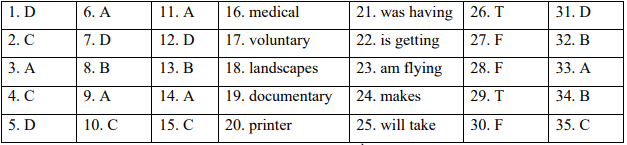
36. I was astonished at the beauty of the floating markets in Cần Thơ.
37. The amazing costumes and special effects of the movie have attracted a large audience.
38. In many modern families husbands tend to help out their wives with housework.
39. We don’t go to the movies now as often as we used to do when we were younger.
40. The plot in a thriller is much more gripping than the plot in a comedy.
41. I haven’t travelled abroad for two years.
42. That sofa isn’t big enough for three people (to sit on).
43. It was such hot weather that he couldn’t sleep.
44. I don’t mind helping you with your homework.
45. I didn’t sing as well as my friend.
HƯỚNG DẪN GIẢI CHI TIẾT
1. D
Kiến thức: Trọng âm của từ có 2 và 3 âm tiết
Giải thích:
A. sculpture /ˈskʌlp.tʃər/
B. portrait /ˈpɔː.trət/
C. artwork /ˈɑːt.wɜːk/
D. museum /mjuːˈziː.əm/
Trọng âm đáp án D rơi vào âm tiết thứ hai, các đáp án còn lại trọng âm rơi vào âm tiết thứ nhất.
Chọn A.
2. C
Kiến thức: Trọng âm của từ có từ 3 tiết trở lên
Giải thích:
A. geologist /dʒiˈɒl.ə.dʒɪst/
B. biologist /baɪˈɒl.ə.dʒɪst/
C. activist /ˈæk.tɪ.vɪst/
D. psychologist /saɪˈkɒl.ə.dʒɪst/
Trọng âm đáp án C rơi vào âm tiết thứ nhất, các đáp án còn lại trọng âm rơi vào âm tiết thứ hai.
Chọn C.
3. A
Kiến thức: Phát âm “oo”
Giải thích:
A. room /ruːm/
B. poor /pɔːr/
C. door /dɔːr/
D. floor /flɔːr/
Phần gạch chân của đáp án A đọc là /u:/, các đáp án còn lại phát âm là /ɔː/.
Chọn A.
4. C
Kiến thức: Phát âm “o”
Giải thích:
A. cottage /ˈkɒt.ɪdʒ/
B. block /blɒk/
C. town /taʊn/
D. accommodation /əˌkɒm.əˈdeɪ.ʃən/
Phần gạch chân của đáp án C đọc là /aʊ/, các đáp án còn lại phát âm là /ɒ/.
Chọn C.
5. D
Kiến thức: Phát âm “a”
Giải thích:
A. blanket /ˈblæŋ.kɪt/
B. man /mæn/
C. charity /ˈtʃær.ə.ti/
D. donate /dəʊˈneɪt/
Phần gạch chân của đáp án D đọc là /eɪ/, các đáp án còn lại phát âm là /æ/.
Chọn D.
6. A
Kiến thức: Thì quá khứ đơn
Giải thích:
Cấu trúc: didn’t use to + Vo (nói về thói quen hay hành động thường xuyên xảy ra ở hiện tại chưa từng diễn ra trong quá khứ)
These days, I eat more than before. I didn’t use to eat as much.
(Những ngày này tôi ăn nhiều hơn trước đây. Tôi chưa từng ăn nhiều thế này.)
Chọn A.
7. D
Kiến thức: Từ vựng
Giải thích:
A. like (v): thích
B. receive (v): nhận được
C. make (v): tạo ra, làm ra
D. download (v): tải xuống
Users can download music conveniently with an online music store from their personal computers.
(Người dùng có thể tải nhạc một cách thuận tiện với một cửa hàng nhạc trực tuyến từ máy tính cá nhân của họ.)
Chọn D.
8. B
Kiến thức: Từ vựng
Giải thích:
mops (v): lau nhà
washes (v): rửa => wash the dishes: rửa chén/ bát
waters (v): tưới nước
does (v): làm
After lunch, my brother washes the dishes and sometimes he does the ironing.
(Em tôi thường rửa chén sau bữa trưa và đôi khi nó còn là/ ủi quần áo.)
Chọn D.
9. A
Kiến thức: Từ vựng
Giải thích:
A. camper van (n): xe cắm trại
B. boat (n): con thuyền
C. cottage (n): nhà nhỏ ở nông thôn
D. studio (n): xưởng sáng tạo
He drives an old camper van in mountainous areas around the country.
(Ông ta lái cái xe cắm trại cũ lên vùng đồi núi khắp đất nước.)
Chọn A.
10. C
Kiến thức: Từ vựng
Giải thích:
network (n): mạng lưới
piece (n): mẩu/ mảnh
block (n): khối => block of flats: chung cư
part (n): phần
A serious fire in a high-rise block of flats has left many people homeless.
(Vụ hỏa hoạn nghiêm trọng tại chung cư cao tầng đã khiến nhiều người mất nhà.)
Chọn C.
11. A
Kiến thức: Từ vựng
Giải thích:
A. donate (v): khuyên góp
B. receive (v): nhận được
C. rise (v): tăng lên
D. spend (v): dành ra
Social media has made it easier to donate money with a system of fundraising websites to help the needy.
(Mạng xã hội đã làm cho việc khuyên góp tiền trở nên dễ dàng hơn với hệ thống các trang gây quỹ đề giúp đỡ người nghèo.)
Chọn A.
12. D
Kiến thức: Liên từ
Giải thích:
after: sau khi
during: trong suốt (khoảng thời gian)
while: trong khi
when: khi
Ta sử dụng when trong thì quá khứ đơn để thể hiện một hành động đang xảy ra trong quá khứ (QKTD) thì có một hành động khác xen vào (QKĐ).
Cấu trúc: S1 + was/ were V-ing + WHEN + S2 + Ved/V2
I was having dinner when my friends arrived.
(Tôi đang ăn tối thì bạn tôi đến.)
Chọn D
13. B
Kiến thức: Trạng từ
Giải thích:
A. a bit (n): một chút, một ít
B. extremely (adv): cực kỳ
C. slightly (adv): ở mức không đáng kể
D. a little (adj): nhỏ, ít
It was a(n) extremely easy victory for her. She achieved it with no difficulty at all.
(Đó là một chiến thắng cực kỳ dễ dàng với cô ấy. Cô ta đạt được nó không chút khó khăn.)
14. A
Kiến thức: Mệnh đề chỉ kết quả với so/such
Giải thích:
Cấu trúc: S1 + be + so + adj + that + S2 + V2 + … .
= S1 + V1 + such + a/an + adj + N + that + S2 + V2 + …: quá… đến nỗi mà…
It was such a beautiful painting that she decided to hang in the hallway.
(Bức tranh đó đẹp đến nỗi cô ấy quyết định treo nó ở hành lang.)
Chọn A.
15. D
Kiến thức: Thì hiện tại hoàn thành.
Giải thích:
A. already (adv): đã … rồi (S + have/ has already Ved/V3)
B. just (adv): vừa mới (S + have/ has just Ved/V3)
C. yet (adv): đã rồi (S + have/ has NOT Ved/V3 + YET:… chưa…)
D. since (adv): từ khi
I haven’t updated my Twitter with a new profile picture yet.
(Tôi vẫn chưa cập nhật ảnh đại diện mới cho tài khoản Twitter của mình.)
Chọn D.
16. medical
Kiến thức: Từ loại
Giải thích:
Đằng sau chỗ trống là một danh từ (supplies), nên ta cần điền vào chỗ trống một tính từ.
medicine (n): y tế
medical (adj): thuộc về y tế
China is one of the world’s biggest producers of a wide range of medical supplies.
(Trung Quốc là một trong những nhà sản xuất lớn nhất thế giới về các loại thiết bị y tế.)
Đáp án: medical
17. voluntary
Kiến thức: Từ loại
Giải thích:
Đằng sau chỗ trống là một danh từ (organisations), nên ta cần điền vào chỗ trống một tính từ.
volunteer (n): tình nguyện viên
voluntary (adj): thuộc về tình nguyện
A great number of social services are provided by the government and voluntary organisations.
(Một số lượng lớn các dịch vụ được cung cấp bởi chính phủ và các tổ chức tình nguyện.)
Đáp án: voluntary
18. landscapes
Kiến thức: Từ loại
Giải thích:
Đằng trước chỗ trống có mạo từ “the”, đằng sau chỗ trống là giới từ “of”, nên chỗ trống cần điền một danh từ, động từ chính trong câu là “are” nên chỗ trống cần điền một danh từ số nhiều.
land (n): đất
landscape (n): phong cảnh
From white sand beaches to mountains that hug the clouds, the landscapes of Vietnam are some of the most breathtaking landscapes.
(Từ những bãi biển cát trắng đến những ngọn núi ôm lấy những đám mây, phong cảnh của Việt Nam là một trong số những cảnh quan ngoạn mục nhất.)
Đáp án: landscapes
19. documentary
Kiến thức: Từ loại
Giải thích:
Đằng trước chỗ trống là một tính từ thì chỗ trống cần điền một danh từ.
document (n): tài liệu
documentary (n): phim tài liệu
17th Parallel: Vietnam in War is a famous documentary that shows the effects of the American bombing campaign on Vietnamese people.
(Vĩ tuyến 17: Chiến tranh nhân dân là một bộ phim tài liệu nổi tiếng cho thấy những ảnh hưởng của chiến dịch ném bom của Mỹ đến với người dân Việt Nam.)
Đáp án: documentary
20. printer
Kiến thức: Từ loại
Giải thích:
Sau this là một danh từ hoặc một cụm danh từ nên ta điền một danh từ vào chỗ trống.
print (v): in
printer (n): máy in
This laser printer is purely mechanical, and its speed is very high.
(Máy in la-de này chạy hoàn toàn bằng cơ và tốc độ của nó rất cao.)
Đáp án: printer
21. was having
Kiến thức: Thì quá khứ tiếp diễn
Giải thích:
Cấu trúc: S1 + was/were + V-ing + … + when/while + S2 + Ved/V2 + … => dùng thì quá khứ tiếp diễn để diễn tả một hành động đang xảy ra thì có một hành động khác xen vào trong quá khứ.
He was having a shower when someone knocked at the door.
(Anh ấy đang tắm khi có ai đó gõ cửa.)
Đáp án: was having
22. is getting
Kiến thức: Thì hiện tại tiếp diễn
Giải thích:
Dấu hiệu nhận biết thì hiện tại tiếp diễn “right now” =>cấu trúc S + is/am/are + Ving + … . (dùng để diễn tả hành động đang xảy ra ngay tại thời điểm nói.)
Mai is getting ready for school, so she can’t come to the phone right now.
(Mai đang chuẩn bị đồ đến trường nên bây giờ cô ấy không thể nghe điện thoại được.)
Đáp án: is getting
23. am flying
Kiến thức: Thì hiện tại tiếp diễn.
Giải thích:
Cấu trúc: S + is/am/are + Ving + … . Thì hiện tại tiếp diễn diễn tả một hành động sắp xảy ra trong tương lai gần, thường diễn tả một kế hoạch đã lên lịch sẵn.
Dấu hiệu nhận biết: I’ve got the plane tickets! (Tôi đã có vé máy bay rồi đây!)
I am flying to Korea for a holiday soon. I’ve got the plane tickets!
(Tôi sẽ bay qua Hàn Quốc để nghỉ mát sớm thôi. Tôi đã có vé rồi!)
Đáp án: am flying
24. makes
Kiến thức: Thì hiện tại đơn
Giải thích:
Thì hiện tại đơn diễn tả sự thật/ sự việc đúng => Cấu trúc: S (số ít) + Vs/es
This new computer makes my life a lot easier.
(Cái máy tính mới này đã khiến cuộc sống của tôi trở nên dễ dàng hơn.)
Đáp án: makes
25. will take
Kiến thức: Câu điều kiện loại 1
Giải thích:
Cấu trúc: If + S1 + V0/s-es + …, S2 + will + V0 + …
Câu điều kiện loại 1 thường dùng để đặt ra một điều kiện có thể có thật (ở hiện tại hoặc tương lai) với kết quả có thể xảy ra.
I will take you to the bus station if you like.
(Tôi sẽ đưa bạn đến bến xe buýt nếu bạn thích.)
Đáp án: will take
Bài nghe:
Peter: Hi Anne. I haven’t seen you for such a long time. How have you been?
Anne: Hi Peter. Nice to see you again. Recently, I have been busy helping out at a local orphanage.
Peter: Oh, sounds interesting! Tell me a bit about the place you work.
Anne: Yes, it’s really cool. It’s a huge space with lots of activities and events every weekend.
Peter: What do you do there?
Anne: I tutor the children. They are really bright and lovely. After school, we often pick up trash and clean up the area. Everyone joins in and I am quite proud of our work. Now, the place looks a lot better.
Peter: That sounds fun! I used to help at a home for elderly people. It was hard and I felt quite tired at first. But I always went home feeling pleased that I’d done it. Doing charity gives us opportunities to meet new people and learn new skills.
Anne: I felt the same. I didn’t use to like speaking to new people, so it gave me more confidence. Did you use to do it every weekend?
Peter: Sure, I spent a lot of time there until I got too much homework. It was a pity.
Anne: I think the semester is ending soon. Do you want to come along with me this summer? It would be a nice idea.
Peter: Well, definitely. I’d love to go.
Dịch bài nghe:
Peter: Chào Anne. Lâu lắm rồi mình không thấy cậu. Cậu có khỏe không?
Anne: Chào Peter. Thật vui khi gặp lại cậu. Gần đây mình đang bận giúp đỡ ở một cô nhi viện địa phương.
Peter: Ồ, nghe thật thú vị đó! Nói cho mình biết một chút về nơi bạn làm việc đi.
Anne: À, nó rất là tuyệt. Nó là một nơi rộng lớn với rất nhiều hoạt động và sự kiện mỗi cuối tuần.
Peter: Cậu làm gì ở đó?
Anne: Mình hướng dẫn bọn trẻ học. Chúng rất sáng dạ và đáng yêu. Tụi mình thường nhặt rác và dọn dẹp khu vực đó. Mọi người đều tham gia và mình khá tự hào về công việc của tụi mình. Bây nơi đó trông tốt hơn nhiều rồi.
Peter: Nghe thật vui đó! Mình đã từng đi giúp việc ở một viện dưỡng lão. Lúc đầu nó rất khó khăn và mình thấy khá mệt. Nhưng mình luôn về nhà với sự hài lòng với những gì mình đã làm. Làm việc từ thiện cho chúng ta cơ hội để gặp những người bạn mới và học những kĩ năng mới.
Anne: Mình cũng cảm thấy mệt. Mình từng không thích nói chuyện với người lạ, nên nó đem lại cho mình nhiều tự tin hơn? Cậu có từng làm vậy mỗi cuối tuần không?
Peter: Có chứ, mình từng dành nhiều thời gian ở đó cho đến khi mình có quá nhiều bài tập phải làm. Khá là đáng tiếc.
Anne: Mình nghĩ là học kì này sẽ kết thúc sớm thôi? Cậu có muốn đi theo mình vào hè này không? Đó là một ý kiến hay đó.
Peter: Được, chắc chắn rồi. Mình rất muốn đi.
26. T
Kiến thức: Nghe hiểu
Giải thích:
Anne is working at an orphanage.
(Anne đang làm việc ở một cô nhi viện.)
Thông tin: Recently, I have been busy helping out at a local orphanage.
(Gần đây mình đang bận giúp đỡ ở một cô nhi viện địa phương.)
Đáp án: True
27. F
Kiến thức: Nghe hiểu
Giải thích:
Anne feels ashamed of her charity work.
(Anne cảm thấy xấu hổ vì công việc từ thiện của mình.)
Thông tin: Everyone joins in and I am quite proud of our work.
(Mọi người đều tham gia và mình khá tự hào về công việc của tụi mình.)
Đáp án: False
28. F
Kiến thức: Nghe hiểu
Giải thích:
Peter regrets helping elderly people.
(Peter cảm thấy hối hận vì đã giúp việc ở viện dưỡng lão.)
Thông tin: Sure, I spent a lot of time there until I got too much homework. It was a pity.
(Có chứ, mình từng dành nhiều thời gian ở đó cho đến khi mình có quá nhiều bài tập phải làm. Khá là đáng tiếc.)
Đáp án: False
29. T
Kiến thức: Nghe hiểu
Giải thích:
Peter had a lot of homework when he was doing charity work.
(Peter có rất nhiều bài tập trong lúc làm tình nguyện.)
Thông tin: Sure, I spent a lot of time there until I got too much homework. It was a pity.
(Có chứ, mình từng dành nhiều thời gian ở đó cho đến khi mình có quá nhiều bài tập phải làm. Khá là đáng tiếc.)
Đáp án: True
30. F
Kiến thức: Nghe hiểu
Giải thích:
Peter isn’t going to do charity work this summer.
(Peter sẽ không đi làm tình nguyện vào hè này.)
Thông tin:
Anne: I think the semester is ending soon. Do you want to come along with me this summer? It would be a nice idea.
(Mình nghĩ là học kì này sẽ kết thúc sớm thôi? Cậu có muốn đi theo mình vào hè này không? Đó là một ý kiến hay đó.)
Peter: Well, definitely. I’d love to go.
(Được, chắc chắn rồi. Mình rất muốn đi.)
Đáp án: True
Dịch bài đọc:
Thành phố Bắc Kinh có một vấn đề lớn với chất lượng không khí đến nỗi mà có những ngày bạn không thể thấy được những tòa nhà ở hai bên đường. Ngày càng nhiều người phải chống chọi với những cơn đau ngực và khó thở. Trẻ em và người già đang gặp nguy hiểm nhất.
Một tháp lọc sương mù đã được xây dựng ở khu phố nghệ thuật ở Bắc Kinh vào tuần trước. Đó là một phần của dự án thanh lọc không khí bởi Daan Roosegaarde đến từ Hà Lan và nó được thiết kế để lọc sương mù và tạo ra không khí sạch. Nó là một cái tháp cao bảy mét trông giống cái máy lọc không khí mà bạn sở hữu ở nhà mình. Roosegaarde miêu tả nó giống như cái máy lọc sương mù lớn nhất trên thế giới.
Tháp lọc sương mù được tạo ra bởi Roosegaarde và một công ty công nghê xanh ở cộng hòa Hà Lan. Nó chạy bằng năng lượng tái tạo. Các phân tử sương mù nguy hiểm đến sức khỏe được thu gom lại và lưu trữ bên trong tháp. Sau đó tháp thổi ra không khí sạch. Roosegaarde dùng chỗ phân tử sương mù thu được để làm trang sức. Khi bạn mua một chiếc vòng “lọc sương mù” hoặc một cặp măng-sét, nghĩa là bạn mua một nghìn mét khối không khí sạch.
Roosegaarde có ý tưởng cho dự án lọc sương khi anh ấy đến Bắc Kinh vào năm 2013. Một ngày, anh ấy nhìn ra ngoài cửa sổ khách sạn và anh ấy không thể thấy bất cứ thứ gì. Thành phố đã biết mất dưới lớp sương mù dày.
Roosegaarde và Bộ Bảo vệ Môi trường Trung Quốc đang dự định lắp đặt 800 máy lọc không khí khổng lồ ở các công viên khắp Trung Quốc để nâng cao ý thức về vấn đề lớn về ô nhiễm. Anh ấy tin rằng cả nhân dân và chính phủ cần cùng nhau hành động để chiến đấu với sự ô nhiễm. Anh ấy ước mơ rằng trong mười đến mười lăm năm nữa chúng ta sẽ không cần đến những cái tháp của anh ấy nữa.
31. D
Kiến thức: Đọc hiểu
Giải thích:
Theo đoạn văn, ai là người phải chống chọi với ô nhiễm không khí?
A. Người trưởng thành
B. Trẻ em
C. Người già
D. Cả B và C
Thông tin: Children and the elderly are most at risk.
(Trẻ em và người già đang gặp nguy hiểm nhất.)
Chọn D
32. B
Kiến thức: Đọc hiểu
Giải thích:
Tháp lọc sương mù trong giống cái gì?
A. Sương mù
B. Một máy lọc không khí ở nhà
C. Một máy hút bụi
D. Phân tử
Thông tin: The seven-metre-high tower resembles the kind of air purifier you may have in your house.
(Nó là một cái tháp cao bảy mét trông giống cái máy lọc không khí mà bạn sở hữu ở nhà mình.)
Chọn B
33. A
Kiến thức: Đọc hiểu
Giải thích:
Bạn có thể làm gì từ các phân tử sương mù?
A. Trang sức
B. Măng-sét
C. Năng lượng tái tạo
D. Không khí sạch
Thông tin: Roosegaarde uses the collected smog particles to make jewellery.
(Roosegaarde dùng chỗ phân tử sương mù thu được để làm trang sức.)
Chọn A
34. B
Kiến thức: Đọc hiểu
Giải thích:
Điều gì đã khiến Roosegaarde muốn thiết kế tháp hút sương mù?
A. Sự hỗ trợ của chính phủ cộng hòa Hà Lan
B. Ô nhiễm không khí ở Bắc Kinh
C. Sự giúp đỡ của Bộ Bảo vệ Môi trường Trung Quốc
D. Công dân Bắc Kinh
Thông tin: Roosegaarde got the idea for the Smog Free Project when he visited Beijing in 2013.
(Roosegaarde có ý tưởng cho dự án lọc sương khi anh ấy đến Bắc Kinh vào năm 2013.)
Chọn B
35. C
Kiến thức: Đọc hiểu
Giải thích:
Đâu là tiêu đề cho bài đọc?
A. Chất lượng không khí ở khu vực Bắc Kinh
B. Roosegaarde và phát minh mới của anh ấy
C. Tháp hút sương mù và tạo ra không khí sạch
D. Giấc mơ điên rồ nhất của Roosegaarde
Thông tin: Last week, a Smog Free Tower was built in the arts district of Beijing. It is part of an air purifying project by Daan Roosegaarde from Holland and is designed to take in smog and release clean air.
(Một tháp lọc sương mù đã được xây dựng ở khu phố nghệ thuật ở Bắc Kinh vào tuần trước. Đó là một phần của dự án thanh lọc không khí bởi Daan Roosegaarde đến từ Hà Lan và nó được thiết kế để lọc sương mù và tạo ra không khí sạch.)
Chọn C
36.
Kiến thức: Thì quá khứ đơn
Giải thích:
Cấu trúc: S + was/were + adj + …
be astonished at: ngạc nhiên, kinh ngạc
Đáp án: I was astonished at the beauty of the floating markets in Cần Thơ.
(Tôi đã kinh ngạc với vẻ đẹp của chợ nổi Cần Thơ.)
37.
Kiến thức: Thì hiện tại hoàn thành
Giải thích:
Cấu trúc: S + have/has + VIII/ed + … .
Đáp án: The amazing costumes and special effects of the movie have attracted a large audience.
(Những bộ trang phục và hiệu ứng kỹ xảo tuyệt vời của bộ phim đã thu hút một lượng lớn khán giả.)
38.
Kiến thức: Thì hiện tại đơn
Giải thích:
Cấu trúc: S + V0 + … .
Đáp án: In many modern families husbands tend to help out their wives with housework.
(Ở những gia đình hiện đại, những người chồng có xu hướng giúp vợ mình công việc nhà.)
39.
Kiến thức: Thì hiện tại đơn, quá khứ đơn và cấu trúc used to
Giải thích:
Cấu trúc: S + V0 + … .
- used to + V0: một việc thường xuyên xảy ra trong quá khứ những đã không còn ở hiện tại.
- Ở thì quá khứ đơn, ta sử dụng when để diễn tả một hành động xảy ra trong một thời gian ngắn ở quá khứ.
Đáp án: We don’t go to the movies now as often as we used to do when we were younger.
(Bây giờ chúng tôi không tới rạp chiếu phim thường xuyên như ngày chúng tôi còn nhỏ.)
40.
Kiến thức: Câu so sánh hơn với tính từ dài
Giải thích:
Cấu trúc so sánh hơn với tính từ dài: S + be + much + more + tính từ dài + than + … .
Chúng ta sử dụng much trong câu so sánh để nhấn mạnh sự so sánh trong câu.
Đáp án: The plot in a thriller is much more gripping than the plot in a comedy.
(Cốt truyện của một bộ phim giật gân thú vị hơn nhiều so với cốt truyện của một vở hài kịch.)
41.
Kiến thức: Thì hiện tại hoàn thành
Giải thích:
Cấu trúc: S + have + VIII/ed + …
một khoảng thời gian + ago = for + một khoảng thời gian
I stopped travelling abroad two years ago.
(Tôi đã dừng việc đi du lịch nước ngoài cách đây 2 năm.)
Đáp án: I haven’t travelled abroad for two years.
(Tôi đã không đi du lịch nước ngoài hai năm rồi.)
42.
Kiến thức: Cấu trúc enough
Giải thích:
Cấu trúc với “enough”: S + be + adj + enough + for sth + to V0
Three people can’t sit on that sofa. It isn’t big enough.
(Ba người không thể ngồi trên chiếc sô pha kia. Nó không đủ lớn.)
Đáp án: That sofa isn’t big enough for three people (to sit on).
(Chiếc sofa không đủ lớn cho ba người ngồi lên.)
43.
Kiến thức: Mệnh đề chỉ kết quả với so/such
Giải thích:
Cấu trúc: S1 + be + so + adj + that + S2 + V2 + … .
= S1 + V1 + such + a/an + adj + N + that + S2 + V2 + … : quá… đến nỗi mà…
The weather was so hot that he couldn’t sleep.
(Thời tiết quá nóng đến nỗi mà anh ấy không thể ngủ được.)
Đáp án: It was such hot weather that he couldn’t sleep.
44.
Kiến thức: Cấu trúc với mind
Cấu trúc: mind + V-ing (ngại/ phiền làm việc gì)
I’ll help you with your homework.
(Tôi sẽ giúp bạn với bài tập về nhà.)
Đáp án: I don’t mind helping you with your homework.
(Tôi không phiền giúp bạn làm bài tập về nhà.)
45.
Kiến thức: Cấu trúc so sánh bằng
Giải thích:
Cấu trúc: S1 + V1 + as + adv + as + ...
My friend sang better than I did.
(Bạn tôi hát hay hơn tôi.)
Đáp án: I didn’t sing as well as my friend.
(Tôi hát không hay bằng bạn tôi.)
Đề thi học kì 1 Tiếng Anh 10 Global Success - Đề số 7
Đề bài
I. PRONUNCIATION
Choose the word whose underlined part is pronounced differently.
1.
A. desktop
B. geology
C. iron
D. documentary
2.
A. fantasy
B. landscape
C. charity
D. laser
Choose the word that has a different stressed syllable from the rest.
3.
A. treasure
B. marine
C. support
D. superb
4.
A. filament
B. linguistics
C. bungalow
D. benefit
5.
A. apartment
B. breathtaking
C. senior
D. comedy
II. VOCABULARY AND GRAMMAR
Choose the best option (A, B, C or D) to complete each of the following sentences.
6. My father is __________ the garage at the moment. It’s so messy.
A. tidying
B. washing
C. painting
D. vacuuming
7. __________ is the science of minds and brains.
A. Linguistics
B. Psychology
C. Archaeology
D. Geology
8. I must say that J. K. Rowling is such a(n) __________ novelist with her seven-volume children’s fantasy series, Harry Potter.
A. predictable
B. fascinated
C. imaginative
D. fascinating
9. The hotel offers __________ and cozy rooms with a terrific view of the Hạ Long Bay.
A. floating
B. underground
C. breathtaking
D. spacious
10. __________ are where the elderly can benefit from social services and be cared for when necessary.
A. Senior centres
B. Orphanages
C. Medical supplies
D. Homeless shelters
11. My father often __________ home early in the afternoon to do the vacuuming before we can have dinner.
A. come
B. comes
C. coming
D. is coming
12. There __________ something wrong with the search engine when I __________ to post my photos on Facebook.
A. is – tried
B. was – used to try
C. was – was trying
D. is – was trying
13. “Stranger Things” is __________ series I’ve seen this summer.
A. fascinating
B. less fascinating
C. more fascinating
D. the most fascinating
14. My grandfather __________ in this mining town since he __________ here in 1989.
A. has worked – moved
B. is working – moved
C. used to work – moves
D. works – moves
15. My friend Suzy chose __________ the elderly because she thought this __________ a big difference to their lives.
A. to help – shall make
B. helping – must make
C. to help – would make
D. helping – might make
Write the correct forms of the words in brackets.
16. Opportunities for conversation may arise if parents and children do the __________ chores together. (HOUSE)
17. A robotic vacuum cleaner can make cleaning the floor a less boring and __________ task. (LABOUR)
18. That is a __________ which is based on a novel which was released 5 years ago. (DOCUMENT)
19. Hội An is one of the most popular tourist __________ in Việt Nam with its antique markets and beautiful landscape. (ATTRACT)
20. You are encouraged to donate __________ supplies, blankets, and food to the needy ones. (MEDICINE)
III. LISTENING
Listen to a radio programme about a future house and decide whether the following sentences are true (T) or false (F).
21. You may be living in a fully connected smart home twenty years later.
22. Household appliances can be controlled remotely in a smart home.
23. Doing household chores in a smart home is time-consuming.
24. A smart home can be programmed to provide medical care.
25. Everyone has the chance to live in a smart home in the future.
IV. READING
Read the advertisement and choose the best option (A, B, C or D) to complete each of the sentences below.
Customer Service Assistant
Let’s spread the love of reading in the community! The Charity Shop in Reading is excited to announce the 10th Reading Camp. Any high school students who live in Hà Nội can help in our camp. The opening ceremony will take place next Sunday, 7 December, from 09.00–11.00 in the morning. Volunteers should show up at 14 Đinh Tiên Hoàng Street. There will be a free parking space there and each volunteer will have a free breakfast before we open the Reading Camp. The camp has already been set up and all you need to do is to control the activities in different smaller camps after having some training.
We are looking for 4–5 customer service volunteers for each task. Tasks may include:
Raising money for the Reading Camp fund. Our aim is to collect enough money from the visitors to run this event next year and give away books to street children and those who live in orphanages.
Receiving book donations from visitors who will come to Hàng Khay Street. Your job is to receive books from visitors and give some advice on their book purchasing if necessary.
The Reading Camp Tour needs volunteers to lead the book tours along Lê Thái Tổ Street. There will be a guidebook and you will be trained before the tours begin. You just need to love books and can introduce some of them to the visitors.
The role would suit a sociable, friendly person with the confidence to approach visitors. Training will be provided and time commitment is flexible.
For further information or to register for your favourite positions, please contact Ms. Hà (0984236845) or email us at thereadingcamphanoi@gmail.com.
26. Volunteers need to arrive at __________ to attend the opening ceremony.
A. Đinh Tiên Hoàng Street
B. Hàng Khay Street
C. Lê Thái Tổ Street
27. Before the camp begins, volunteers need to __________.
A. come early to help with setting up the camp
B. buy themselves a small breakfast
C. have some training on their managing activities
28. During the camp, volunteers can choose to __________.
A. raise money for the camp from other volunteers
B. welcome book donations from visitors
C. sell books to street children or orphanages
29. The Reading Camp tour will take place on __________.
A. Hàng Khay Street
B. Đinh Tiên Hoàng Street
C. Lê Thái Tổ Street
30. Book tour leaders will __________.
A. need to sell books to the visitors
B. have a guidebook to run their tours
C. not have to introduce books to the visitors
Read the advertisement again and complete the summary below with only one word for each blank.
The Reading Camp will take place next Sunday and volunteers need to arrive at 14 Đinh Tiên Hoàng Street before the camp begins. Parking is (31) __________ and each volunteer will receive a small breakfast. After having some training, their tasks are to (32) __________ the activities in different smaller camps. They can choose to raise money to give books to street children and those living in (33) __________. Some volunteers can welcome visitors and advise visitors on their (34) __________ if needed or lead book tours. A sociable, friendly person is recommended for this post and time commitment is (35) __________.
V. WRITING
Rearrange the given words to make complete sentences. Do not change the given words.
36. generations / many / since / Nowadays, / cannot / families / move away / together / young / afford / several / have / to / people / generations / living.
→ _______________________________________________________________.
37. still / time / assistant / At / I / was / research / this / year, / last / a / working / as.
→ _______________________________________________________________.
38. has / him / Harry / since / changed / not / anything / time / the / I / last / met.
→ _______________________________________________________________.
39. floating / impressed / around / markets / has / its / Cần Thơ / Việt Nam / with / network / and / tourists/ canal.
→ _______________________________________________________________.
40. local / difference / smallest / environment / to / even / actions / make / a / can / with / the / the / We.
→ _______________________________________________________________.
Use the words in capitals to rewrite the sentences. Do not change the given word.
41. People once burned candles to light their houses in the past. (USED)
→ People _____________________________ to light their houses in the past.
42. My friend thinks this movie is more fascinating than any other ones. (MOST)
→ My friend thinks this is _____________________________ movie.
43. I’m not old enough to drive a motorbike. (TOO)
→ I’m _____________________________ drive a motorbike.
44. Anna is a more fluent French speaker than I am. (SPEAK)
→ Anna can _____________________________ than I can.
45. Teenagers are encouraged to take part in charity work. (SHOULD)
→ Teenagers _____________________________ charity work.
--------------------THE END--------------------
Đáp án
HƯỚNG DẪN GIẢI
Thực hiện: Ban chuyên môn trithuchub.com
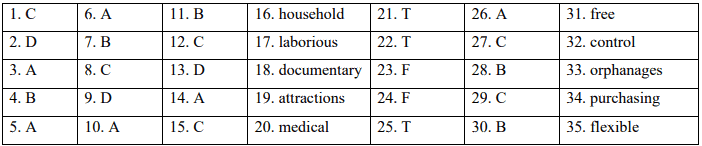
36. Nowadays, many families have several generations living together since young people cannot afford to move away.
37. At this time last year, I was still working as a research assistant.
38. Harry has not changed anything since the last time I met him.
39. Cần Thơ has impressed tourists around Việt Nam with its canal network and floating markets.
40. We can make a difference to the local environment with even the smallest actions.
41. People used to burn candles to light their houses in the past.
42. My friend thinks this is the most fascinating movie.
43. I’m too young to drive a motorbike.
44. Anna can speak French more fluently than I can.
45. Teenagers should take part in charity work.
HƯỚNG DẪN GIẢI CHI TIẾT
1. C
Kiến thức: Phát âm “o”
Giải thích:
A. desktop /ˈdesktɒp/
B. geology /dʒiˈɒlədʒi/
C. iron /ˈaɪən/
D. documentary /ˌdɒkjuˈmentri/
Phần được gạch chân ở phương án C được phát âm /ə/, các phương án còn lại phát âm /ɒ/.
Chọn C
2. D
Kiến thức: Phát âm “a”
Giải thích:
A. fantasy /ˈfæntəsi/
B. landscape /ˈlændskeɪp/
C. charity /ˈtʃærəti/
D. laser /ˈleɪzə(r)/
Phần được gạch chân ở phương án D được phát âm /eɪ/, các phương án còn lại phát âm /æ/.
Chọn D
3. A
Kiến thức: Trọng âm của từ có 2 âm tiết
Giải thích:
A. treasure /ˈtreʒə(r)/
B. marine /məˈriːn/
C. support /səˈpɔːt/
D. superb /suːˈpɜːb/
Phương án A có trọng âm 1, các phương án còn lại có trọng âm 2.
Chọn A
4. B
Kiến thức: Trọng âm của từ có 3 âm tiết
Giải thích:
A. filament /ˈfɪləmənt/
B. linguistics /lɪŋˈɡwɪstɪks/
C. bungalow /ˈbʌŋɡələʊ/
D. benefit /ˈbenɪfɪt/
Phương án B có trọng âm 2, các phương án còn lại có trọng âm 1.
Chọn B
5. A
Kiến thức: Trọng âm của từ có 3 âm tiết
Giải thích:
A. apartment /əˈpɑːtmənt/
B. breathtaking /ˈbreθteɪkɪŋ/
C. senior /ˈsiːniə(r)/
D. comedy /ˈkɒmədi/
Phương án A có trọng âm 2, các phương án còn lại có trọng âm 1.
Chọn A
6. A
Kiến thức: Từ vựng
Giải thích:
A. tidying (v): dọn dẹp
B. washing (v): rửa
C. painting (v): vẽ
D. vacuuming (v): hút bụi
My father is tidying the garage at the moment. It’s so messy.
(Bố tôi đang thu dọn nhà để xe vào lúc này. Nó rất lộn xộn.)
Chọn A
7. B
Kiến thức: Từ vựng
Giải thích:
A. Linguistics (n): ngôn ngữ học
B. Psychology (n): tâm lý học
C. Archaeology (n): khảo cổ học
D. Geology (n): địa chất học
Psychology is the science of minds and brains.
(Tâm lý học là khoa học về tâm trí và não bộ.)
Chọn B
8. C
Kiến thức: Từ vựng
Giải thích:
A. predictable (adj): đoán trước được
B. fascinated (adj): cuốn hút
C. imaginative (adj): giàu trí tưởng tượng
D. fascinating (adj): lôi cuốn
I must say that J. K. Rowling is such an imaginative novelist with her seven-volume children’s fantasy series, Harry Potter.
(Tôi phải nói rằng J. K. Rowling là một tiểu thuyết gia giàu trí tưởng tượng với bộ truyện giả tưởng dành cho trẻ em gồm bảy tập của bà, Harry Potter.)
Chọn C
9. D
Kiến thức: Từ vựng
Giải thích:
A. floating (adj): nổi trên mặt nước
B. underground (adj): dưới đất
C. breathtaking (adj): ngoạn mục
D. spacious (adj): rộng rãi
The hotel offers spacious and cozy rooms with a terrific view of the Hạ Long Bay.
(Khách sạn cung cấp các phòng rộng rãi và ấm cúng với tầm nhìn tuyệt đẹp ra Vịnh Hạ Long.)
Chọn D
10. A
Kiến thức: Từ vựng
Giải thích:
A. Senior centres (n): trung tâm chăm sóc người cao tuổi
B. Orphanages (n): trại trẻ mồ côi
C. Medical supplies (n): vật tư y tế
D. Homeless shelters (n): nhà cho người vô gia cư
Senior centres are where the elderly can benefit from social services and be cared for when necessary.
(Các trung tâm chăm sóc người cao tuổi là nơi người cao tuổi có thể hưởng lợi từ các dịch vụ xã hội và được chăm sóc khi cần thiết.)
Chọn A
11. B
Kiến thức: Thì hiện tại đơn
Giải thích:
Dấu hiệu nhận biết: “often” => Thì hiện tại đơn dạng khẳng định: S (số ít) + Vs/es
My father often comes home early in the afternoon to do the vacuuming before we can have dinner.
(Cha tôi thường về nhà sớm vào buổi chiều để hút bụi trước khi chúng tôi ăn tối.)
Chọn B
12. C
Kiến thức: Thì quá khứ đơn – quá khứ tiếp diễn
Giải thích:
Để diễn tả một hành động đang diễn ra, một hành động ngắn xen vào dùng cấu trúc: When + S + was/were V-ing, S + Ved/V2
There was something wrong with the search engine when I was trying to post my photos on Facebook.
(Đã xảy ra sự cố với công cụ tìm kiếm khi tôi cố gắng đăng ảnh của mình lên Facebook.)
Chọn C
13. D
Kiến thức: So sánh nhất
Giải thích:
Cấu trúc so sánh nhất với tính từ dài: S + be + the most + adj + N
“Stranger Things” is the most fascinating series I’ve seen this summer.
(“Stranger Things” là loạt phim hấp dẫn nhất tôi từng xem trong mùa hè này.)
Chọn D
14. A
Kiến thức: Thì hiện tại hoàn thành
Giải thích:
Cấu trúc thì hiện tại hoàn thành với “since”: S + have/has Ved/V3 + SINCE + S + Ved/V2
My grandfather has worked in this mining town since he moved here in 1989.
(Ông tôi đã làm việc ở thị trấn mỏ này kể từ khi ông chuyển đến đây vào năm 1989.)
Chọn A
15. C
Kiến thức: Dạng của động từ
Giải thích:
Cấu trúc: chose + to V (chọn làm việc gì)
Câu đang dùng thì quá khứ đơn nên chỗ trống thứ hai cũng phải ở thì quá khứ đơn => would make
My friend Suzy chose to help the elderly because she thought this would make a big difference to their lives.
(Bạn tôi, Suzy, đã chọn giúp đỡ người già vì cô ấy nghĩ điều này sẽ tạo ra sự khác biệt lớn cho cuộc sống của họ.)
Chọn C
16. household
Kiến thức: Từ vựng – từ loại
Giải thích:
Trước danh từ “chores” cần tính từ bổ nghĩa cho nó.
house (n): ngôi nhà
household (adj): trong gia đình; dùng cho gia đình => Cụm từ: household chores (việc lặt vặt trong nhà)
Opportunities for conversation may arise if parents and children do the household chores together.
(Cơ hội trò chuyện có thể nảy sinh nếu cha mẹ và con cái cùng nhau làm việc nhà.)
Đáp án: household
17. laborious
Kiến thức: Từ vựng – từ loại
Giải thích:
Trước liên từ “and” là tính từ “boring” nên chỗ trống cũng phải là tính từ.
labour (n): lao động
laborious (adj): vất vả
A robotic vacuum cleaner can make cleaning the floor a less boring and laborious task.
(Robot hút bụi có thể làm cho việc lau sàn trở nên bớt nhàm chán và tốn nhiều công sức hơn.)
Đáp án: laborious
18. documentary
Kiến thức: Từ vựng – từ loại
Giải thích:
Sau mạo “a” cần một danh từ.
document (n): tài liệu
documentary (n): phim tài liệu
That is a documentary which is based on a novel which was released 5 years ago.
(Đó là một bộ phim tài liệu dựa trên một cuốn tiểu thuyết đã được phát hành cách đây 5 năm.)
Đáp án: documentary
19. attractions
Kiến thức: Từ vựng – từ loại
Giải thích:
Sau so sánh nhất “the most” cần một danh từ/ cụm danh từ.
attract (v): thu hút, hấp dẫn, lôi cuốn
attraction (n): sức hút => tourist attraction: điểm thu hút du khách
Hội An is one of the most popular tourist attractions in Việt Nam with its antique markets and beautiful landscape.
(Hội An là một trong những điểm thu hút khách du lịch nổi tiếng nhất ở Việt Nam với những khu chợ đồ cổ và cảnh quan tuyệt đẹp.)
Đáp án: attractions
20. medical
Kiến thức: Từ vựng – từ loại
Giải thích:
Trước chuỗi danh từ “supplies” cần một tính từ để bổ nghĩa.
medicine (n): thuốc
medical (adj): (thuộc) y học => medical supplies: hỗ trợ về y tế
You are encouraged to donate medical supplies, blankets, and food to the needy ones.
(Bạn được khuyến khích quyên góp vật tư y tế, chăn màn và thức ăn cho những người khó khăn.)
Đáp án: medical
Bài nghe:
Today I’m reporting from the Future House show and I’m going to start with a question – where will you be living twenty years from now?
Well, you’ll be living in a fully connected smart home!
Smart homes and smart technology have now become reality, not the future nor any science fiction.
How do they benefit our lives?
A smart home can be designed in such a way that household appliances such as fridges, televisions and air conditioners can be controlled by the homeowner using a remote control.
One benefit is that the smart home can save you a lot of time – especially when you are busy at work. With the tap of a finger on your mobile phone, you can do the washing up, turn on the robotic vacuum cleaner and water the plants. These laborious tasks are now done for you.
Plus, with the smart home, you manage your shopping better – when you need medical supplies in emergencies, your house can be programmed to buy all necessary items. Or just imagine you binge-watching your favourite series on a rainy day without any worries about buying household goods. Why? Because you can now visit a shopping website and the house will arrange purchases for you.
In the future, such homes will be available for everybody!
Tạm dịch:
Hôm nay tôi đang tường thuật từ chương trình Ngôi nhà tương lai và tôi sẽ bắt đầu với một câu hỏi - bạn sẽ sống ở đâu trong hai mươi năm nữa?
Chà, bạn sẽ được sống trong một ngôi nhà thông minh được kết nối đầy đủ!
Nhà thông minh và công nghệ thông minh giờ đây đã trở thành hiện thực, không phải tương lai hay khoa học viễn tưởng nữa.
Chúng mang lại lợi ích như thế nào cho cuộc sống của chúng ta?
Một ngôi nhà thông minh có thể được thiết kế theo cách mà các thiết bị gia dụng như tủ lạnh, tivi và điều hòa không khí có thể được điều khiển bởi chủ nhà bằng điều khiển từ xa.
Một lợi ích là ngôi nhà thông minh có thể giúp bạn tiết kiệm rất nhiều thời gian – đặc biệt là khi bạn bận rộn với công việc. Chỉ với một cú chạm ngón tay trên điện thoại di động, bạn có thể giặt giũ, bật máy hút bụi robot và tưới cây. Những nhiệm vụ tốn nhiều công sức này hiện đã được thực hiện cho bạn.
Ngoài ra, với ngôi nhà thông minh, bạn quản lý việc mua sắm của mình tốt hơn – khi bạn cần vật tư y tế trong trường hợp khẩn cấp, ngôi nhà của bạn có thể được lập trình để mua tất cả các mặt hàng cần thiết. Hoặc chỉ cần tưởng tượng bạn say sưa xem bộ phim yêu thích của mình vào một ngày mưa mà không phải lo lắng về việc mua đồ gia dụng. Tại sao? Bởi vì bây giờ bạn có thể truy cập một trang web mua sắm và ngôi nhà sẽ sắp xếp việc mua hàng cho bạn.
Trong tương lai, những ngôi nhà như vậy sẽ có sẵn cho tất cả mọi người!
21. T
Kiến thức: Nghe hiểu
Giải thích:
You may be living in a fully connected smart home twenty years later.
(Bạn có thể sống trong một ngôi nhà thông minh được kết nối đầy đủ hai mươi năm sau.)
Thông tin: where will you be living twenty years from now? Well, you’ll be living in a fully connected smart home!
(bạn sẽ sống ở đâu hai mươi năm nữa? Chà, bạn sẽ được sống trong một ngôi nhà thông minh được kết nối đầy đủ!)
Chọn T
22. T
Kiến thức: Nghe hiểu
Giải thích:
Household appliances can be controlled remotely in a smart home.
(Các thiết bị gia dụng có thể được điều khiển từ xa trong ngôi nhà thông minh.)
Thông tin: A smart home can be designed in such a way that household appliances such as fridges, televisions and air conditioners can be controlled by the homeowner using a remote control.
(Một ngôi nhà thông minh có thể được thiết kế theo cách mà các thiết bị gia dụng như tủ lạnh, tivi và điều hòa không khí có thể được điều khiển bởi chủ nhà bằng điều khiển từ xa.)
Chọn T
23. F
Kiến thức: Nghe hiểu
Giải thích:
Doing household chores in a smart home is time-consuming.
(Làm việc nhà trong một ngôi nhà thông minh rất tốn thời gian.)
Thông tin: One benefit is that the smart home can save you a lot of time – especially when you are busy at work.
(Một lợi ích là ngôi nhà thông minh có thể giúp bạn tiết kiệm rất nhiều thời gian – đặc biệt là khi bạn bận rộn với công việc.)
Chọn F
24. F
Kiến thức: Nghe hiểu
Giải thích:
A smart home can be programmed to provide medical care.
(Một ngôi nhà thông minh có thể được lập trình để cung cấp dịch vụ chăm sóc y tế.)
Thông tin: Plus, with the smart home, you manage your shopping better – when you need medical supplies in emergencies, your house can be programmed to buy all necessary items.
(Ngoài ra, với ngôi nhà thông minh, bạn quản lý việc mua sắm của mình tốt hơn – khi bạn cần vật tư y tế trong trường hợp khẩn cấp, ngôi nhà của bạn có thể được lập trình để mua tất cả các mặt hàng cần thiết.)
Chọn F
25. T
Kiến thức: Nghe hiểu
Giải thích:
Everyone has the chance to live in a smart home in the future.
(Mọi người đều có cơ hội sống trong một ngôi nhà thông minh trong tương lai.)
Thông tin: In the future, such homes will be available for everybody!
(Trong tương lai, những ngôi nhà như vậy sẽ có sẵn cho tất cả mọi người.)
Chọn T
Bài đọc:
Customer Service Assistant
Let’s spread the love of reading in the community! The Charity Shop in Reading is excited to announce the 10th Reading Camp. Any high school students who live in Hà Nội can help in our camp. The opening ceremony will take place next Sunday, 7 December, from 09.00–11.00 in the morning. Volunteers should show up at 14 Đinh Tiên Hoàng Street. There will be a free parking space there and each volunteer will have a free breakfast before we open the Reading Camp. The camp has already been set up and all you need to do is to control the activities in different smaller camps after having some training.
We are looking for 4–5 customer service volunteers for each task. Tasks may include:
Raising money for the Reading Camp fund. Our aim is to collect enough money from the visitors to run this event next year and give away books to street children and those who live in orphanages.
Receiving book donations from visitors who will come to Hàng Khay Street. Your job is to receive books from visitors and give some advice on their book purchasing if necessary.
The Reading Camp Tour needs volunteers to lead the book tours along Lê Thái Tổ Street. There will be a guidebook and you will be trained before the tours begin. You just need to love books and can introduce some of them to the visitors.
The role would suit a sociable, friendly person with the confidence to approach visitors. Training will be provided and time commitment is flexible.
For further information or to register for your favourite positions, please contact Ms. Hà (0984236845) or email us at thereadingcamphanoi@gmail.com.
Tạm dịch:
Trợ lý chăm sóc khách hàng
Hãy lan tỏa tình yêu đọc sách tới cộng đồng! Cửa hàng Sách từ thiện vui mừng thông báo mở Reading Camp lần thứ 10. Bất kỳ học sinh trung học sống ở Hà Nội đều có thể giúp đỡ trong trại của chúng tôi. Lễ khai mạc sẽ diễn ra vào Chủ Nhật tới, ngày 7 tháng 12, từ 09:00–11:00 sáng. Các tình nguyện viên có mặt tại 14 Đinh Tiên Hoàng. Sẽ có một chỗ đậu xe miễn phí ở đó và mỗi tình nguyện viên sẽ có một bữa ăn sáng miễn phí trước khi chúng tôi mở cửa Trại. Trại đã được thiết lập hoàn chỉnh và tất cả những gì bạn cần làm là kiểm soát các hoạt động trong các trại nhỏ khác nhau sau khi được đào tạo.
Chúng tôi đang tìm kiếm 4–5 tình nguyện viên chăm sóc khách hàng cho mỗi nhiệm vụ. Nhiệm vụ có thể bao gồm:
Quyên tiền cho quỹ Reading Camp. Mục đích của chúng tôi là nhận được tiền đóng góp từ khách tham quan để tổ chức sự kiện này vào năm sau và tặng sách cho trẻ em đường phố và những trẻ sống trong trại trẻ mồ côi.
Nhận quyên góp sách từ du khách sẽ đến phố Hàng Khay. Công việc của bạn là nhận sách từ khách và đưa ra một số lời khuyên về việc mua sách của họ nếu cần.
Reading Camp Tour cần tình nguyện viên dẫn dắt các tour sách dọc đường Lê Thái Tổ. Sẽ có một cuốn sách hướng dẫn và bạn sẽ được đào tạo trước khi các chuyến tham quan bắt đầu. Bạn chỉ cần yêu thích sách và có thể giới thiệu những cuốn sách đó cho khách tham quan.
Vị trí này sẽ phù hợp với một người hòa đồng, thân thiện với sự tự tin khi tiếp cận khách tham quan. Sẽ được đào tạo và cam kết về thời gian linh hoạt.
Để biết thêm thông tin chi tiết hoặc đăng ký các vị trí yêu thích, vui lòng liên hệ Ms. Hà (0984236845) hoặc gửi email cho chúng tôi theo địa chỉ thereadingcamphanoi@gmail.com.
26. A
Kiến thức: Đọc hiểu
Giải thích:
Các tình nguyện viên cần đến __________ để tham dự lễ khai mạc.
A. Đường Đinh Tiên Hoàng
B. Phố Hàng Khay
C. Đường Lê Thái Tổ
Thông tin: Volunteers should show up at 14 Đinh Tiên Hoàng Street.
(Các tình nguyện viên có mặt tại 14 Đinh Tiên Hoàng.)
Chọn A
=> Volunteers need to arrive at Đinh Tiên Hoàng Street to attend the opening ceremony.
(Tình nguyện viên cần đến đường Đinh Tiên Hoàng để tham dự lễ khai mạc.)
27. C
Kiến thức: Đọc hiểu
Giải thích:
Trước khi trại bắt đầu, các tình nguyện viên cần phải __________.
A. đến sớm để giúp dựng trại
B. mua cho mình một bữa sáng nhỏ
C. được đào tạo về các hoạt động quản lý của họ
Thông tin: The camp has already been set up and all you need to do is to control the activities in different smaller camps after having some training.
(Trại đã được thiết lập và tất cả những gì bạn cần làm là kiểm soát các hoạt động trong các trại nhỏ khác nhau sau khi được đào tạo.)
Chọn C
=> Before the camp begins, volunteers need to have some training on their managing activities.
(Trước khi trại bắt đầu, các tình nguyện viên cần được đào tạo về các hoạt động quản lý của họ.)
28. B
Kiến thức: Đọc hiểu
Giải thích:
Trong thời gian cắm trại, tình nguyện viên có thể chọn __________.
A. gây quỹ cho trại từ các tình nguyện viên khác
B. hoan nghênh quyên góp sách từ du khách
C. bán sách cho trẻ em đường phố hoặc trại trẻ mồ côi
Thông tin: Receiving book donations from visitors who will come to Hàng Khay Street.
(Nhận quyên góp sách của du khách đến phố Hàng Khay.)
Chọn B
=> During the camp, volunteers can choose to welcome book donations from visitors.
(Trong thời gian diễn ra trại, các tình nguyện viên có thể chọn tiếp nhận sách do du khách quyên góp.)
29. C
Kiến thức: Đọc hiểu
Giải thích:
Chuyến tham quan Reading Camp sẽ diễn ra trên __________.
A. Phố Hàng Khay
B. Đường Đinh Tiên Hoàng
C. Đường Lê Thái Tổ
Thông tin: The Reading Camp Tour needs volunteers to lead the book tours along Lê Thái Tổ Street.
(Reading Camp Tour cần tình nguyện viên dẫn dắt các tour sách dọc đường Lê Thái Tổ.)
Chọn C
=> The Reading Camp tour will take place on Lê Thái Tổ Street.
(Reading Camp tour sẽ diễn ra trên đường Lê Thái Tổ.)
30. B
Kiến thức: Đọc hiểu
Giải thích:
Các trưởng nhóm đặt tour du lịch sẽ __________.
A. cần bán sách cho khách
B. có một cuốn sách hướng dẫn để chạy các tour du lịch của họ
C. không phải giới thiệu sách cho du khách
Thông tin: There will be a guidebook and you will be trained before the tours begin.
(Sẽ có sách hướng dẫn và bạn sẽ được đào tạo trước khi bắt đầu chuyến tham quan.)
Chọn B
=> Book tour leaders will have a guidebook to run their tours.
(Các trưởng nhóm sẽ có một cuốn sách hướng dẫn để điều hành các tour của họ.)
31. free
Kiến thức: Từ vựng
Giải thích:
Sau động từ “is” cần tính từ.
free (adj): miễn phí
Parking is free and each volunteer will receive a small breakfast.
(Bãi đậu xe miễn phí và mỗi tình nguyện viên sẽ nhận được một bữa ăn sáng.)
Đáp án: free
32. control
Kiến thức: Từ vựng
Giải thích:
Sau “to” cần một động từ nguyên thể.
control (v): kiểm soát
After having some training, their tasks are to control the activities in different smaller camps.
(Sau khi được huấn luyện, nhiệm vụ của họ là kiểm soát các hoạt động trong các trại nhỏ khác nhau.)
Đáp án: control
33. orphanages
Kiến thức: Từ vựng
Giải thích:
Sau giới từ “in” cần danh từ chỉ nơi chốn.
orphanages (n): trại trẻ mồ côi
They can choose to raise money to give books to street children and those living in orphanages.
(Họ có thể chọn quyên góp tiền để tặng sách cho trẻ em đường phố và những người sống trong trại trẻ mồ côi.)
Đáp án: orphanages
34. purchasing
Kiến thức: Từ vựng
Giải thích:
Sau tính từ sở hữu “their” cần danh từ.
purchasing (n): sự mua bán
Some volunteers can welcome visitors and advise visitors on their purchasing.
(Một số tình nguyện viên có thể chào đón du khách và tư vấn cho du khách về việc mua hàng của họ.)
Đáp án: purchasing
35. flexible
Kiến thức: Từ vựng
Giải thích:
Sau động từ “is” cần tính từ.
flexible (adj): linh hoạt
A sociable, friendly person is recommended for this post and time commitment is flexible.
(Một người hòa đồng, thân thiện được đề xuất cho vị trí này và thời gian cam kết linh hoạt.)
Đáp án: flexible
36.
Kiến thức: Từ vựng
Giải thích:
Cấu trúc câu thì hiện tại đơn dạng khẳng định: S (số nhiều) + V
since + S + V: bởi vì
afford + to V: có khả năng làm việc gì
Đáp án: Nowadays, many families have several generations living together since young people cannot afford to move away.
(Ngày nay, nhiều gia đình có nhiều thế hệ cùng chung sống vì thanh niên không đủ khả năng chuyển đi nơi khác.)
37.
Kiến thức: Thì hiện tại tiếp diễn
Giải thích:
Cụm trạng từ: At this time last year (Vào thời điểm này năm ngoái)
Cấu trúc thì quá khứ tiếp diễn: I was + V-ing
Cụm từ: work as + a/an + N (làm việc như là một…)
Đáp án: At this time last year, I was still working as a research assistant.
(Vào thời điểm này năm ngoái, tôi vẫn đang làm trợ lý nghiên cứu.)
38.
Kiến thức: Thì hiện tại hoàn thành với “since”
Giải thích:
Cấu trúc thì hiện tại hoàn thành với “since”: S + have/has Ved/P2 + SINCE + S + Ved/V2
Đáp án: Harry has not changed anything since the last time I met him.
(Harry không thay đổi gì kể từ lần cuối tôi gặp anh ấy.)
39.
Kiến thức: Thì hiện tại hoàn thành
Giải thích:
Cấu trúc thì hiện tại hoàn thành dạng khẳng định: S (số ít) + has Ved/P2
Cụm từ: impress someone with something (gây ấn tượng cho ai với cái gì)
Đáp án: Cần Thơ has impressed tourists around Việt Nam with its canal network and floating markets.
(Cần Thơ đã gây ấn tượng với khách du lịch khắp Việt Nam với hệ thống kênh rạch và chợ nổi.)
40.
Kiến thức: Động từ khuyết thiếu
Giải thích:
Cấu trúc với động từ “can”: S + can + V(nguyên thể)
Cụm từ: make a difference (tạo nên sự khác biệt)
Đáp án: We can make a difference to the local environment with even the smallest actions.
(Chúng ta có thể tạo ra sự khác biệt cho môi trường địa phương bằng những hành động dù là nhỏ nhất.)
41. used to burn
Kiến thức: Cấu trúc used to
Giải thích:
Cấu trúc: once + quá khứ đơn = used to + V (đã từng)
People once burned candles to light their houses in the past.
(Người ta đã từng đốt nến để thắp sáng nhà trong quá khứ.)
Đáp án: People used to burn candles to light their houses in the past.
(Ngày xưa người ta đốt nến để thắp sáng trong nhà.)
42. is the most fascinating
Kiến thức: Cấu trúc so sánh nhất
Giải thích:
Cấu trúc so sánh nhất với tính từ dài: S + be + the most + adj + N
My friend thinks this movie is more fascinating than any other ones.
(Bạn tôi nghĩ rằng bộ phim này hấp dẫn hơn bất kỳ bộ phim nào khác.)
Đáp án: My friend thinks this is the most fascinating movie.
(Bạn tôi nghĩ rằng đây là bộ phim hấp dẫn nhất.)
43. too young to
Kiến thức: Cấu trúc too…to
Giải thích:
Cấu trúc: S + be + not + adj + enough + to V (không đủ…để…)
= S + be + too + adj + to V (quá… để…)
I’m not old enough to drive a motorbike.
(Tôi không đủ tuổi để lái xe máy.)
Đáp án: I’m too young to drive a motorbike.
(Tôi còn quá trẻ để lái xe máy.)
44. speak French more fluently
Kiến thức: Cấu trúc so sánh với trạng từ
Giải thích:
Cấu trúc so sánh với trạng từ dài: N1 + V + more + adv + than + N2
Anna is a more fluent French speaker than I am.
(Anna là người nói tiếng Pháp lưu loát hơn tôi.)
Đáp án: Anna can speak French more fluently than I can.
(Anna có thể nói tiếng Pháp lưu loát hơn tôi.)
45. should take part in
Kiến thức: Động từ khuyết thiếu
Giải thích:
Cụm từ: S + be encouraged to V = S + should + V (ai đó được khuyến khích làm gì)
Teenagers are encouraged to take part in charity work.
(Thiếu niên được khuyến khích tham gia công tác từ thiện.)
Đáp án: Teenagers should take part in charity work.
(Thanh thiếu niên nên tham gia vào công việc từ thiện.)
Đề thi học kì 1 Tiếng Anh 10 Global Success - Đề số 8
Đề bài
I. PRONUNCIATION
Choose the word whose underlined part is pronounced differently.
1.
A. talent
B. forecast
C. opera
D. travel
2.
A. curtain
B. carpet
C. work
D. surf
Choose the word that has a different stressed syllable from the rest.
3.
A. charming
B. market
C. detached
D. terraced
4.
A. documentary
B. exhibition
C. reality
D. Vietnamese
II. VOCABULARY AND GRAMMAR
Choose the best option (A, B, C or D) to complete each of the following sentences.
5. In my free time, I love watching __________ because they have a lot of fascinating characters and wonderful plots.
A. documentaries
B. cooking programs
C. talent shows
D. soap operas
6. I like a __________ because this type of house is all on the ground floor and doesn’t have stairs.
A. terraced house
B. bungalow
C. semi-detached house
D. camper van
7. Students can __________ old clothes to help the needy.
A. donate
B. donates
C. throw away
D. throws away
8. When the new movie about Spiderman came out, it dominated the __________.
A. genre
B. box office
C. movie theatre
D. science fiction
9. Nam’s parents __________ in that apartment since 2006.
A. have lived
B. are living
C. live
D. lived
10. The city council let the local charity __________ to help the orphanages every summer.
A. donate blood
B. lead nature tours
C. raise money
D. collect rubbish
11. The Mona Lisa is __________ painting in the world.
A. most famous
B. the more famous
C. the most famous
D. as famous as
12. Ngoc has worked for a couch-surfing service __________ over 5 years.
A. since
B. in
C. for
D. at
13. We can __________ to help clean up the environment.
A. pick up rubbish
B. rescue animals
C. help the elderly
D. donate money
14. She is a __________. She likes to read everywhere she goes.
A. bookworm
B. storyteller
C. TV viewer
D. binge watcher
15. Are you moving to a new house on Saturday? I __________ you if you like.
A. will help
B. have helped
C. help
D. am helping
Write the correct forms of the words in brackets.
16. Halong Bay is probably the most popular tourist __________ in Vietnam. (ATTRACT)
17. Doing charity work is a great way for students to learn how to __________ with others. (EMPATHY)
18. The great thing about a __________ house is that you don’t share any walls with anyone. (DETACH)
19. Donating blood to the hospital is a __________ activity. (MEAN)
20. Hotel __________ is included in the price of the holiday. (ACCOMMODATE)
III. READING
Read the text. Complete gaps with sentences A-E. There is one extra sentence.
A. Most houses have different rooms for different activities.
B. That’s what home means to me.
C. My older sister spends a lot of time in the garden.
D. When I’m away from home, I usually feel homesick.
E. But a home is a house full of people with their favourite rooms.
What makes your house a home?
In English, the words ‘house’ and ‘home’ do not have the same meaning. In towns and cities, a modern house is a building with four walls and a roof above it, often on a street with many other houses. (21)__________ People can dine in the kitchen, sleep in the bedrooms, take a shower in the bathroom, and relax in the living room.
(22)__________ For example, my favourite room is my bedroom. It has all my things in it so it’s not very spacious, but I really love it. My mum loves reading in the charming living room. Tom, the cat, lies under her feet by the hot fireplace. And my dad can cook pretty well so he’s usually in the kitchen.
(23)__________ Of course, I miss all my music, my games, and my books, but I also miss family routines. Our house is rather noisy in the mornings before work or school. Then, when I get back in the evening, Tom jumps on me with his dirty cat feet, and there is the fantastic smell of the food in the kitchen.
So, home is the people and animals who live in a house, and the objects in the rooms that are special to us. It’s the activities we do, our feelings, and the familiar surroundings. Home is also the community we are part of. Every summer, there’s a big party in our street. When new people move in, they have a housewarming party with all the neighbours. (24)__________
by Minh Trang, student and future journalist
Read the text again and decide whether the sentences are True (T) or False (F).
25. ‘House’ and ‘home’ have the same meaning in English. _____ _____
26. Trang’s family members have their favourite rooms. __________
27. Trang’s family hasn’t got a pet. __________
28. Trang misses family activities when she’s not at home. ___________
29. Trang thinks that home is the community that she belongs to. __________
30. There’s a party in her street every year. __________
IV. WRITING
Use the given words or phrases to make complete sentences.
31. My sister / TV binge watcher / so / she / watch / soap opera / every day.
→ ____________________________________________.
32. This drama series / have / complex / plots / and / inspiring / characters.
→ _____________________________________________.
33. She / grow up / on the farm / with / family.
→ _____________________________________________.
34. He / lent / new laptop / to / sister / but / she / not / give / it / back / yet.
→ _____________________________________________.
35. I / meet / Ha / last night / and / I / not / see / him / since then.
→ _____________________________________________.
V. LISTENING
Listen to a radio program and choose the correct answer.
36. Who is Annie Leibovitz?
A. a guest artist
B. a famous photographer
C. a programmer
37. What does Annie always do when taking photographs?
A. She makes sure that they tell a story.
B. She takes photos of actors and champions.
C. She creates the background for her portraits.
38. What does Sarah’s work include?
A. landscape and huge objects
B. paintings and small objects
C. paintings and portraits
39. Annie’s gallery is going to be about
A. June
B. summer
C. Sarah and her
40. How long have Annie and Sarah been working on their gallery?
A. 5 years
B. since June
C. 3 months
---------------------THE END---------------------
Đáp án
HƯỚNG DẪN GIẢI
Thực hiện: Ban chuyên môn trithuchub.com
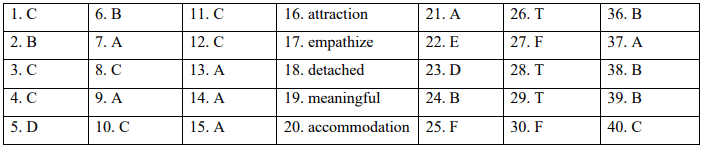
31. My sister is a TV binge watcher, so she watches soap opera every day.
32. This drama series have complex plots and inspiring characters.
33. She grew up on the farm with family.
34. He lent his new laptop to his sister, but she has not given it back yet.
35. I met Ha last night and I have not seen him since then.
HƯỚNG DẪN GIẢI CHI TIẾT
1. C
Kiến thức: Phát âm “a”
Giải thích:
A. talent /ˈtæl.ənt/
B. forecast /ˈfɔːrkæst/
C. opera /ˈɒp.ər.ə/
D. travel /ˈtræv.əl/
Phần được gạch chân ở phương án C được phát âm /ə/, các phương án còn lại phát âm /æ/.
Chọn C
2. B
Kiến thức: Phát âm “ur”, “ar”, “or”
Giải thích:
A. curtain /ˈkɜː.tən/
B. carpet /ˈkɑː.pɪt
C. work /wɜːk/
D. surf /sɜːf/
Phần được gạch chân ở phương án B được phát âm /ɑː/, các phương án còn lại phát âm /ɜː/.
Chọn B
3. C
Kiến thức: Trọng âm từ có 2 âm tiết
Giải thích:
A. charming /ˈtʃɑː.mɪŋ/
B. market /ˈmɑː.kɪt/
C. detached /dɪˈtætʃt/
D. terraced /ˈter.əst/
Phương án C có trọng âm 2, các phương án còn lại có trọng âm 1.
Chọn C
4. C
Kiến thức: Trọng âm từ có 3 âm tiết trở lên
Giải thích:
A. documentary /dɒk.jəˈmen.tər.i/
B. exhibition /ˌek.sɪˈbɪʃ.ən/
C. reality /riˈæl.ə.ti/
D. Vietnamese /ˌvjet.nəˈmiːz/
Phương án C có trọng âm 2, các phương án còn lại có trọng âm 3.
Chọn C
5. C
Kiến thức: Từ vựng
Giải thích:
A. documentaries (n): phim tài liệu
B. cooking programs (n): chương trình nấu ăn
C. talent shows (n): chương trình tài năng
D. soap operas (n): phim truyền hình dài tập
In my free time, I love watching soap operas because they have a lot of fascinating characters and wonderful plots.
(Trong thời gian rảnh rỗi, tôi thích xem phim truyền hình dài tập vì chúng có rất nhiều nhân vật hấp dẫn và cốt truyện tuyệt vời.)
Chọn D
6. B
Kiến thức: Từ vựng
Giải thích:
A. terraced house (n): nhà liền kề
B. bungalow (n): nhà gỗ
C. semi-detached house (n): nhà song lập
D. camper van (n): xe cắm trại
I like a bungalow because this type of house is all on the ground floor and doesn’t have stairs.
(Tôi thích một ngôi nhà gỗ vì loại nhà này đều ở tầng trệt và không có cầu thang.)
Chọn B
7. A
Kiến thức: Từ vựng
Giải thích:
Cấu trúc với động từ khuyết thiếu: can + Vo
donate (v): quyên góp
throw away (v): vứt bỏ
Students can donate old clothes to help the needy.
(Học sinh có thể quyên góp quần áo cũ để giúp đỡ người nghèo.)
Chọn A
8. C
Kiến thức: Từ vựng
Giải thích:
A. genre (n): thể loại
B. box office (n): phòng vé
C. movie theatre (n): rạp chiếu phim
D. science fiction (n): khoa học viễn tưởng
When the new movie about Spiderman came out, it dominated the movie theatre.
(Khi bộ phim mới về Người nhện ra mắt, nó đã thống trị rạp chiếu phim.)
Chọn C
9. A
Kiến thức: Thì hiện tại hoàn thành
Giải thích:
Dấu hiệu của thì hiện tại hoàn thành là “since 2006” (kể từ năm 2006) => Cấu trúc dạng khẳng định chủ ngữ số nhiều: S + have + V3/ed.
Nam’s parents have lived in that apartment since 2006.
(Bố mẹ Nam đã sống trong căn hộ đó từ năm 2006.)
Chọn A
10. C
Kiến thức: Từ vựng
Giải thích:
A. donate blood: hiến máu
B. lead nature tours: dẫn tour du lịch thiên nhiên
C. raise money: quyên góp tiền
D. collect rubbish: thu gom rác
The city council let the local charity raise money to help the orphanages every summer.
(Hội đồng thành phố để tổ chức từ thiện địa phương quyên góp tiền giúp đỡ các trại trẻ mồ côi vào mỗi mùa hè.)
Chọn C
11. C
Kiến thức: So sánh nhất của tính từ dài
Giải thích:
Công thức so sánh nhất của tính từ dài (famous): S + tobe + the most + adj
The Mona Lisa is the most famous painting in the world.
(Mona Lisa là bức tranh nổi tiếng nhất thế giới.)
Chọn C
12. C
Kiến thức: Thì hiện tại hoàn thành
Giải thích:
Trong câu có động từ chính là “has worked” ở thì hiện tại hoàn thành => Cần điền dấu hiệu là “for” hoặc “since”
since + mốc thời gian
for + khoảng thời gian
Ngoc has worked for a couch-surfing service for over 5 years.
(Ngọc đã làm việc cho một dịch vụ ở nhờ khi đi du lịch hơn 5 năm.)
Chọn C
13. A
Kiến thức: Từ vựng
Giải thích:
A. pick up rubbish: nhặt rác
B. rescue animals: giải cứu động vật
C. help the elderly: giúp đỡ người già
D. donate money: quyên góp tiền
We can pick up rubbish to help clean up the environment.
(Chúng ta có thể nhặt rác để góp phần làm sạch môi trường.)
Chọn A
14. A
Kiến thức: Từ vựng
Giải thích:
A. bookworm (n): người thích đọc sách
B. storyteller (n): người kể chuyện
C. TV viewer (n): người xem TV
D. binge watcher (n): người cày phim
She is a bookworm. She likes to read everywhere she goes.
(Cô ấy là một con mọt sách. Cô ấy thích đọc ở bất cứ đâu mà cô ấy đến.)
Chọn A
15. A
Kiến thức: Thì tương lai đơn
Giải thích:
Để đưa ra một lời đề nghị giúp đỡ trong lúc nói, ta dùng thì tương lai đơn: S + will + Vo.
Are you moving to a new house on Saturday? I will help you if you like.
(Bạn sẽ chuyển đến một ngôi nhà mới vào thứ Bảy hả? Tôi sẽ giúp bạn nếu bạn thích.)
Chọn A
16. attraction
Kiến thức: Từ vựng – từ loại
Giải thích:
Sau danh từ “tourist” cần một danh từ nữa để tạo thành cụm danh từ để bổ sung nghĩa cho tính từ là “popular”
attract (v): thu hút
attraction (n): sự thu hút => tourist attraction: điểm thu hút du khách
Halong Bay is probably the most popular tourist attraction in Vietnam.
(Vịnh Hạ Long có lẽ là điểm thu hút khách du lịch phổ biến nhất ở Việt Nam.)
Đáp án: attraction
17. empathize
Kiến thức: Từ vựng – từ loại
Giải thích:
Cấu trúc: learn how to + V (học cách để làm việc gì)
empathy (n): sự đồng cảm
emphathize (v): đồng cảm
Doing charity work is a great way for students to learn how to emphathize with others.
(Làm công việc từ thiện là một cách tuyệt vời để học sinh học cách đồng cảm với người khác.)
Đáp án: emphathize
18. detached
Kiến thức: Từ vựng – từ loại
Giải thích:
Sau mạo từ “a” và trước danh từ “house” cần dùng tính từ.
detach (v): tách ra
detached (adj): riêng biệt
The great thing about a detached house is that you don’t share any walls with anyone.
(Điều tuyệt vời về một ngôi nhà biệt lập là bạn không chia sẻ bất kỳ bức tường nào với bất kỳ ai.)
Đáp án: detached
19. meaningful
Kiến thức: Từ vựng – từ loại
Giải thích:
Sau mạo từ “a” và trước danh từ “activity” cần dùng tính từ.
mean (v): có nghĩa
meaningful (a): ý nghĩa
Donating blood to the hospital is a meaningful activity.
(Hiến máu cho bệnh viện là một hoạt động ý nghĩa.)
Đáp án: meaningful
20. accommodation
Kiến thức: Từ vựng – từ loại
Giải thích:
Trước động từ “is” cần một danh từ số ít để đóng vai trò chủ ngữ.
accommodate (v): chứa
accommodation (n): chỗ ở
Hotel accommodation is included in the price of the holiday.
(Chỗ ở khách sạn được bao gồm trong giá của kỳ nghỉ.)
Đáp án: accommodation
21. A
A. Most houses have different rooms for different activities.
(Hầu hết các ngôi nhà có các phòng khác nhau cho các hoạt động khác nhau.)
22. E
E. But a home is a house full of people with their favourite rooms.
(Nhưng một ngôi nhà là một ngôi nhà đầy những người có phòng yêu thích của họ.)
23. D
D. When I’m away from home, I usually feel homesick.
(Khi tôi xa nhà, tôi thường cảm thấy nhớ nhà.)
24. B
B. That’s what home means to me.
(Đó là ý nghĩa của nhà đối với tôi.)
Đoạn văn hoàn chỉnh:
In English, the words ‘house’ and ‘home’ do not have the same meaning. In towns and cities, a modern house is a building with four walls and a roof above it, often on a street with many other houses. (21) Most houses have different rooms for different activities. People can dine in the kitchen, sleep in the bedrooms, take a shower in the bathroom, and relax in the living room.
(22) But a home is a house full of people with their favourite rooms. For example, my favourite room is my bedroom. It has all my things in it so it’s not very spacious, but I really love it. My mum loves reading in the charming living room. Tom, the cat, lies under her feet by the hot fireplace. And my dad can cook pretty well so he’s usually in the kitchen.
(23) When I’m away from home, I usually feel homesick. Of course, I miss all my music, my games, and my books, but I also miss family routines. Our house is rather noisy in the mornings before work or school. Then, when I get back in the evening, Tom jumps on me with his dirty cat feet, and there is the fantastic smell of the food in the kitchen.
So, home is the people and animals who live in a house, and the objects in the rooms that are special to us. It’s the activities we do, our feelings, and the familiar surroundings. Home is also the community we are part of. Every summer, there’s a big party in our street. When new people move in, they have a housewarming party with all the neighbours. (24) That’s what home means to me.
Tạm dịch:
Trong tiếng Anh, từ ‘house’ và ‘home’ không có nghĩa giống nhau. Ở các thị trấn và thành phố, một ngôi nhà hiện đại là một tòa nhà có bốn bức tường và một mái nhà ở trên, thường nằm trên một con phố có nhiều ngôi nhà khác. Hầu hết các ngôi nhà đều có các phòng khác nhau cho các hoạt động khác nhau. Mọi người có thể dùng bữa trong bếp, ngủ trong phòng ngủ, tắm trong phòng tắm và thư giãn trong phòng khách.
Nhưng một ngôi nhà là một ngôi nhà đầy người với những căn phòng yêu thích của họ. Ví dụ, phòng yêu thích của tôi là phòng ngủ của tôi. Nó chứa tất cả những thứ của tôi trong đó nên nó không rộng rãi lắm, nhưng tôi thực sự thích nó. Mẹ tôi thích đọc sách trong phòng khách duyên dáng. Tom, con mèo, nằm dưới chân cô bên lò sưởi nóng. Và bố tôi có thể nấu ăn khá giỏi nên ông ấy thường ở trong bếp.
Khi tôi xa nhà, tôi thường cảm thấy nhớ nhà. Tất nhiên, tôi nhớ tất cả âm nhạc, trò chơi và sách của mình, nhưng tôi cũng nhớ những thói quen của gia đình. Nhà của chúng tôi khá ồn ào vào buổi sáng trước khi đi làm hoặc đi học. Sau đó, khi tôi trở về vào buổi tối, Tom nhảy lên người tôi bằng đôi chân mèo bẩn thỉu của nó, và mùi thức ăn thơm lừng trong bếp.
Vì vậy, nhà là những người và động vật sống trong một ngôi nhà, và những đồ vật trong những căn phòng đặc biệt đối với chúng ta. Đó là những hoạt động chúng ta làm, cảm xúc của chúng ta và môi trường xung quanh quen thuộc. Nhà cũng là cộng đồng mà chúng ta là một phần của. Mỗi mùa hè, có một bữa tiệc lớn trên đường phố của chúng tôi. Khi những người mới chuyển đến, họ có một bữa tiệc tân gia với tất cả những người hàng xóm. Đó là ý nghĩa của nhà đối với tôi.
25. F
Kiến thức: Đọc hiểu
Giải thích:
‘House’ and ‘home’ have the same meaning in English.
('House' và 'home' có cùng nghĩa trong tiếng Anh.)
Thông tin: In English, the words ‘house’ and ‘home’ do not have the same meaning.
(Trong tiếng Anh, từ ‘house’ và ‘home’ không có nghĩa giống nhau.)
Chọn F
26. T
Kiến thức: Đọc hiểu
Giải thích:
Trang’s family members have their favourite rooms.
(Các thành viên trong gia đình Trang có những căn phòng yêu thích của họ.)
Thông tin: But a home is a house full of people with their favourite rooms.
(Nhưng một ngôi nhà là một ngôi nhà đầy những người có phòng yêu thích của họ.)
Chọn T
27. F
Kiến thức: Đọc hiểu
Giải thích:
Trang’s family hasn’t got a pet.
(Gia đình Trang không nuôi thú cưng.)
Thông tin: Tom jumps on me with his dirty cat feet,
(Tom nhảy vào tôi với đôi chân mèo bẩn thỉu của anh ấy,)
Chọn F
28. T
Kiến thức: Đọc hiểu
Giải thích:
Trang misses family activities when she’s not at home.
(Trang nhớ các hoạt động gia đình khi cô ấy không ở nhà.)
Thông tin: When I’m away from home, I usually feel homesick.
(Khi tôi xa nhà, tôi thường cảm thấy nhớ nhà.)
Chọn T
29. T
Kiến thức: Đọc hiểu
Giải thích:
Trang thinks that home is the community that she belongs to.
(Trang cho rằng nhà là cộng đồng mà cô thuộc về.)
Thông tin: Home is also the community we are part of.
(Nhà cũng là cộng đồng mà chúng ta là một phần trong đó.)
Chọn T
30. F
Kiến thức: Đọc hiểu
Giải thích:
There’s a party in her street every year.
(Có một bữa tiệc trên đường phố của cô ấy hàng năm.)
Thông tin: Every summer, there’s a big party in our street.
(Mỗi mùa hè, có một bữa tiệc lớn trên đường phố của chúng tôi.)
Chọn F
31.
Kiến thức: Viết câu với thì hiện tại đơn
Giải thích:
Công thức khẳng định của thì hiện tại đơn:
Với động từ tobe: S (số ít) + is + a/an + N
Với động từ thường: she + Vs/es
so: vì vậy
Đáp án: My sister is a TV binge watcher, so she watches soap opera every day.
(Em gái tôi là một người thích cày phim, vì vậy em ấy xem phim truyền hình dài tập mỗi ngày.)
32.
Kiến thức: Viết câu với thì hiện tại đơn
Giải thích:
Chủ ngữ “this drama series” là chủ ngữ số nhiều => động từ “have” nguyên mẫu.
and: và
Đáp án: This drama series have complex plots and inspiring characters.
(Bộ phim truyền hình dài tập này có cốt truyện phức tạp và các nhân vật đầy cảm hứng.)
33.
Kiến thức: Viết câu với thì quá khứ đơn
Giải thích:
Công thức khẳng định của thì quá khứ đơn của động từ thường: S + V2/ed
Đáp án: She grew up on the farm with family.
(Cô lớn lên trong trang trại với gia đình.)
34.
Kiến thức: Viết câu với thì quá khứ đơn và hiện tại hoàn thành
Giải thích:
Công thức khẳng định của thì quá khứ đơn của động từ thường: S + V2/ed.
Trong câu có dấu hiệu của thì hiện tại hoàn thành “yet” (vẫn chưa) => Công thức phủ định đối với chủ ngữ số ít là: S + has + not + V3/ed + yet
but: nhưng
Đáp án: He lent his new laptop to his sister, but she has not given it back yet.
(Anh ấy cho chị gái mượn máy tính xách tay mới của mình, nhưng chị ấy vẫn chưa trả lại.)
35.
Kiến thức: Viết câu với thì quá khứ đơn và hiện tại hoàn thành
Giải thích:
Công thức khẳng định của thì quá khứ đơn của động từ thường (dấu hiệu nhận biết “last night”): S + V2/ed.
Trong câu có dấu hiệu của thì hiện tại hoàn thành “since than” (kể từ đó) => Công thức phủ định đối với chủ ngữ số nhiều là: I + have + not + V3/ed
Đáp án: I met Ha last night and I have not seen him since then.
(Tôi đã gặp Hà tối qua và tôi đã không gặp anh ấy kể từ đó.)
Transcipt:
Presenter: It’s two thirty on Saturday afternoon, and you’re listening to the Culture Program. In this part of the program, we invite a guest to talk about photography. This week, we have Annie Leibovitz. She is the most famous portrait photographer in the world. Welcome to the Culture Program.
Annie: Thank you.
Presenter: Annie, tell us about your job.
Annie: Well, I am a photographer. I have photographed famous actors, singers, Olympic champions and designers. When taking photos, I always make sure that my photographs tell an inspiring story. I also have another person to help me. She’s very good.
Presenter: Oh, does she have a name?
Annie: Yes, she’s Sarah Oliphant. She helps me create the backgrounds for my portraits. Her works have landscapes, paintings or small objects. She truly is an artist. We’ve worked together very well for almost 5 years now.
Presenter: Wow, that’s a long time. Do you plan to have a gallery of your photos?
Annie: Yes, I am going to open a gallery in June. It is about summer. Sarah and I have worked very hard on it for 3 months. I hope everyone can come to see it.
Tạm dịch:
Người dẫn chương trình: Bây giờ là hai giờ ba mươi chiều Thứ Bảy, và bạn đang nghe Chương trình Văn hóa. Trong phần này của chương trình, chúng tôi mời một khách mời nói chuyện về nhiếp ảnh. Tuần này, chúng ta có Annie Leibovitz. Cô là nhiếp ảnh gia chân dung nổi tiếng nhất thế giới. Chào mừng đến với Chương trình Văn hóa.
Annie: Cảm ơn bạn.
Người trình bày: Annie, hãy cho chúng tôi biết về công việc của bạn.
Annie: À, tôi là một nhiếp ảnh gia. Tôi đã chụp ảnh các diễn viên, ca sĩ, nhà vô địch Olympic và nhà thiết kế nổi tiếng. Khi chụp ảnh, tôi luôn đảm bảo rằng những bức ảnh của mình sẽ kể một câu chuyện đầy cảm hứng. Tôi cũng có một người khác để giúp tôi. Cô ấy rất tốt.
Người dẫn chương trình: Ồ, cô ấy có tên không?
Annie: Vâng, cô ấy là Sarah Oliphant. Cô ấy giúp tôi tạo nền cho các bức chân dung của mình. Các tác phẩm của cô có phong cảnh, tranh vẽ hoặc đồ vật nhỏ. Cô ấy thực sự là một nghệ sĩ. Chúng tôi đã làm việc cùng nhau rất tốt trong gần 5 năm nay.
Người dẫn chương trình: Chà, đó là một thời gian dài. Bạn có kế hoạch để có một bộ sưu tập các bức ảnh của bạn?
Annie: Vâng, tôi sẽ mở một phòng trưng bày vào tháng Sáu. Đó là về mùa hè. Sarah và tôi đã làm việc rất chăm chỉ trong 3 tháng. Tôi hy vọng mọi người có thể đến xem nó.
36. B
Kiến thức: Nghe hiểu
Giải thích:
Annie Leibovitz là ai?
A. một nghệ sĩ khách mời
B. một nhiếp ảnh gia nổi tiếng
C. một lập trình viên
Thông tin: She is the most famous portrait photographer in the world.
(Cô là nhiếp ảnh gia chân dung nổi tiếng nhất thế giới.)
Chọn B
37. A
Kiến thức: Nghe hiểu
Giải thích:
Annie luôn làm gì khi chụp ảnh?
A. Cô đảm bảo rằng họ kể một câu chuyện.
B. Cô ấy chụp ảnh các diễn viên và nhà vô địch.
C. Cô ấy tạo nền cho những bức chân dung của mình.
Thông tin: I always make sure that my photographs tell an inspiring story.
(Tôi luôn đảm bảo rằng những bức ảnh của mình kể một câu chuyện đầy cảm hứng.)
Chọn A
38. B
Kiến thức: Nghe hiểu
Giải thích:
Công việc của Sarah bao gồm những gì?
A. phong cảnh và những vật thể khổng lồ
B. tranh và đồ vật nhỏ
C. tranh và chân dung
Thông tin: Her works have landscapes, paintings or small objects.
(Các tác phẩm của cô có phong cảnh, tranh vẽ hoặc đồ vật nhỏ.)
Chọn B
39. B
Kiến thức: Nghe hiểu
Giải thích:
Phòng trưng bày của Annie sẽ về
A. tháng sáu
B. mùa hè
C. Sarah và cô ấy
Thông tin: It is about summer
(Đó là về mùa hè)
Chọn B
40. C
Kiến thức: Nghe hiểu
Giải thích:
Annie và Sarah đã làm việc trên phòng trưng bày của họ được bao lâu rồi?
A. 5 năm
B. kể từ tháng 6
C. 3 tháng
Thông tin: Sarah and I have worked very hard on it for 3 months.
(Sarah và tôi đã làm việc rất chăm chỉ trong 3 tháng.)
Chọn C
Đề thi học kì 1 Tiếng Anh 10 Global Success - Đề số 9
Đề bài
I. LANGUAGE
Find the word which has a different sound in the part underlined.
1.
A. wheat
B. heat
C. heavily
D. lead
2.
A. good
B. flood
C. foot
D. food
3.
A. farmer
B. father
C. fat
D. far
Choose the word which has a different stress pattern from the others.
4.
A. dictionary
B. umbrella
C. computer
D. community
5.
A. addition
B. remember
C. different
D. supposing
Choose the best one (A, B, C or D) to complete the sentence or replace the underlined word.
6. Farmers have worked hard on their rice crops. If they _______ to work hard, they ________ good crops.
A. continued - would have
B. continued - had
C. continue - will have
D. continue - have
7. Women are more likely to be victims of ________ violence.
A. home
B. family
C. domestic
D. household
8. It is believed that in India, when there is death in the family, the family members don't attend any marriages and do not ________ any festivals for a year.
A. take part
B. celebrate
C. like
D. perform
9. Without conservation, human beings ________ survive for a long time.
A. wouldn't
B. will
C. won't
D. would
10. International Women's Day is an occasion to make more ________ towards achieving gender equality.
A. progress
B. improvement
C. movement
D. development
11. For years, tablets have enriched our lives at work and at home, allowing us to stay ____ and access information with ease.
A. connecting
B. connected
C. connect
D. connection
12. Viet Nam has abundant mineral water sources, ____ throughout the country.
A. be found
B. finding
C. find
D. found
13. Some private companies in China try to avoid employing women of child bearing ____ and sometimes sack them once they are going to have a baby.
A. years
B. time
C. old
D. age
14. I don't feel very well this morning. I've got _______ sore throat.
A. a
B. an
C. the
D. x
15. The ________ mangrove forest is home to a variety of wildlife.
A. flooded
B. flood
C. flooding
D. floods
IV. Mark the letter A, B, C, or D to indicate the underlined part that needs correction in each of the following questions.
16. If someone came into the store, smile and say, “May I help you?"
A. If
B. came
C. smile
D. May
17. The deplete of the ozone layer is not a good thing for the Earth.
A. deplete
B. is
C. a
D. for
18. Every student who majors in English are ready to participate in this contest.
A. who
B. are
C. to participate
D. in
Mark the letter A, B, C, or D to indicate the correct response to each of the following exchanges.
19. Lan: "Do you always like to go to the same place for your holiday?” - Nam: “____”
A. It is strange that some people go to the same place again and again.
B. I don't think so. I always like to experience different places.
C. Preference for certain places is still common among a number of tourists.
D. Different places have different attractions.
20. "Why don't we have a look at some websites for more information about the environment?" – “____”
A. Yes, thanks.
B. Yes, why not?
C. It's my pleasure.
D. Do we?
II. READING
Read the passage below and decide which answer A, B, C or D fits each numbered gap.
There are many ways that can help the environment, and even the smallest step can have significant results.
The environmental problem of landfills is a difficult issue to fix. As more waste is put into landfills, the bigger the problem gets. Wastes that are not biodegradable or are slow to decompose can (21) __________ in landfill sites for centuries, often emitting gases that could be harmful to the environment. Keeping paper out of landfills is just one way that recycling helps the environment.
Recycling items often uses less energy than manufacturing products from natural sources. Making paper that is using recycled pulp, (22) ________, is much less energy intensive than using new wood. While there are benefits to growing trees because of the carbon dioxide that they consume, it will be the damage (23) _________ is done to the environment by putting paper in landfills and using energy to produce new items.
Waste in landfills emit gases as it rots. This can pollute the environment. Anyone who has passed a landfill site during hot weather will be familiar with the unpleasant smell and flies that can be found near a landfill site. Reducing the items in landfills will help to (24) _________ the pollution that it causes. Recycling wastes also typically emits less carbon dioxide and carbon monoxide, thus reducing the carbon footprint of a product.
Another benefit of recycling is that there is often a significant cost saving to be made when using recycle goods. Recycling leaves and grass, for instance, is a great way to make compost. (25) _________ homemade compost is obviously a lot cheaper than buying compost and this is a useful way to save money. Saving money through recycling ultimately helps the environment.
Recycling is just one of many ways that we can help the environment. Every step that we take, however small, is one more towards helping and supporting the environment in which we live. Getting everyone involved, from children to adults, can help produce a better environment for many generations to come.
21.
A. remain
B. effect
C. cause
D. attack
22.
A. so
B. but
C. although
D. for instance
23.
A. who
B. which
C. that
D. what
24.
A. last
B. reduce
C. increase
D. stretch
25.
A. Using
B. Recycled
C. Concluded
D. Made
Read the passage, and choose the correct answer A, B, C or D for each question.
A Franklin electronic dictionary is actually a helpful gadget to possess with you all of the time. Any device involving dictionaries is great to use for people who go on out of their country on business trips. Tourists would also benefit very much from such a device.
Moreover, students will also find this gadget helpful especially whenever they are studying an important foreign language in another country. There is also a great diversity of dictionaries that anybody can choose whichever works to them best.
These dictionaries are also quite easy to use and incorporate various functions. Some of them are main functions, besides translating a foreign word, which would be to provide spelling check-ups, find the meaning and synonyms connected with any particular word as well as provide examples of how a word is used in a sentence. A typical Franklin electronic dictionary is more than that. By entering the meaning of a word of mouth, you would have the ability to pull up many words that you are researching for.
These is a comprehensive database that comprises about 1,000,000 words and phrase replacements. It also comes with idiomatic expressions, professional medical, technical words or ones very popular for business. It is also ideal for professionals who have to work in a country accompanied by a different language.
Franklin Electronic Marketers have been among the leading manufactures regarding handheld electronic inventions. Its main office is situated in Burlington, New Jersey and has been around the business of creating these electronic tools since 1981.
Some of the original devices that they produced included punctuation correctors, of the fact that first was all the Spelling Ace built in 1986. These devices were a great aid to students all over the globe.
The company continues to service clients from everywhere. Although they are popular in the world, especially targeting the particular Hispanic market whose native language is Spanish; Franklin's products are also quite well-known for Asia, particularly Japan. The company aims to address this growing importance of language tools as more people are aiming to learn about new languages.
26. The word “professionals” in paragraph 4 is closest in meaning to __________.
A. people who often use modern electronic dictionaries
B. people with a high level of education and training
C. people who are very good at languages
D. people who work in foreign countries
27. The electronic dictionary has various functions because it can ___________.
A. expand a wide range to suit various people's preferences
B. enter the meaning of a word of mouth and get so many words related
C. translate foreign words, check spelling, give meanings and synonyms, and the use of them
D. explain how a word is employed in a sentence and correct punctuation in sentences
28. The database of the dictionary includes all the following EXCEPT __________.
A. professional medical, technical words
B. technical terms in various fields and internet lingo
C. idiomatic expressions or ones very popular for business
D. about 1,000,000 words and word and phrase replacements
29. With the diversity of dictionaries, we can choose _________.
A. the one that is portable
B. the one that suits us best
C. the one that is handy and cheap
D. the one that has the largest vocabulary
30. The Franklin electronic dictionary are very popular all over the world, especially in __________.
A. Burlington, New Jersey
C. Europe and Asia
B. Japan
D. South America and Asia
III. WRITING
Rewrite the sentences without changing the meaning of the first ones.
31. He sits around too much. He isn’t fit.
=> If he ________________________________________.
32. “If catch the plane I’ll be home by four o’clock” she said.
=> She told me __________________________________.
33. “Do you know the girl over there?" Tom said.
=> Tom asked ___________________________________.
34. A boy s bike was taken. He went to the police station. (whose)
=> The boy _____________________________________.
35. Mount Everest is higher than every mountain in the world. (high)
=> ____________________________________________.
IV. LISTENING
Listen and answer the following questions.
36. Why couldn't Ba Duc attract more tourists to his old house before 2000?
37. How many tourists now visit his garden every day?
38. When did Tu Binh start ecotourism activities to attract visitors?
39. What do tourists do with the small fish they catch in Tu Binh's fishpond?
40. How many tourists now visit his farm every day?
-----------------THE END-----------------
Xem đáp án
HƯỚNG DẪN GIẢI
Thực hiện: Ban chuyên môn trithuchub.com
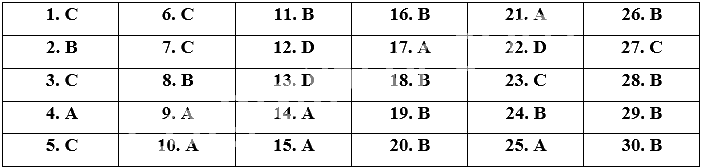
31. If he didn’t sit around too much, he would be fit.
32. She said if she caught the plane, she would be home by four o'clock.
33. Tom asked me if I knew the girl over there.
34. The boy whose bike was taken went to the police station.
35. Mount Everest is the highest mountain in the world.
36. Tourists did not have many interesting activities to do.
37. Around 100 tourists.
38. In 2005.
39. They released small fish back into the pond.
40. Around 300 visitors.
HƯỚNG DẪN GIẢI CHI TIẾT
1. C
Kiến thức: Phát âm “ea”
Giải thích:
A. wheat /wiːt/
B. heat /hiːt/
C. heavily /ˈhev.əl.i/
D. lead /liːd/
Phần được gạch chân ở phương án C được phát âm /e/, các phương án còn lại phát âm /i:/.
Chọn C
2. B
Kiến thức: Phát âm “oo”
Giải thích:
A. good /ɡʊd/
B. flood /flʌd/
C. foot /fʊt/
D. food /fuːd/
Phần được gạch chân ở phương án B được phát âm /ʌ /, các phương án còn lại phát âm /ʊ/.
Chọn B
3. C
Kiến thức: Phát âm “a”
Giải thích:
A. farmer /ˈfɑː.mər/
B. father /ˈfɑː.ðər/
C. fat /fæt/
D. far /fɑːr/
Phần được gạch chân ở phương án C được phát âm /æ/, các phương án còn lại phát âm /ɑː/.
Chọn C
4. A
Kiến thức: Trọng âm
Giải thích:
A. dictionary /ˈdɪk.ʃən.ər.i/
B. umbrella /ʌmˈbrel.ə/
C. computer /kəmˈpjuː.tər/
D. community /kəˈmjuː.nə.ti/
Phương án A có trọng âm 1, các phương án còn lại có trọng âm 2.
Chọn A
5. C
Kiến thức: Trọng âm
Giải thích:
A. addition /əˈdɪʃ.ən/
B. remember /rɪˈmem.bər/
C. different /ˈdɪf.ər.ənt/
D. supposing /səˈpəʊz/
Phương án C có trọng âm 1, các phương án còn lại có trọng âm 2.
Chọn C
6. C
Kiến thức: Câu điều kiện loại 1
Giải thích:
- Câu điều kiện loại 1 diễn tả một việc hiển nhiên, nguyên nhân – kết quả.
- Cấu trúc câu điều kiện loại 1: If + S + V(s/es), S + will / can + Vo (nguyên thể).
Farmers have worked hard on their rice crops. If they continue to work hard, they will have good crops.
(Nông dân đã làm việc chăm chỉ trên vụ lúa của họ. Nếu họ tiếp tục làm việc chăm chỉ, họ sẽ có mùa màng bội thu.)
Chọn C
7. C
Kiến thức: Từ vựng
Giải thích:
A. home (n): nhà
B. family (n): gia đình
C. domestic (n): trong nhà
D. household (n): hộ gia đình
Women are more likely to be victims of domestic violence.
(Phụ nữ có nhiều khả năng trở thành nạn nhân của bạo lực gia đình.)
Chọn C
8. B
Kiến thức: Từ vựng
Giải thích:
A. take part (v): tham gia
B. celebrate (v): tổ chức
C. like (v): thích
D. perform (v): biểu diễn
It is believed that in India, when there is death in the family, the family members don't attend any marriages and do not celebrate any festivals for a year.
(Người ta tin rằng ở Ấn Độ, khi có người chết trong gia đình, các thành viên trong gia đình không tham dự bất kỳ đám cưới nào và không tổ chức bất kỳ lễ hội nào trong một năm.)
Chọn B
9. A
Kiến thức: Câu điều kiện loại 2
Giải thích:
Without = If + Not: nếu không có
- Câu điều kiện loại 2 diễn tả một việc không có thật ở hiện tại.
- Cấu trúc câu điều kiện loại 2: If + S + V2/ed, S + would/ could + Vo (nguyên thể).
Without conservation, human beings wouldn’t survive for a long time.
(Nếu không bảo tồn, con người sẽ không tồn tại trong một thời gian dài.)
Chọn A
10. A
Kiến thức: Từ vựng
Giải thích:
A. progress (n): tiến bộ
B. improvement (n): cải thiện
C. movement (n): di chuyển
D. development (n): phát triển
Cụm từ “make progress”: tiến bộ
International Women's Day is an occasion to make more progress towards achieving gender equality.
(Ngày Quốc tế Phụ nữ là dịp để đạt được nhiều tiến bộ hơn nhằm đạt được bình đẳng giới.)
Chọn A
11. B
Kiến thức: Dạng động từ
Giải thích:
connect (v): kết nối
Cụm động từ “stay connected”: giữ kết nối
For years, tablets have enriched our lives at work and at home, allowing us to stay connected and access information with ease.
(Trong nhiều năm, máy tính bảng đã làm phong phú thêm cuộc sống của chúng ta tại nơi làm việc và ở nhà, cho phép chúng ta duy trì kết nối và truy cập thông tin một cách dễ dàng.)
Chọn B
12. D
Kiến thức: Dạng động từ
Giải thích:
Rút gọn động từ thành V-ing khi mang nghĩa chủ động.
Rút gọn động từ thành V3/ed khi mang nghĩa bị động.
Dựa vào nghĩa của câu, ta rút động từ “find” (tìm thấy) thành dạng V3/ed.
find – found – found (v): tìm thấy
Viet Nam has abundant mineral water sources, found throughout the country.
(Việt Nam có nguồn nước khoáng phong phú, được tìm thấy trên khắp cả nước.)
Chọn D
13. D
Kiến thức: Từ vựng
Giải thích:
A. years (n): năm
B. time (n): lần
C. old (adj): già
D. age (n): tuổi
Some private companies in China try to avoid employing women of childbearing age and sometimes sack them once they are going to have a baby.
(Một số công ty tư nhân ở Trung Quốc cố gắng tránh tuyển dụng phụ nữ trong độ tuổi sinh đẻ và đôi khi sa thải họ khi họ sắp có con.)
Chọn D
14. A
Kiến thức: Mạo từ
Giải thích:
Mạo từ “a” đứng trước một danh từ đếm được số ít bằng đầu bằng phụ âm và chưa xác định cụ thể chính xác đối tượng hoặc đối tượng được nhắc đến lần đầu tiên.
sore throat: đau họng => đối tượng nhắc đến lần đầu và không cụ thể => dùng “a”
I don't feel very well this morning. I've got a sore throat.
(Tôi không cảm thấy rất tốt sáng nay. Tôi đã bị đau họng.)
Chọn A
15. A
Kiến thức: Dạng động từ
Giải thích:
Rút gọn động từ thành V-ing khi mang nghĩa chủ động.
Rút gọn động từ thành V3/ed khi mang nghĩa bị động.
Dựa vào nghĩa của câu, ta rút động từ “flood” (ngập lụt) thành dạng V3/ed.
flood – flooded – flooded (v): ngập lụt
The flooded mangrove forest is home to a variety of wildlife.
(Rừng ngập mặn ngập nước là nơi sinh sống của nhiều loại động vật hoang dã.)
Chọn A
16. B
Kiến thức: Sửa lỗi sai
Giải thích:
Câu điều kiện loại 1 dùng để diễn tả một sự việc, hiện tượng có thể xảy ra trong hiện tại hoặc tương lai.
Cấu trúc câu điều kiện loại 1: If + S + V(s/es), S + will/can + Vo (nguyên thể)
came (v2) => comes (thì hiện tại đơn chủ ngữ số ít)
If someone comes into the store, smile and say, “May I help you?"
(Nếu ai đó bước vào cửa hàng, hãy mỉm cười và nói: “Tôi có thể giúp gì cho bạn?”)
Chọn B
17. A
Kiến thức: Sửa lỗi sai
Giải thích:
Sau mạo từ “the” cần một danh từ.
Động từ tobe đang chia “is” nên phải là danh từ số ít.
deplete (v): suy giảm => depletion (n): sự suy giảm
The depletion of the ozone layer is not a good thing for the Earth.
(Sự suy giảm tầng ozon không phải là điều tốt cho Trái đất.)
Chọn A
18. B
Kiến thức: Sửa lỗi sai
Giải thích:
Thì hiện tại đơn chủ ngữ số ít là “every student” (mỗi học sinh) thì động từ tobe phải là “is”.
are => is
Every student who majors in English is ready to participate in this contest.
(Mọi sinh viên chuyên ngành tiếng Anh đều sẵn sàng tham gia cuộc thi này.)
Chọn B
19. B
Kiến thức: Chức năng giao tiếp
Giải thích:
A. It is strange that some people go to the same place again and again.
(Thật kỳ lạ khi một số người cứ lặp đi lặp lại cùng một địa điểm.)
B. I don't think so. I always like to experience different places.
(Tôi không nghĩ vậy. Tôi luôn thích trải nghiệm những nơi khác nhau.)
C. Preference for certain places is still common among a number of tourists.
D. Different places have different attractions.
(Sở thích cho một số địa điểm vẫn còn phổ biến đối với một số khách du lịch.)
Lan: "Do you always like to go to the same place for your holiday?” - Nam: “I don't think so. I always like to experience different places.”
(Lan: “Bạn có luôn thích đi đến cùng một nơi cho kỳ nghỉ của mình không?” - Nam: "Tôi không nghĩ vậy. Tôi luôn thích trải nghiệm những nơi khác nhau.")
Chọn B
20. B
Kiến thức: Chức năng giao tiếp
Giải thích:
A. Yes, thanks.
(Vâng, cảm ơn.)
B. Yes, why not?
(Ừ, tại sao không?)
C. It's my pleasure.
(Đó là vinh hạnh của tôi.)
D. Do we?
(Thật hả?)
"Why don't we have a look at some websites for more information about the environment?" – “Yes, why not?”
("Tại sao chúng ta không xem một số trang web để biết thêm thông tin về môi trường?" – “Ừ, tại sao không?”)
Chọn B
21. A
Kiến thức: Từ vựng
Giải thích:
A. remain (v): tồn đọng
B. effect (n): ảnh hưởng
C. cause (v): gây ra
D. attack (v): tấn công
Wastes that are not biodegradable or are slow to decompose can remain in landfill sites for centuries,
(Chất thải không thể phân hủy sinh học hoặc phân hủy chậm có thể tồn tại trong các bãi chôn lấp trong nhiều thế kỷ,)
Chọn A
22. D
Kiến thức: Từ vựng
Giải thích:
A. so: vì vậy
B. but: nhưng
C. although: mặc dù
D. for instance: ví dụ
Making paper that is using recycled pulp, for instance, is much less energy intensive than using new wood.
(Chẳng hạn, sản xuất giấy sử dụng bột giấy tái chế sẽ tốn ít năng lượng hơn nhiều so với sử dụng gỗ mới.)
Chọn D
23. C
Kiến thức: Đại từ quan hệ
Giải thích:
A. who : người mà
B. which: cái mà
C. that: điều mà
D. what: cái gì
While there are benefits to growing trees because of the carbon dioxide that they consume, it will be the damage that is done to the environment by putting paper in landfills and using energy to produce new items.
(Mặc dù việc trồng cây mang lại những lợi ích do lượng khí carbon dioxide mà chúng tiêu thụ, nhưng đó sẽ là tác hại đối với môi trường do đưa giấy vào bãi chôn lấp và sử dụng năng lượng để sản xuất các mặt hàng mới.)
Chọn C
24. B
Kiến thức: Từ vựng
Giải thích:
A. last (v): kéo dài
B. reduce (v): cắt giảm
C. increase (v): tăng
D. stretch (v): làm căng
Reducing the items in landfills will help to reduce the pollution that it causes.
(Giảm các vật dụng trong bãi chôn lấp sẽ giúp giảm ô nhiễm mà nó gây ra.)
Chọn B
25. A
Kiến thức: Từ vựng
Giải thích:
A. Using (v): sử dụng
B. Recycled (v): tái chế
C. Concluded (v): kết luận
D. Made (v): làm
Using homemade compost is obviously a lot cheaper than buying compost and this is a useful way to save money.
(Sử dụng phân trộn tự chế rõ ràng là rẻ hơn rất nhiều so với mua phân hữu cơ và đây là một cách hữu ích để tiết kiệm tiền.)
Chọn A
Bài đọc hoàn chỉnh:
There are many ways that can help the environment, and even the smallest step can have significant results.
The environmental problem of landfills is a difficult issue to fix. As more waste is put into landfills, the bigger the problem gets. Wastes that are not biodegradable or are slow to decompose can (21) remain in landfill sites for centuries, often emitting gases that could be harmful to the environment. Keeping paper out of landfills is just one way that recycling helps the environment.
Recycling items often uses less energy than manufacturing products from natural sources. Making paper that is using recycled pulp, (22) for instance, is much less energy intensive than using new wood. While there are benefits to growing trees because of the carbon dioxide that they consume, it will be the damage (23) that is done to the environment by putting paper in landfills and using energy to produce new items.
Waste in landfills emit gases as it rots. This can pollute the environment. Anyone who has passed a landfill site during hot weather will be familiar with the unpleasant smell and flies that can be found near a landfill site. Reducing the items in landfills will help to (24) reduce the pollution that it causes. Recycling wastes also typically emits less carbon dioxide and carbon monoxide, thus reducing the carbon footprint of a product.
Another benefit of recycling is that there is often a significant cost saving to be made when using recycle goods. Recycling leaves and grass, for instance, is a great way to make compost. (25) Using homemade compost is obviously a lot cheaper than buying compost and this is a useful way to save money. Saving money through recycling ultimately helps the environment.
Recycling is just one of many ways that we can help the environment. Every step that we take, however small, is one more towards helping and supporting the environment in which we live. Getting everyone involved, from children to adults, can help produce a better environment for many generations to come.
Tạm dịch:
Có nhiều cách có thể giúp ích cho môi trường và ngay cả bước nhỏ nhất cũng có thể mang lại kết quả đáng kể.
Vấn đề môi trường của các bãi chôn lấp là một vấn đề khó khắc phục. Càng nhiều chất thải được đưa vào bãi chôn lấp, vấn đề càng lớn. Chất thải không phân hủy sinh học hoặc chậm phân hủy có thể (21) tồn tại ở các bãi chôn lấp trong nhiều thế kỷ, thường thải ra các loại khí có thể gây hại cho môi trường. Giữ giấy không bị chôn lấp chỉ là một cách tái chế giúp ích cho môi trường.
Các mặt hàng tái chế thường sử dụng ít năng lượng hơn so với các sản phẩm sản xuất từ các nguồn tự nhiên. (22) Chẳng hạn, sản xuất giấy sử dụng bột giấy tái chế ít tốn năng lượng hơn nhiều so với sử dụng gỗ mới. Mặc dù có những lợi ích khi trồng cây vì lượng khí carbon dioxide mà chúng tiêu thụ, nhưng đó sẽ là thiệt hại (23) mà được gây ra cho môi trường bằng cách đưa giấy vào bãi chôn lấp và sử dụng năng lượng để sản xuất các mặt hàng mới.
Chất thải trong các bãi chôn lấp phát ra khí khi nó thối rữa. Điều này có thể gây ô nhiễm môi trường. Bất cứ ai đã từng đi qua bãi rác trong thời tiết nóng bức sẽ quen với mùi khó chịu và ruồi có thể được tìm thấy gần bãi rác. Giảm các mặt hàng trong bãi chôn lấp sẽ giúp (24) giảm ô nhiễm mà nó gây ra. Chất thải tái chế cũng thường thải ra ít carbon dioxide và carbon monoxide hơn, do đó làm giảm lượng khí thải carbon của sản phẩm.
Một lợi ích khác của việc tái chế là thường tiết kiệm được một khoản chi phí đáng kể khi sử dụng hàng tái chế. Ví dụ, tái chế lá và cỏ là một cách tuyệt vời để làm phân hữu cơ. (25) Sử dụng phân trộn tự chế rõ ràng là rẻ hơn rất nhiều so với mua phân trộn và đây là một cách hữu ích để tiết kiệm tiền. Tiết kiệm tiền thông qua tái chế cuối cùng sẽ giúp ích cho môi trường.
Tái chế chỉ là một trong nhiều cách mà chúng ta có thể giúp ích cho môi trường. Mỗi bước chúng ta thực hiện, dù nhỏ, là thêm một bước hướng tới việc giúp đỡ và hỗ trợ môi trường chúng ta đang sống. Thu hút mọi người tham gia, từ trẻ em đến người lớn, có thể giúp tạo ra một môi trường tốt hơn cho nhiều thế hệ mai sau.
26. B
Kiến thức: Đọc hiểu
Giải thích:
Từ “professionals” trong đoạn 4 gần nghĩa nhất với __________.
A. những người thường sử dụng từ điển điện tử hiện đại
B. những người có trình độ học vấn và đào tạo cao
C. những người rất giỏi ngôn ngữ
D. những người làm
professionals (n): các chuyên gia
Thông tin: It is also ideal for professionals who have to work in a country accompanied by a different language.
(Nó cũng lý tưởng cho các chuyên gia phải làm việc ở một quốc gia kèm theo một ngôn ngữ khác.)
Chọn B
27. C
Kiến thức: Đọc hiểu
Giải thích:
Từ điển điện tử có nhiều chức năng khác nhau vì nó có thể ___________.
A. mở rộng phạm vi rộng để phù hợp với sở thích của nhiều người
B. nhập nghĩa của một từ truyền miệng và nhận được rất nhiều từ liên quan
C. dịch từ nước ngoài, kiểm tra chính tả, đưa ra nghĩa và từ đồng nghĩa, và cách sử dụng chúng
D. giải thích cách một từ được sử dụng trong câu và chấm câu đúng trong câu
Thông tin: Some of them are main functions, besides translating a foreign word, which would be to provide spelling check-ups, find the meaning and synonyms connected with any particular word as well as provide examples of how a word is used in a sentence.
(Một số trong số chúng là các chức năng chính, bên cạnh việc dịch một từ nước ngoài, sẽ cung cấp tính năng kiểm tra chính tả, tìm nghĩa và từ đồng nghĩa được kết nối với bất kỳ từ cụ thể nào cũng như cung cấp các ví dụ về cách một từ được sử dụng trong câu.)
Chọn C
28. B
Kiến thức: Đọc hiểu
Giải thích:
Cơ sở dữ liệu của từ điển bao gồm tất cả những thứ sau NGOẠI TRỪ __________.
A. y tế chuyên nghiệp, từ kỹ thuật
B. thuật ngữ kỹ thuật trong các lĩnh vực khác nhau và biệt ngữ internet
C. thành ngữ hoặc những người rất phổ biến cho kinh doanh
D. khoảng 1.000.000 từ và từ, cụm từ thay thế
Thông tin: There is a comprehensive database that comprises about 1,000,000 words and phrase replacements. It also comes with idiomatic expressions, professional medical, technical words or ones very popular for business.
(Đây là một cơ sở dữ liệu toàn diện bao gồm khoảng 1.000.000 từ và cụm từ thay thế. Nó cũng đi kèm với các thành ngữ, y tế chuyên nghiệp, từ kỹ thuật hoặc những từ rất phổ biến cho doanh nghiệp)
=> Không đề cập đến thông tin ở câu B
Chọn B
29. B
Kiến thức: Đọc hiểu
Giải thích:
Với sự đa dạng của từ điển, chúng ta có thể chọn _________.
A. cái có thể mang theo
B. cái phù hợp với chúng ta nhất
C. cái tiện dụng và rẻ tiền
D. cái có từ vựng lớn nhất
Thông tin: There is also a great diversity of dictionaries that anybody can choose whichever works to them best.
(Ngoài ra còn có rất nhiều loại từ điển mà bất kỳ ai cũng có thể chọn từ nào phù hợp nhất với mình.)
Chọn B
30. D
Kiến thức: Đọc hiểu
Giải thích:
Từ điển điện tử Franklin rất phổ biến trên toàn thế giới, đặc biệt là ở __________.
A. Burlington, New Jersey
B. Nhật Bản
C. Châu Âu và Châu Á
D. Nam Mỹ và Châu Á
Thông tin: Franklin's products are also quite well-known for Asia, particularly Japan.
(Các sản phẩm của Franklin cũng khá nổi tiếng ở Châu Á, đặc biệt là Nhật Bản.)
Chọn D
31.
Kiến thức: Câu điều kiện loại 2
Giải thích:
- Câu điều kiện loại 2 diễn tả một việc không có thật ở hiện tại.
- Cấu trúc câu điều kiện loại 2: If + S + V2/ed, S + would/ could + Vo (nguyên thể).
He sits around too much. He isn’t fit.
(Anh ấy ngồi một chỗ quá nhiều. Anh ấy không cân đối.)
Đáp án: If he didn’t sit around too much, he would be fit.
(Nếu anh ấy không ngồi một chỗ quá nhiều, anh ấy sẽ cân đối.)
32.
Kiến thức: Câu tường thuật
Giải thích:
Công thức câu tường thuật dạng kể với động từ tường thuật “told” (nói): S + told + O + S + V (lùi thì).
Quy tắc lùi thì: thì hiện tại đơn => thì quá khứ đơn
+ catch – caught (v): bắt
+ will – would: sẽ
“If catch the plane I’ll be home by four o’clock” she said.
(“Nếu bắt máy bay, tôi sẽ về nhà lúc bốn giờ,” cô ấy nói.)
Đáp án: She said if she caught the plane, she would be home by four o'clock.
(Cô ấy nói nếu cô ấy bắt máy bay, cô ấy sẽ về nhà lúc 4 giờ.)
33.
Kiến thức: Câu tường thuật
Giải thích:
Công thức câu tường thuật dạng câu hỏi Yes/No với động từ tường thuật “asked” (hỏi): S + asked + O + IF + S + V (lùi thì).
Quy tắc lùi thì: thì hiện tại đơn: “know” (v) => thì quá khứ đơn “knew”
“Do you know the girl over there?" Tom said.
(“Anh có biết cô gái đằng kia không?” Tom nói.)
Đáp án: Tom asked me if I knew the girl over there.
(Tom hỏi tôi có biết cô gái đằng kia không.)
34.
Kiến thức: Mệnh đề quan hệ
Giải thích:
Danh từ chỉ người “he” (anh ấy) ở câu thứ hai thay thế cho tính từ sở hữu “a boy’s” (của cậu bé) ở câu đầu tiên => dùng “whose” (của)
A boy’s bike was taken. He went to the police station.
(Xe đạp của một cậu bé đã bị lấy mất. Anh đến đồn cảnh sát.)
Đáp án: The boy whose bike was taken went to the police station.
(Cậu bé bị lấy xe đạp đã đến đồn cảnh sát.)
35.
Kiến thức: So sánh nhất
Giải thích:
Công thức so sánh nhất với tính từ ngắn chủ ngữ số ít ở thì hiện tại đơn dạng khẳng định: S + is + the + tính từ ngắn + est + danh từ số ít.
Mount Everest is higher than every mountain in the world.
(Đỉnh Everest cao hơn mọi ngọn núi trên thế giới.)
Đáp án: Mount Everest is the highest mountain in the world.
(Đỉnh Everest là ngọn núi cao nhất thế giới.)
36.
Kiến thức: Nghe hiểu
Giải thích:
Why couldn't Ba Duc attract more tourists to his old house before 2000?
(Tại sao trước năm 2000, Ba Đức không thu hút được nhiều khách du lịch đến ngôi nhà cũ của mình?)
Thông tin: very few tourists returned for a second visit. Then Ba Đức had an idea. He thought if tourists had more activities to do while visiting his house, they would stay longer.
(và rất ít khách du lịch quay lại lần thứ hai. Rồi Ba Đức nảy ra một ý. Anh nghĩ nếu khách du lịch có nhiều hoạt động hơn khi đến thăm nhà anh, họ sẽ ở lại lâu hơn.)
Đáp án: Tourists did not have many interesting activities to do.
(Khách du lịch không có nhiều hoạt động thú vị để làm.)
37.
Kiến thức: Nghe hiểu
Giải thích:
How many tourists now visit his garden every day?
(Bây giờ có bao nhiêu khách du lịch đến thăm khu vườn của anh ấy mỗi ngày?)
Thông tin: At present, Ba Đức welcomes around 100 visitors a day.
(Hiện mỗi ngày Ba Đức đón khoảng 100 lượt khách.)
Đáp án: Around 100 tourists.
(khoảng 100 khách thăm quan.)
38.
Kiến thức: Nghe hiểu
Giải thích:
When did Tu Binh start ecotourism activities to attract visitors?
(Từ khi nào Tứ Bình bắt đầu hoạt động du lịch sinh thái để thu hút khách?)
Thông tin: Similarly, Tư Bình of Vĩnh Long Province turned his 2.1-hectare fish pond into an ecotourism destination in 2005.
(Tương tự, Tư Bình của tỉnh Vĩnh Long đã biến ao cá rộng 2,1 ha của mình thành một điểm du lịch sinh thái vào năm 2005.)
Đáp án: In 2005.
(Vào năm 2005.)
39.
Kiến thức: Nghe hiểu
Giải thích:
What do tourists do with the small fish they catch inTu Binh's fish pond?
(Du khách làm gì với những con cá nhỏ mà họ bắt được ở ao cá của Tứ Bình?)
Thông tin: Tourists can now catch fish in the pond, but then they have to release the small ones back into the pond.
(Khách du lịch bây giờ có thể bắt cá trong ao, nhưng sau đó họ phải thả những con nhỏ trở lại ao)
Đáp án: They released small fish back into the pond.
(Họ thả cá nhỏ trở lại hồ.)
40.
Kiến thức: Nghe hiểu
Giải thích:
How many tourists now visit his farm every day?
(Có bao nhiêu khách du lịch hiện nay đến thăm trang trại của anh ấy mỗi ngày?)
Thông tin: Tư Bình now runs a very successful ecotourism business with around 300 visitors every day.
(Tư Bình hiện đang kinh doanh du lịch sinh thái rất thành công với khoảng 300 du khách mỗi ngày.)
Đáp án: Around 300 visitors.
(Khoảng 300 khách thăm quan.)
Bài nghe:
While many sights in Viet Nam are hardly known to tourists, some farmers in the Mekong Delta have attracted hundreds of foreign visitor spent more than 15 minutes at his house, and very few tourists returned for a second visit. Then Ba Đức had an idea. He thought if tourists had more activities to do while visiting his house, they would stay longer. He then turned his 2.5-hectare farm into an ecological garden, with a fish pond where tourists can go fishing. His wife started cooking home-made meals for the visitors and even teaching them how to cook local specialities. At present, Ba Đức welcomes around 100 visitors a day.
Similarly, Tư Bình of Vĩnh Long Province turned his 2.1-hectare fish pond into an ecotourism destination in 2005. Tourists can now catch fish in the pond, but then they have to release the small ones back into the pond. He also kept several exotic birds and raised some African ostriches. Bird watching and ostrich riding became very popular activities for tourists to enjoy on his farm. Tư Bình now runs a very successful ecotourism business with around 300 visitors every day.
Tạm dịch:
Trong khi nhiều điểm tham quan ở Việt Nam hầu như không được khách du lịch biết đến, một số nông dân ở đồng bằng sông Cửu Long đã thu hút hàng trăm khách tham quan nước ngoài đã dành hơn 15 phút tại nhà của họ, và rất ít khách du lịch trở lại trong chuyến thăm thứ hai. Sau đó, Ba Đức đã có một ý tưởng. Ông nghĩ nếu khách du lịch có nhiều hoạt động để làm trong khi đến thăm nhà của mình, họ sẽ ở lại lâu hơn. Sau đó, ông chuyển trang trại rộng 2,5 ha của mình thành một khu vườn sinh thái, với một ao cá nơi khách du lịch có thể đi câu cá. Vợ ông bắt đầu nấu các bữa ăn tự nấu cho du khách và thậm chí dạy họ cách nấu các món đặc sản địa phương. Hiện nay, Ba Đức đón khoảng 100 du khách mỗi ngày.
Tương tự như vậy, Tư Bình của tỉnh Vĩnh Long đã biến ao cá rộng 2,1 ha của mình thành điểm du lịch sinh thái vào năm 2005. Khách du lịch có thể bắt cá trong ao, nhưng sau đó họ phải thả những con cá nhỏ vào ao Ngài. và nuôi một số đà điểu châu Phi. Xem chim và cưỡi đà điểu bởi vì các hoạt động rất phổ biến cho khách du lịch thưởng thức trên trang trại của mình. Tư Bình hiện đang điều hành một doanh nghiệp du lịch sinh thái rất thành công với khoảng 300 du khách mỗi ngày.
Đề thi học kì 1 Tiếng Anh 10 Global Success - Đề số 10
Đề bài
I. LANGUAGE
Find the word which has a different sound in the part underlined.
1.
A. favourite
B. family
C. language
D. activity
2.
A. radio
B. those
C. process
D. professor
3.
A. affected
B. worked
C. suggested
D. decided
Choose the word which has a different stress pattern from the others.
4.
A. flexibility
B. gravitation
C. traditional
D. inactivity
5.
A. wonder
B. kangaroo
C. periodical
D. population
Choose the best one (A, B, C or D) to complete the sentence or replace the underlined word.
6. Chen ________ us that air pollution _________ a serious problem in Beijing.
A. say - is
B. told - was
C. told - be
D. said - was
7. In Korea, many people still feel that women should be in charge of ________ after getting married.
A. house husband
B. householder
C. housekeeping
D. homemaker
8. Lack of an education severely restricts a woman's access ________ information and opportunities.
A. about
B. from
C. to
D. with
9. It is believed in Brazil that placing a small cup or dish of salt in the corner of your house will ________ you good luck.
A. carry
B. bring
C. take
D. result
10. If pollution ________ on, the earth _________ a dangerous place to live on.
A. would go - would become
B. would go - became
C. go - will become
D. goes - will become
11. The principle of equal pay is that men and women doing _________ work should get paid the same amount.
A. similar
B. same
C. alike
D. identical
12. My father is busy at the moment. If he ________ busy now, he _______ us to Cat Ba National Park at the weekend.
A. were - would take
B. were not - would take
C. were - wouldn't take
D. is not - won't take
13. In Yemen, women have less __________ to property ownership, credit, training and employment.
A. use
B. access
C. possibility
D. way
14. Due to the gender pay gap, women _______ less than men in every country, from as little as 6% in Belgium to as high as 37% in South Korea.
A. work
B. earn
C. save
D. make
15. I like _______ blue T-shirt over there better than __________ red one.
A. a – a
B. a – the
C. the – a
D. the – the
Mark the letter A, B, C, or D to indicate the underlined part that needs correction in each of the following questions.
16. If businesses want to protect the environment, they will aid the local community and educating travellers.
A. businesses want
B. protect the environment
C. will aid
D. educating
17. Nowadays, many of us tried to live in a way that will damage the environment as little as possible.
A. many of
B. tried to live
C. damage the environment
D. as little as
18. They complained that there isn't any fresh water in the local area.
A. complained
B. there isn’t
C. fresh water
D. the local area
Mark the letter A, B, C, or D to indicate the correct response to each of the following exchanges.
19. “So, Sven, you've been learning English for ten years. That's a long time.”-“____”
A. Yes, so what? I want to keep learning until I can hold a conversation like a native speaker.
B. It's none of your business! I want to keep learning until I can hold a conversation like a native speaker.
C. I suppose it is, but I want to keep learning until I can hold a conversation like a native speaker.
D. Well, look at yourself first. I want to keep learning until I can hold a conversation like a native speaker.
20. Nam: "How important is tourism to our country?" - Lan: “____”
A. More and more companies are advertising about ecotourism.
B. It really helps to create more jobs for a lot of people.
C. Tourism is also an industry.
D. It is hard to develop without learning about tourism.
II. READING
Read the passage below and decide which answer A, B, C or D fits each numbered gap.
Birds differ in their behavior just as much as their physical traits. They even use very different methods to build their nests. Some bird nests have the art of architecture beyond our imagination. Birds (21) ________ their nests in many different places and environments. Some live on high branches, some live in bushes and some of them even nest on the ground. Birds use their nests mainly to hatch their eggs and raise their (22) ________.
Because of the destruction of trees, plants, bushes, etc., these birds are losing their habitats and breeding grounds. There is a great lack of optimal breeding areas for birds. Proper breeding areas for birds are decreasing at an alarming rate. Nowadays, it is hard for birds to find even the space to build nests.
Some birds build nests on naturally formed tree hollows on ancient trees. But (23) ________, there are very less old trees left in our country except rural areas. Ducks are going towards extinction because they build their nest on old trees using the hollows, and we have almost no such trees. We know that birds play an (24) _______ and irreplaceable role in nature.
We should not destroy or harm any bird's nest. We can teach our children to observe birds and nests and how they take care of eggs. If we can encourage our children like this, it will be a great start to their education.
We need to let people know how to keep enough open space around their homes (25) ________ birds will feel safe. This is not just for the birds; it will help us too. We will gain more in the long run if we preserve the forests for our leisure and for animals and birds.
21.
A. make
B. build
C. sleep
D. create
22.
A. product
B. conclusion
C. result
D. offspring
23.
A. luckily
B. specially
C. suddenly
D. unfortunately
24.
A. Like
B. Unlike
C. Alike
D. Invaluable
25.
A. which
B. who
C. where
D. when
Read the passage, and choose the correct answer A, B, C or D for each question.
A pioneer leader for women's rights, Susan Anthony became one of the leading women reformers of the 19th century. In Rochester, New York, she began her first public crusade on behalf of temperance, the habit of not drinking alcohol. The temperance movement dealt with the abuses of women and children who suffered from alcoholic husbands. Also, she worked tirelessly against slavery and for women's rights. Anthony helped write the history of woman suffrage.
At the time Anthony lived, women did not have the right to vote. Because she voted in the 1872 election, a US official arrested Anthony. She hoped to prove that women had the legal right to vote under the provisions of the 14th and 15th Amendments to the Constitution. At her trial, a hostile federal judge found her guilty and fined her $100, which she refused to pay.
Anthony did not work alone. She worked with reformers of women's rights such as Elizabeth Cady Stanton and Amelia Bloomer. Susan worked for the American Anti-Slavery Society with Frederick Douglas, a fugitive slave and black abolitionist.
On July 2nd 1979, the US Mint honored her by issuing the Susan Anthony dollar coin. Although Anthony did not live to see the fruits of her efforts, the establishment of the 19th Amendment is indebted to her efforts, according to US historians.
26. What is the main idea of the passage?
A. Slavery was one of Susan Anthony's causes.
B. Susan Anthony did not accept the use of alcohol.
C. Reformers do not always see the results of their efforts.
D. Susan Anthony never gave up her struggle for all people's freedom.
27. In which of the following ways did the US Mint honor her life's work?
A. Susan Anthony dollars were created.
B. The Susan Anthony stamp was issued.
C. The Susan Anthony dollar coin was issued.
D. The Susan Anthony Memorial Park was built in Rochester.
28. The underlined word “crusade” in paragraph 1 is closest in meaning to ____.
A. an attempt to fight evil
B. a battle against authority
C. a campaign to work tirelessly for one's beliefs
D. a war against the enemies in the Middle Ages
29. Anthony advocated all of the following EXCEPT ____.
A. slavery should be abolished
B. women are citizens and should have the right to vote
C. employers should provide childcare for female employees
D. alcohol should be prohibited because of the abuse it causes
30. What would historians say about Susan Anthony's greatest achievement?
A. She was an activist and raised a family at the same time.
B. She worked with abolitionists to get the country rid of slavery.
C. Women had the legal right to vote led to the provisions of the 14th and 15th Amendments to the Constitution.
D. Her tireless efforts to guarantee women the right to vote led to the establishment of the 19th Amendment to the Constitution.
III. WRITING
Rewrite the sentences without changing the meaning of the first ones.
31. They don’t understand the problem. They won’t find a solution.
=> If they _____________________________________.
32. Tom said to his sister “I want to buy a gift for our mother”.
=> Tom told ___________________________________.
33. We want to visit a temple. It opens at 7.00. (that)
=> The temple__________________________________.
34. Many people believe that no sea in the world is warmer than the Red Sea.
=> Many people believe that the Red Sea ____________.
35. It's not necessary for you to do the test.
=> You_______________________________________.
IV. LISTENING
Listen and decide whether the following statements are true (T) or false (F).
36. In 2020, it was estimated that more than 1 billion people traveled each year.
37. Tourism is not important for the economy.
38. Tourists can damage the environment directly or indirectly.
39. By travelling by plane, tourists can reduce the negative impact of their travel on the environment.
40. We cannot reduce the negative impact of tourism on the environment.
----------------THE END----------------
Xem đáp án
HƯỚNG DẪN GIẢI
Thực hiện: Ban chuyên môn trithuchub.com
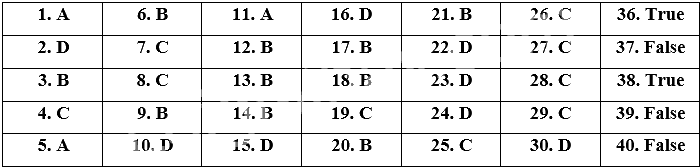
31. If they understood the problem, they would find a solution.
32. Tom told his sister he wanted to buy a gift for their mother.
33. The temple that we want to visit opens at 7.00.
34. Many people believe that the Red Sea is the warmest sea in the world.
35. You don’t need to do the test.
HƯỚNG DẪN GIẢI CHI TIẾT
1. A
Kiến thức: Phát âm “a”
Giải thích:
A. favourite /ˈfeɪ.vər.ɪt/
B. family /ˈfæm.əl.i/
C. language /ˈlæŋ.ɡwɪdʒ/
D. activity /ækˈtɪv.ə.ti/
Phần được gạch chân ở phương án A được phát âm /ei/, các phương án còn lại phát âm /æ/.
Chọn A
2. D
Kiến thức: Phát âm “o”
Giải thích:
A. radio /ˈreɪ.di.əʊ/
B. those /ðəʊz/
C. process /ˈprəʊ.ses/
D. professor /prəˈfes.ər/
Phần được gạch chân ở phương án D được phát âm /ə/, các phương án còn lại phát âm /əʊ/.
Chọn D
3. B
Kiến thức: Phát âm “ed”
Giải thích:
A. affected /əˈfek.tɪd/
B. worked /wɜːkt/
C. suggested /səˈdʒestid/
D. decided /dɪˈsaɪ.dɪd/
Phần được gạch chân ở phương án B được phát âm /t/, các phương án còn lại phát âm /id/.
Chọn B
4. C
Kiến thức: Trọng âm
Giải thích:
A. flexibility /flek.səˈbɪl.ə.ti/
B. gravitation /ɡræv.ɪˈteɪ.ʃən/
C. traditional /trəˈdɪʃ.ən.əl/
D. inactivity /ɪnˈæk.tɪv/
Phương án C có trọng âm 2, các phương án còn lại có trọng âm 3.
Chọn C
5. A
Kiến thức: Trọng âm
Giải thích:
A. wonder /ˈwʌn.dər/
B. kangaroo /kæŋ.ɡərˈuː/
C. periodical /pɪə.riˈɒd.ɪ.kəl/
D. population /pɒp.jəˈleɪ.ʃən/
Phương án A có trọng âm 1, các phương án còn lại có trọng âm 3.
Chọn A
6. B
Kiến thức: Câu tường thuật
Giải thích:
Công thức câu tường thuật dạng kể với động từ tường thuật “told” (bảo): S + told + O + S + V (lùi thì).
Công thức câu tường thuật dạng kể với động từ tường thuật “said” (nói): S + said + to O + S + V (lùi thì).
Chen told us that air pollution was a serious problem in Beijing.
(Chen nói với chúng tôi rằng ô nhiễm không khí là một vấn đề nghiêm trọng ở Bắc Kinh.)
Chọn B
7. C
Kiến thức: Từ vựng
Giải thích:
A. house husband (n): bố làm nội trợ
B. householder (n): chủ nhà
C. housekeeping (n): chăm sóc nhà cửa
D. homemaker (n): nội trợ
In Korea, many people still feel that women should be in charge of housekeeping after getting married.
(Ở Hàn Quốc, nhiều người vẫn cảm thấy rằng phụ nữ nên đảm đương việc nội trợ sau khi kết hôn.)
Chọn C
8. C
Kiến thức: Giới từ
Giải thích:
A. about: về
B. from: từ
C. to: tới
D. with: với
Cụm từ “access to”: tiếp cận với
Lack of an education severely restricts a woman's access to information and opportunities.
(Thiếu giáo dục hạn chế nghiêm trọng khả năng tiếp cận thông tin và cơ hội của phụ nữ.)
Chọn C
9. B
Kiến thức: Từ vựng
Giải thích:
A. carry (v): mang
B. bring (v): mang lại
C. take (v): lấy
D. result (v): dẫn đến
It is believed in Brazil that placing a small cup or dish of salt in the corner of your house will bring you good luck.
(Ở Brazil, người ta tin rằng đặt một chiếc cốc nhỏ hoặc đĩa muối ở góc nhà sẽ mang lại may mắn cho bạn.)
Chọn B
10. D
Kiến thức: Câu điều kiện loại 1
Giải thích:
- Câu điều kiện loại 1 diễn tả một việc hiển nhiên, nguyên nhân – kết quả.
- Cấu trúc câu điều kiện loại 1: If + S + V(s/es), S + will / can + Vo (nguyên thể).
If pollution goes on, the earth will become a dangerous place to live on.
(Nếu ô nhiễm tiếp diễn, trái đất sẽ trở thành một nơi nguy hiểm để sinh sống.)
Chọn D
11. A
Kiến thức: Từ vựng
Giải thích:
A. similar (adj): tương tự
B. same (adj): cùng
C. alike (adj): giống nhau
D. identical (adj): giống hệt
The principle of equal pay is that men and women doing similar work should get paid the same amount.
(Nguyên tắc trả lương ngang nhau là đàn ông và phụ nữ làm những công việc giống nhau sẽ được trả số tiền như nhau.)
Chọn A
12. B
Kiến thức: Câu điều kiện loại 2
Giải thích:
- Câu điều kiện loại 2 diễn tả một việc không có thật ở hiện tại.
- Cấu trúc câu điều kiện loại 2: If + S + V2/ed, S + would/ could + Vo (nguyên thể).
Lưu ý: động từ tobe trong câu điều kiện loại 2 luôn là “were” cho mọi chủ ngữ.
My father is busy at the moment. If he were not busy now, he would take us to Cat Ba National Park at the weekend.
(Bố tôi đang bận vào lúc này. Nếu bây giờ anh ấy không bận, anh ấy sẽ đưa chúng tôi đến Vườn quốc gia Cát Bà vào cuối tuần.)
Chọn B
13. B
Kiến thức: Từ vựng
Giải thích:
A. use (v): sử dụng
B. access (v): tiếp cận
C. possibility (v): có khả năng
D. way (v): cách
Cụm từ “access to” (tiếp cận với)
In Yemen, women have less access to property ownership, credit, training and employment.
(Ở Yemen, phụ nữ ít được tiếp cận với quyền sở hữu tài sản, tín dụng, đào tạo và việc làm.)
Chọn B
14. B
Kiến thức: Từ vựng
Giải thích:
A. work (v): làm việc
B. earn (v): kiếm tiền
C. save (v): tiết kiệm
D. make (v): làm
Due to the gender pay gap, women earn less than men in every country, from as little as 6% in Belgium to as high as 37% in South Korea.
(Do khoảng cách về thu nhập theo giới tính, phụ nữ kiếm được ít tiền hơn nam giới ở mọi quốc gia, từ ít nhất là 6% ở Bỉ đến 37% ở Hàn Quốc.)
Chọn B
15. D
Kiến thức: Mạo từ
Giải thích:
Cả hai đối tượng đều đã được xác định vì nó được đem ra so sánh với nhau qua câu so sánh hơn => dùng mạo từ “the”.
I like the blue T-shirt over there better than the red one.
(Tôi thích cái áo phông màu xanh đằng kia hơn cái màu đỏ.)
Chọn D
16. D
Kiến thức: Sửa lỗi sai
Giải thích:
Liên từ “and” (và) dùng để nối hai loại từ giống nhau.
Trước “and” đang là một động từ nguyên thể “aid” (hỗ trợ) theo sau động từ khiếm khuyết “will” (sẽ) nên sau “and” cũng cần một động từ ở dạng nguyên thể.
educating => educate
educate (v): giáo dục
If businesses want to protect the environment, they will aid the local community and educate travellers.
(Nếu các doanh nghiệp muốn bảo vệ môi trường, họ sẽ hỗ trợ cộng đồng địa phương và giáo dục khách du lịch.)
Chọn D
17. B
Kiến thức: Sửa lỗi sai
Giải thích:
Dấu hiệu nhận biết thì hiện tại đơn “nowadays” (ngày nay) => công thức thì hiện tại đơn ở dạng khẳng định chủ ngữ số nhiều “many of us” (nhiều người trong chúng ta): S + Vo.
tried to live => try to live: cố gắng sống
try (v): cố gắng
Nowadays, many of us try to live in a way that will damage the environment as little as possible.
(Ngày nay, nhiều người trong chúng ta cố gắng sống theo cách gây hại cho môi trường ít nhất có thể.)
Chọn B
18. B
Kiến thức: Sửa lỗi sai
Giải thích:
Công thức câu tưởng thuật dạng kể với động từ tường thuật “complained” (than phiền): S + complained + S + V (lùi thì).
there isn’t => there wasn’t (không có)
They complained that there wasn’t any fresh water in the local area.
(Họ phàn nàn rằng không có nước ngọt trong khu vực địa phương.)
Chọn B
19. C
Kiến thức: Chức năng giao tiếp
Giải thích:
A. Yes, so what? I want to keep learning until I can hold a conversation like a native speaker.
(Vâng thì sao? Tôi muốn tiếp tục học cho đến khi tôi có thể nói chuyện như người bản ngữ.)
B. It's none of your business! I want to keep learning until I can hold a conversation like a native speaker.
(Đó không phải là việc của bạn! Tôi muốn tiếp tục học cho đến khi tôi có thể nói chuyện như người bản ngữ.)
C. I suppose it is, but I want to keep learning until I can hold a conversation like a native speaker.
(Tôi cho là vậy, nhưng tôi muốn tiếp tục học cho đến khi tôi có thể nói chuyện như người bản ngữ.)
D. Well, look at yourself first. I want to keep learning until I can hold a conversation like a native speaker.
(Chà, hãy nhìn lại chính mình trước. Tôi muốn tiếp tục học cho đến khi tôi có thể nói chuyện như người bản xứ.)
“So, Sven, you've been learning English for ten years. That's a long time.”-“I suppose it is, but I want to keep learning until I can hold a conversation like a native speaker. ”
(“Vậy, Sven, bạn đã học tiếng Anh được mười năm rồi. Đó là một thời gian dài.”-“Tôi cho là vậy, nhưng tôi muốn tiếp tục học cho đến khi tôi có thể nói chuyện như một người bản ngữ.)
Chọn C
20. B
Kiến thức: Chức năng giao tiếp
Giải thích:
A. More and more companies are advertising about ecotourism.
(Ngày càng có nhiều công ty quảng cáo về du lịch sinh thái.)
B. It really helps to create more jobs for a lot of people.
(Nó thực sự giúp tạo thêm việc làm cho nhiều người.)
C. Tourism is also an industry.
(Du lịch cũng là một ngành công nghiệp.)
D. It is hard to develop without learning about tourism.
(Không học về du lịch thì khó phát triển được.)
Nam: "How important is tourism to our country?" - Lan: “It really helps to create more jobs for a lot of people.”
(Nam: "Du lịch quan trọng như thế nào đối với đất nước chúng ta?" - Lan: “Nó thực sự giúp tạo thêm công ăn việc làm cho rất nhiều người.”)
Chọn B
21. B
Kiến thức: Từ vựng
Giải thích:
A. make (v): làm
B. build (v): xây
C. sleep (v): ngủ
D. create (v): tạo ra
Birds build their nests in many different places and environments.
(Chim xây tổ ở nhiều nơi và nhiều môi trường khác nhau.)
Chọn B
22. D
Kiến thức: Từ vựng
Giải thích:
A. product (n): sản phẩm
B. conclusion (n): kết luận
C. result (n): kết quả
D. offspring (n): con cháu
Birds use their nests mainly to hatch their eggs and raise their offspring.
(Các loài chim sử dụng tổ của chúng chủ yếu để ấp trứng và nuôi con.)
Chọn D
23. D
Kiến thức: Từ vựng
Giải thích:
A. luckily (adv): may mắn
B. specially (adv): đặc biệt
C. suddenly (adv): đặc biệt
D. unfortunately (adv): không may
But unfortunately, there are very less old trees left in our country except rural areas.
(Nhưng rất tiếc, cây cổ thụ ở nước ta còn lại rất ít, ngoại trừ các vùng nông thôn.)
Chọn D
24. D
Kiến thức: Từ vựng
Giải thích:
A. Like (adj): như
B. Unlike (adj): không giống
C. Alike (adj): tương tự
D. invaluable (adj): vô giá
We know that birds play an invaluable and irreplaceable role in nature.
(Chúng ta biết rằng các loài chim đóng một vai trò vô giá và không thể thay thế trong tự nhiên.)
Chọn D
25. C
Kiến thức: Trạng từ quan hệ
Giải thích:
A. which: cái mà
B. who: người mà
C. where: nơi mà
D. when: khi mà
Trước vị trí trống là trạng ngữ chỉ nơi chốn “homes” (nhà), sau vị trí trống là một mệnh đề S + V “bird will” => dùng “where” (nơi mà).
We need to let people know how to keep enough open space around their homes where birds will feel safe.
(Chúng ta cần cho mọi người biết cách giữ đủ không gian thoáng đãng xung quanh nhà của họ, nơi những chú chim sẽ cảm thấy an toàn.)
Chọn C
Bài đọc hoàn chỉnh:
Birds differ in their behavior just as much as their physical traits. They even use very different methods to build their nests. Some bird nests have the art of architecture beyond our imagination. Birds (21) build their nests in many different places and environments. Some live on high branches, some live in bushes and some of them even nest on the ground. Birds use their nests mainly to hatch their eggs and raise their (22) offspring.
Because of the destruction of trees, plants, bushes, etc., these birds are losing their habitats and breeding grounds. There is a great lack of optimal breeding areas for birds. Proper breeding areas for birds are decreasing at an alarming rate. Nowadays, it is hard for birds to find even the space to build nests.
Some birds build nests on naturally formed tree hollows on ancient trees. But (23) unfortunately, there are very less old trees left in our country except rural areas. Ducks are going towards extinction because they build their nest on old trees using the hollows, and we have almost no such trees. We know that birds play an (24) invaluable and irreplaceable role in nature.
We should not destroy or harm any bird's nest. We can teach our children to observe birds and nests and how they take care of eggs. If we can encourage our children like this, it will be a great start to their education.
We need to let people know how to keep enough open space around their homes (25) where birds will feel safe. This is not just for the birds; it will help us too. We will gain more in the long run if we preserve the forests for our leisure and for animals and birds.
Tạm dịch:
Các loài chim khác nhau về hành vi cũng như đặc điểm thể chất của chúng. Chúng thậm chí còn sử dụng các phương pháp rất khác nhau để xây tổ của mình. Một số tổ chim có kiến trúc nghệ thuật ngoài sức tưởng tượng của chúng ta. Chim (21) xây tổ ở nhiều nơi và môi trường khác nhau. Một số sống trên cành cây cao, một số sống trong bụi rậm và một số thậm chí còn làm tổ trên mặt đất. Chim sử dụng tổ của chúng chủ yếu để ấp trứng và nuôi (22) con của chúng.
Do sự tàn phá của cây cối, thực vật, bụi rậm, v.v., những con chim này đang mất đi môi trường sống và nơi sinh sản. Rất thiếu các khu vực sinh sản tối ưu cho các loài chim. Các khu vực sinh sản thích hợp cho các loài chim đang giảm ở mức báo động. Ngày nay, các loài chim thậm chí còn khó tìm được không gian để xây tổ.
Một số loài chim làm tổ trên các hốc cây hình thành tự nhiên trên các cây cổ thụ. Nhưng (23) thật không may, có rất ít cây cổ thụ ở nước ta ngoại trừ các vùng nông thôn. Vịt sắp tuyệt chủng vì chúng làm tổ trên những cây cổ thụ bằng cách sử dụng các hốc cây, và chúng ta hầu như không có những cây như vậy. Chúng tôi biết rằng các loài chim đóng một vai trò (24) vô giá và không thể thay thế trong tự nhiên.
Chúng ta không nên phá hoại hay làm hại bất kỳ tổ chim nào. Chúng ta có thể dạy con mình quan sát các loài chim và tổ cũng như cách chúng chăm sóc trứng. Nếu chúng ta có thể khuyến khích con cái mình như vậy, đó sẽ là một khởi đầu tuyệt vời cho việc học của chúng.
Chúng ta cần cho mọi người biết cách giữ đủ không gian thoáng xung quanh nhà của họ (25), nơi mà chim sẽ cảm thấy an toàn. Điều này không chỉ dành cho những con chim; nó cũng sẽ giúp chúng ta. Về lâu dài, chúng ta sẽ thu được nhiều lợi ích hơn nếu chúng ta bảo tồn các khu rừng để chúng ta giải trí cũng như cho các loài động vật và chim chóc.
26. C
Kiến thức: Đọc hiểu
Giải thích:
Ý chính của đoạn văn là gì?
A. Chế độ nô lệ là một trong những nguyên nhân của Susan Anthony.
B. Susan Anthony không chấp nhận việc sử dụng rượu.
C. Những người cải cách không phải lúc nào cũng nhìn thấy kết quả của những nỗ lực của họ.
D. Susan Anthony không bao giờ từ bỏ cuộc đấu tranh của mình cho tự do của tất cả mọi người.
Thông tin: Although Anthony did not live to see the fruits of her efforts, the establishment of the 19th Amendment is indebted to her efforts, according to US historians.
(Theo các nhà sử học Hoa Kỳ, mặc dù Anthony không còn sống để nhìn thấy thành quả từ những nỗ lực của bà, nhưng việc thành lập Tu chính án thứ 19 là nhờ vào những nỗ lực của bà.)
Chọn C
27. C
Kiến thức: Đọc hiểu
Giải thích:
Bằng cách nào sau đây US Mint đã vinh danh công việc để đời của cô ấy?
A. Đồng đô la Susan Anthony đã được tạo ra.
B. Con tem Susan Anthony đã được phát hành.
C. Đồng đô la Susan Anthony được phát hành.
D. Công viên tưởng niệm Susan Anthony được xây dựng ở Rochester.
Thông tin: On July 2nd 1979, the US Mint honored her by issuing the Susan Anthony dollar coin.
(Vào ngày 2 tháng 7 năm 1979, US Mint đã vinh danh bà bằng cách phát hành đồng đô la Susan Anthony.)
Chọn C
28. C
Kiến thức: Đọc hiểu
Giải thích:
Từ được gạch dưới “crusade” trong đoạn 1 gần nghĩa nhất với ____.
A. một nỗ lực để chống lại cái ác
B. một cuộc chiến chống lại chính quyền
C. một chiến dịch hoạt động không mệt mỏi vì niềm tin của một người
D. một cuộc chiến chống lại kẻ thù trong thời trung cổ
crusade (n): chiến dịch
Thông tin: In Rochester, New York, she began her first public crusade on behalf of temperance, the habit of not drinking alcohol.
(Tại Rochester, New York, cô bắt đầu chiến dịch công khai đầu tiên của mình nhân danh sự điều độ, thói quen không uống rượu.)
Chọn C
29. C
Kiến thức: Đọc hiểu
Giải thích:
Anthony ủng hộ tất cả những điều sau NGOẠI TRỪ ____.
A. chế độ nô lệ nên được bãi bỏ
B. phụ nữ là công dân và nên có quyền bầu cử
C. người sử dụng lao động nên cung cấp dịch vụ chăm sóc trẻ em cho nhân viên nữ
D. rượu nên bị cấm vì sự lạm dụng mà nó gây ra
Cả bài đọc không hề đề cập đến từ khóa “childcare” (chăm sóc trẻ em).
Chọn C
30. D
Kiến thức: Đọc hiểu
Giải thích:
Các nhà sử học sẽ nói gì về thành tựu lớn nhất của Susan Anthony?
A. Cô ấy là một nhà hoạt động và đồng thời nuôi nấng một gia đình.
B. Cô ấy đã làm việc với những người theo chủ nghĩa bãi nô để đất nước thoát khỏi chế độ nô lệ.
C. Phụ nữ có quyền bầu cử hợp pháp dẫn đến các điều khoản của Tu chính án thứ 14 và 15 của Hiến pháp.
D. Những nỗ lực không mệt mỏi của bà nhằm đảm bảo quyền bầu cử cho phụ nữ đã dẫn đến việc thành lập Tu chính án thứ 19 của Hiến pháp.
Thông tin: Although Anthony did not live to see the fruits of her efforts, the establishment of the 19th Amendment is indebted to her efforts, according to US historians.
(Theo các nhà sử học Hoa Kỳ, mặc dù Anthony không còn sống để nhìn thấy thành quả từ những nỗ lực của bà, nhưng việc thành lập Tu chính án thứ 19 là nhờ vào những nỗ lực của bà.)
Chọn D
31.
Kiến thức: Viết câu điều kiện loại 2
Giải thích:
- Câu điều kiện loại 2 diễn tả một việc không có thật ở hiện tại.
- Cấu trúc câu điều kiện loại 2: If + S + V2/ed, S + would/ could + Vo (nguyên thể).
understand – understood – understood (v): hiểu
They don’t understand the problem. They won’t find a solution.
(Họ không hiểu vấn đề. Họ sẽ không tìm ra giải pháp.)
Đáp án: If they understood the problem, they would find a solution.
(Nếu họ hiểu vấn đề, họ sẽ tìm ra giải pháp.)
32.
Kiến thức: Viết câu tường thuật
Giải thích:
Công thức câu tường thuật dạng kể với động từ tường thuật “told” (bảo): S + told + O + S + V (lùi thì).
Quy tắc lùi thì: thì hiện tại đơn “want” => thì quá khứ đơn “wanted”
Tom said to his sister “I want to buy a gift for our mother”.
(Tom nói với em gái của mình "Anh muốn mua một món quà cho mẹ của chúng ta".)
Đáp án: Tom told his sister he wanted to buy a gift for their mother.
(Tom nói với em gái anh ấy rằng anh ấy muốn mua một món quà cho mẹ của họ.)
33.
Kiến thức: Viết câu với mệnh đề quan hệ
Giải thích:
Chủ ngữ “it” (nó) ở câu thứ hai thay thế cho danh từ chỉ vật “temple” (ngôi đền) ở câu đầu tiên => dùng “that” vì “that” có thể thay thế cho “which” (cái mà)
We want to visit a temple. It opens at 7.00.
(Chúng tôi muốn đến thăm một ngôi đền. Nó mở cửa lúc 7.00.)
Đáp án: The temple that we want to visit opens at 7.00.
(Ngôi đền mà chúng tôi muốn đến thăm mở cửa lúc 7 giờ.)
34.
Kiến thức: Viết câu với so sánh nhất
Giải thích:
Công thức viết câu so sánh nhất với tính từ ngắn, chủ ngữ số ít ở dạng khẳng định thì hiện tại đơn: S + is + the + tính từ ngắn + est + danh từ số ít.
warm (adj): ấm
Many people believe that no sea in the world is warmer than the Red Sea.
(Nhiều người cho rằng không có vùng biển nào trên thế giới ấm hơn Biển Đỏ.)
Đáp án: Many people believe that the Red Sea is the warmest sea in the world.
(Nhiều người cho rằng Biển Đỏ là vùng biển ấm nhất thế giới.)
35.
Kiến thức: Viết câu với động từ “need”
Giải thích:
“It's not necessary”: không cần thiết.
Cấu trúc viết câu với động từ thường “need” (cần) ở dạng phủ định thì hiện tại đơn chủ ngữ só nhiều “you” (bạn): S + don’t need + to Vo.
It's not necessary for you to do the test.
(Bạn không cần thiết phải làm bài kiểm tra.)
Đáp án: You don’t need to do the test.
(Bạn không cần phải làm bài kiểm tra.)
36. True
Kiến thức: Nghe hiểu
Giải thích:
In 2020, it was estimated that more than 1 billion people traveled each year.
(Vào năm 2020, ước tính có hơn 1 tỷ người đi du lịch mỗi năm.)
Thông tin: In 2020, it was estimated that 1.4 billion tourists travelled every year.
(Năm 2020, ước tính có 1,4 tỷ lượt khách du lịch mỗi năm)
Chọn True
37. False
Kiến thức: Nghe hiểu
Giải thích:
Tourism is not important for the economy.
(Du lịch không quan trọng đối với nền kinh tế.)
Thông tin: While tourism is very important to the economy, there is also a price to pay especially in terms of the environment.
(Mặc dù du lịch rất quan trọng đối với nền kinh tế, nhưng cũng có một cái giá phải trả, đặc biệt là về môi trường.)
Chọn False
38. True
Kiến thức: Nghe hiểu
Giải thích:
Tourists can damage the environment directly or indirectly.
(Khách du lịch có thể trực tiếp hoặc gián tiếp hủy hoại môi trường.)
Thông tin: Sometimes, the impact is direct, such as when tourists litter the streets or use up natural resources of the local areas such as clean water or energy. Other times, the impact is less direct but still large.
(Đôi khi, tác động là trực tiếp, chẳng hạn như khi khách du lịch xả rác ra đường hoặc sử dụng hết tài nguyên thiên nhiên của địa phương như nước sạch hoặc năng lượng. Những lần khác, tác động ít trực tiếp hơn nhưng vẫn lớn.)
Chọn True
39. False
Kiến thức: Nghe hiểu
Giải thích:
By travelling by plane, tourists can reduce the negative impact of their travel on the environment.
(Bằng cách đi du lịch bằng máy bay, khách du lịch có thể giảm tác động tiêu cực của việc đi lại đối với môi trường.)
Thông tin: When tourists travel for instance, they often travel by planes or vehicles that use a lot of fuel. This damages the environment as well.
(Ví dụ, khi khách du lịch đi du lịch, họ thường di chuyển bằng máy bay hoặc phương tiện sử dụng nhiều nhiên liệu. Điều này cũng gây thiệt hại cho môi trường.)
Chọn False
40. False
Kiến thức: Nghe hiểu
Giải thích:
We cannot reduce the negative impact of tourism on the environment.
(Chúng ta không thể giảm tác động tiêu cực của du lịch đối với môi trường.)
Thông tin: However, it is possible to reduce such negative impact on the environment by traveling more responsibly and in a more eco-friendly way.
(Tuy nhiên, có thể giảm tác động tiêu cực đó đến môi trường bằng cách đi du lịch có trách nhiệm hơn và thân thiện với môi trường hơn.)
Chọn False
Bài nghe:
The number of tourists has increased over the years. In 1950, there were only 25 million international tourist arrivals. In 2020, it was estimated that 1.4 billion tourists travelled every year. While tourism is very important to the economy, there is also a price to pay especially in terms of the environment. In fact, the negative impact of tourism on the local environment is huge. Sometimes, the impact is direct, such as when tourists litter the streets or use up natural resources of the local areas such as clean water or energy. Other times, the impact is less direct but still large. When tourists travel for instance, they often travel by planes or vehicles that use a lot of fuel. This damages the environment as well. In either way, tourists are knowingly or not knowingly damaging the environment as they travel. However, it is possible to reduce such negative impact on the environment by traveling more responsibly and in a more eco-friendly way.
Tạm dịch:
Lượng khách du lịch tăng dần qua các năm. Năm 1950, chỉ có 25 triệu lượt khách du lịch quốc tế. Vào năm 2020, ước tính có 1,4 tỷ khách du lịch đi du lịch mỗi năm. Trong khi du lịch rất quan trọng đối với nền kinh tế, thì cũng có một cái giá phải trả, đặc biệt là về mặt môi trường. Trên thực tế, tác động tiêu cực của du lịch đối với môi trường địa phương là rất lớn. Đôi khi, tác động trực tiếp, chẳng hạn như khi khách du lịch xả rác trên đường phố hoặc sử dụng tài nguyên thiên nhiên của khu vực địa phương như nước sạch hoặc năng lượng. Những lần khác, tác động ít trực tiếp hơn nhưng vẫn lớn. Ví dụ, khi khách du lịch đi du lịch, họ thường di chuyển bằng máy bay hoặc các phương tiện sử dụng nhiều nhiên liệu. Điều này cũng làm hại môi trường. Bằng cả hai cách, khách du lịch đang cố ý hoặc không cố ý làm tổn hại đến môi trường khi họ đi du lịch. Tuy nhiên, có thể giảm tác động tiêu cực đó lên môi trường bằng cách đi du lịch có trách nhiệm hơn và thân thiện hơn với môi trường.
Luyện trắc nghiệm Toán lớp 1 Lớp LOP10
Học đi đôi với hành! Làm ngay các bộ đề trắc nghiệm chấm điểm tức thì, có đáp án chi tiết giúp ghi nhớ kiến thức sâu và chuẩn bị tốt cho các bài kiểm tra.
Học tập & ôn luyện trên ứng dụng Tri Thức Hub
Tải ứng dụng Tri Thức Hub trên điện thoại hoặc máy tính bảng (hỗ trợ Android & iOS) để làm bài kiểm tra, luyện tập và lưu tiến độ học tập!