
Đề thi học kì 1 Tiếng Anh 8
Đề cương ôn tập học kì 1 Tiếng Anh 8 - Global Success
A. NỘI DUNG ÔN TẬP
I. Từ vựng
Unit 1. Leisure time
+ Các hoạt động trong thời gian rảnh rỗi
+ Cụm từ thể hiện sự thích/ không thích
Unit 2. Life in the countryside
+ Cuộc sống ở nông thôn
Unit 3. Teenagers
+ Câu lạc bộ ở trường, việc sử dụng mạng xã hội và áp lực của thanh thiếu niên
Unit 4. Ethnics groups of Viet Nam
+ Đời sống của các dân tộc Việt Nam
Unit 5. Our customs and traditions
+ Các truyền thống và phong tục
Unit 6. Lifestyles
+ Những lối sống khác nhau
II. Ngữ âm
1. Âm /ʊ/ và /uː/
2. Âm /ə/ và /ɪ/
3. Âm /ʊə/ và /ɔɪ/
4. Âm /k/ và /g/
5. Âm /n/ và /ŋ/
6. Âm /br/ và /pr/
III. Ngữ pháp
1. Động từ chỉ sự yêu thích + V-ing/ to V
2. So sánh hơn của trạng từ
3. Câu đơn và câu ghép
4. Câu hỏi Wh và Yes/ No
5. Danh từ đếm được và không đếm được
6. Trường hợp không dùng mạo từ
7. Thì tương lai đơn & câu điều kiệ loại 1
B. BÀI TẬP
I. Từ vựng
Unit 1
Fill in each blank with a suitable word.
1. Mark is ________ about sport, and he can play basketball, football, table tennis, and golf.
2. Are you keen ________ gardening or going shopping?
3. Many girls are interested in ________ DIY.
4. My mum and I love ________, so we can spend hours in the kitchen.
5. Is your grandfather ________ of collecting stamps and coins? - Yes, he is.
6. What does your brother do in his free time? - He usually ________ the net.
Đáp án:
|
1. crazy |
2. on |
3. doing |
|
4. cooking |
5. fond |
6. surfs |
Unit 2
Choose the correct words to complete the following sentences.
1. The workers are _____ a truck with timber.
A. unloading B. loading C. taking D. filling
2. He often _____ holes in his garden to plant trees.
A. ploughs B. picks C. digs D. collects
3. My uncle hired extra workers to help at harvest _____.
A. time B. point C. period D. season
4. From the hilltop, we can see row after row of orange trees _____ to the horizon.
A. running B. expanding C. enlarging D. stretching
5. People in my village grow rice in vast _____ fields.
A. corn B. wheat C. pad D. paddy
Đáp án:
|
1. B |
2. C |
3. A |
4. D |
5. D |
Unit 3
Choose the best answer A, B, C or D to complete the sentences.
1. It might take a while for this to _______ the file.
A. log on B. write C. upload D. discover
2. Before we made a decision, we spent hours __________ various websites.
A. browsing B. logging out C. uploading D. downloading
3. Remember to go over your essay _________ for grammar and spelling mistakes before you hand it in to the teacher.
A. browsing B. surfing C. connecting D. checking
4. I need a password in order to ________ .
A. check B. log on C. surf D. browse
5. Once the drives are installed, _______ power and data cables to each one.
A. combine B. mix C. check D. connect
Đáp án:
|
1. C |
2. A |
3. D |
4. B |
5. D |
Unit 4
Choose the best answer A, B, C or D to complete the sentences.
1. We want to make sure all _________ have the same opportunities to succeed.
A. population B. festivals C. ethnic groups D. race groups
2. As a child, I loved walking around on _____________.
A. stilts B. pieces C. poles D. wood
3. Our hotel room _________ the habour.
A. looked B. looked at C. looked over D. overlooked
4. Most pupils learn how to play a _________ instrument.
A. music B. musical C. voice D. sound
5. The farmers were at work in the __________ fields.
A. steep B. terraced C. high D. row
Đáp án:
|
1. C |
2. D |
3. D |
4. B |
5. B |
Unit 5
Choose the best answer A, B, C or D to complete the sentences.
1. The 'wai' is the traditional __________ of people in Thailand.
A. goodbye B. hello C. greeting D. greetings
2. When two Maori people meet, they __________ each other's noses.
A. touch B. feel C. take D. kiss
3. Do you know the _________ way to welcome people in Tibet?
A. custom B. customer C. customary D. tradition
4. The 'xoe' dance is a spiritual _________ of Thai ethnic people.
A. customs B. tradition C. habit D. dancing
5. In Viet Nam you shouldn't use only the first name to __________ people older than you.
A. speak B. talk C. say D. address
Đáp án:
|
1. C |
2. A |
3. C |
4. D |
5. D |
Unit 6
Choose the best answer A, B, C or D to complete the sentences.
1. It is his _________ to read several books a week.
A. action B. activity C. practice D. training
2. Email is a highly effective _________ of communication.
A. mean B. means C. equipment D. devices
3. Knitting and weaving are popular __________.
A. tasks B. skills C. positions D. crafts
4. What is her __________? - Is she Professor or Doctor?
A. title B. career C. job D. salary
5. I don't know how they manage to support their expensive _______.
A. lifetime B. lifestyle C. lifespan D. life story
Đáp án:
|
1. D |
2. B |
3. D |
4. A |
5. B |
II. Ngữ âm
Find the word which has a different sound in the part underlined.
1. A. school B. food C. foot D. fool
2. A. staple B. maintain C. stay D. habit
3. A. spoon B. took C. could D. wood
4. A. dogsled B. nomadic C. online D. offline
5. A. wood B. look C. shook D. poor
6. A. catch B. cattle C. harvest D. paddy
7. A. picturesque B. herd C. ferry D. stretch
8. A. drink B. income C. pink D. uncle
9. A. milk B. lighthouse C. kite D. nice
10. A. although B. plough C. neighbour D. laugh
11. A. tour B. sour C. tourist D. sure
12. A. carp B. martial C. marvelous D. careful
13. A. coin B. noisy C. soil D. tortoise
14. A. pagoda B. drop C. offering D. bonding
15. A. gourmet B. signature C. mature D. gourd
16. A. cellphone B. cool C. caught D. cup
17. A. school B. ache C. chair D. chorus
18. A. fix B. example C. box D. next
19. A. guess B. guest C. guerrilla D. dialogue
20. A. quiet B. question C. quick D. unique
Đáp án:

III. Ngữ pháp
Exercise 1
Complete the conversations with the correct form of the verbs in brackets.
Mai: I _______ (1. not like / watch) football. I __________ (2. Hate/ stand) around and ________(get) cold.
Lan: Me, too. I __________ (4. prefer/ be) indoors. I _________ (5. not mind/ /play) football - on my computer!
Nick: Ha ha! I know your brother's really good at football, Mai. __________ (6. he/ like / play) at the back?
Mai: Tuan? No, he _________ (7. prefer/play) centre forward. He __________ (8. (like / score) goals!
Lan: Great pass, Tuan!
Mai: Lan, do you like football?
Nick: No, but she _________ (9. not mind/ watch) Tuan!
Đáp án:
|
1. doesn’t like watching |
2. hate standing |
3. getting |
|
4. prefer being |
5. don’t mind playing |
6. Does he like playing |
|
7. prefers playing |
8. likes scoring |
9. doesn’t mind watching |
Exercise 2
Complete the sentences using the correct form of the words in brackets. Add than where necessary.
1. I think I work __________ Jack does. (hard)
2. We finished the job a lot _________ we'd expected. (quickly)
3. She always arrives at work much _________ anyone else. (early)
4. The children are behaving _______ they usually do. (badly)
5. Of all the animals in the world, the tortoise lives _________ humans. (long)
Đáp án:
|
1. harder than |
2. more quickly than |
3. earlier than |
4. worse than |
5. longer than |
Exercise 3
Choose the best answer to complete each of the following sentences.
1. I couldn't repair my bike, _________ I didn't have the right tools.
A. so B. for C. because of D. therefore
2. I was tired __________ I walked all the way home.
A. so B. or C. but D. and
3. The post office was closed _________ I couldn't mail my letter.
A. so B. but C. and D. for
4. I couldn't use the pay phone, _________ I didn't have any coins with me.
A. and B. for C. but D. so
5. I have to eat breakfast in the morning; _______ I get hungry before my lunch break.
A. therefore B. for C. otherwise D. however
Đáp án:
|
1. B |
2. C |
3. A |
4. B |
5. C |
Exercise 4
Choose the correct word.
1. Is there any / some coffee left?
2. How much / many apples have we got?
3. Can you get me a few / a little butter?
4. We've got very little / very few carrots left.
5. How much / many sugar do you take in your tea?
Đáp án:
|
1. any |
2. many |
3. a little |
4. very few |
5. much |
Exercise 5
Make appropriate IFA-questions based on the answers.
1.
A: _______________________________?
B: My mother. (My mother bought me a new coat.)
2.
A: _______________________________?
B: Tomorrow. (We're going to the museum tomorrow.)
3.
A: _______________________________?
B: Because I didn't feel good. (I stayed at home yesterday because I didn't feel good.)
4.
A: _______________________________?
B: His problems. (Jack talked about his problems.)
5.
A: _______________________________?
B: At 3 pm. (The history class begins at 3 pm.)
Đáp án:
1. Who bought you a new coat?
2. When are you going to the museum?
3. Why did you stay at home yesterday?
4. What did Jack talk about?
5. What time does the history class begin?
Exercise 6
Complete the sentences with a/an, the or 0 (zero article).
1. My uncle is _____ engineer at ______ local garage.
2. ________ Statue of Liberty is in _________ New York.
3. ______ happiness doesn't come from ______ money.
4. Call ______ fire station! There's _______ fire.
5. Nobody saw ______ shark as it swam past ______ boat.
Đáp án:
|
1. an - a |
2. The - 0 |
3. 0 - 0 |
4. the – a |
5. the – the |
Exercise 7
Complete the text with will or won’t and the verbs given below.
|
not buy be not come get have invite make |
My sister, Linda, (1)________ 18 this year. It’s an important birthday in the UK, so I think she (2) _______ a big present from us. I think we (3) ___________ a big party and she (4) _______ lots of friends and relatives. Dad (5)________ a big cake too. He’s good at cooking so he (6)_______ one from the beker’s. Our dog is scared of loud music so he (7)______to the party.
Đáp án:
|
1. will be |
2. will get |
3. will have |
4. will invite |
|
5. will make |
6. won’t buy |
7. won’t come |
|
Exercise 8
Put the verbs in brackets into the present simple or future simple.
1. If I (have) ________ problems, my mum (help)________ me.
2. If my father (go) ________ to bed late, he (be)_________ bad-tempered in the morning.
3. If my sister (play)______ her music too loudly, my mum (shout) ________at her.
4. If my brother (have)________ lots of homework, he (eat) _________dinner in his room.
5. If my brother (not have)__________ any homework, he (practise)_________ guitar and (write) _________ songs.
Đáp án:
|
1. have – will help |
2. goes – will be |
3. plays – will shout |
4. has – will eat |
5. doesn’t have – will practice - write |
-----------------THE END-----------------
Đề thi học kì 1 Tiếng Anh 8 Global Success - Đề số 6
Đề bài
PART 1. LANGUAGE
Choose the word whose underlined part is pronounced differently from that of the others.
1.
A. streets
B. phones
C. books
D. makes
2.
A. chorus
B. scheme
C. watching
D. chaos
Choose the word whose stress pattern is different from that of the others.
3.
A. question
B. believe
C. concern
D. request
4.
A. disaster
B. avalanche
C. tsunami
D. announcement
Choose the option that best completes each of the following sentences.
5. Be quiet, please! I'm trying to ______ on my homework.
A. concentrate
B. log
C. advise
D. bully
6. Does your brother dislike ________ his friends? - Yes, he prefers ________ them.
A. call / message
B. calling / messaging
C. to call / to message
D. to call / message
7. From the hilltop, we can see row after row of orange trees _____ to the horizon.
A. running
B. expanding
C. enlarging
D. stretching
8. The environment won't help us if we ____ it.
A. annoy
B. worry
C. alarm
D. disturb
9. A _____ is a violent storm with very strong winds that move in a circle.
A. tornado
B. flood
C. volcano
D. landslide
10. They spend a lot of time surfing the net; ______, they have little time to read books.
A. however
B. therefore
C. although
D. otherwise
11. I’m free ________ 3 p.m. on Thursday, but I have band practice after that.
A. at
B. until
C. in
D. from
12. We should walk to school, _______ we shouldn’t throw trash on the ground.
A. so
B. and
C. but
D. or
13. Minh: _________is the weather girl on VTV3 at 8 o’clock tonight? - Bao: She is Hoai Anh.
A. Who
B. What
C. When
D. Why
14. Gary is very busy with his job. He has ________ time for other things.
A. little
B. a little
C. few
D. a few
15. Tom: What an attractive hair style you have got, Mary! - Mary: ___________.
A. Thank you very much. I am afraid
B. You are telling a lie
C. Thank you for your compliment
D. I don’t like your sayings
16. Jason: Would you like a drink? - Daisy: ___________.
A. I don’t like coffee
B. I prefer tea
C. Coffee, please
D. I’m very thirsty
Supply the correct form of the given word.
17. Finding a balance between what humans and animals need will help prevent habitat _____. (DESTROY)
18. It is _____ to imagine the changes that robots are bringing to our world. (BELIEVE)
19. My sister is keen on ________. She wants to become a chef in the future. (COOK)
20. At harvest time _________ are busy cutting and collecting crops. (FARM)
PART 2. READING
Choose the option that best completes each blank in the passage.
Some teenagers enjoy spending free time with their friends. Others prefer doing leisure activities with their family members. I love spending time with my family (21) ______ it’s a great way to connect with them.
At the weekend, we usually go for a bike ride. We (22) ______ to some nearby villages to enjoy the fresh air. We take photos and look at them later. My big brother and I are also (23) ______ cooking. My brother looks for easy recipes. After that, we prepare the ingredients and cook. Sometimes the food is good, but sometimes it isn’t; nevertheless, we love (24) ______ we cook. The leisure activity I like the most is doing DIY projects with my mum. She teaches me (25) ______ my own dresses and doll clothes. On special occasions, we make special dresses together. Once I won the first prize in a costume contest at my school.
21.
A. so
B. and
C. because
D. but
22.
A. run
B. walk
C. drive
D. cycle
23.
A. at
B. into
C. on
D. with
24.
A. whatever
B. whenever
C. wherever
D. however
25.
A. make
B. making
C. to make
D. made
Read the following passage. Choose TRUE if the statement is true, FALSE if the statement is false.
I feel fortunate that I am living in a peaceful village in southern Viet Nam. The scenery here is beautiful and picturesque with vast fields stretching long distances. The houses are surrounded by green trees. There are lakes, ponds, and canals here and there. The air is fresh and cool. Life here seems to move more slowly than in cities. The people work very hard. They grow vegetables, cultivate rice, and raise cattle. At harvest time, they use combine harvesters to harvest their crops. Many families live by growing fruit trees in the orchards. Others live by fishing in lakes, ponds, and canals. Life in the village is very comfortable for children. They play traditional games. Sometimes they help their parents pick fruit and herd cattle.
People in my village know each other well. They are friendly and hospitable. They often meet each other in the evening, eating fruit, playing chess, singing folk songs, and chatting about everyday activities.
26. Life in the author’s village is very peaceful.
27. The people in the village work very hard.
28. Villagers live only by catching fish in lakes, ponds, and canals.
29. The children are always busy helping their parents.
30. The villagers get along well.
PART 3. WRITING
Rewrite the above sentence with the given beginning in such a way that the meaning stays unchanged.
31. My sister makes a mess. My mum makes her weed the garden. (Whenever)
=> __________________________________________.
32. Rita might fail her driving test. But she can take it again. (If)
=> __________________________________________.
33. We usually visit museums when we have leisure time. (enjoy)
=> __________________________________________.
34. It was cold. However, Tom still went swimming. (Although)
=> __________________________________________.
35. My sister walks to school everyday.
=> My sister goes ______________________________.
PART 4. LISTENING
Listen again and give short answers to the following questions. Use no more than THREE words.
36. What is the listening text about?
37. How many sources of water pollution are there?
38. What are two common sources of drinking water?
39. What type of effect does water pollution have on our life?
40. What products can we use to reduce water pollution?
------------------------THE END------------------------
Xem đáp án
HƯỚNG DẪN GIẢI
Thực hiện: Ban chuyên môn Loigiaihay.com
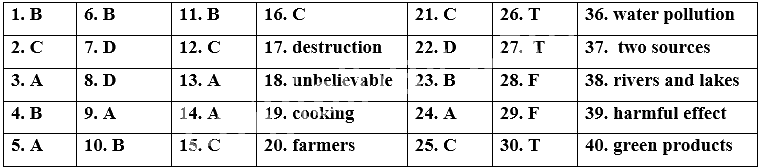

31. Whenever my sister makes a mess, my mum makes her weed the garden.
32. If Rita fails her driving test, she can take it again.
33. We enjoy visiting museums when we have leisure time.
34. Although it was cold, Tom still went swimming.
35. My sister goes to school on foot every day.
HƯỚNG DẪN GIẢI CHI TIẾT
1. B
Kiến thức: Phát âm “s”
Giải thích:
Cách phát âm đuôi -s, -es:
- Đuôi s, es phát âm là /iz/ khi tận cùng là các âm /s/, /z/, /ʃ/, /ʒ/, /tʃ/, /dʒ/.
- Đuôi s, es phát âm là /s / khi tận cùng là các âm /p/, /f/, /t/, /k/, /ө/.
- Đuôi s, es phát âm là /z/ khi tận cùng là các âm còn lại.
A. streets /striːts/
B. phones /fəʊnz/
C. books /bʊks/
D. makes /meɪks/
Phần được gạch chân ở phương B được phát âm /z/, các phương án còn lại phát âm /s/.
Chọn B
2. C
Kiến thức: Phát âm “ch”
Giải thích:
A. chorus /ˈkɔː.rəs/
B. scheme /skiːm/
C. watching /wɒtʃ/
D. chaos /ˈkeɪ.ɒs/
Phần được gạch chân ở phương C được phát âm /tʃ/, các phương án còn lại phát âm /k/.
Chọn C
3. A
Kiến thức: Trọng âm từ có 2 âm tiết
Giải thích:
A. question /ˈkwes.tʃən/
B. believe /bɪˈliːv/
C. concern /kənˈsɜːn/
D. request /rɪˈkwest/
Phương án A có trọng âm 1, các phương án còn lại có trọng âm 2.
Chọn A
4. B
Kiến thức: Trọng âm từ có 3 âm tiết
Giải thích:
A. disaster /dɪˈzɑː.stər/
B. avalanche /ˈæv.əl.ɑːntʃ/
C. tsunami /tsuːˈnɑː.mi/
D. announcement /əˈnaʊns.mənt/
Phương án B có trọng âm 1, các phương án còn lại có trọng âm 2.
Chọn B
5. A
Kiến thức: Từ vựng
Giải thích:
A. concentrate (v): tập trung
B. log (v): đăng nhập
C. advise (v); khuyên nhủ
D. bully (v): bắt nạt
concentrate on: chú ý vào
Be quiet, please! I'm trying to concentrate on my homework.
(Làm ơn im lặng đi! Tôi đang cố gắng tập trung vào bài tập về nhà của mình.)
Chọn A
6. B
Kiến thức: V-ing/ to V
Giải thích:
dislike + V-ing: không thích làm gì
prefer + V-ing: thích làm gì hơn
Does your brother dislike calling his friends? - Yes, he prefers messaging them.
(Anh trai bạn không thích gọi điện cho bạn bè phải không? - Vâng, anh ấy thích nhắn tin cho họ hơn.)
Chọn B
7. D
Kiến thức: Từ vựng
Giải thích:
A. running (v): chạy
B. expanding (v): mở rộng (làm cho lớn hơn về số lượng và kích thước)
C. enlarging (v): mở rộng, phóng to (làm cho kích thước lớn hơn)
D. stretching (v): kéo dài
From the hilltop, we can see row after row of orange trees stretching to the horizon.
(Từ trên đỉnh đồi, chúng ta có thể nhìn thấy từng hàng cây cam trải dài đến tận chân trời.)
Chọn D
8. D
Kiến thức: Từ vựng
Giải thích:
A. annoy (v): làm phiền
B. worry (v): lo lắng
C. alarm (v): báo động
D. disturb (v): làm phiền
The environment won't help us if we disturb it.
(Môi trường sẽ không giúp chúng ta nếu chúng ta làm xáo trộn nó.)
Chọn D
9. A
Kiến thức: Từ vựng
Giải thích:
A. tornado (n): lốc xoáy
B. flood (n): lũ lụt
C. volcano (n): núi lửa
D. landslide (n): lở đất
A tornado is a violent storm with very strong winds that move in a circle.
(Lốc xoáy là một cơn bão dữ dội với sức gió rất mạnh di chuyển theo vòng tròn.)
Chọn A
10. B
Kiến thức: Liên từ
Giải thích:
A. however: tuy nhiên
B. therefore: do đó
C. although: mặc dù
D. otherwise: ngược lại
They spend a lot of time surfing the net; therefore, they have little time to read books.
(Họ dành nhiều thời gian để lướt mạng; do đó, họ có ít thời gian để đọc sách.)
Chọn B
11. B
Kiến thức: Giới từ
Giải thích:
A. at: tại
B. until: cho tới khi
C. in: trong
D. from: từ
I’m free until 3 p.m. on Thursday, but I have band practice after that.
(Tôi rảnh đến 3 giờ chiều. vào thứ năm, nhưng sau đó tôi có buổi tập với ban nhạc.)
Chọn B
12. C
Kiến thức: Liên từ
Giải thích:
A. so: vì vậy
B. and: và
C. but: nhưng
D. or: hoặc
We should walk to school, but we shouldn’t throw trash on the ground.
(Chúng ta nên đi bộ đến trường nhưng không nên vứt rác xuống đất.)
Chọn C
13. A
Kiến thức: Từ để hỏi
Giải thích:
A. Who: Ai
B. What: Cái gì
C. When: Khi nào
D. Why: Tại sao
Minh: Who is the weather girl on VTV3 at 8 o’clock tonight? - Bao: She is Hoai Anh.
(Minh: Cô gái dự báo thời tiết trên kênh VTV3 lúc 8 giờ tối nay là ai? - Bảo: Cô ấy là Hoài Anh.)
Chọn A
14. A
Kiến thức: Lượng từ
Giải thích:
Đây là dạng câu mang tính tiêu cực. Gary bận việc đến nỗi không có thời gian cho việc khác. Do đó sử dụng “little” do “time” (thời gian) là danh từ không đếm được
A. little (+ N không đếm được): ít ỏi không đủ đủ dùng (mang nghĩa tiêu cực)
B. a little (+N không đếm được): ít ỏi nhưng vẫn đủ dùng (mang nghĩa tích cực)
C. few (+ N đếm được số nhiều): ít ỏi không đủ đủ dùng (mang nghĩa tiêu cực)
D. a few (+ N đếm được số nhiều): ít ỏi nhưng vẫn đủ dùng (mang nghĩa tích cực)
Gary is very busy with his job. He has little time for other things.
(Gary rất bận rộn với công việc của mình. Anh ấy có rất ít thời gian cho những việc khác.)
Chọn A
15. C
Kiến thức: Chức năng giao tiếp
Giải thích:
A. Cảm ơn bạn rất nhiều. Tôi sợ
B. Bạn đang nói dối
C. Cảm ơn lời khen của bạn
D. Tôi không thích những câu nói của bạn
Tom: What an attractive hair style you have got, Mary! - Mary: Thank you for your compliment.
(Tom: Thật là một kiểu tóc hấp dẫn mà bạn có, Mary! - Mary: Cảm ơn lời khen của bạn.)
Chọn C
16. C
Kiến thức: Chức năng giao tiếp
Giải thích:
A. Tôi không thích cà phê
B. Tôi thích trà hơn
C. Cà phê, làm ơn
D. Tôi khát quá
Jason: Would you like a drink? - Daisy: Coffee, please.
(Jason: Bạn có muốn uống gì không? - Daisy: Cà phê nhé.)
Chọn C
17. destruction
Kiến thức: Từ vựng – Từ loại
Giải thích:
Kiến thức: Từ vựng – Từ loại
Giải thích:
destroy (v): phá hủy
destruction (n): sự phá hủy
Finding a balance between what humans and animals need will help prevent habitat destruction.
(Tìm kiếm sự cân bằng giữa những gì con người và động vật cần sẽ giúp ngăn chặn sự phá hủy môi trường sống.)
Đáp án: destruction
18. unbelievable
Kiến thức: Từ vựng – Từ loại
Giải thích:
Cấu trúc: S + be + adj => cần một tính từ chủ động để mô tả tính chất của sự vật
believe (v): tin tưởng
unbelievable (adj): tin tưởng
It is unbelievable to imagine the changes that robots are bringing to our world.
(Thật không thể tưởng tượng được những thay đổi mà robot mang lại cho thế giới của chúng ta.)
Đáp án: unbelievable
19. cooking
Kiến thức: Từ vựng – Từ loại
Giải thích:
keen on + V-ing: thích làm gì
cook (v): nấu ăn
cooking (v): nấu ăn (dạng V-ing của động từ “cook)
My sister is keen on cooking. She wants to become a chef in the future.
(Em gái tôi rất thích nấu ăn. Cô ấy muốn trở thành một đầu bếp trong tương lai.)
Đáp án: cooking
20. farmers
Kiến thức: Từ vựng – Từ loại
Giải thích:
Chỗ trống cần một danh từ; sau danh từ, động từ tobe ở dạng “are”, vì vậy danh từ cần điền ở dạnh số nhiều.
farm (n): nông trại
farmer (n): nông dân
At harvest time farmers are busy cutting and collecting crops.
(Vào thời điểm thu hoạch, nông dân đang bận rộn cắt và thu hoạch cây trồng.)
Đáp án: farmers
21. C
Kiến thức: Liên từ
Giải thích:
A. so: vì vậy
B. and: và
C. because: bởi vì
D. but: nhưng
I love spending time with my family (21) because it’s a great way to connect with them.
(Tôi thích dành thời gian cho gia đình mình (21) vì đó là cách tuyệt vời để kết nối với họ.)
Chọn C
22. D
Kiến thức: Từ vựng
Giải thích:
A. run (v): chạy
B. walk (v); đi bộ
C. drive (v): lái xe
D. cycle (v): đạp xe
We (22) cycle to some nearby villages to enjoy the fresh air.
(Chúng tôi (22) đạp xe đến một số ngôi làng gần đó để tận hưởng không khí trong lành.)
Chọn D
23. B
Kiến thức: Giới từ
Giải thích:
A. at: tại
B. into: vào
C. on: trên
D. with: với
My big brother and I are also (23) into cooking.
(Anh trai tôi và tôi cũng (23) nấu ăn.)
Chọn B
24. A
Kiến thức: Liên từ
Giải thích:
A. whatever: bất cứ điều gì
B. whenever: bất cứ khi nào
C. wherever: bất cứ nơi nào
D. however: tuy nhiên
Sometimes the food is good, but sometimes it isn’t; nevertheless, we love (24) whatever we cook.
(Đôi khi đồ ăn ngon nhưng đôi khi lại không; tuy nhiên, chúng tôi yêu thích (24) bất cứ điều gì chúng tôi nấu ăn.)
Chọn A
25. C
Kiến thức: V-ing/ to V
Giải thích:
Cấu trúc: teach sb to V: dạy ai làm gì
She teaches me (25) to make my own dresses and doll clothes.
(Cô ấy dạy tôi (25) cách tự may váy và quần áo búp bê.)
Chọn C
Đoạn văn hoàn chỉnh:
Some teenagers enjoy spending free time with their friends. Others prefer doing leisure activities with their family members. I love spending time with my family (21) because it’s a great way to connect with them.
At the weekend, we usually go for a bike ride. We (22) cycle to some nearby villages to enjoy the fresh air. We take photos and look at them later. My big brother and I are also (23) into cooking. My brother looks for easy recipes. After that, we prepare the ingredients and cook. Sometimes the food is good, but sometimes it isn’t; nevertheless, we love (24) whatever we cook. The leisure activity I like the most is doing DIY projects with my mum. She teaches me (25) to make my own dresses and doll clothes. On special occasions, we make special dresses together. Once I won the first prize in a costume contest at my school.
Tạm dịch:
Một số thanh thiếu niên thích dành thời gian rảnh rỗi với bạn bè của họ. Những người khác thích tham gia các hoạt động giải trí cùng các thành viên trong gia đình họ. Tôi thích dành thời gian cho gia đình mình (21) vì đó là cách tuyệt vời để kết nối với họ.
Vào cuối tuần, chúng tôi thường đi xe đạp. Chúng tôi (22) đạp xe đến một số ngôi làng gần đó để tận hưởng không khí trong lành. Chúng tôi chụp ảnh và xem chúng sau. Anh trai tôi và tôi cũng (23) nấu ăn. Anh trai tôi tìm kiếm những công thức nấu ăn dễ dàng. Sau đó chúng ta chuẩn bị nguyên liệu và nấu ăn. Đôi khi đồ ăn ngon nhưng đôi khi lại không; tuy nhiên, chúng tôi yêu thích (24) bất cứ điều gì chúng tôi nấu ăn. Hoạt động giải trí tôi thích nhất là thực hiện các dự án DIY cùng mẹ. Cô ấy dạy tôi (25) cách tự may váy và quần áo búp bê. Vào những dịp đặc biệt, chúng tôi cùng nhau may những bộ váy đặc biệt. Có lần tôi đoạt giải nhất trong một cuộc thi trang phục ở trường.
Bài đọc hiểu:
I feel fortunate that I am living in a peaceful village in southern Viet Nam. The scenery here is beautiful and picturesque with vast fields stretching long distances. The houses are surrounded by green trees. There are lakes, ponds, and canals here and there. The air is fresh and cool. Life here seems to move more slowly than in cities. The people work very hard. They grow vegetables, cultivate rice, and raise cattle. At harvest time, they use combine harvesters to harvest their crops. Many families live by growing fruit trees in the orchards. Others live by fishing in lakes, ponds, and canals. Life in the village is very comfortable for children. They play traditional games. Sometimes they help their parents pick fruit and herd cattle.
People in my village know each other well. They are friendly and hospitable. They often meet each other in the evening, eating fruit, playing chess, singing folk songs, and chatting about everyday activities.
Tạm dịch:
Tôi cảm thấy may mắn vì mình đang sống ở một ngôi làng yên bình ở miền Nam Việt Nam. Phong cảnh ở đây đẹp như tranh vẽ với những cánh đồng rộng lớn trải dài một quãng đường dài. Những ngôi nhà được bao quanh bởi cây xanh. Chỗ này chỗ nọ có ao, hồ, kênh rạch. Không khí trong lành và mát mẻ. Cuộc sống ở đây dường như chuyển động chậm hơn so với ở thành phố. Mọi người làm việc rất chăm chỉ. Họ trồng rau, trồng lúa và chăn nuôi gia súc. Đến mùa thu hoạch, họ sử dụng máy gặt đập liên hợp để thu hoạch cây trồng. Nhiều gia đình sống bằng nghề trồng cây ăn quả trong vườn. Những người khác sống bằng nghề đánh cá ở hồ, ao, kênh rạch. Cuộc sống ở làng rất thoải mái đối với trẻ em. Họ chơi các trò chơi truyền thống. Đôi khi chúng giúp bố mẹ hái trái cây và chăn gia súc.
Mọi người ở làng tôi đều biết rõ nhau. Họ rất thân thiện và hiếu khách. Họ thường gặp nhau vào buổi tối, ăn trái cây, chơi cờ, hát dân ca và trò chuyện về sinh hoạt đời thường.
26. T
Kiến thức: Đọc hiểu
Giải thích:
Life in the author’s village is very peaceful.
(Cuộc sống ở làng của tác giả yên bình.)
Thông tin: I feel fortunate that I am living in a peaceful village in southern Viet Nam.
(Tôi cảm thấy may mắn vì tôi đang sống trong một ngôi làng yên bình ở miền Bắc Việt Nam.)
Đáp án: T
27. T
Kiến thức: Đọc hiểu
Giải thích:
The people in the village work very hard.
(Những người trong làng làm việc chăm chỉ.)
Thông tin: The people work very hard.
(Mọi người làm việc chăm chỉ.)
Đáp án: T
28. F
Kiến thức: Đọc hiểu
Giải thích:
Villagers live only by catching fish in lakes, ponds, and canals.
(Dân làng chỉ sống bằng cách bắt cá trong ao hồ và kênh.)
Thông tin: They grow vegetables, cultivate rice, and raise cattle. At harvest time, they use combine harvesters to harvest their crops. Many families live by growing fruit trees in the orchards. Others live by fishing in lakes, ponds, and canals.
(Họ trồng rau, cấy lúa và chăn nuôi gia súc. Vào mùa thu hoặc, họ sử dụng máy gặt đập liên hợp để thu hoạch nông sản. Nhiều gia đình sống bằng cách trồng cây ăn quả trong vườn. Những người khác sống bằng cách đi câu cá trong các hồ ao và kênh.)
Đáp án: F
29. F
Kiến thức: Đọc hiểu
Giải thích:
The children are always busy helping their parents.
(Đám trẻ luôn bận rộn giúp đỡ bố mẹ.)
Thông tin: Sometimes they help their parents pick fruit and herd cattle.
(Thi thoảng, chúng giúp bố mẹ bằng cách đi hái trái cây và đi chăn gia súc.)
Đáp án: F
30. T
Kiến thức: Đọc hiểu
Giải thích:
The villagers get along well.
(Dân làng sống với nhau chan hòa.)
Thông tin: People in my village know each other well. They are friendly and hospitable.
(Những người trong làng tôi biết nhau rất rõ. Họ rất thân thiện và hiếu khách.)
Đáp án: T
31.
Kiến thức: Liên từ
Giải thích:
Whenever S1 + V1, S2 + V2: diễn tả sự lặp lại của một hành động hay sự việc nào đó.
My sister makes a mess. My mum makes her weed the garden.
(Em gái tôi đang làm loạn. Mẹ tôi bắt cô ấy nhổ cỏ trong vườn.)
=> Whenever my sister makes a mess, my mum makes her weed the garden.
(Bất cứ khi nào em gái tôi làm bừa bộn, mẹ tôi đều bắt em ấy nhổ cỏ trong vườn.)
Đáp án: Whenever my sister makes a mess, my mum makes her weed the garden.
32.
Kiến thức: Câu điều kiện loại 1
Giải thích:
Cấu trúc câu điều kiện loại 1: If + S + V(s/es), S + will + V
Rita might fail her driving test. But she can take it again.
(Rita có thể trượt bài kiểm tra lái xe. Nhưng cô ấy có thể lấy lại được.)
=> If Rita fails her driving test, she can take it again.
(Nếu Rita trượt bài kiểm tra lái xe, cô ấy có thể thi lại.)
Đáp án: If Rita fails her driving test, she can take it again.
33.
Kiến thức: V-ing/ to V
Giải thích:
enjoy + V-ing: thích làm gì
We usually visit museums when we have leisure time.
(Chúng tôi thường ghé thăm viện bảo tàng khi có thời gian rảnh rỗi.)
=> We enjoy visiting museums when we have leisure time.
(Chúng tôi thích tham quan viện bảo tàng khi có thời gian rảnh rỗi.)
Đáp án: We enjoy visiting museums when we have leisure time.
34.
Kiến thức: Liên từ
Giải thích:
Although S1 + V1, S2 + V2: mặc dù … nhưng …
It was cold. However, Tom still went swimming.
(Trời lạnh. Tuy nhiên, Tom vẫn đi bơi.)
=> Although it was cold, Tom still went swimming.
(Mặc dù trời lạnh nhưng Tom vẫn đi bơi.)
Đáp án: Although it was cold, Tom still went swimming.
35.
Kiến thức: V-ing/ to V
Giải thích:
walk to school = go to school on foot: đi bộ đến trường
My sister walks to school everyday.
(Em gái tôi đi bộ đến trường hàng ngày.)
=> My sister goes to school on foot every day.
(Em gái tôi đi bộ đến trường hàng ngày.)
Đáp án: to school on foot every day.
Bài nghe:
All living things need water but water pollution has become a serious problem. Polluted water is unsafe for drinking and for other uses.
Water pollution happens when wastes and toxic substances make the water unsafe. There are two sources of water pollution: man-made and natural. Man-made substances pollute water when they flow into the water from factories and homes. Natural pollution occurs when rainwater with toxic chemicals flows into rivers or lakes. These rivers and lakes are a source of drinking water for humans. Water pollution has a harmful effect on our lives. But there are ways we can reduce water pollution. The first thing we can do is to treat water from factories and households. We should stop littering, especially dumping waste into rivers and lakes. Finally, we can reduce water pollution by using green products and avoiding single-use products like plastic bags.
Tạm dịch:
Tất cả các sinh vật sống đều cần nước nhưng ô nhiễm nước đã trở thành một vấn đề nghiêm trọng. Nước bị ô nhiễm không an toàn để uống và cho các mục đích sử dụng khác.
Ô nhiễm nước xảy ra khi chất thải và các chất độc hại làm cho nước không an toàn. Có hai nguyên nhân gây ô nhiễm nước: nhân tạo và tự nhiên. Các chất nhân tạo gây ô nhiễm nước khi chúng chảy vào nước từ các nhà máy và nhà ở. Ô nhiễm tự nhiên xảy ra khi nước mưa có hóa chất độc hại chảy vào sông hoặc hồ. Các sông, hồ này là nguồn cung cấp nước uống cho con người. Ô nhiễm nước có ảnh hưởng có hại đến cuộc sống của chúng ta. Tuy nhiên, có nhiều cách để chúng ta có thể giảm thiểu ô nhiễm nước. Điều đầu tiên chúng ta có thể làm là xử lý nước từ các nhà máy và hộ gia đình. Chúng ta nên ngừng xả rác, đặc biệt là việc đổ rác xuống sông hồ. Cuối cùng, chúng ta có thể giảm ô nhiễm nước bằng cách sử dụng các sản phẩm xanh và tránh các sản phẩm sử dụng một lần như túi nhựa.
36. water pollution
Kiến thức: Nghe hiểu
Giải thích:
What is the listening text about?
(Bài nghe nói về điều gì?)
=> water pollution (ô nhiễm nước)
Thông tin: All living things need water but water pollution has become a serious problem.
(Tất cả các sinh vật sống đều cần nước nhưng ô nhiễm nước đã trở thành một vấn đề nghiêm trọng.)
Đáp án: water pollution
37. two sources
How many sources of water pollution are there?
(Có bao nhiêu nguồn gây ô nhiễm nước?)
=> two sources (2 nguồn)
Thông tin: There are two sources of water pollution: man-made and natural.
(Có hai nguyên nhân gây ô nhiễm nước: nhân tạo và tự nhiên.)
Đáp án: two sources
38. rivers and lakes
Kiến thức: Nghe hiểu
Giải thích:
What are two common sources of drinking water?
(Hai nguồn nước uống phổ biến là gì )
=> rivers and lakes (sông hồ)
Thông tin: These rivers and lakes are a source of drinking water for humans.
(Các sông, hồ này là nguồn cung cấp nước uống cho con người.)
Đáp án: rivers and lakes
39. harmful effect
Kiến thức: Nghe hiểu
Giải thích:
What type of effect does water pollution have on our life?
(Ô nhiễm nước có ảnh hưởng gì đến cuộc sống của chúng ta?)
=> harmful effect (ảnh hưởng có hại)
Thông tin: Water pollution has a harmful effect on our lives.
(Ô nhiễm nước có ảnh hưởng có hại đến cuộc sống của chúng ta.)
Đáp án: harmful effect
40. green products
Kiến thức: Nghe hiểu
Giải thích:
What products can we use to reduce water pollution?
(Chúng ta có thể sử dụng những sản phẩm nào để giảm ô nhiễm nước?)
=> green products (sản phẩm xanh)
Thông tin: Finally, we can reduce water pollution by using green products and avoiding single-use products like plastic bags.
(Cuối cùng, chúng ta có thể giảm ô nhiễm nước bằng cách sử dụng các sản phẩm xanh và tránh các sản phẩm sử dụng một lần như túi nhựa.)
Đáp án: green products
Đề thi học kì 1 Tiếng Anh 8 Global Success - Đề số 7
Đề bài
PART I. LISTENING
Listen to five different conversations. Choose the best option (A, B, C or D).
1. What does Mary want to be in the future?
A. a forest firefighter
B. a zookeeper
C. a vet
D. a designer
2. What does Mark like best about his city?
A. the traffic
B. the museum
C. the local dishes
D. the entertainment
3. What are the students going to do this weekend?
A. recycle plastic bottles
. go to the beach
C. collect rubbish
D. join the clean-up day
4. Which animal did the girl decide to write about?
A. the lemur
B. the gorilla
C. the sea turtle
D. the macaw
5. Where did the car crash happen?
A. in front of the restaurant
B. in front of the shop
C. in front of the school
D. in front of the library
PART II. LANGUAGE
Choose the word that has the underlined part pronounced differently from the others.
6.
A. perform
B. rocky
C. boring
D. important
7.
A. leaves
B. enjoys
C. pollutes
D. avoids
8.
A. happened
B. appeared
C. erupted
D. destroyed
Choose the word that has a stress pattern different from the others.
9.
A. design
B. village
C. shelter
D. province
10.
A. important
B. historic
C. exciting
D. beautiful
Choose the best option (A, B, C or D).
11. Many people love going to Hội An for its _____________ buildings. They are old and unique.
A. modern
B. historic
C. friendly
D. busy
12. The building _________ while my family was sleeping at this time yesterday.
A. shook
B. blew
C. erupted
D. overflowed
13. Kim is planning __________ the Times Square in New York City.
A. visit
B. visits
C. to visit
D. visiting
14. In May 2010, heavy rains caused floods in _____ Nashville, the USA. The flood waters covered all the areas of _________city.
A. the/the
B. the / a
C. -/a
D. -/ the
15. I suggest _________ clean-up events at the beach every week.
A. join
B. joins
C. to join
D. joining
16. John: "Hey, did you hear about the plane crash yesterday? Many people were lost." - Sarah: "________________”
A. How terrible!
B. It's nice of you to say so.
C. Thank you.
D. I'm well.
17. The emergency lighting __________ as soon as the electricity_________ cut.
A. work / is
B. will work / will be
C. will work/ is
D. work / will be
18. The documentary about the Titanic shipwreck ___________ at 8 p.m on Channel 4.
A. starts
B. is going to start
C. will start
D. is starting
19. Everybody was___________ when the disaster happened.
A. terrified
B. relieved
C. relaxed
D. excited
20. The town was ________ with a lot of volunteers from different places.
A. quiet
B. crowded
C. beautiful
D. empty
Give the correct form of the words in brackets.
21. Henry doesn’t like living in the cities because there’s too much _______ in the air. (POLLUTE)
22. We can save many endangered animals if we stop _________ hunting. (LEGAL)
23. In West End, you can enjoy the _______ city life and go shopping in the crowded high streets. (EXCITE)
24. Everyone was relieved after the __________ put out the fire. (FIRE)
25. Dolphins are friendly animals, but you must be ________ when you are around them. (CARE)
PART III. READING
Read the text about global warming. Choose the best option (A, B, C or D).
GLOBAL WARMING
Many natural (26) __________, such as floods, storms and heat waves, are caused by global warming. The question is what causes global warming? Most scientists agree that human activities are to blame For warming the Earth. The increased temperature can cause a number of environmental issues. Firstly, this causes rain to come more frequently and makes storms (27) __________even stronger.
Secondly, global warming makes ice caps melt. When ice caps melt, the sea level will (28) __________– which is dangerous to people living near the sea. Finally, global warming also causes changes in (29) __________ environment, which destroys many animals habitats. Many animals are now threatened by habitat (30) __________.
It is critical to protect the environment. To prevent the Earth from warming, we must be prepared and find solutions to help save our planet.
26.
A. crashes
B. disasters
C. accidents
D. experiences
27.
A. become
B. becomes
C. to become
D. becoming
28.
A. dry up
B. disappear
C. rise
D. pollute
29.
A. a
B. an
C. the
D. –
30.
A. loss
B. lost
C. lose
D. loose
Read the text about Skeleton Coast. Write R (right) or W (wrong).
The Skeleton Coast
The Skeleton Coast is the coastline of southern Africa. It got its name because people found many bones from whales and seals there. There were also a lot of human bones along the coast. This place is famous for having a large number of shipwrecks, over a thousand in fact. When sailors hear about the Skeleton Coast, they are usually terrified.
In 1912, a ship called The Gertrud Woermann II sank and disappeared into the ocean. The ship was carrying hundreds of people, horses, and other items when it was destroyed by a strong storm. The Winston was another shipwreck off the Skeleton Coast. It hit the shore on 17 October, 1970. People can still see parts of the ship along the coast.
Sometimes a shipwreck comes with treasure. The discovery of the Bom Jesus was in April 2008, and a worker found many gold coins from the shipwreck. Most of the coins were of Spanish origin. However, it is believed that the ship came from Portugal, and it was sailing to India.
31. People found many bones of animals and humans along the coast.
32. Skeleton Coast is a favourite place for sailors.
33. A strong storm caused the shipwreck of The Gertrud Woermann II.
34. Parts of The Winston disappeared completely after the shipwreck.
35. The Bom Jesus was a Spanish ship.
PART IV. WRITING
Rearrange the given words to make complete sentences.
36. wants/ landscape/ to/ brother/ become/ a/ gardener./ My
=> ______________________________________
37. Lily/ in/ explosion/ was/ when/ the/ reading/ happened./ library/ the
=> ______________________________________
Rewrite the sentences without changing their meanings.
38. If we don't stop illegal pet trade, many animals will be endangered.
=> Unless_______________________________________.
39. My parents don't like living in the city because there's too much traffic.
=> My parents hate_______________________________.
40. Don't use your car too much, or you'll make the air more polluted.
=> If you ______________________________________.
-------------------THE END-------------------
Xem đáp án
HƯỚNG DẪN GIẢI
Thực hiện: Ban chuyên môn trithuchub.com
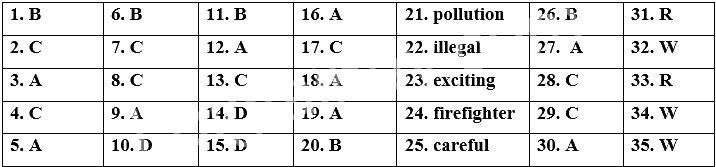
36. My brother wants to become a landscape gardener.
37. Lily was reading in the library when the explosion happened.
38. Unless we stop the illegal pet trade, many animals will be endangered.
39. My parents hate living in the city because there's too much traffic.
40. If you use your car too much, you'll make the air more polluted.
HƯỚNG DẪN GIẢI CHI TIẾT
1. B
Kiến thức: Nghe hiểu
Giải thích:
Mary muốn trở thành người như thế nào trong tương lai?
A. một lính cứu hỏa rừng
B. một người trông coi vườn thú
C. một bác sĩ thú y
D. một nhà thiết kế
Thông tin: I think I'll be a zookeeper when I grow up.
(Tôi nghĩ tôi sẽ trở thành người trông coi vườn thú khi lớn lên.)
Chọn B
2. C
Kiến thức: Nghe hiểu
Giải thích:
Mark thích điều gì nhất ở thành phố của anh ấy?
A. giao thông
B. bảo tàng
C. các món ăn địa phương
D. giải trí
Thông tin: But what I love most about my city is the local food.
(Nhưng điều tôi yêu thích nhất ở thành phố của mình là ẩm thực địa phương.)
Chọn C
3. A
Kiến thức: Nghe hiểu
Giải thích:
Cuối tuần này học sinh sẽ làm gì?
A. tái chế chai nhựa
B. đi biển
C. thu gom rác
D. tham gia ngày dọn dẹp
Thông tin: However, you will have to collect plastic bottles at home, and recycle them.
(Tuy nhiên, bạn sẽ phải thu gom chai nhựa ở nhà và tái chế chúng.)
Chọn A
4. C
Kiến thức: Nghe hiểu
Giải thích:
Cô gái quyết định viết về con vật nào?
A. vượn cáo
B. khỉ đột
C. rùa biển
D. vẹt đuôi dài
Thông tin: I heard you wrote about the sea turtles.
(Tôi nghe nói bạn viết về rùa biển.)
Chọn C
5. A
Kiến thức: Nghe hiểu
Giải thích:
Vụ tai nạn ô tô xảy ra ở đâu?
A. trước nhà hàng
B. trước cửa hàng
C. trước trường học
D. trước thư viện
Thông tin: It was in front of the restaurant, you're our school, I think two people were injured.
(Đó là ở phía trước nhà hàng, bạn là trường học của chúng tôi, tôi nghĩ có hai người bị thương.)
Chọn A
Bài nghe:
1. What does Mary want to be in the future?
Drew: This dress looks great Mary, you are always very creative. I'm sure you will become an excellent designer in the future.
Mary: Thanks. I prefer working at the zoo and looking after the animals. I think I'll be a zookeeper when I grow up. What about you, Drew?
Drew: I want to be a forest firefighter.
Mary: That's cool.
2. What does Mark like best about his city?
Mie: I'm really excited about coming to your city next summer, Mark.
Mark: Me too, Mie.
Mie: Tell me a bit about your city.
Mark: Well, the traffic is quite busy, but there's lots of entertainment and you can go shopping and lots of shops and malls. There's also a famous museum. But what I love most about my city is the local food. It's very delicious.
3. What are the students going to do this weekend?
Mr Jones: Everyone's attention please. We are going to have a clean up day at the beach this weekend.
Students: Wow, how can Mr. Jones?
Mr Jones: It was canceled because of the big storm coming in. However, you will have to collect plastic bottles at home, and recycle them. And you need to send me pictures of your results. Is that clear to everyone?
Students:Yes, Mr. Jones.
4. Which animal did the girl decide to write about?
Laura’s friend: Laura, did you finish your homework about endangered animals?
Laura: Yes, I just finished it yesterday. I heard you wrote about the sea turtles, right?
Laura’s friend: Exactly. What animals did you write about?
Laura:Well, I wanted to write about the gorilla, but I didn't know much about this animal. Then the Lemur was quite difficult to write. so I chose Macaw.
5. Where did the car crash happen?
A: The shop is going to close. Why are you so late?
B: I got stuck in traffic. There was a car crash on my way here, and the rovers were crowded.
A: Oh really? Or was a car crash?
B: It was in front of the restaurant, you're our school, I think two people were injured.
A: Oh, tears. That's bad.
Tạm dịch:
1. Mary muốn trở thành người như thế nào trong tương lai?
Drew: Chiếc váy này trông rất tuyệt Mary, bạn luôn rất sáng tạo. Tôi chắc chắn bạn sẽ trở thành một nhà thiết kế xuất sắc trong tương lai.
Mary: Cảm ơn. Tôi thích làm việc ở sở thú và chăm sóc động vật hơn. Tôi nghĩ tôi sẽ trở thành người trông coi vườn thú khi lớn lên. Còn bạn thì sao, Drew?
Drew: Tôi muốn trở thành lính cứu hỏa rừng.
Mary: Điều đó thật tuyệt.
2. Mark thích điều gì nhất ở thành phố của anh ấy?
Mie: Tôi thực sự háo hức được đến thành phố của bạn vào mùa hè tới, Mark.
Mark: Anh cũng vậy, Mie.
Mie: Hãy kể cho tôi nghe một chút về thành phố của bạn.
Mark: Ồ, giao thông khá đông đúc, nhưng có rất nhiều hoạt động giải trí và bạn có thể đi mua sắm cũng như rất nhiều cửa hàng và trung tâm thương mại. Ngoài ra còn có một bảo tàng nổi tiếng. Nhưng điều tôi yêu thích nhất ở thành phố của mình là ẩm thực địa phương. Nó rất ngon.
3. Cuối tuần này học sinh sẽ làm gì?
Ông Jones: Xin mọi người chú ý. Chúng ta sẽ có một ngày dọn dẹp ở bãi biển vào cuối tuần này.
Học sinh: Wow, làm sao mà thầy Jones được?
Ông Jones: Nó đã bị hủy vì cơn bão lớn đang kéo đến. Tuy nhiên, bạn sẽ phải thu gom chai nhựa ở nhà và tái chế chúng. Và bạn cần gửi cho tôi hình ảnh kết quả của bạn. Mọi người đã rõ chưa?
Học sinh: Vâng, thưa ông Jones.
4. Cô gái quyết định viết về con vật nào?
Bạn của Laura: Laura, bạn đã làm xong bài tập về nhà về các loài động vật có nguy cơ tuyệt chủng chưa?
Laura: Vâng, tôi vừa mới làm xong nó ngày hôm qua. Tôi nghe nói bạn viết về rùa biển. Phải?
Bạn của Laura: Chính xác. Bạn đã viết về những con vật nào?
Laura: À, tôi muốn viết về khỉ đột, nhưng tôi không biết nhiều về loài vật này. Khi đó Vượn cáo khá khó viết. nên tôi đã chọn vẹt đuôi dài.
5. Vụ tai nạn ô tô xảy ra ở đâu?
A: Cửa hàng sắp đóng cửa. Tại sao bạn đến muộn vậy?
B: Tôi bị kẹt xe. Có một vụ tai nạn ô tô trên đường tôi tới đây, và xe rover rất đông.
Đáp: Ồ thật sao? Hay là một vụ tai nạn ô tô?
B: Đó là ở phía trước nhà hàng, bạn là trường học của chúng tôi, tôi nghĩ có hai người bị thương.
A: Ôi, nước mắt. Thật tồi tệ.
6. B
Kiến thức: Phát âm “o”
Giải thích:
A. perform /pəˈfɔːm/
B. rocky /ˈrɒk.i/
C. boring /ˈbɔː.rɪŋ/
D. important /ɪmˈpɔː.tənt/
Phần được gạch chân ở phương B được phát âm /ɒ/, các phương án còn lại phát âm /ɔː/.
Chọn B
7. C
Kiến thức: Phát âm “s”
Giải thích:
Cách phát âm đuôi -s, -es:
- Đuôi s, es phát âm là /iz/ khi tận cùng là các âm /s/, /z/, /ʃ/, /ʒ/, /tʃ/, /dʒ/.
- Đuôi s, es phát âm là /s / khi tận cùng là các âm /p/, /f/, /t/, /k/, /ө/.
- Đuôi s, es phát âm là /z/ khi tận cùng là các âm còn lại.
A. leaves /liːvz/
B. enjoys /ɪnˈdʒɔɪz/
C. pollutes /pəˈluːts/
D. avoids /əˈvɔɪdz/
Phần được gạch chân ở phương C được phát âm /s/, các phương án còn lại phát âm /z/.
Chọn C
8. C
Kiến thức: Phát âm “ed”
Giải thích:
Cách phát âm đuôi -ed
Đuôi /ed/ được phát âm là /t/: Khi động từ kết thúc bằng âm /s/, /f/, /p/, /ʃ/, /tʃ/, /k/.
Đuôi /ed/ được phát âm là /id/: Khi động từ kết thúc bằng âm /t/ hoặc /d
Đuôi /ed/ được phát âm là /d/: Với những trường hợp còn lại.
A. happened /ˈhæp.ənd/
B. appeared /əˈpɪərd/
C. erupted /ɪˈrʌptid/
D. destroyed /dɪˈstrɔɪd/
Phần được gạch chân ở phương C được phát âm /id/, các phương án còn lại phát âm /d/.
Chọn C
9. A
Kiến thức: Trọng âm có 2 âm tiết
Giải thích:
A. design /dɪˈzaɪn/
B. village /ˈvɪl.ɪdʒ/
C. shelter /ˈʃel.tər/
D. province /ˈprɒv.ɪns/
Phương án A có trọng âm 2, các phương án còn lại có trọng âm 1.
Chọn A
10. D
Kiến thức: Trọng âm có 3 âm tiết
Giải thích:
A. important /ɪmˈpɔː.tənt/
B. historic /hɪˈstɒr.ɪk/
C. exciting /ɪkˈsaɪ.tɪŋ/
D. beautiful /ˈbjuː.tɪ.fəl/
Phương án D có trọng âm 1, các phương án còn lại có trọng âm 2.
Chọn D
11. B
Kiến thức: Từ vựng
Giải thích:
A. modern (adj): hiện đại
B. historic (adj): lịch sử
C. friendly (adj): thân thiện
D. busy (adj): bận
Many people love going to Hội An for its historic buildings. They are old and unique.
(Nhiều người thích đến Hội An vì những tòa nhà lịch sử ở đây. Chúng cũ và độc đáo.)
Chọn B
12. A
Kiến thức: Từ vựng
Giải thích:
A. shook (v): rung chuyển
B. blew (v): thổi
C. erupted (v): phun trào
D. overflowed (v): tràn
The building shook while my family was sleeping at this time yesterday.
(Tòa nhà rung chuyển khi gia đình tôi đang ngủ vào giờ này ngày hôm qua.)
Chọn A
13. C
Kiến thức: V-ing/ to V
Giải thích:
plan + to V: có kế hoạch làm gì
Kim is planning to visit Times Square in New York City.
(Kim đang có kế hoạch đến thăm Quảng trường Thời đại ở thành phố New York.)
Chọn C
14. D
Kiến thức: Mạo từ
Giải thích:
Nashville là tên một thành phố => Không cần mạo từ
“city” chỉ thành phố Nashville đã được người nói đề cập trước đó => dùng mạo từ “the”
In May 2010, heavy rains caused floods in Nashville, the USA. The flood waters covered all the areas of the city.
(Tháng 5/2010, mưa lớn gây lũ lụt ở Nashville, Mỹ. Nước lũ bao trùm toàn bộ khu vực của thành phố.)
Chọn D
15. D
Kiến thức: V-ing/ to V
Giải thích:
suggest + V-ing: đề xuất làm gì
I suggest joining clean-up events at the beach every week.
(Tôi khuyên bạn nên tham gia các sự kiện dọn dẹp bãi biển hàng tuần.)
Chọn D
16. A
Kiến thức: Chức năng giap tiếp
Giải thích:
A. Thật khủng khiếp!
B. Thật tốt khi bạn nói như vậy.
C. Cảm ơn bạn.
D. Tôi ổn.
John: "Hey, did you hear about the plane crash yesterday? Many people were lost." - Sarah: " How terrible!”
(John: "Này, cậu có nghe nói về vụ tai nạn máy bay ngày hôm qua không? Nhiều người đã mất tích." - Sarah: "Thật kinh khủng!")
Chọn A
17. C
Kiến thức: Liên từ
Giải thích:
Cấu trúc: S1 + V (tương lai đơn) + as soon as + S2 + V (hiện tại đơn/hiện tại hoàn thành): nói về 2 hành động nối tiếp diễn ra ở tương lai chưa diễn ra ở thời điểm nói.
The emergency lighting will work as soon as the electricity is cut.
(Hệ thống chiếu sáng khẩn cấp sẽ hoạt động ngay khi mất điện.)
Chọn C
18. A
Kiến thức: Thì hiện tại đơn
Giải thích:
Thì hiện tại đơn nói về một lịch trình có sẵn, chương trình, thời gian biểu cố định.
The documentary about the Titanic shipwreck starts at 8 p.m on Channel 4.
(Phim tài liệu về vụ đắm tàu Titanic bắt đầu lúc 8 giờ tối trên Kênh 4.)
Chọn A
19. A
Kiến thức: Từ vựng
Giải thích:
A. terrified (adj): kinh hãi
B. relieved (adj): nhẹ nhõm
C. relaxed (adj): thư giãn
D. excited (adj): vui mừng
Everybody was terrified when the disaster happened.
(Mọi người đều vô cùng kinh hãi khi thảm họa xảy ra.)
Chọn A
20. B
Kiến thức: Từ vựng
Giải thích:
A. quiet (adj): yên tĩnh
B. crowded (adj): đông đúc
C. beautiful (adj): đẹp
D. empty (adj): trống không, vắng vẻ
The town was crowded with a lot of volunteers from different places.
(Thị trấn đông đúc với rất nhiều tình nguyện viên từ nhiều nơi khác nhau.)
Chọn B
21. pollution
Kiến thức: Từ vựng – Từ loại
Giải thích:
Sau “much” cần một danh từ.
pollute (v): ô nhiễm
pollution (n): sự ô nhiễm
Henry doesn’t like living in the cities because there’s too much pollution in the air.
(Henry không thích sống ở thành phố vì không khí quá ô nhiễm.)
Đáp án: pollution
22. illegal
Kiến thức: Từ vựng – Từ loại
Giải thích:
“hunting” là một danh từ => Chỗ trống cần điền một tính từ.
legal (adj): hợp pháp
illegal (adj): bất hợp pháp
We can save many endangered animals if we stop illegal hunting.
(Chúng ta có thể cứu được nhiều loài động vật có nguy cơ tuyệt chủng nếu chúng ta ngừng săn bắt trái phép.)
Đáp án: illegal
23. exciting
Kiến thức: Từ vựng – Từ loại
Giải thích:
Sau mạo từ “the” cần một danh từ.
excite (v): kích động
exciting (adj): thú vị
In the West End, you can enjoy the exciting city life and go shopping in the crowded high streets.
(Ở West End, bạn có thể tận hưởng cuộc sống thành phố thú vị và đi mua sắm trên những con phố đông đúc.)
Đáp án: exciting
24. firefighter
Kiến thức: Từ vựng – Từ loại
Giải thích:
Sau mạo từ “the” cần một danh từ.
fire (n): ngọn lửa
firefighter (n): lính cứu hỏa
Everyone was relieved after the firefighter put out the fire.
(Mọi người thở phào nhẹ nhõm sau khi lính cứu hỏa dập tắt đám cháy.)
Đáp án: fire-fighter
25. careful
Kiến thức: Từ vựng – Từ loại
Giải thích:
Cấu trúc: S + be + adj => cần một tính từ chủ động để mô tả tính chất của sự vật
care (n): quan tâm
careful (adj): cẩn thận
Dolphins are friendly animals, but you must be careful when you are around them.
(Cá heo là loài động vật thân thiện nhưng bạn phải cẩn thận khi ở gần chúng.)
Đáp án: careful
26. B
Kiến thức: Từ vựng
Giải thích:
A. crashes (n): sự cố
B. disasters (n): thiên tai
C. accidents (n): tai nạn
D. experiences (n): kinh nghiệm
Many natural (26) disasters, such as floods, storms and heat waves, are caused by global warming.
(Nhiều thiên tai (26), chẳng hạn như lũ lụt, bão và sóng nhiệt, là do sự nóng lên toàn cầu.)
Chọn B
27. A
Kiến thức: V-ing/ to V
Giải thích:
make + V-inf: khiến
Firstly, this causes rain to come more frequently and makes storms (27) become even stronger.
(Thứ nhất, điều này khiến mưa đến thường xuyên hơn và khiến bão (27) càng mạnh hơn.)
Chọn A
28. C
Kiến thức: Từ vựng
Giải thích:
A. dry up (v): cạn kiệt
B. disappear (v): biến mất
C. rise (v): tăng lên
D. pollute (v): ô nhiễm
When ice caps melt, the sea level will (28) rise– which is dangerous to people living near the sea.
(Khi băng tan, mực nước biển sẽ (28) dâng lên - điều này gây nguy hiểm cho những người sống gần biển.)
Chọn C
29. C
Kiến thức: Mạo từ
Giải thích:
“The” khi nói về một vật riêng hoặc một người mà cả người nghe và người nói đều biết.
Finally, global warming also causes changes in (29) the environment, which destroys many animals' habitats.
(Cuối cùng, sự nóng lên toàn cầu cũng gây ra những thay đổi trong (29) môi trường, phá hủy môi trường sống của nhiều loài động vật.)
Chọn C
30. A
Kiến thức: Từ vựng – Từ loại
Giải thích:
A. loss (n): sự mất mát
B. lost (adj): thất lạc
C. lose (v): mất
D. loose (adj): lỏng lẻo
Many animals are now threatened by habitat (30) loss.
(Nhiều loài động vật hiện đang bị đe dọa do mất môi trường sống.)
Chọn A
Đoạn văn hoàn chỉnh:
GLOBAL WARMING
Many natural (26) disasters, such as floods, storms and heat waves, are caused by global warming. The question is what causes global warming? Most scientists agree that human activities are to blame For warming the Earth. The increased temperature can cause a number of environmental issues. Firstly, this causes rain to come more frequently and makes storms (27) become even stronger.
Secondly, global warming makes ice caps melt. When ice caps melt, the sea level will (28) rise which is dangerous to people living near the sea. Finally, global warming also causes changes in (29) the environment, which destroys many animals' habitats. Many animals are now threatened by habitat (30) loss.
It is critical to protect the environment. To prevent the Earth from warming, we must be prepared and find solutions to help save our planet.
Tạm dịch:
SỰ NÓNG LÊN TOÀN CẦU
Nhiều thiên tai (26), chẳng hạn như lũ lụt, bão và sóng nhiệt, là do sự nóng lên toàn cầu. Câu hỏi đặt ra là nguyên nhân gây ra hiện tượng nóng lên toàn cầu? Hầu hết các nhà khoa học đều đồng ý rằng các hoạt động của con người là nguyên nhân khiến Trái đất nóng lên. Nhiệt độ tăng lên có thể gây ra một số vấn đề về môi trường. Thứ nhất, điều này khiến mưa đến thường xuyên hơn và khiến bão (27) càng mạnh hơn.
Thứ hai, hiện tượng nóng lên toàn cầu làm băng tan. Khi băng tan, mực nước biển sẽ (28) dâng cao gây nguy hiểm cho người dân sống gần biển. Cuối cùng, sự nóng lên toàn cầu cũng gây ra những thay đổi trong (29) môi trường, phá hủy môi trường sống của nhiều loài động vật. Nhiều loài động vật hiện đang bị đe dọa do mất môi trường sống (30).
Điều quan trọng là phải bảo vệ môi trường. Để ngăn chặn Trái đất nóng lên, chúng ta phải chuẩn bị và tìm giải pháp giúp cứu hành tinh của chúng ta.
Bài đọc hiểu:
The Skeleton Coast
The Skeleton Coast is the coastline of southern Africa. It got its name because people found many bones from whales and seals there. There were also a lot of human bones along the coast. This place is famous for having a large number of shipwrecks, over a thousand in fact. When sailors hear about the Skeleton Coast, they are usually terrified.
In 1912, a ship called The Gertrud Woermann II sank and disappeared into the ocean. The ship was carrying hundreds of people, horses, and other items when it was destroyed by a strong storm. The Winston was another shipwreck off the Skeleton Coast. It hit the shore on 17 October, 1970. People can still see parts of the ship along the coast.
Sometimes a shipwreck comes with treasure. The discovery of the Bom Jesus was in April 2008, and a worker found many gold coins from the shipwreck. Most of the coins were of Spanish origin. However, it is believed that the ship came from Portugal, and it was sailing to India.
Tạm dịch:
Bờ biển Skeleton
Bờ biển Skeleton là bờ biển phía nam châu Phi. Nó có tên như vậy vì người ta tìm thấy nhiều xương của cá voi và hải cẩu ở đó. Ngoài ra còn có rất nhiều xương người dọc theo bờ biển. Nơi này nổi tiếng vì có số lượng lớn các vụ đắm tàu, thực tế là hơn một nghìn. Khi các thủy thủ nghe về Skeleton Coast, họ thường rất sợ hãi.
Năm 1912, con tàu mang tên Gertrud Woermann II bị chìm và biến mất dưới đại dương. Con tàu chở hàng trăm người, ngựa và các vật dụng khác thì bị một cơn bão mạnh phá hủy. Winston là một con tàu đắm khác ngoài khơi Skeleton Coast. Nó dạt vào bờ vào ngày 17 tháng 10 năm 1970. Người ta vẫn có thể nhìn thấy các phần của con tàu dọc theo bờ biển.
Đôi khi một vụ đắm tàu đi kèm với kho báu. Bom Jesus được phát hiện vào tháng 4 năm 2008 và một công nhân đã tìm thấy nhiều đồng tiền vàng từ con tàu đắm. Hầu hết các đồng tiền đều có nguồn gốc từ Tây Ban Nha. Tuy nhiên, người ta tin rằng con tàu đến từ Bồ Đào Nha và đang đi đến Ấn Độ.
31. R
Kiến thức: Đọc hiểu
Giải thích:
People found many bones of animals and humans along the coast.
(Người ta tìm thấy nhiều xương của động vật và con người dọc bờ biển.)
Thông tin: It got its name because people found many bones from whales and seals there. There were also a lot of human bones along the coast.
(Nó có tên như vậy vì người ta tìm thấy nhiều xương của cá voi và hải cẩu ở đó. Ngoài ra còn có rất nhiều xương người dọc theo bờ biển.)
Đáp án: R
32. W
Kiến thức: Đọc hiểu
Giải thích:
Skeleton Coast is a favourite place for sailors.
(Skeleton Coast là địa điểm yêu thích của các thủy thủ.)
Thông tin: When sailors hear about the Skeleton Coast, they are usually terrified.
(Khi các thủy thủ nghe về Skeleton Coast, họ thường rất sợ hãi.)
Đáp án: W
33. R
Kiến thức: Đọc hiểu
Giải thích:
A strong storm caused the shipwreck of The Gertrud Woermann II.
(Một cơn bão mạnh đã gây ra vụ đắm tàu The Gertrud Woermann II.)
Thông tin: The ship was carrying hundreds of people, horses, and other items when it was destroyed by a strong storm.
(Con tàu chở hàng trăm người, ngựa và các vật dụng khác thì bị một cơn bão mạnh phá hủy.)
Đáp án: R
34. W
Kiến thức: Đọc hiểu
Giải thích:
Parts of The Winston disappeared completely after the shipwreck.
(Các bộ phận của Winston biến mất hoàn toàn sau vụ đắm tàu.)
Thông tin: People can still see parts of the ship along the coast.
(Người ta vẫn có thể nhìn thấy các phần của con tàu dọc theo bờ biển.)
Đáp án: W
35. W
Kiến thức: Đọc hiểu
Giải thích:
The Bom Jesus was a Spanish ship.
(Bom Jesus là một con tàu của Tây Ban Nha.)
Thông tin: However, it is believed that the ship came from Portugal, and it was sailing to India.
(Tuy nhiên, người ta tin rằng con tàu đến từ Bồ Đào Nha và đang đi đến Ấn Độ.)
Đáp án: W
36.
Kiến thức: Cấu trúc câu cơ bản
Giải thích:
Cấu trúc câu: S + V + O
S: Tính từ sở hữu + danh từ => My brother (anh trai tôi)
V: want + to V => wants to be come (muốn trở thành)
O: mạo từ + danh từ => a landscape gardener (người làm vườn cảnh)
=> My brother wants to become a landscape gardener.
(Anh trai tôi muốn trở thành một người làm vườn cảnh.)
Đáp án: My brother wants to become a landscape gardener.
37.
Kiến thức: Thì quá khứ đơn và quá khứ tiếp diễn
Giải thích:
Cấu trúc thì quá khứ đơn và quá khứ tiếp diễn với “when”:
+ thì quá khứ đơn: hành động ngắn => the explosion happened (vụ nổ xảy ra)
+ thì quá khứ tiếp diễn: hành động kéo dài => Lily was reading in the libraty (Lily đang đọc trong thư viện)
=> Lily was reading in the library when the explosion happened.
(Lily đang đọc sách trong thư viện thì vụ nổ xảy ra.)
Đáp án: Lily was reading in the library when the explosion happened.
38.
Kiến thức: Câu điều kiện loại 1
Giải thích:
Unless + S + V (thì hiện tại đơn), S+ will/ can/ shall + V = If not + S + V (thì hiện tại đơn), S+ will/ can/ shall + V
If we don't stop illegal pet trade, many animals will be endangered.
(Nếu chúng ta không ngăn chặn việc buôn bán thú cưng bất hợp pháp, nhiều loài động vật sẽ gặp nguy hiểm.)
=> Unless we stop the illegal pet trade, many animals will be endangered.
(Trừ khi chúng ta ngăn chặn việc buôn bán thú cưng bất hợp pháp, nhiều loài động vật sẽ gặp nguy hiểm.)
Đáp án: we stop illegal pet trade, many animals will be endangered.
39.
Kiến thức: V-ing/ to V
Giải thích:
don’t like + V-ing = hate + V-ing: ghét làm gì
My parents don't like living in the city because there's too much traffic.
(Bố mẹ tôi không thích sống ở thành phố vì có quá nhiều xe cộ qua lại.)
=> My parents hate living in the city because there's too much traffic.
(Bố mẹ tôi ghét sống ở thành phố vì có quá nhiều xe cộ qua lại.)
Đáp án: living in the city because there's too much traffic.
40.
Kiến thức: Câu điều kiện loại 1
Giải thích:Cấu trúc: If + S + V (simple present), S + will/can/shall + V
Don't use your car too much, or you'll make the air more polluted.
(Đừng sử dụng ô tô quá nhiều, nếu không bạn sẽ làm cho không khí trở nên ô nhiễm hơn.)
=> If you use your car too much, you'll make the air more polluted.
(Nếu bạn sử dụng ô tô quá nhiều, bạn sẽ làm cho không khí trở nên ô nhiễm hơn.)
Đáp án: use your car too much, you'll make the air more polluted.
Đề thi học kì 1 Tiếng Anh 8 Global Success - Đề số 8
Đề bài
PART I. LANGUAGE
Choose the word whose underlined part is pronounced differently.
1.
A. block
B. report
C. iPod
D. novel
2.
A. victim
B. realize
C. violence
D. childhood
3.
A. tablet
B. gadget
C. battery
D. strange
Choose the word that has a different stressed syllable from the rest.
4.
A. typhoon
B. outdoor
C. valley
D. thunder
5.
A. actor
B. produce
C. perform
D. review
Choose the best answer for each question.
6. It’s a not good _________ movie. We didn’t find it funny and slept throughout most of the films.
A. sci-fi
B. comedy
C. fairy tale
D. romantic
7. The process when kids undergo a lot of physical and mental changes to become teenagers is called_______.
A. childhood
B. adulthood
C. puberty
D. adolescents
8. There ________ some news for you, both good and bad. What would you like to hear first?
A. is
B. are
C. were
D. was
9. 50% of the interviewed teenagers in the UK said they used their phones more than 3 hours per day, and __________ do the teenagers from Japan.
A. neither
B. so
C. too
D. either
10. Get me the jacket please, it’s __________ cold today.
A. freezing
B. boiling
C. stormy
D. raining
11. You use a __________ to make your phone battery go full again.
A. gadget
B. camera
C. charger
D. tablet
12. Bullying can make the victims feel ________ and pressured to go back to school.
A. hopeful
B. envious
C. hopeless
D. amazing
13. No one in my team wants to lose the game, and _________ does the opponent team.
A. neither
B. so
C. either
D. too
14. I and Anna was best friend during my childhood, but now we don’t __________ well.
A. get along
B. break down
C. give up
D. hang up
15. She’s the _________ actress in the play. She did the role so well that everyone was crying over the character.
A. good
B. better
C. best
D. worst
Fill in the blank with the correct form of the word in the bracket.
16. The ______________ at our school’s anniversary was amazing. (PERFORM)
17. This ______________ is so awful. He makes me look so ugly in my wedding album! (PHOTO)
18. Many teenagers go through a difficult ______________ due to parental pressure. (CHILD)
19. In 2011, there was a massive ______________ in Japan. (EARTH)
20. The film receives both positive and negative ______________ from the audience. (VIEW)
PART II. READING
Read the text and choose the best answer for the below questions.
Today I learn about a convenient gadget called the iPod nano, which works as a music player. iPod nano is a product by Apple. It is only 1.6 inches wide and 3.5 inches long, so it’s a very tiny device. These iPods come with two different colours (black and white) and two different memory sizes: 2GB (for almost 500 songs) and 4GB (1000 songs) so you can choose what fits you most. Apple also includes some accessories when you buy the nano Ipod: the package comes with a pair of earphones, a charger and a cable. iPod nano’s battery can last for up to 5 hours when it is fully charged.
You can download your favourite songs and import them into the iPods to listen to your music anywhere you go. To do this, plug in the cable and connect your iPod to your laptop or computer. Next, go to some music websites like Soundcloud to download your favourite tracks. When the music files are on your computer, you can move them into the iPod folder. You can also add in more songs or delete the songs in this way!
21. How many songs can you download with a 4GB iPod nano?
A. 500 songs
B. more than 1000 songs
C. 1000 songs
D. less than 500 songs
22. What item is NOT included in the iPod nano package?
A. charger
B. memory card
C. earphones
D. cable
23. What does the word “them” refer to?
A. iPod nano
B. computer
C. folder
D. music files
24. What is NOT true about the iPod nano?
A. The battery can last for 5 hours.
B. They are made by Apple.
C. They are big devices.
D. They have two different colours.
25. What is the main idea of the text?
A. Apple’s iPod industry.
B. The features of iPod nano.
C. How to download songs.
D. The benefits of music.
Choose the best answer to fill in each numbered blank in the text below.
When violent events happen outside the control of humans, they are called natural disasters. Natural forces are the causes of these events. There are many kinds of natural disasters, and they can (26) ________loss of life, injury, and damage to property.
So, can we predict natural disasters? The answer is a definite 'yes' for (27) ________kinds of natural disasters. Scientists understand the factors that lead to storms, tornadoes, and floods. (28) ________, it is much more difficult to predict earthquakes and volcanic eruptions. Some volcanos (29) ________leak gases or pour out lava before erupting, but others do not give any warnings at all. It is also difficult to predict earthquakes although scientists are (30) ________of the regions where earthquakes are most likely to happen.
26.
A. take in
B. result in
C. come in
D. get in
27.
A. some
B. few
C. lots
D. little
28.
A. Moreover
B. Therefore
C. However
D. Otherwise
29.
A. should
B. must
C. will
D. may
30.
A. aware
B. fond
C. concerned
D. crazy
PART III. WRITING
Rewrite the sentence using the word given in the bracket. DO NOT CHANGE THE GIVEN WORDS.
31. Both Mary and Bob use electronic devices for more than 5 hours a day. (SO)
→ ____________________________________________________.
32. Jill and Anna plan to meet each other once a week. (GET)
→ ____________________________________________________.
33. I was watching the news on TV. Suddenly, they reported an emergency notice about the typhoon. (WHEN)
→ ____________________________________________________.
34. My dad watches sports news everyday. He loves it. (WATCHING)
→ _____________________________________________________.
35. Everyone in my class is shorter than Bill. (TALLEST)
→ _____________________________________________________.
PART IV. LISTENING
Listen and fill in the blanks.
36. Margaret wants to become a __________.
37. Patricia and Barbara want to be __________.
38. Ken will be a good __________ because he's funny.
39. The dream of Margaret’s mother was to become a__________.
40. Margaret's father wanted to start a__________.
----------------------THE END----------------------
Xem đáp án
HƯỚNG DẪN GIẢI
Thực hiện: Ban chuyên môn trithuchub.com
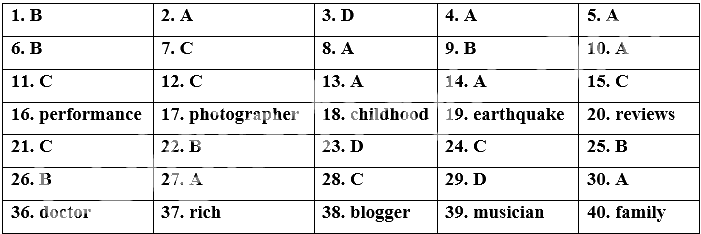
31. Mary uses electronic devices for more than 5 hours a day, so does Bob.
32. Jill and Anna plan to get together once a week.
33. I was watching the news on TV when they reported an emergency notice about the typhoon.
34. My dad loves watching sports news every day.
35. Bill is the tallest person in my class.
HƯỚNG DẪN GIẢI CHI TIẾT
1. B
Kiến thức: Phát âm “o”
Giải thích:
A. block /blɒk/
B. report /rɪˈpɔːt/
C. iPod /ˈaɪ.pɒd/
D. novel /ˈnɒv.əl/
Phần được gạch chân ở phương án B được phát âm /ɔː/, các phương án còn lại phát âm /ɒ/.
Đáp án: B
2. A
Kiến thức: Phát âm “i”
Giải thích:
A. victim /ˈvɪk.tɪm/
B. realize /ˈrɪə.laɪz/
C. violence /ˈvaɪə.ləns/
D. childhood /ˈtʃaɪld.hʊd/
Phần được gạch chân ở phương án A được phát âm /ɪ/, các phương án còn lại phát âm /aɪ/.
Đáp án: A
3. D
Kiến thức: Phát âm “a”
Giải thích:
A. tablet /ˈtæb.lət/
B. gadget /ˈɡædʒ.ɪt/
C. battery /ˈbæt.ər.i/
D. strange /streɪndʒ/
Phần được gạch chân ở phương án D được phát âm /eɪ/, các phương án còn lại phát âm /æ/.
Đáp án: D
4. A
Kiến thức: Trọng âm từ có 2 âm tiết
Giải thích:
A. typhoon /taɪˈfuːn/
B. outdoor /ˈaʊtˌdɔːr/
C. valley /ˈvæl.i/
D. thunder /ˈθʌn.dər/
Phương án A có trọng âm 2, các phương án còn lại có trọng âm 1.
Đáp án: A
5. A
Kiến thức: Trọng âm từ có 2 âm tiết
Giải thích:
A. actor /ˈæk.tər/
B. produce /prəˈdʒuːs/
C. perform /pəˈfɔːm/
D. review /rɪˈvjuː/
Phương án A có trọng âm 1, các phương án còn lại có trọng âm 2.
Đáp án: A
6. B
Kiến thức: Từ vựng
Giải thích:
A. sci-fi: khoa học viễn tưởng
B. comedy: hài kịch
C. fairy tale: cổ tích
D. romantic: lãng mạn
It’s a not good comedy movie. We didn’t find it funny and slept throughout most of the films.
Tạm dịch: Đó là một bộ phim hài không hay. Chúng tôi không thấy buồn cười và ngủ suốt hầu hết các bộ phim.
Đáp án: B
7. C
Kiến thức: Từ vựng
Giải thích:
A. childhood (n): thời thơ ấu
B. adulthood (n): tuổi trưởng thành
C. puberty (n): tuổi dậy thì
D. adolescents (n): thanh thiếu niên
The process when kids undergo a lot of physical and mental changes to become teenagers is called puberty.
Tạm dịch: Quá trình trẻ trải qua nhiều thay đổi về thể chất và tinh thần để trở thành thiếu niên được gọi là tuổi dậy thì.
Đáp án: C
8. A
Kiến thức: Thì của động từ
Giải thích:
Câu kể ở hiện tại => động từ chia thì hiện tại đơn.
Danh từ chính “news” là danh từ không đếm được => chia động từ tobe dạng số ít: “is”.
There is some news for you, both good and bad. What would you like to hear first?
Tạm dịch: Có một số tin tức dành cho bạn, cả tốt lẫn xấu. Bạn muốn nghe điều gì đầu tiên?
Đáp án: A
9. B
Kiến thức: Câu đồng tình
Giải thích:
Cấu trúc “so do + N”: ai/cái gì cũng vậy => dùng trong câu khẳng định diễn tả sự đồng tình.
50% of the interviewed teenagers in the UK said they used their phones more than 3 hours per day, and so do the teenagers from Japan.
Tạm dịch: 50% thanh thiếu niên được phỏng vấn ở Anh cho biết họ sử dụng điện thoại hơn 3 giờ mỗi ngày và thanh thiếu niên ở Nhật Bản cũng vậy.
Đáp án: B
10. A
Kiến thức: Từ vựng
Giải thích:
A. freezing: đóng băng
B. boiling: sôi
C. stormy: giông bão
D. raining: mưa
Cụm từ “freezing cold” (lạnh cóng, rét cóng)
Get me the jacket please, it’s freezing cold today.
Tạm dịch: Làm ơn lấy cho tôi chiếc áo khoác, hôm nay trời lạnh cóng.
Đáp án: A
11. C
Kiến thức: Từ vựng
Giải thích:
A. gadget (n): tiện ích
B. camera (n): máy ảnh
C. charger (n): bộ sạc
D. tablet (n): máy tính bảng
You use a charger to make your phone battery go full again.
Tạm dịch: Bạn sử dụng bộ sạc để làm pin điện thoại đầy trở lại.
Đáp án: C
12. C
Kiến thức: Từ vựng
Giải thích:
A. hopeful (adj): hy vọng
B. envious (adj): ghen tị
C. hopeless (adj): tuyệt vọng
D. amazing (adj): tuyệt vời
Bullying can make the victims feel hopeless and pressured to go back to school.
Tạm dịch: Bắt nạt có thể khiến nạn nhân cảm thấy tuyệt vọng và bị áp lực phải quay lại trường học.
Đáp án: C
13. A
Kiến thức: Câu đồng tình
Giải thích:
Cụm “neither do/does + S”: ai đó cũng không: dùng diễn tả sự đồng tình trong câu phủ định.
No one in my team wants to lose the game, and neither does the opponent team.
Tạm dịch: Không ai trong đội của tôi muốn thua trận và đội đối thủ cũng vậy.
Đáp án: A
14. A
Kiến thức: Cụm động từ
Giải thích:
A. get along: thân thiết, có quan hệ tốt
B. break down: sụp đổ, tan vỡ
C. give up: từ bỏ
D. hang up: kết thúc
I and Anna was best friend during my childhood, but now we don’t get along well.
Tạm dịch: Tôi và Anna là bạn thân thời thơ ấu, nhưng bây giờ chúng tôi không còn thân thiết nữa.
Đáp án: A
15. C
Kiến thức: So sánh hơn nhất
Giải thích:
Phía trước có “the” => phía sau cần điền tính từ dạng so sánh hơn nhất.
A. good: tốt
B. better: tốt hơn
C. best: tốt nhất
D. worst: tệ nhất
She’s the best actress in the play. She did the role so well that everyone was crying over the character.
Tạm dịch: Cô ấy là nữ diễn viên xuất sắc nhất trong vở kịch. Cô ấy đã nhập vai xuất sắc đến mức mọi người đều phải khóc vì nhân vật này.
Đáp án: C
16. performance
Kiến thức: Từ loại
Giải thích:
Vị trí còn trống cần điền một danh từ số ít làm chủ ngữ cho câu.
perform (v): thể hiện
performance (n): màn trình diễn
The performance at our school’s anniversary was amazing.
Tạm dịch: Buổi biểu diễn tại lễ kỷ niệm trường chúng tôi thật tuyệt vời.
Đáp án: performance
17. photographer
Kiến thức: Từ loại
Giải thích:
Vị trí còn trống cần điền một danh từ chỉ người số ít làm chủ ngữ cho câu.
photo (n): bức ảnh
photographer (n): nhiếp ảnh gia
This photographer is so awful. He makes me look so ugly in my wedding album!
Tạm dịch: Nhiếp ảnh gia này tệ quá. Anh ấy khiến tôi trông thật xấu xí trong album cưới!
Đáp án: photographer
18. childhood
Kiến thức: Từ loại
Giải thích:
Sau mạo từ “a” và tính từ “difficult” cần điền một danh từ số ít để tạo thành cụm danh từ.
child (n): đứa trẻ
childhood (n): tuổi thơ
Many teenagers go through a difficult childhood due to parental pressure.
Tạm dịch: Nhiều thanh thiếu niên phải trải qua tuổi thơ khó khăn do áp lực của cha mẹ.
Đáp án: childhood
19. earthquake
Kiến thức: Từ loại
Giải thích:
Vị trí còn trống cần điền một danh từ mang nghĩa “trận động đất”.
Earth (n): Trái Đất
earthquake (n): trận động đất
In 2011, there was a massive earthquake in Japan.
Tạm dịch: Năm 2011, có một trận động đất lớn ở Nhật Bản.
Đáp án: earthquake
20. reviews
Kiến thức: Từ loại
Giải thích:
Vị trí còn trống cần điền một danh từ đứng sau tính từ “positive and negative”. Phía trước có từ “both” => danh từ phía sau chia ở dạng số nhiều.
view (n): quan điểm, góc nhìn
review (n): nhận xét, đánh giá
The film receives both positive and negative reviews from the audience.
Tạm dịch: Bộ phim nhận được cả đánh giá tích cực và tiêu cực từ khán giả.
Đáp án: reviews
21. C
Kiến thức: Đọc hiểu
Giải thích:
Bạn có thể tải xuống bao nhiêu bài hát với iPod nano 4GB?
A. 500 songs: 500 bài hát
B. more than 1000 songs: hơn 1000 bài hát
C. 1000 songs: 1000 bài hát
D. less than 500 songs: dưới 500 bài hát
Thông tin: iPod nano is a product by Apple … These iPods come with two different colours (black and white) and two different memory sizes: 2GB (for almost 500 songs) and 4GB (1000 songs).
Tạm dịch: iPod nano là sản phẩm của Apple … Những chiếc iPod này có hai màu khác nhau (đen và trắng) và hai kích cỡ bộ nhớ khác nhau: 2GB (cho gần 500 bài hát) và 4GB (cho 1000 bài hát).
Đáp án: C
22. B
Kiến thức: Đọc hiểu
Giải thích:
Vật phẩm nào KHÔNG được bao gồm trong gói iPod nano?
A. charger: bộ sạc
B. memory card: thẻ nhớ
C. earphones: tai nghe
D. cable: cáp
Thông tin: Apple also includes some accessories when you buy the nano Ipod: the package comes with a pair of earphones, a charger and a cable.
Tạm dịch: Apple cũng tặng kèm một số phụ kiện khi bạn mua Ipod nano: gói đi kèm một cặp tai nghe, bộ sạc và cáp.
Đáp án: B
23. D
Kiến thức: Đọc hiểu
Giải thích:
Từ “they” ám chỉ điều gì?
A. iPod nano
B. computer: máy tính
C. folder: thư mục
D. music files: tập tin nhạc
Thông tin: When the music files are on your computer, you can move them into the iPod folder.
Tạm dịch: Khi các tập tin nhạc đã có trên máy tính của bạn, bạn có thể di chuyển chúng vào thư mục iPod.
Đáp án: D
24. C
Kiến thức: Đọc hiểu
Giải thích:
Điều gì KHÔNG đúng về iPod nano?
A. The battery can last for 5 hours: Pin có thể hoạt động trong 5 giờ.
B. They are made by Apple: Chúng được sản xuất bởi Apple.
C. They are big devices: Chúng là những thiết bị lớn.
D. They have two different colours: Chúng có hai màu khác nhau.
Thông tin: It is only 1.6 inches wide and 3.5 inches long, so it’s a very tiny device.
Tạm dịch: Nó chỉ rộng 1,6 inch và dài 3,5 inch, vì vậy đây là một thiết bị rất nhỏ.
Đáp án: C
25. B
Kiến thức: Đọc hiểu
Giải thích:
Ý chính của văn bản là gì?
A. Apple’s iPod industry: Ngành công nghiệp iPod của Apple.
B. The features of iPod nano: Các tính năng của iPod nano.
C. How to download songs: Cách tải bài hát.
D. The benefits of music: Lợi ích của âm nhạc.
Đáp án: B
Dịch bài đọc:
Hôm nay tôi tìm hiểu về một thiết bị tiện lợi có tên là iPod nano, hoạt động như một máy nghe nhạc. iPod nano là sản phẩm của Apple. Nó chỉ rộng 1,6 inch và dài 3,5 inch, vì vậy đây là một thiết bị rất nhỏ. Những chiếc iPod này có hai màu khác nhau (đen và trắng) và hai kích cỡ bộ nhớ khác nhau: 2GB (cho gần 500 bài hát) và 4GB (cho 1000 bài hát) để bạn có thể chọn loại phù hợp với mình nhất. Apple cũng tặng kèm một số phụ kiện khi bạn mua Ipod nano: gói đi kèm một cặp tai nghe, bộ sạc và cáp. Pin của iPod nano có thể kéo dài tới 5 giờ khi được sạc đầy.
Bạn có thể tải xuống các bài hát yêu thích của mình và nhập chúng vào iPod để nghe nhạc ở mọi nơi. Để thực hiện việc này, hãy cắm cáp và kết nối iPod với máy tính xách tay hoặc máy tính của bạn. Tiếp theo, hãy truy cập một số trang web âm nhạc như Soundcloud để tải những bản nhạc bạn yêu thích. Khi các tệp nhạc đã có trên máy tính của bạn, bạn có thể di chuyển chúng vào thư mục iPod. Bạn cũng có thể thêm nhiều bài hát hơn hoặc xóa bài hát theo cách này!
26. B
Kiến thức: Cụm động từ
Giải thích:
A. take in: lấy
B. result in: dẫn tới, gây ra
C. come in: đi vào
D. get in: đem vào
There are many kinds of natural disasters, and they can (26) result in loss of life, injury, and damage to property.
Tạm dịch: Có rất nhiều loại thiên tai, và chúng có thể dẫn đến mất mạng, thương tích, và thiệt hại về tài sản.
Đáp án: B
27. A
Kiến thức: Lượng từ
Giải thích:
A. some: một số
B. (a) few: một vài (+ danh từ đếm được)
C. lots (+ of): nhiều
D. (a) little: một ít (+ danh từ không đếm được)
The answer is a definite 'yes' for (27) some kinds of natural disasters.
Tạm dịch: Câu trả lời là chắc chắn 'có' cho (27) một số loại thiên tai.
Đáp án: A
28. C
Kiến thức: Liên từ
Giải thích:
A. Moreover: Hơn nữa
B. Therefore: Do đó
C. However: Tuy nhiên
D. Otherwise: Nếu không thì
Scientists understand the factors that lead to storms, tornadoes, and floods. (28) However, it is much more difficult to predict earthquakes and volcanic eruptions.
Tạm dịch: Các nhà khoa học hiểu rõ các yếu tố dẫn đến bão, lốc xoáy, lũ lụt. Tuy nhiên, việc dự đoán động đất và núi lửa phun trào khó khăn hơn nhiều.
Đáp án: C
29. D
Kiến thức: Động từ khuyết thiếu
Giải thích:
A. should: nên
B. must: phải
C. will: sẽ
D. may: có thể
Some volcanos (29) may leak gases or pour out lava before erupting, but others do not give any warnings at all.
Tạm dịch: Một số núi lửa có thể rò rỉ khí hoặc phun ra dung nham trước khi phun trào.
Đáp án: D
30. A
Kiến thức: Từ vựng
Giải thích:
A. aware (+ of): hiểu, nhận thức
B. fond (+ of): thích thú
C. concerned (+ about): lo lắng
D. crazy (+ about): thích, phát cuồng
It is also difficult to predict earthquakes although scientists are (30) aware of the regions where earthquakes are most likely to happen.
Tạm dịch: Nó cũng là khó khăn để dự đoán động đất mặc dù các nhà khoa học nhận thức được các khu vực nơi động đất có nhiều khả năng xảy ra nhất.
Đáp án: A
Bài hoàn chỉnh:
When violent events happen outside the control of humans, they are called natural disasters. Natural forces are the causes of these events. There are many kinds of natural disasters, and they can (26) result in loss of life, injury, and damage to property.
So, can we predict natural disasters? The answer is a definite 'yes' for (27) some kinds of natural disasters. Scientists understand the factors that lead to storms, tornadoes, and floods. (28) However, it is much more difficult to predict earthquakes and volcanic eruptions. Some volcanos (29) may leak gases or pour out lava before erupting, but others do not give any warnings at all. It is also difficult to predict earthquakes although scientists are (30) aware of the regions where earthquakes are most likely to happen.
Tạm dịch:
Khi những sự kiện bạo lực xảy ra ngoài tầm kiểm soát của con người, chúng được gọi là thiên tai. Các lực lượng tự nhiên là nguyên nhân của những sự kiện này. Có rất nhiều loại thiên tai, và họ có thể dẫn đến mất mạng, thương tích, và thiệt hại về tài sản.
Vậy chúng ta có thể dự đoán được thảm họa thiên nhiên không? Câu trả lời là chắc chắn 'có' cho một số loại thiên tai. Các nhà khoa học hiểu rõ các yếu tố dẫn đến bão, lốc xoáy, lũ lụt. Tuy nhiên, việc dự đoán động đất và núi lửa phun trào khó khăn hơn nhiều. Một số núi lửa có thể rò rỉ khí hoặc phun ra dung nham trước khi phun trào, nhưng một số khác lại không đưa ra bất kỳ cảnh báo nào cả. Nó cũng là khó khăn để dự đoán động đất mặc dù các nhà khoa học nhận thức được các khu vực nơi động đất có nhiều khả năng xảy ra nhất.
31.
Kiến thức: Câu đồng tình với “so”
Giải thích:
Cụm “so do/does + S”: diễn tả sự đồng tình trong câu khẳng định.
Both Mary and Bob use electronic devices for more than 5 hours a day.
(Cả Mary và Bob đều sử dụng thiết bị điện tử hơn 5 giờ mỗi ngày.)
Đáp án: Mary uses electronic devices for more than 5 hours a day, so does Bob.
(Mary sử dụng thiết bị điện tử hơn 5 giờ mỗi ngày, Bob cũng vậy.)
32.
Kiến thức: Cụm động từ
Giải thích:
Cấu trúc “meet each other” = “get together”: gặp nhau.
Jill and Anna plan to meet each other once a week.
(Jill và Anna dự định gặp nhau mỗi tuần một lần.)
Đáp án: Jill and Anna plan to get together once a week.
33.
Kiến thức: Thì quá khứ đơn – quá khứ tiếp diễn
Giải thích:
Câu diễn tả một hành động đang diễn ra trong quá khứ thì hành động khác xen vào => hành động đang diễn ra, kéo dài chia quá khứ tiếp diễn; hành động ngắn xen vào chia quá khứ đơn.
Cấu trúc: S1 + was/were + V-ing + when + S2 + V-ed + O.
I was watching the news on TV. Suddenly, they reported an emergency notice about the typhoon.
(Tôi đang xem tin tức trên TV. Đột nhiên, họ báo cáo một thông báo khẩn cấp về cơn bão.)
Đáp án: I was watching the news on TV when they reported an emergency notice about the typhoon.
(Tôi đang xem tin tức trên TV thì họ đưa ra thông báo khẩn cấp về cơn bão.)
34.
Kiến thức: Động từ theo sau bởi V-ing
Giải thích:
Cấu trúc: S + love + V-ing (yêu thích làm việc gì)
My dad watches sports news every day. He loves it.
(Bố tôi xem tin tức thể thao hàng ngày. Ông ấy yêu nó.)
Đáp án: My dad loves watching sports news every day.
(Bố tôi thích tin tức thể thao hàng ngày.)
35.
Kiến thức: So sánh hơn – so sánh nhất
Giải thích:
Cấu trúc câu so sánh nhất: S + be + the + tính từ ngắn – EST
Everyone in my class is shorter than Bill.
(Mọi người trong lớp tôi đều thấp hơn Bill.)
Đáp án: Bill is the tallest person in my class.
(Bill là người cao nhất trong lớp tôi.)
Bài nghe:
Margaret: Hi, Mom.
Mom: Hi, Margaret. How was school?
Margaret: It was good. We talked about our dreams for the future. Mine is to be a doctor.
Mom: Oh, I thought your dream was to be a famous actress.
Margaret: It was, but I think that helping people is more important than being things.
Mom: What about Patricia and Barbara? What's their dream?
Margaret: Theirs are to work at a bank.
Mom: Why do they want to work at a bank?
Margaret: It's because they want to be rich.
Mom: I see. How about your friend Ken?
Margaret: His dream is to be a blogger.
Mom: That's a good idea. He's very funny.
Margaret: I know. Mom, when you were my age, what was your dream?
Mom: Oh, mine was to become a musician.
Margaret: But Mom, why didn't you do that?
Mom: It's because your father and I didn't have the same dream. His was to start a family.
Margaret: Oh!
Tạm dịch:
Margaret: Chào mẹ.
Mẹ: Chào Margaret. Ở trường thế nào?
Margaret: Nó rất tốt. Chúng con nói chuyện về ước mơ tương lai của mình. Của con là trở thành một bác sĩ.
Mẹ: Ồ, mẹ tưởng ước mơ của con là trở thành một nữ diễn viên nổi tiếng.
Margaret: Đúng vậy, nhưng tôi nghĩ việc giúp đỡ mọi người quan trọng hơn là trở thành cái kia.
Mẹ: Thế còn Patricia và Barbara thì sao? Ước mơ của họ là gì?
Margaret: Họ sẽ làm việc tại ngân hàng.
Mẹ: Tại sao họ muốn làm việc tại ngân hàng?
Margaret: Đó là vì họ muốn giàu có.
Mẹ: Mẹ hiểu rồi. Còn bạn Ken của con thì sao?
Margaret: Ước mơ của bạn ấy là trở thành một blogger.
Mẹ: Đó là một ý tưởng hay. Cậu ấy rất hài hước.
Margaret: Con biết. Mẹ ơi, khi mẹ bằng tuổi con, ước mơ của mẹ là gì?
Mẹ: Ồ, ước mơ của mẹ là trở thành một nhạc sĩ.
Margaret: Nhưng mẹ ơi, tại sao mẹ không làm vậy?
Mẹ: Đó là vì bố con và mẹ không có cùng ước mơ. Mơ ước của ông ấy là thành lập một gia đình.
Margaret: Ồ!
36. doctor
Kiến thức: Nghe hiểu
Giải thích:
Sau mạo từ “a” cần danh từ số ít bắt đầu bằng phụ âm.
doctor: bác sĩ
Margaret wants to become a doctor.
(Margaret muốn trở thành bác sĩ.)
Thông tin: Margaret: Mine is to be a doctor.
Tạm dịch: Margaret: (Ước mơ) của con là trở thành một bác sĩ.
Đáp án: doctor
37. rich
Kiến thức: Nghe hiểu
Giải thích:
Sau “become” cần một tính từ hoặc danh từ.
rich (adj): giàu có
Patricia and Barbara want to be rich.
(Patricia và Barbara muốn trở nên giàu có.)
Thông tin: It's because they want to be rich.
Tạm dịch: Đó là vì họ muốn giàu có.
Đáp án: rich
38. blogger
Kiến thức: Nghe hiểu
Giải thích:
Sau mạo từ “a” và tính từ “good” cần danh từ số ít.
blogger (n): người viết nhật ký điện tử
Ken will be a good blogger because he's funny.
(Ken sẽ là một người viết nhật ký điện tử giỏi vì anh ấy vui tính.)
Thông tin:
Mom: I see. How about your friend Ken?
Margaret: His dream is to be a blogger.
Mom: That's a good idea. He's very funny.
Tạm dịch:
Mẹ: Mẹ hiểu rồi. Còn bạn Ken của con thì sao?
Margaret: Ước mơ của cậu ấy là trở thành một blogger.
Mẹ: Đó là một ý tưởng hay. Cậu ấy rất buồn cười.
Đáp án: blogger
39. musician
Kiến thức: Nghe hiểu
Giải thích:
Sau mạo từ “a” cần danh từ số ít bắt đầu bằng phụ âm.
musician (n): nhạc sĩ
The dream of Margaret’s mother was to become a musician.
(Ước mơ của mẹ Margaret là trở thành một nhạc sĩ.)
Thông tin: Mom: Oh, mine was to become a musician.
Tạm dịch: Mẹ: Ồ, mơ ước của mẹ là trở thành một nhạc sĩ.
Đáp án: musician
40. family
Kiến thức: Nghe hiểu
Giải thích:
Sau mạo từ “a” cần danh từ số ít bắt đầu bằng phụ âm.
family (n): gia đình
Margaret's father wanted to start a family.
(Cha của Margaret muốn bắt đầu một gia đình.)
Thông tin: It's because your father and I didn't have the same dream. His was to start a family.
Tạm dịch: Đó là vì bố con và mẹ không có cùng ước mơ. Mơ ước của ông ấy là thành lập một gia đình.
Đáp án: family
Luyện trắc nghiệm Toán lớp 1 Lớp LOP8
Học đi đôi với hành! Làm ngay các bộ đề trắc nghiệm chấm điểm tức thì, có đáp án chi tiết giúp ghi nhớ kiến thức sâu và chuẩn bị tốt cho các bài kiểm tra.
Học tập & ôn luyện trên ứng dụng Tri Thức Hub
Tải ứng dụng Tri Thức Hub trên điện thoại hoặc máy tính bảng (hỗ trợ Android & iOS) để làm bài kiểm tra, luyện tập và lưu tiến độ học tập!