
Đề thi vào 10 môn Anh Cần Thơ
Đề thi vào 10 môn Anh Cần Thơ năm 2026
Đề bài
Đề thi gồm 2 phần: Trắc nghiệm và Tự luận
A. PHẦN TRẮC NGHIỆM (7,0 điểm; gồm 28 câu, từ câu 1 đến câu 28).
Choose the option (A, B, C or D) to indicate the correct answer to each of the following questions.
Question 1: She didn't go to school ______ she had a bad cold.
A. but B. so C. although D. because
Question 2: Remember to ______ the lights and fans when we don't use them.
A. turn off B. go on C. look for D. come in
Question 3: She usually ______ her job well and earns a lot of money.
A. quits B. loses C. does D. stops
Question 4: It is important to eat a healthy ______ to stay strong.
A. lifestyle B. diet C. body D. habit
Question 5: When I arrived home yesterday, my mother ______ dinner.
A. cooked B. was cooking C. cooks D. is cooking
Question 6: Children should follow useful advice ______ their parents give to them.
A. who B. whose C. where D. which
Question 7: Many people ______ organic food if it is cheaper.
A. bought B. will buy C. would buy D. have bought
Question 8: A cup of coffee helps us stay awake ______ the morning.
A. in B. at C. on D. with
Question 9: The shirt was ______ than he thought. He didn't buy it.
A. as expensive B. more expensive C. the most expensive D. expensive
Choose the option (A, B, C or D) to indicate the word(s) or sentence that best completes each of the following exchanges.
Question 10: Jack and Susan are cleaning their classroom.
Susan: "Could you help me take out the garbage, Jack?"
Jack: "______. I'll do it for you."
A. Sure B. Sorry C. Thanks D. Well-done
Question 11: Two friends are discussing how to help the local community.
Mai: "I think we should give our old books to the local library."
Lan: "______. Poor children can borrow them for the coming school year."
A. I completely agree B. That's wrong
C. Not at all D. No worry
Choose the option (A, B, C or D) to indicate the best arrangement of utterances or sentences to make a meaningful exchange or letter in each of the following questions.
Question 12:
A. Todd: Hey, what countries have you travelled to, Meg?
B. Todd: Wow! Three beautiful countries.
C. Meg: I've been to England, France and Singapore.
A. a-b-c B. c-b-a C. a-c-b D. b-c-a
Question 13:
Dear Linda,
A. I started using an AI learning app to improve my English.
B. I am writing to share something interesting with you.
C. How about your study? I hope to hear from you soon.
D. Last month, my teacher introduced several AI tools to our class.
e. It has helped me practise vocabulary and grammar more effectively.
Best,
Jessica
A. a-b-c-d-e B. b-e-d-a-c C. b-d-a-e-c D. b-d-a-c-e
Read the following sign or notice and choose the option (A, B, C or D) to indicate the correct answer to each of the following questions.
Question 14: What does this sign mean?
A. You won't buy a new phone here.
B. You will buy a new phone here.
C. You mustn't use your phone here.
D. You must use your phone here.
Question 15: What does the notice say?
A. The library is open 5 days a week.
B. The library closes later on Saturday.
C. The library is not open on Sunday.
D. The library closes early on Sunday.
Choose the option (A, B, C or D) to indicate the sentence that is closest in meaning to the original sentence in the following question.
Question 16: "Why don't we cook a big meal for our family?" their parents suggested.
A. Their parents suggested not cooking a big meal for their family.
B. Their parents suggested cooking a big meal for our family.
C. Their parents suggested not cooking a big meal for our family.
D. Their parents suggested cooking a big meal for their family.
Choose the option (A, B, C or D) to indicate the sentence that best combines two sentences in the following question.
Question 17: The lady is very kinD. She often provides food and clothes for street children.
A. The lady who she often provides food and clothes for street children is very kind.
B. The lady she often provides food and clothes for street children is very kind.
C. The lady often provides food and clothes for street children is very kind.
D. The lady who often provides food and clothes for street children is very kind.
Read the following announcement and choose the option (A, B, C or D) that best fits each of the numbered blanks.
REDUCING PLASTIC WASTE AT SCHOOL
Join us in a school project to keep our place clean. Let's (18) ______ our school better together!
Program Highlights:
- Learn why plastic is bad for the environment.
- Bring your own water bottles, paper bags (19) ______ lunch boxes.
- Collect plastic products and (20) ______ them to the recycling bin.
Details:
- Date: September 10–12.
- Participants: Students who want to do (21) ______ activities for nature.
- Registration: Sign up by September 5.
For more information, visit (22) ______ school office.
Question 18: A. make B. do C. play D. get
Question 19: A. because B. although C. but D. and
Question 20: A. take B. to take C. taking D. takes
Question 21: A. use B. useful C. usefully D. usefulness
Question 22: A. a B. an C. the D. no article
Read the following text and choose the option (A, B, C or D) to indicate the best answer to each of the following questions.
Many people are interested in keeping in shape. It can be easy for some people, but for those with bad daily habits, it can be very hard. Here are some tips to help you keep in shape. Try to exercise regularly. Do not work out a lot in one day and rest for the other days of the week. Exercising irregularly is not a good way to keep in shape. Also, do not skip breakfast. Breakfast is the most important meal of the day. Many people skip breakfast because they do not have enough time to eat in the morning. When you skip breakfast, you have a higher chance of overeating at lunch, and you tend to snack a lot. Also, eat plenty of fruit, vegetables, and grains. You get necessary vitamins from them to stay strong and healthy. Try to eat less of foods that are high in fat and cholesterol. Lastly, get enough sleep. A lack of sleep will affect your brain functions, and it can lead to stress. Too much stress is harmful to your health. When following these simple tips, people will be stronger, happier, and more active every day.
Question 23: What is the passage mainly about?
A. How to gain weight B. How to keep fit
C. How to avoid stress D. How to snack a lot
Question 24: The word "hard" in line 2 is CLOSEST in meaning to ______.
A. difficult B. easy C. attractive D. helpful
Question 25: The word "skip" in line 4 is OPPOSITE in meaning to ______.
A. drink B. cook C. taste D. eat
Question 26: The word "they" in line 5 refers to ______.
A. habits B. people C. tips D. days
Question 27: Which of the following is NOT true according to the passage?
A. Breakfast is the most important meal of the day.
B. Fruit and vegetables provide essential vitamins.
C. Eating more fatty food helps keep in shape.
D. A lack of sleep can cause stress.
Question 28: According to the passage, what should people do to keep in shape?
A. Eat too much at lunch. B. Exercise regularly.
C. Get less sleep. D. Snack a lot.
B. PHẦN TỰ LUẬN (3,0 điểm; gồm 12 câu, từ câu 1 đến câu 12).
Part 1. Complete each of the following sentences with the correct forms of the words in the brackets.
Question 1: This boy wants to be a software ______. (DESIGN)
Question 2: The doctor acted ______ to save her life. (QUICK)
Question 3: Ha Long Bay is a ______ wonder in Vietnam. (NATURE)
Question 4: My sister can ______ well with foreign visitors. (COMMUNICATION)
Part 2. Complete the second sentence so that it has the same meaning as the original one.
Question 5: It rained heavily, but John went to class on time.
→ Although __________________________________________.
Question 6: I don't know how to create a website.
→ I wish that __________________________________________.
Question 7: Leave home early or you will be late for school.
→ If _________________________________________________.
Question 8: "Will you tell Daisy the truth when you meet her?" Maria asked Tom.
→ Maria asked Tom if _________________________________.
Part 3. Make meaningful sentences using the words given.
Question 9: Her best friend / move / to another city / two years ago.
→ _________________________________________________.
Question 10: Minh / play tennis / his friends / at 7 p.m. last night.
→ _________________________________________________.
Question 11: He / always / hope / study / a foreign country, so he / spend most time / learn English.
→ _________________________________________________.
Question 12: Her teaching style / engaging that / her students / pay full attention / the lesson / she / teach now.
→ _________________________________________________.
Xem đáp án
HƯỚNG DẪN GIẢI
Thực hiện: Ban chuyên môn trithuchub.com
A. PHẦN TRẮC NGHIỆM
|
1. D |
5. B |
9. B |
13. D |
17. D |
21. B |
25. D |
|
2. A |
6. D |
10. A |
14. C |
18. A |
22. C |
26. B |
|
3. C |
7. B |
11. A |
15. C |
19. D |
23. B |
27. C |
|
4. B |
8. A |
12. C |
16. D |
20. A |
24. A |
28. B |
B. PHẦN TỰ LUẬN
1. designer
2. quickly
3. natural
4. communicate
5. it rained heavily, John went to class on time.
6. I knew how to create a website.
7. you don't leave home early, you will be late for school.
8. he would tell Daisy the truth when he met her.
9. Her best friend moved to another city two years ago.
10. Minh was playing tennis with his friends at 7 p.m. last night.
11. He always hopes to study in a foreign country, so he spends most time learning English.
12. Her teaching style is so engaging that her students pay full attention to the lesson she is teaching now.
Đề thi vào 10 môn Anh Cần Thơ năm 2025
Đề bài
A. PHẦN TRẮC NGHIỆM (7,0 điểm; gồm 28 câu, từ câu 1 đến câu 28).
Mark the letter A, B, C or D on your answer sheet to indicate the correct answer to each of the following questions.
Question 1: The teacher ________ is teaching us English is very experienced.
A. which
B. whose
C. whom
D. who
Question 2: This charity _________ free meals for old people.
A. presents
B. gives
C. sends
D. provides
Question 3: If you get enough sleep, you _________ better.
A. will feel
B. felt
C. have felt
D. would feel
Question 4: Our class plans to have the school-year-end party _________ Thursday.
A. at
B. for
C. on
D. in
Question 5: Ha Long Bay is considered a famous tourist _________ in Quang Ninh Province.
A. boat
B. destination
C. office
D. company
Question 6: _________ she doesn't have free time, she still cooks big meals for her family.
A. Because
B. So
C. However
D. Although
Question 7: You should ___________ books to read and have more ideas about your project.
A. turn off
B. look for
C. come in
D. go on
Question 8: This river in autumn is __________ than it is in summer.
A. peaceful
B. more peaceful
C. the most peaceful
D. as peaceful
Question 9: Her classmate came to help her when she _________ math exercises.
A. was doing
B. is doing
C. did
D. does
Mark the letter A, B, C or D on your answer sheet to indicate the sentence that best completes
each of the following exchanges.
Question 10: Hoa and Tram are talking about next summer holiday.
Hoa: "I'm having a vacation in Ha Tien with my classmates."
Tram: "____________”
A. Not at all.
B. No problem.
C. Have a nice trip!
D. You're welcome.
Question 11: Two students are discussing what to do to relax.
Nam: "Let's go on a picnic after the examination."
Linh: “_____________”
A. That's a good idea.
B. What a nice gift!
C. I'm fine, thanks.
D. I'm sorry to hear about that.
Mark the letter A, B, C or D on your answer sheet to indicate the best arrangement of utterances or sentences to make a meaningful exchange or text in each of the following questions.
Question 12: Dear Grace,
a. During this time, you will also learn more about our company.
b. The interview will last for about 45 minutes.
c. We would like to invite you for an interview at 10 a.m. on 21st September at our offices.
d. I look forward to meeting you.
e. Thank you for your application for the position of sales manager.
Best regards,
Anna Green
A. c – a – b – e – d
B. e – c – b – a – d
C. e – a – c – b – d
D. c – b – a – e – d
Question 13:
a. Todd: I guess I am healthy. I love junk food, but I try to eat lots of fruits to stay healthy.
b. Meg: What kind of fruits do you like to eat?
c. Meg: You look healthy, Todd. Do you eat lots of fruits and vegetables?
A. a – b – c
B. c – b – a
C. c – a – b
D. b – a – c
Read the following sign or notice and mark the letter A, B, C or D on your answer sheet to indicate the correct answer to each of the following questions.
Question 14: What does the notice say?


A. Three pizzas cost the same as two on weekdays.
B. You get a free pizza when you buy one pizza.
C. The third time you visit, you get a free pizza.
D. Pedro's Pizza Bar only opens at weekends.
Question 15: What does the sign say?

A. Motorbikes must not go this way.
B. Motorbikes cannot avoid this way.
C. Motorbikes should not avoid this way.
D. Motorbikes must go this way.
Read the following announcement and mark the letter A, B, C or D on your answer sheet to indicate the correct option that best fits each of the numbered blanks.
REGISTER TO DO THE DUKE OF EDINBURGH'S AWARD
Your leader: Mr. Jones
What you need to do:
- Fill in the online form with all your details.
- Choose the activities you are interested in (16) __________.
Here are some (17) __________ ideas:
- Supporting older people, picking up rubbish or working with animals
- Joining dance, sport (18) __________ exercise classes
- Playing an instrument, studying a language, learning chess or (19) _________ your life skills
You have to do each activity you choose for at least an hour a week for three months.
For more information, contact Mr. Jones in (20) __________ head office.
Question 16:
A. to doing
B. doing
C. do
D. to do
Question 17:
A. use
B. useful
C. usefully
D. uselessly
Question 18:
A. or
B. although
C. because
D. so
Question 19:
A. reducing
B. returning
C. destroying
D. improving
Question 20:
A. no article
B. a
C. the
D. an
Mark the letter A, B, C or D on your answer sheet to indicate the sentence that best combines two sentences in the following question.
Question 21: My sister likes the new dress. I bought it last Sunday.
A. My sister likes the new dress which I bought last Sunday.
B. My sister likes the new dress who bought it last Sunday.
C. My sister likes the new dress who I bought it last Sunday.
D. My sister likes the new dress which I bought it last Sunday.
Mark the letter A, B, C or D on your answer sheet to indicate the sentence that is closest in meaning to the original sentence in the following question.
Question 22: "Will you join The Lantern Festival when you come to Hoi An?" Minh asked me.
A. Minh asked me if he will join The Lantern Festival when he comes to Hoi An.
B. Minh asked me if he would join The Lantern Festival when he came to Hoi An.
C. Minh asked me if I would join The Lantern Festival when I came to Hoi An.
D. Minh asked me if I will join The Lantern Festival when I come to Hoi An.
Read the following passage and mark the letter A, B, C or D on your answer sheet to indicate the best answer to each of the following questions.
It is common among parents to complain about the viewing habits of TV addicted teens. Do they know something kids don't? Well, according to a recent study, too much TV could increase the odds of becoming depressed as an adult.
Researchers observed a sample of about 4,100 American teenagers for seven years. When first surveyed in 1995, they watched TV for an average of 2.3 hours each day. They also spent 37 minutes watching videos, 25 minutes playing computer games and 2.3 hours listening to the radio.
In 2002, when the same group was interviewed, 7.4% of them had developed symptoms of depression. The study showed that the number of hours of TV watched per day increased the risk of becoming depressed while similar activities, such as playing computer games and watching videos, did not. Teens who became depressed watched an average of 22 more minutes of TV per day than their peers. That relationship suggests that TV may be a part of the problem.
The results don't prove that TV viewing itself makes us feel sad or moody, but the evidence suggests a clear link. If you are a teenager, the next time your parents shout, "Turn that thing off!" don't roll your eyes and ignore them; go jogging, listen to music, chat online, anything to keep physically, and emotionally healthy!
Question 23: What is the main idea of the passage?
A. Listening to the radio has no effect on mental health.
B. Parents should always monitor their children's online activities.
C. Too much TV in teens may be linked to depression later in life.
D. Teenagers should play more computer games to stay healthy.
Question 24: The word "increase" in paragraph 1 is OPPOSITE in meaning to _______.
A. promote
B. raise
C. reduce
D. multiply
Question 25: The word "they" in paragraph 2 refers to _________.
A. researchers
B. parents
C. adults
D. teenagers
Question 26: The word "showed" in paragraph 3 is CLOSEST in meaning to __________.
A. encouraged
B. taught
C. controlled
D. found
Question 27: According to the passage, what does the article say about computer games?
A. They are worse than watching videos.
B. They are not as bad as TV.
C. They are better than watching videos.
D. They are just as bad as TV.
Question 28: Which of the following is NOT TRUE about the findings in the study?
A. Watching videos was not linked to an increased risk of depression.
B. The study followed teenagers over a period of seven years.
C. Teens who watched more TV had a higher risk of depression.
D. Listening to the radio increased the chances of depression.
B. PHẦN TỰ LUẬN (3,0 điểm; gồm 12 câu, từ câu 1 đến câu 12).
Part 1. Complete each of the following sentences with the correct forms of the words in the brackets.
Question 1: They think _________, so they don't agree with each other. (DIFFERENT)
Question 2: The little girl has a _________ of teddy bears in her bedroom. (COLLECT)
Question 3: All the countries have to work together to ________ the environment. (PROTECTION)
Question 4: Teenagers are __________ about their future because of their fluent English. (CONFIDENCE)
Part 2. Complete the second sentence so that it has the same meaning as the original one.
Question 5: Ted was hard-working, so he got high marks.
→ Because ____________________________________.
Question 6: We don't have free time to join the picnic.
→ We wish that they had __________________________.
Question 7: Put the garbage in the bins or our school will not be clean.
→ If we ________________________________________.
Question 8: Why don't we take regular exercise to stay healthy?
→ Lan suggested _________________________________.
Part 3. Use the words provided to make meaningful sentences.
Question 9: Our class / go to the cinema / last week.
→ ______________________________________________.
Question 10: The grandma / read stories to her grandson / 8 o'clock last night.
→ ______________________________________________.
Question 11: Instead of / ride motorbikes, / many people should go to work / bus / reduce traffic jams.
→ ______________________________________________.
Question 12: The lady / be / such / kind person / she / always spend / her free time/help homeless people her community.
→ ______________________________________________.
-------------------HẾT-------------------
Xem đáp án
HƯỚNG DẪN GIẢI
Thực hiện: Ban chuyên môn trithuchub.com
A. PHẦN TRẮC NGHIỆM

B. PHẦN TỰ LUẬN
1. differently
2. collection
3. protect
4. confident
5. Ted was hard-working, he got high marks
6. we had free time to join the picnic
7. don’t put the garbage in the bins, our school will not be clean
Hoặc: put the garbage in the bins, our school will be clean
8. taking regular exercise to stay healthy / that we (should) take regular exercise to stay healthy
9. Our class went to the cinema last week.
10. The grandma was reading stories to her grandson at 8 o’clock last night.
11. Instead of riding motorbikes, many people go to work by bus to reduce traffic jams.
12. The lady is such a kind person that she always spends her free time helping homeless people in her community.
Đề thi vào 10 môn Anh Cần Thơ năm 2023
Đề bài
A. PHẦN TRẮC NGHIỆM (7,0 điểm; gồm 35 câu, từ câu 1 đến câu 35)
Mark the letter A, B, C or D on your answer sheet to indicate the option that best completes each of the following exchanges.
Question 1: Tung is talking to Mai about her new job.
- Tung: "You have just got your dream job. Congratulations!"
Mai: “______”
A. No problem! We're friends.
B. Of course, here you are.
C. Yes, I'd love to.
D. Thank you!
Question 2: Thuan and Phong are discussing the reasons people should live in the countryside.
- Thuan: "I think that people should live in their village and work in farming."
- Phong: “______. Rice and vegetables are important to our lives."
A. It's not true
B. I'm so sorry
C. I don't agree with you
D. I agree with you
Mark the letter A, B, C or D on your answer sheet to indicate the correct answer to each of the following questions.
Question 3: To avoid _______ traffic accidents, everybody should drive carefully.
A. had
B. to have
C. have
D. having
Question 4: They ________ camping with their old friends two days ago.
A. go
B. are going
C. went
D. will go
Question 5: Old people in the town prefer jogging _______ the morning to stay healthy.
A. in
B. with
C. on
D. doing
Question 6: It is very good _______ exercise regularly because it helps us enjoy good health.
A. to do
B. do
C. did
D. doing
Question 7: The lady always ______ street cildren and gives a lot of money to help them.
A. thinks about
B. turns on
C. goes away
D. gets back
Question 8: He feels very ______ to pass the coming exam easily because he has studied
A. confident
B. bored
C. disappointed
D. nervous
Question 9: It has rained a lot this week, _______ the weather becomes cooler today.
A. however
B. so
C. because
D. but
Question 10: We ______ each other since 2020.
A. know
B. have known
C. knew
D. will go
Question 11: English learners should be patient because it ______ much time to learn a language.
A. checks
B. costs
C. takes
D. spends
Question 12: If you study hard at secondary school, you ______ successful in getting a place at high school.
A. were
B. will be
C. would be
D. was
Question 13: At first, this store only sold sticky rice cakes - traditional Vietnamese ______.
A. song
B. costume
C. food
D. dance
Question 14: Now he goes to school by electric bike instead of _______.
A. walk
B. walked
C. to walk
D. walking
Question 15: My cousin is getting married next week. He has just ______ my family to his wedding party.
A. made
B. explored
C. given
D. invited
Question 16: Students are looking _____ to receiving awards for their best performance during the school year.
A. forward
B. over
C. around
D. after
Question 17: Teenagers would like ______ latest trends in fashion.
A. to follow
B. following
C. follow
D. followed
Question 18: My mother wishes I _______ my clothes all over the floor tomorrow.
A. don't leave
B. wouldn't leave
C. didn't leave
D. won't leave
Question 19: Trees______ are being planted in the school yard will make our school greener and more beautiful.
A. which
B. who
C. whom
D. why
Question 20: The girl _______ won a scholarship to study in the USA is my classmate.
A. where
B. which
C. who
D. when
Question 21: They prepared carefully for their trip,______ many things start to go wrong now.
A. because
B. therefore
C. but
D. so
Mark the letter A, B, C or D on your answer sheet to indicate the word which has the underlined part pronounced differently from the others in each of the following questions.
Question 22:
A. access
B. effect
C. essay
D. exam
Question 23:
A. connected
B. arrived
C. enjoyed
D. described
Read the following passage and mark the letter A, B, C or D on your answer sheet to indicate the correct answer to each of the following questions.
At first, these animals, great white sharks in the Pacific Ocean, wildebeest in Africa, Arctic terns in the Atlantic, seem completely different. One swims, one walks, and the other flies. But they all have one thing in common. They all migrate. Some migrating animals move to a place with a better temperature. Some go to find food or water. The groups travel as one, trying to survive. During the trip, they face many different challenges.
One challenge is distance. Some migrating animals take very long trips. They go far away from their home areas. For example, great white sharks swim from Australia to South Africa and back. In nine months, they swim about 20,000 kilometers.
Another challenge is finding enough food and water during the journey. For example, each Mali elephant needs over 200 liters of water each day. To get this, they need to go from one waterhole to another.
Finally, migrating animals have to avoid other animals that want to eat them. For example, zebras have to stay away from lions. Traveling as a group helps keep them safe. All the zebras in the group can watch for danger. When one zebra is in trouble, the other members make a circle around it. By working as a group, migrating animals can survive some of the world's most extraordinary journeys.
Question 24: What is the passage mainly about?
A. Purposes for animal migration
B. Safe ways of animal migration
C. Time for animal migration
D. Challenges of animal migration
Question 25: How many big challenges for the animals does the passage talk about?
A. four
B. three
C. two
D. five
Question 26: According to the passage, which of the following statements is NOT true?
A. Zebras help each other when they are in trouble.
B. Different kinds of animals migrate.
C. Each Mali elephant needs more than 200 liters of water a day.
D. Great white sharks swim from Australia to South Africa in nine months.
Question 27: The word "this" in paragraph 3 refers to_____.
A. food
B. water
C. journey
D. challenge
Question 28: The word "survive" in paragraph 4 is closest in meaning to______.
A. try to drink
B. stop to eat
C. want to end
D. continue to live
Mark the letter A, B, C or D on your answer sheet to indicate the word which differs
from the others in the position of the primary stress in each of the following questions.
Question 29:
A. interest
B. nature
C. advice
D. danger
Question 30:
A. develop
B. encourage
C. exercise
D. inventor
Read the following passage and mark the letter A, B, C or D on your answer sheet to indicate the correct word that best fits each of the numbered blanks.
The world's first film was shown in 1895 by two French brothers, Louis (31)______ Auguste Lumièrre. Although it only consisted (32)_____short, simple scenes, people loved it and films have been popular ever since. The first films were silent, with titles on the screen to explain the story.
Soon the public had their favourite actors and actresses and, in this way the first film stars (33)______. In 1927, the first "talkie", a film with sound, was shown and from then on, the public would only accept this kind of film.
Further improvements continued, particularly in America, which produced 95% of all films. With the arrival of television in the 1950s, fewer people went to see films, but in (34) _____ years cinema audiences have grown again. More countries have started to produce films that influence film-making and there are currently many (35)_____film industries.
Question 31:
A. and
B. so
C. but
D. because
Question 32:
A. by
B. of
C. with
D. on
Question 33:
A. appear
B. will appear
C. are appearing
D. appeared
Question 34:
A. now
B. modern
C. recent
D. present
Question 35:
A. nation
B. national
C. nationality
D. nationally
B. PHẦN TỰ LUẬN (3,0 điểm; gồm 12 câu, từ câu 1 đến câu 12)
Part 1: Complete the following sentences with the correct forms of the words in capitals.
Question 1: His parents haven't had any_________ with him. (COMMUNICATE)
Question 2: My favorite band performed____________ at the concert. (BEAUTIFUL)
Question 3: Don't ask me to help with French. I am___________ at this language. (USE)
Question 4: Last year, many visitors_________________ to stay in homestays and learn the lifestyle of the villagers. (DECISION)
Part 2: Complete the second sentence so that it has the same meaning as the first.
Question 5: It is very hot at noon, but the workers still continue their work.
- Although _____________________________.
Question 6: Daisy bought a new bike last Sunday.
→ A new bike____________________________.
Question 7: "I will be on vacation in Sa Pa.", she said.
→ She said that__________________________.
Question 8: Minh doesn't know how to play the guitar, so he can't enter this contest.
→ If Minh________________________________.
Part 3: Make meaningful sentences using the words given.
Question 9: My uncle / play golf/ every weekend.
→ ______________________________________.
Question 10: Mrs. Green / watch TV/ the living room / at the moment.
→ ______________________________________.
Question 11: He / start early/ yesterday morning / but / still miss the bus / because / the heavy rain.
→ ______________________________________.
Question 12: Can Tho/which/be/ the central city/the MeKong/know/ one / the famous tourist destinations.
→ ______________________________________.
-THE END-
Đáp án
HƯỚNG DẪN GIẢI CHI TIẾT
THỰC HIỆN: BAN CHUYÊN MÔN trithuchub.com
A. PHẦN TRẮC NGHIỆM
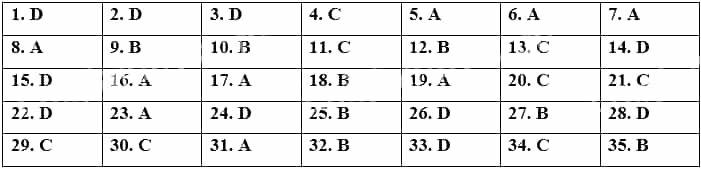
B. PHẦN TỰ LUẬN
Part 1:
1. communication
2. beautifully
3. useless
4. decided
Part 2:
5. it is very hot at noon, the workers still continue their work.
6. A new bike was bought by Daisy last Sunday.
7. She said that she would be on vacation in Sa Pa.
8. If Minh knew jow to play the guitar, he could enter this contest.
Part 3:
9. My uncle plays golf every weekend.
10. Mrs. Green is watching TV in the living room at the moment.
11. He started early yesterday morning but still missed the bus because of the heavy rain.
12. Can Tho, which is the central city of the Mekong, is known as one of the famouse tourist destination.
HƯỚNG DẪN GIẢI CHI TIẾT
1. (TH)
Kiến thức: Cấu trúc cơ bản
Giải thích:
A. No problem! We're friends: Không vấn đề gì! Chúng ta là bạn.
B. Of course, here you are: Tất nhiên rồi, bạn đây.
C. Yes, I'd love to: Vâng, tôi rất muốn.
D. Thank you!: Cảm ơn bạn!
Tạm dịch: Tùng đang nói chuyện với Mai về công việc mới của cô ấy.
- Tùng: "Bạn vừa có được công việc mơ ước. Xin chúc mừng!"
Mai: “Thank you!: Cảm ơn bạn!”
Đáp án D.
2. (TH)
Kiến thức: Cấu trúc cơ bản
Giải thích:
A. It's not true: Điều đó không đúng
B. I'm so sorry: Tôi rất xin lỗi
C. I don't agree with you: Tôi không đồng ý với bạn
D. I agree with you: Tôi đồng ý với bạn
Tạm dịch: Thuận và Phong đang thảo luận về lý do mọi người nên sống ở nông thôn.
- Thuận: "Tôi nghĩ rằng mọi người nên sống ở làng của mình và làm nghề nông."
- Phong: “: Tôi đồng ý với bạn. Gạo và rau rất quan trọng đối với cuộc sống của chúng ta."
Đáp án D.
3. (TH)
Kiến thức: Cấu trúc cơ bản
Giải thích:
- avoid + V-ing: tránh, phòng tránh…
Tạm dịch: Để tránh bị tai nạn giao thông, mọi người nên lái xe cẩn thận.
Đáp án D.
4. (TH)
Kiến thức: Cấu trúc cơ bản
Giải thích: “two days ago” là dấu hiệu của thì quá khứ đơn
Tạm dịch: Họ đi cắm trại với những người bạn cũ cách đây hai ngày.
Đáp án C.
5. (TH)
Kiến thức: Cấu trúc cơ bản
Giải thích: “in the morning”: vào buổi sáng
Tạm dịch: Người già ở thị trấn thích chạy bộ vào buổi sáng để giữ sức khỏe.
Đáp án A.
6. (TH)
Kiến thức: Cấu trúc cơ bản
Giải thích:
- It is very + adj + to + V-infinitive: Nó/ Điều gì… để làm gì,,,
Tạm dịch: Việc tập thể dục thường xuyên rất tốt vì nó giúp chúng ta có được sức khỏe tốt.
Đáp án A.
7. (TH)
Kiến thức: Từ vựng
Giải thích:
A. thinks about: nghĩ về
B. turns on: bật
C. goes away: bỏ đi
D. gets back: quay lại
Tạm dịch: Bà luôn nghĩ đến trẻ em đường phố và cho rất nhiều tiền để giúp đỡ các em.
Đáp án A.
8. (TH)
Kiến thức: Từ vựng
Giải thích:
A. confident (adj): tự tin
B. bored (adj): chán
C. disappointed (adj): thất vọng
D. nervous (adj): lo lắng
Tạm dịch: Anh ấy cảm thấy rất tự tin để vượt qua kỳ thi sắp tới một cách dễ dàng vì anh ấy đã học.
Đáp án A.
9. (TH)
Kiến thức: Cấu trúc cơ bản
Giải thích:
A. however: tuy nhiên
B. so: vậy
C. because: vì
D. but: nhưng
Tạm dịch: Tuần này trời mưa nhiều nên hôm nay thời tiết trở nên mát mẻ hơn.
Đáp án B.
10. (TH)
Kiến thức: Cấu trúc cơ bản
Giải thích: “since + mốc thời gian”: dấu hiệu thì hiện tại hoàn thành
Tạm dịch: Chúng ta quen nhau từ năm 2020.
Đáp án B.
11. (TH)
Kiến thức: Từ vựng
Giải thích:
A. checks (v): kiểm tra
B. costs (v): chi phí
C. takes (v): mất
D. spends (v): chi tiêu
Tạm dịch: Người học tiếng Anh nên kiên nhẫn vì học một ngôn ngữ cần nhiều thời gian.
Đáp án C.
12. (TH)
Kiến thức: Cấu trúc cơ bản
Giải thích: Câu điều kiện loại 1: If + S + V-s/es, S + will + V-infinitive
Tạm dịch: Nếu em học tập chăm chỉ ở trường cấp 2 thì em sẽ được nhận vào trường cấp 3.
Đáp án B.
13. (TH)
Kiến thức: Từ vựng
Giải thích:
A. song (n): bài hát
B. costume (n): trang phục
C. food (n): thức ăn
D. dance (n): khiêu vũ
Tạm dịch: Lúc đầu cửa hàng này chỉ bán bánh nếp – món ăn truyền thống của Việt Nam.
Đáp án C.
14. (TH)
Kiến thức: Cấu trúc cơ bản
Giải thích: instead of + V-ing: thay vì…
Tạm dịch: Hiện nay cháu đi học bằng xe đạp điện thay vì đi bộ.
Đáp án D.
15. (TH)
Kiến thức: Từ vựng
Giải thích:
A. made (v): làm
B. explored (v): khám phá
C. given (v): cho
D. invited (v): mời
Tạm dịch: Tuần sau anh họ tôi sẽ kết hôn. Anh ấy vừa mời gia đình tôi đến dự tiệc cưới của anh ấy.
Đáp án D.
16. (TH)
Kiến thức: Cấu trúc cơ bản
Giải thích: look forward to + V-ing: mong chờ, háo hức…
Tạm dịch: Học sinh mong muốn nhận được giải thưởng vì đã có thành tích tốt nhất trong năm học.
Đáp án A.
17. (TH)
Kiến thức: Cấu trúc cơ bản
Giải thích: would like + to + V-infinitive: diễn tả mong muốn, ý thích của người nói.
Tạm dịch: Thanh thiếu niên muốn theo đuổi những xu hướng thời trang mới nhất.
Đáp án A.
18. (TH)
Kiến thức: Cấu trúc cơ bản
Giải thích: S1 + wish(es) + S2 + V-ed: câu wish cho hiện tại – sự việc không có thật ở hiện tại
Tạm dịch: Mẹ ước ngày mai tôi sẽ không vứt quần áo khắp sàn nhà.
Đáp án B.
19. (TH)
Kiến thức: Cấu trúc cơ bản
Giải thích: “trees” (n): những cái cây => chỉ vật => dùng “which”
Tạm dịch: Cây xanh được trồng ở sân trường sẽ làm cho trường học của chúng ta xanh hơn, đẹp hơn.
Đáp án A.
20. (TH)
Kiến thức: Cấu trúc cơ bản
Giải thích: “the girl”: cô gái => chỉ người => dùng “who”
Tạm dịch: Cô gái giành được học bổng du học Mỹ là bạn cùng lớp của tôi.
Đáp án C.
21. (TH)
Kiến thức: Cấu trúc cơ bản
Giải thích:
A. because: bởi vì
B. therefore: do đó
C. but: nhưng
D. so: vì vậy
Tạm dịch: Họ đã chuẩn bị kỹ lưỡng cho chuyến đi của mình, nhưng bây giờ nhiều thứ bắt đầu không ổn.
Đáp án C.
22. (TH)
Kiến thức: Phát âm
Giải thích:
A. access /ˈækses/
B. effect /ɪˈfekt/
C. essay /ˈeseɪ/
D. exam /ɪɡˈzæm/
Phương án D phát âm là /ɪ/, các phương án còn lại phát âm là /e/.
Đáp án D.
23. (TH)
Kiến thức: Phát âm
Giải thích:
A. connected /kəˈnektɪd/
B. arrived /əˈraɪvd/
C. enjoyed /ɪnˈdʒɔɪd/
D. described /dɪˈskraɪb/
Phương án A phát âm là /ɪd/, các phương án còn lại phát âm là /d/.
Đáp án A.
24. (TH)
Kiến thức: Đọc hiểu
Giải thích: Đoạn văn chủ yếu nói về điều gì?
A. Purposes for animal migration: Mục đích di cư của động vật
B. Safe ways of animal migration: Các cách di chuyển động vật an toàn
C. Time for animal migration: Thời gian di cư của động vật
D. Challenges of animal migration: Những thách thức về di cư của động vật
Thông tin: At first, these animals, great white sharks in the Pacific Ocean, wildebeest in Africa, Arctic terns in the Atlantic, seem completely different. One swims, one walks, and the other flies. But they all have one thing in common. They all migrate. Some migrating animals move to a place with a better temperature. Some go to find food or water.
Tạm dịch: Lúc đầu, những loài động vật này, cá mập trắng lớn ở Thái Bình Dương, linh dương đầu bò ở châu Phi, nhạn biển Bắc Cực ở Đại Tây Dương, dường như hoàn toàn khác nhau. Một con bơi, một con đi và con kia bay. Nhưng tất cả họ đều có một điểm chung. Tất cả họ đều di cư. Một số động vật di cư di chuyển đến nơi có nhiệt độ tốt hơn.
Đáp án D.
25. (TH)
Kiến thức: Đọc hiểu
Giải thích: Đoạn văn nói đến bao nhiêu thử thách lớn đối với các loài động vật?
A. four: bốn
B. three: ba
C. two: hai
D. five: năm
Thông tin: One challenge is distance. Some migrating animals take very long trips. Another challenge is finding enough food and water during the journey. Finally, migrating animals have to avoid other animals that want to eat them.
Tạm dịch: Một thách thức là khoảng cách. Một thử thách khác là tìm đủ thức ăn và nước uống trong suốt hành trình. Cuối cùng, động vật di cư phải tránh những động vật khác muốn ăn thịt chúng.
Đáp án B.
26. (TH)
Kiến thức: Đọc hiểu
Giải thích: Theo đoạn văn, câu nào sau đây KHÔNG đúng?
A. Zebras help each other when they are in trouble: Ngựa vằn giúp đỡ lẫn nhau khi gặp khó khăn.
B. Different kinds of animals migrate: Các loại động vật khác nhau di cư.
C. Each Mali elephant needs more than 200 liters of water a day: Mỗi con voi Mali cần hơn 200 lít nước mỗi ngày.
D. Great white sharks swim from Australia to South Africa in nine months: Cá mập trắng lớn bơi từ Úc đến Nam Phi trong chín tháng.
Thông tin: For example, great white sharks swim from Australia to South Africa and back. In nine months, they swim about 20,000 kilometers.
Tạm dịch: Ví dụ, cá mập trắng lớn bơi từ Úc đến Nam Phi và quay trở lại. Trong chín tháng, chúng bơi khoảng 20.000 km.
Đáp án D.
27. (TH)
Kiến thức: Đọc hiểu
Giải thích: Từ "this" ở đoạn 3 đề cập đến_____.
A. food (n): thức ăn
B. water (n): nước
C. journey (n): hành trình
D. challenge (n): thử thách
Thông tin: Another challenge is finding enough food and water during the journey. For example, each Mali elephant needs over 200 liters of water each day.
Tạm dịch: Một thử thách khác là tìm đủ thức ăn và nước uống trong suốt hành trình. Ví dụ, mỗi con voi Mali cần hơn 200 lít nước mỗi ngày.
Đáp án B.
28. (TH)
Kiến thức: Đọc hiểu
Giải thích: Từ "survive" ở đoạn 4 gần nghĩa nhất với______.
A. try to drink: cố gắng uống
B. stop to eat: dừng ăn
C. want to end: muốn kết thúc
D. continue to live: tiếp tục sống
Tạm dịch: survive (v): tồn tại
Đáp án D.
Dịch bài đọc:
Lúc đầu, những loài động vật này, cá mập trắng lớn ở Thái Bình Dương, linh dương đầu bò ở châu Phi, nhạn biển Bắc Cực ở Đại Tây Dương, dường như hoàn toàn khác nhau. Một con bơi, một con đi và con kia bay. Nhưng tất cả họ đều có một điểm chung. Tất cả họ đều di cư. Một số động vật di cư di chuyển đến nơi có nhiệt độ tốt hơn. Một số đi tìm thức ăn hoặc nước uống. Các nhóm du hành như một, cố gắng sống sót. Trong chuyến đi, họ phải đối mặt với nhiều thử thách khác nhau.
Một thách thức là khoảng cách. Một số loài động vật di cư phải thực hiện những chuyến đi rất dài. Họ đi xa quê hương. Ví dụ, cá mập trắng lớn bơi từ Úc đến Nam Phi và quay trở lại. Trong chín tháng, chúng bơi khoảng 20.000 km.
Một thử thách khác là tìm đủ thức ăn và nước uống trong suốt hành trình. Ví dụ, mỗi con voi Mali cần hơn 200 lít nước mỗi ngày. Để có được điều này, họ cần phải đi từ hố nước này sang hố nước khác.
Cuối cùng, động vật di cư phải tránh những động vật khác muốn ăn thịt chúng. Ví dụ, ngựa vằn phải tránh xa sư tử. Đi du lịch theo nhóm giúp họ được an toàn. Tất cả ngựa vằn trong nhóm đều có thể đề phòng nguy hiểm. Khi một con ngựa vằn gặp rắc rối, các thành viên khác sẽ đứng thành vòng tròn xung quanh nó. Bằng cách làm việc theo nhóm, các loài động vật di cư có thể sống sót sau một số hành trình phi thường nhất thế giới.
29. (TH)
Kiến thức: Trọng âm
Giải thích:
A. interest /ˈɪntrəst/
B. nature /ˈneɪtʃə(r)/
C. advice /ədˈvaɪs/
D. danger /ˈdeɪndʒə(r)/
Phương án C trọng âm rơi vào âm tiết thứ 2, các phương án còn lại trọng âm rơi vào âm tiết thứ 1.
Đáp án C.
30. (TH)
Kiến thức: Trọng âm
Giải thích:
A. develop /dɪˈveləp/
B. encourage /ɪnˈkʌrɪdʒ/
C. exercise /ˈeksəsaɪz/
D. inventor /ɪnˈventə(r)/
Phương án C trọng âm rơi vào âm tiết thứ 1, các phương án còn lại trọng âm rơi vào âm tiết thứ 2.
Đáp án C.
31. (TH)
Kiến thức: Đọc điền từ
Giải thích:
A. and: và
B. so: vậy
C. but: nhưng
D. because: vì
Tạm dịch: Bộ phim đầu tiên trên thế giới được chiếu vào năm 1895 bởi hai anh em người Pháp, Louis và Auguste Lumière.
Đáp án A.
32. (TH)
Kiến thức: Đọc điền từ
Giải thích: consist of + V-ing: bao gồm…
Tạm dịch: Mặc dù chỉ bao gồm những cảnh ngắn, đơn giản nhưng nó được mọi người yêu thích và các bộ phim trở nên nổi tiếng kể từ đó.
Đáp án B.
33. (TH)
Kiến thức: Đọc điền từ
Giải thích: Vế trước của câu kể đang ở thì quá khứ đơn => động từ vế sau chia thì quá khứ đơn
Tạm dịch: Chẳng bao lâu sau, công chúng đã có những nam nữ diễn viên yêu thích của họ và bằng cách này, những ngôi sao điện ảnh đầu tiên đã xuất hiện.
Đáp án D.
34. (TH)
Kiến thức: Đọc điền từ
Giải thích:
A. now (adv): bây giờ
B. modern (adj): hiện đại
C. recent (adv): gần đây
D. present (adv): hiện tại
Tạm dịch: Với sự xuất hiện của truyền hình vào những năm 1950, ít người đến xem phim hơn, nhưng trong những năm gần đây, lượng khán giả xem phim đã tăng trở lại.
Đáp án C.
35. (TH)
Kiến thức: Đọc điền từ
Giải thích:
A. nation (n): dân tộc, quốc gia
B. national (adj): dân tộc, quốc gia
C. nationality (n): quốc tịch
D. nationally (adv): toàn quốc
Tạm dịch: Nhiều quốc gia đã bắt đầu sản xuất những bộ phim có ảnh hưởng đến việc làm phim và hiện có nhiều ngành công nghiệp điện ảnh quốc gia.
Đáp án B.
Dịch bài đọc:
Bộ phim đầu tiên trên thế giới được chiếu vào năm 1895 bởi hai anh em người Pháp, Louis và Auguste Lumière.
Mặc dù chỉ bao gồm những cảnh ngắn, đơn giản nhưng nó được mọi người yêu thích và các bộ phim trở nên nổi tiếng kể từ đó. Những bộ phim đầu tiên đều là phim câm, có tiêu đề trên màn hình để giải thích câu chuyện. Chẳng mấy chốc, công chúng đã có những nam nữ diễn viên yêu thích và bằng cách này, những ngôi sao điện ảnh đầu tiên đã xuất hiện. Năm 1927, bộ phim "talkie" đầu tiên, một bộ phim có âm thanh, được trình chiếu và từ đó trở đi, công chúng chỉ chấp nhận loại phim này. .
Những cải tiến tiếp tục diễn ra, đặc biệt là ở Mỹ, nơi sản xuất 95% tổng số phim. Với sự xuất hiện của truyền hình vào những năm 1950, ít người đến xem phim hơn, nhưng trong những năm gần đây, lượng khán giả xem phim đã tăng trở lại.
Nhiều quốc gia đã bắt đầu sản xuất những bộ phim có ảnh hưởng đến việc làm phim và hiện có nhiều ngành công nghiệp điện ảnh quốc gia.
B. PHẦN TỰ LUẬN
Part 1:
1. (TH)
Kiến thức: Cấu trúc cơ bản
Giải thích:
- Communication (n): sự giao tiếp
Tạm dịch: Bố mẹ anh ấy không hề liên lạc với anh ấy.
Đáp án communication.
2. (TH)
Kiến thức: Cấu trúc cơ bản
Giải thích:
- beautifully (adv): tốt đẹp, đáng hài lòng
Tạm dịch: Ban nhạc tôi yêu thích đã biểu diễn rất hay tại buổi hòa nhạc.
Đáp án beautifully.
3. (TH)
Kiến thức: Cấu trúc cơ bản
Giải thích:
- useless (adv): vô ích, vô dụng
Tạm dịch: Đừng nhờ tôi giúp tiếng Pháp. Tôi vô dụng với ngôn ngữ này.
Đáp án useless.
4. (TH)
Kiến thức: Cấu trúc cơ bản
Giải thích:
- decided (v): quyết định
Tạm dịch: Năm ngoái, nhiều du khách đã quyết định ở lại nhà dân và tìm hiểu lối sống của dân làng.
Đáp án decided.
Part 2:
5. (TH)
Kiến thức: Cấu trúc cơ bản
Giải thích: Buổi trưa trời rất nóng nhưng công nhân vẫn tiếp tục làm việc.
- Although + S + V, S + V: mặc dù…
Tạm dịch: Dù buổi trưa trời rất nóng nhưng các công nhân vẫn tiếp tục công việc.
Đáp án it is very hot at noon, the workers still continue their work.
6. (TH)
Kiến thức: Cấu trúc cơ bản
Giải thích: Daisy mua một chiếc xe đạp mới vào Chủ nhật tuần trước.
- Câu bị động: S + be + V-ed/ PII + by + O
Tạm dịch: Một chiếc xe đạp mới được Daisy mua vào Chủ nhật tuần trước.
Đáp án: A new bike was bought by Daisy last Sunday.
7. (TH)
Kiến thức: Cấu trúc cơ bản
Giải thích: “Tôi sẽ đi nghỉ ở Sa Pa.”, cô nói.
- Câu tường thuật: S + said + that+ S + V (lùi 1 thì so với câu gốc)
Tạm dịch: Cô ấy nói rằng cô ấy sẽ đi nghỉ ở Sa Pa.
Đáp án: She said that she would be on vacation in Sa Pa.
8. (TH)
Kiến thức: Cấu trúc cơ bản
Giải thích: Minh không biết chơi guitar nên không thể tham gia cuộc thi này.
- Câu điều kiện loại 2: If + S + V-ed, S + would/ could + V-infinitive
Tạm dịch: Nếu Minh biết chơi guitar thì anh ấy có thể tham gia cuộc thi này.
Đáp án: If Minh knew jow to play the guitar, he could enter this contest.
Part 3:
9. (TH)
Kiến thức: Cấu trúc cơ bản
Giải thích:
- Câu đơn ở thì hiện tại đơn: S + V(s/es) + dâu hiệu thời gian.
Tạm dịch: Chú tôi chơi gôn vào mỗi cuối tuần.
Đáp án: My uncle plays golf every weekend.
10. (TH)
Kiến thức: Cấu trúc cơ bản
Giải thích:
- S + V-ing + dấu hiệu thì hiện tại tiếp diễn
Tạm dịch: Lúc này bà Green đang xem TV ở phòng khách.
Đáp án: Mrs. Green is watching TV in the living room at the moment.
11. (TH)
Kiến thức: Cấu trúc cơ bản
Giải thích:
- because of + cụm danh từ: bởi vì…
Tạm dịch: Sáng hôm qua anh ấy khởi hành từ sáng sớm nhưng vẫn bị lỡ xe vì trời mưa to.
Đáp án: He started early yesterday morning but still missed the bus because of the heavy rain.
12. (TH)
Kiến thức: Cấu trúc cơ bản
Giải thích:
- Trong mệnh đề quan hệ, Which sẽ đóng vai trò bổ nghĩa cho danh từ đứng trước đó và thường đứng sau dấu phẩy.
Tạm dịch: Cần Thơ, thành phố trung tâm của sông Mê Kông, được biết đến là một trong những địa điểm du lịch nổi tiếng.
Đáp án: Can Tho, which is the central city of the Mekong, is known as one of the famous tourist destinations.
Luyện trắc nghiệm Toán lớp 1 Lớp LOP9
Học đi đôi với hành! Làm ngay các bộ đề trắc nghiệm chấm điểm tức thì, có đáp án chi tiết giúp ghi nhớ kiến thức sâu và chuẩn bị tốt cho các bài kiểm tra.
Học tập & ôn luyện trên ứng dụng Tri Thức Hub
Tải ứng dụng Tri Thức Hub trên điện thoại hoặc máy tính bảng (hỗ trợ Android & iOS) để làm bài kiểm tra, luyện tập và lưu tiến độ học tập!