
Đề thi vào 10 môn Anh Hải Phòng
Đề thi vào 10 môn Anh Hải Phòng năm 2026
Đề bài
Mark the letter A, B, C, or D on your answer sheet to indicate the word whose underlined part is pronounced differently from that of the others in each group.
Question 1. A. expressed B. finished C. promised D. explained
Question 2. A. location B. appearance C. replacement D. occasion
Mark the letter A, B, C, or D on your answer sheet to indicate the best arrangement of utterances to make a meaningful exchange in each of the following questions.
Question 3.
a. Tom: Not at all. Press this button to turn it on. It works automatically.
b. Mary: That would be very helpful. Thank you very much.
c. Mary: Excuse me. Do you mind showing me how to use this robotic vacuum cleaner?
A. b-a-c B. c-a-b C. c-b-a D. a-c-b
Question 4.
a. Alice: Alright. I'll invite more friends to join this meaningful campaign.
b. Ben: How would you feel about organizing a campaign to donate old books to poor children in mountainous areas?
c. Ben: Yes, your contribution would really help them out.
d. Alice: Donate old books to poor children?
A. d-c-a-b B. c-a-b-d C. a-b-c-d D. b-d-c-a
Mark the letter A, B, C or D on your answer sheet to indicate the correct answer to each of the following questions.
Question 5. Unlike a desktop computer, ______ laptop is portable. You can use it in different places.
A. the B. Ø (no article) C. a D. an
Question 6. I'm going to the library to return the dictionary ______ I borrowed last month.
A. whom B. whose C. which D. who
Question 7. There are too ______ parents waiting anxiously around school gates today, hoping their children to do well in the exams.
A. a little B. many C. a few D. much
Question 8. You ______ bring your smart devices into the examination room. It's against the rules.
A. won't B. mustn't C. can D. might
Question 9. My close friend has promised ______ me with my presentation on "World Englishes".
A. to help B. help C. helps D. helping
Question 10. Our family members like to explore different places ______ summer when the weather is nice and warm.
A. about B. at C. for D. in
Question 11. The rapid ______ of the city has led to overcrowding, traffic congestion and a shortage of housing.
A. urbanisation B. urbanise C. urbanised D. urban
Question 12. The locals of Thanh Ha commune, Hai Phong City are ______ a project to promote the development of ecotourism.
A. carrying out B. using up C. taking off D. looking around
Question 13. The view of Vietnam country from outer space is ______ and breathtaking.
A. frustrating B. optimistic C. magnificent D. traditional
Question 14. The leaders of the city are trying to ______ awareness of the importance of energy saving.
A. run B. put C. raise D. make
Question 15. As more tourists travel to one place, it's difficult to keep a ______ between economic development and conservation of heritage sites.
A. landscape B. priority C. destination D. balance
Question 16. Do you think that the "ao dai" (long dress) ______ the beauty of Vietnamese women?
A. symbolises B. pursues C. accomplishes D. contributes
Mark the letter A, B, C, or D on your answer sheet to indicate the sentence that best combines each pair of sentences in the following questions.
Question 17. My close friend Hoa wrote this bestseller. She has received the title "the author of the year".
A. My close friend Hoa has received the title "the author of the year" who wrote this bestseller.
B. My close friend Hoa, whom wrote this bestseller, has received the title "the author of the year".
C. My close friend Hoa, who wrote this bestseller, has received the title "the author of the year".
D. My close friend Hoa, whose wrote this bestseller, has received the title "the author of the year".
Question 18. The noise was extremely loud. We couldn't hear the announcement clearly.
A. The noise was loud enough for us to hear the announcement clearly.
B. The noise was such loud that we couldn't hear the announcement clearly.
C. The noise was too loud that we couldn't hear the announcement clearly.
D. The noise was so loud that we couldn't hear the announcement clearly.
Question 19. She finished her homework. She went out to play with her friends.
A. Before she finished her homework, she went out to play with her friends.
B. After she went out to play with her friends, she finished her homework.
C. As soon as she finished her homework, she went out to play with her friends.
D. While she finished her homework, she went out to play with her friends.
Question 20. The weather was bad. The plane couldn't leave the ground.
A. Because of the bad weather, the plane couldn't leave the ground.
B. As the weather was bad, the plane managed to leave the ground.
C. Since the weather was bad, the plane had to leave the ground immediately.
D. Due to the bad weather, the plane could leave the ground.
Question 21. Students spend a lot of time on practising English. They become fluent speakers.
A. The most time students spend on practising English, the more fluently they become.
B. The more time students spend on practising English, the more fluent they become.
C. The less time students spend on practising English, the more fluent they become.
D. The much time students spend to practise English, the most fluent they become.
Read the following announcement and mark the letter A, B, C, or D on your answer sheet to indicate the correct option that best fits each of the numbered blanks.
ENGLISH PROGRAM FOR GREEN TEENS
The English Program For Green Teens is designed for secondary school students who want to improve their English while learning about environmental protection.
The program (22) ______ place every Saturday morning at the City Youth Center, including speaking, reading, and project-based activities. Participants will work in groups to develop communication skills and environmental awareness. Students are encouraged to join the program to become confident and effective English (23) ______.
All activities are carefully planned to ensure that learning is both effective and (24) ______.
Question 22. A. took B. has taken C. is taking D. takes
Question 23. A. use B. useful C. usefully D. users
Question 24. A. embarrassing B. bustling C. damaging D. engaging
Read the following passage and mark the letter A, B, C, or D on your answer sheet to indicate the correct answer to each of the questions.
In today's digital age, Vietnamese young people are increasingly depending on the virtual world. However, this trend is considered as an unhealthy living habit since it presents several drawbacks and challenges that can have long-term effects on teens' emotional and physical well-being.
According to experts, excessive screentime is a significant concern associated with living a virtual life. Prolonged exposure to digital devices can lead to eye strain, headaches, sleep deprivation and other health issues. Worryingly, teens who assign hours on the Net every day tend to suffer from disappointing performance at school and poor posture. Another negative effect on youngsters is social isolation and disconnection from the real world. Many teens become highly reliant on online interactions and neglect their offline relationships, leading to the feelings of loneliness, anxiety and depression. Additionally, the online world can expose them to cyberbullying, harassment and harmful content, posing a threat to their safety.
To solve the problems, it is recommended that parents set a screentime limit for their children, encourage them to take part in outdoor activities and practise responsible online behaviour. Besides, parents, educators and policymakers need to play an active role in promoting digital literacy and popularising online safety rules for youngsters. These will help them have a well-balanced life between work and play.
Question 25. Which of the following is the main idea of the passage?
A. Virtual living: A new trend and its advantages
B. Virtual living: A positive trend and its benefits
C. Virtual living: Advantages and disadvantages
D. Virtual living: A negative trend and its solutions
Question 26. The word "challenges" in paragraph 1 is CLOSEST in meaning to ______.
A. advantages B. benefits C. experiences D. difficulties
Question 27. The word "excessive" in paragraph 2 is OPPOSITE in meaning to ______.
A. necessary B. extreme C. enormous D. little
Question 28. Which of the following is NOT true according to the passage?
A. Exposure to the online world may lead to cyberbullying.
B. One bad effect of online life is that it creates social isolation.
C. Prolonged use of digital devices can cause health problems.
D. Not many teens become heavily reliant on online interactions.
Question 29. The word "them" in paragraph 3 refers to ______.
A. parents B. youngsters C. educators D. policymakers
Question 30. According to paragraph 3, one solution to teens’ virtual living is that parents should ______.
A. set a time limit to children’s using digital devices
B. have a well-balanced life between work and play
C. behave responsibly whenever they are on the Net
D. participate in training sessions on the Net
Read the following text and mark the letter A, B, C, or D on your answer sheet to indicate the correct word or phrase that best fits each of the numbered blanks.
LIFE IN THE PAST
Life in Viet Nam many years ago was much simpler than it is today. People lived in small houses made (31) ______ wood or bamboo, and most families didn’t own many modern facilities. Electricity was not common in rural areas, so children often studied in the evening using oil lamps.
Transportation was also very limited. Instead of taking buses or (32) ______ motorbikes, students usually walked to school. Without the Internet, children spent their free time playing traditional games or helping their parents with household chores such as cooking, cleaning, or gardening.
(33) ______ the difficulties, life back then had its own charm. Neighbours supported each other during harvest seasons, and street vendors brought food to every corner of the village. As a result, people shared a strong sense of (34) ______ and they felt deeply connected to each other.
Today, although life is more comfortable, many adults feel (35) ______ about the past. As for them, good traditions and customs are still worth preserving.
Question 31. A. on B. at C. of D. in
Question 32. A. transporting B. carrying C. going D. riding
Question 33. A. Because B. Due to C. Although D. Despite
Question 34. A. protection B. collection C. community D. speciality
Question 35. A. nostalgic B. exhilarating C. appreciative D. memorable
Mark the letter A, B, C, or D on your answer sheet to indicate the sentence that is CLOSEST in meaning to each of the following questions.
Question 36. Mr Ba is very busy; however, he spends time playing chess every evening.
A. If Mr Ba is very busy, he will spend time playing chess every evening.
B. Mr Ba spends time playing chess every evening, so he is very busy.
C. Although Mr Ba is very busy, he spends time playing chess every evening.
D. Mr Ba is very busy because he spends time playing chess every evening.
Question 37. Caroline learned a few words of Chinese on her summer vacation to China.
A. Caroline went over a few words of Chinese on her summer vacation to China.
B. Caroline made up a few words of Chinese on her summer vacation to China.
C. Caroline picked up a few words of Chinese on her summer vacation to China.
D. Caroline looked up a few words of Chinese on her summer vacation to China.
Question 38. Mary is disappointed because she is not experienced enough to apply for that job.
A. Mary wishes she were experienced enough to apply for that job.
B. Mary wishes she weren't experienced in order not to apply for that job.
C. Mary wishes she didn't have enough experience to apply for that job.
D. Mary wishes she is so experienced that she could apply for that job.
Question 39. “I am learning how to recycle plastic bottles at home,” Lan said.
A. Lan said that she is learning how to recycle plastic bottles at home.
B. Lan said that she has been learning how to recycle plastic bottles at home.
C. Lan said that she was learning how to recycle plastic bottles at home.
D. Lan said that she learns how to recycle plastic bottles at home.
Question 40. Finish your homework immediately, or you will get bad marks.
A. If you finish your homework immediately, you will get bad marks.
B. If you have finished your homework, you may get bad marks.
C. If you don't finish your homework immediately, you will get bad marks.
D. Unless you finish your homework immediately, you won't get bad marks.
------------------HẾT------------------
Xem đáp án
HƯỚNG DẪN GIẢI
Thực hiện: Ban chuyên môn trithuchub.com
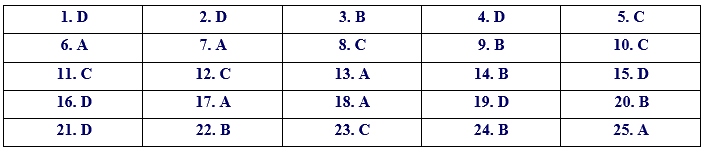
|
1. D |
2. B |
3. B |
4. D |
5. C |
6. C |
7. B |
8. B |
9. A |
10. D |
|
11. A |
12. A |
13. C |
14. C |
15. D |
16. A |
17. C |
18. D |
19. C |
20. A |
|
21. B |
22. D |
23. D |
24. D |
25. D |
26. D |
27. D |
28. D |
29. B |
30. A |
|
31. C |
32. D |
33. D |
34. C |
35. A |
36. C |
37. C |
38. A |
39. C |
40. C |
Đề thi vào 10 môn Anh Hải Phòng năm 2025
Đề bài
Mark the letter A, B, C, or D on your answer sheet to indicate the sentence that is CLOSEST in meaning to the original one.
Question 1. Keep calm, or you won't find the best solution to this problem.
A. Unless you don't keep calm, you won't find the best solution to this problem.
B. If you don't keep calm, you will not find the best solution to this problem.
C. Unless you keep calm, you will find the best solution to this problem.
D. If you keep calm, you will not find the best solution to this problem.
Question 2. If supermarkets offer big discounts, many people will shop there.
A. The bigger supermarkets offer discounts, the more people will shop there.
B. The bigger discounts supermarkets offer, more people will shop there.
C. The many bigger discounts supermarkets offer, the much more people will shop there.
D. The bigger discounts supermarkets offer, the more people will shop there.
Question 3. Mary is very busy with her work, but she reads stories to her children every night.
A. Although Mary is very busy with her work, she reads stories to her children every night.
B. Despite Mary is very busy with her work, she reads stories to her children every night.
C. Though Mary is very busy with her work, but she reads stories to her children every night.
D. Because Mary reads stories to her children every night, she is very busy with her work.
Question 4. "What should I do to stop arguing with my sister?" Lisa said.
A. Lisa wondered what to do to stop arguing with her sister.
B. Lisa wondered what I did to stop arguing with my sister.
C. Lisa wondered what should she do to stop arguing with her sister.
D. Lisa wondered what she to do to stop arguing with her sister.
Mark the letter A, B, C, or D on your answer sheet to indicate the word whose underlined part is pronounced differently from that of the others in each group.
Question 5.
A. dependent
B. bartender
C. majestic
D. permission
Question 6.
A. childhood
B. heritage
C. exhausted
D. habitable
Read the following passage and mark the letter A, B, C, or D on your answer sheet to indicate the correct word that best completes each blank.
The local newspaper carried out a survey with city dwellers about how to (7) _________ the city a more liveable place. Most of the participants in the survey talked about the city's traffic. First, they wanted
(8)_________ traffic laws to stop drivers from ignoring traffic lights and breaking speed limits. This would help reduce road accidents. Second, they hoped their city would improve its public transport system. For example, buses should be clean and have air conditioners. There should be bus lines that reach almost (9) ___________ areas in the city, so it would be easy for people to get around. (10)_________, they said that good public transport could save the city money. The local authority wouldn't need to construct more parking lots and widen roads to cater for the increasing number of private cars. Finally, the survey participants suggested building some traffic apps. The apps could recommend the best routes to drivers to avoid traffic (11)__________. The sooner the government started implementing these, the more convenient it would be to travel around the city.
Question 7.
A. turn
B. get
C. make
D. form
Question 8.
A. smoother
B. lighter
C. safer
D. stricter
Question 9.
A. all
B. no
C. every
D. many
Question 10.
A. Moreover
B. However
C. Otherwise
D. Nevertheless
Question 11.
A. flow
B. signs
C. safety
D. congestion
Mark the letter A, B, C, or D on your answer sheet to indicate the part that is incorrect in each of the following sentences.
Question 12. Not only Mr. Lam but also his wife were present at the scene where the accident happened this morning.
A. the accident
B. at
C. were
D. happened
Question 13. A Sun, which is a source of solar energy, powers many things on Earth.
A. is
B. A
C. on
D. many
Mark the letter A, B, C, or D on your answer sheet to indicate the correct word or phrase that completes each of the following sentences.
Question 14. My mother had to cancel her plans for the weekend because she ___________ the flu.
A. ran out of
B. cut down on
C. got on with
D. came down with
Question 15. A travel __________ is a business that arranges accommodation, tickets and other services for people's holidays and journeys.
A. agency
B. guide
C. lover
D. blogger
Question 16. I'm looking for a souvenir shop __________ sells a variety of handicrafts.
A. whose
B. which
C. where
D. who
Question 17. Alex and Mike are talking about Mike's entrance exam next week.
Alex: "I've heard that you're taking the high school entrance exam next week. Good luck with your exam!"
Mike: "______________”
A. Thank you. I'll try my best.
B. I'm sorry, it is.
C. It's difficult for me to answer.
D. You're so lucky.
Question 18. The IT expert recommended that we ____________ in good antivirus software to protect our computers.
A. investing
B. invested
C. to invest
D. invest
Question 19. Traditional festivals in Vietnam create ___________ experiences that help connect generations.
A. memory
B. memorable
C. memorise
D. memorably
Question 20. Trang is at the school library.
Trang: "May I borrow a book about natural wonders of the world?"
Librarian: "____________”
A. Yes, I like reading about cultures, too.
B. Sure. I'll find it for you.
C. What a pity! I don't know.
D. No, not at all.
Question 21. Jason is a civil engineer. It is a __________ job as it needs a lot of time, efforts, and skills.
A. basic
B. regular
C. repetitive
D. demanding
Question 22. I study in the library as there are too many __________ at home.
A. distracting
B. distract
C. distractions
D. distractedly
Question 23. Can you help me translate this sentence __________ English?
A. by
B. into
C. over
D. with
Question 24. The atmosphere was very peaceful in Sa Pa, __________ I had a relaxing time there.
A. since
B. but
C. so
D. or
Question 25. What ____ the students _____ when the teacher came in?
A. did – do
B. are – doing
C. do – do
D. were – doing
Mark the letter A, B, C, or D on your answer sheet to indicate the sentence that is BEST written from the words/phrases given.
Question 26. It/ be/ disappointing/ holiday/ they/ decide/ask/ money/ back.
A. It was too disappointing holiday that they decided to ask for their money back.
B. It was so a disappointing holiday that they decided to ask for their money back.
C. It was such disappointing holiday that they decided to ask for their money back.
D. It was such a disappointing holiday that they decided to ask for their money back.
Question 27. Those students/ participate/ the community service/ be/ enthusiastic.
A. Those students, participate in the community service, are enthusiastic.
B. Those students, whom they can participate in the community service, are enthusiastic.
C. Those students, who participate in the community service, are enthusiastic.
D. Those students, that participate in the community service, are enthusiastic.
Question 28. Mr. Brown/ wish/he/ have/happy life/.
A. Mr. Brown wishes he will have a happier life.
C. Mr. Brown wishes he had a happier life.
B. Mr. Brown wish he had a happier life.
D. Mr. Brown wishes he has a happier life.
Question 29. Who/ take care/ children/ when/ you/ be/ away/ tomorrow?
A. Who takes care of your children when you will be away tomorrow?
B. Who will take care of your children when you will be away tomorrow?
C. Who took care of your children when you are away tomorrow?
D. Who will take care of your children when you are away tomorrow?
Mark the letter A, B, C, or D on your answer sheet to indicate the word(s) CLOSEST in meaning to the underlined word(s) in each of the following sentences.
Question 30. The two companies agreed to collaborate on a new project last week.
A. cooperate
B. pursue
C. propose
D. compete
Question 31. Part-time jobs provide students with hands-on knowledge and experiences.
A. exciting
B. practical
C. theoretical
D. rewarding
Mark the letter A, B, C, or D on your answer sheet to indicate the word whose main stress position is placed differently from that of the others in each group.
Question 32.
A. additional
B. optimistic
C. embarrassing
D. sustainable
Question 33.
A. preserve
B. remind
C. function
D. police
Mark the letter A, B, C, or D on your answer sheet to indicate the word(s) OPPOSITE in meaning to the underlined word(s) in each of the following sentences.
Question 34. The council decided to shorten the school day to fit in other activities.
A. lengthen
B. broaden
C. reduce
D. explore
Question 35. Mary felt completely stressed out after a hard-working day at the office.
A. relaxed
B. anxious
C. unpleasant
D. sociable
Read the following passage and mark the letter A, B, C, or D on your answer sheet to indicate the correct answer to each of the following questions.
Vietnamese lifestyle has changed significantly over the years. In the past, most people lived in rural areas, and their daily outines were centered around farming and traditional crafts. Families were usually large, and multiple generations lived under the same roof. People traveled by bicycle or on foot, and motorbikes were considered a luxury. Entertainment was simple, consisting of folk songs, traditional games, and family gatherings.
Today, Vietnam has modernized rapidly. Many people now live in urban areas. They work in offices and factories, or run businesses. Houses are smaller, and families tend to be more independent. With the development of technology, life has become more convenient. Cars and motorbikes are common, and people
rely on smartphones for communication and entertainment. The Internet allows access to a vast amount of information, so learning and shopping become easier than ever.
Despite these changes, many Vietnamese traditions remain. Family values are still important, and people continue to celebrate festivals such as Tet and the Mid-Autumn festival. Vietnamese cuisine, with its balance of flavors and fresh ingredients, is still widely enjoyed. While life today is more fast-paced and technology-driven, the essence of Vietnamese culture continues to be preserved.
Question 36. According to the passage, which of the following statements is NOT mentioned?
A. Vietnamese families in the past were usually extended families.
B. The Internet helps shopping and learning become more convenient today.
C. People commonly lived in luxurious houses in the past.
D. Vietnamese traditions are still valued today.
Question 37. The word "rapidly" in the second paragraph can be replaced by _________.
A. commonly
B. quickly
C. slowly
D. gradually
Question 38. How did most people in Vietnam earn their living in the past?
A. By running large businesses.
B. By working in offices.
C. Through farming and traditional crafts.
D. By using technology.
Question 39. What important traditions in Vietnamese lifestyle still remain?
A. Family values and festivals.
B. Running businesses.
C. Families with multiple generations.
D. Farming as the main occupation.
Question 40. What does the passage mainly discuss?
A. The importance of Vietnamese family traditions.
B. The history of Vietnamese education.
C. The modernization of Vietnamese urban areas.
D. The changes of Vietnamese lifestyle overtime.
------------------HẾT------------------
Xem đáp án
HƯỚNG DẪN GIẢI
Thực hiện: Ban chuyên môn trithuchub.com


Đề thi vào 10 môn Anh Hải Phòng năm 2023
Đề bài
Mark the letter A, B, C, or D to indicate the word whose main stress position is placed differently from that of the others in each group.
Question 1:
A. global
B. puzzle
C. decide
D. rusty
Question 2:
A. attraction
B. remember
C. gravity
D. historic
Read the following passage and mark the letter A, B, C or D to indicate the correct answer to the questions that follow.
In the Mekong Delta, Long Dinh village in Tien Giang province is famous for its traditional craft of weaving sedge mats. The mats' high quality makes them popular domestically, and they are also exported to markets worldwide. In spite of its well-established reputation for this traditional craft, mat weaving only started here some 50 years ago. It was first introduced by immigrants from Kim Son, a famous mat weaving village in Ninh Binh province. However, the technique of weaving sedge mats in Long Dinh, as compared with other places, is somewhat different. Long Dinh branded mats are thicker and have more attractive colours and patterns.
Weaving sedge mats is similar to growing rice. Long Dinh mat production mainly occurs during the dry season, from January to April. Weavers have to work the hardest in May and June; otherwise, when the rainy season starts in July, they will have to put off finishing their products till the next dry season. No matter how much work it requires, Long Dinh mat producers stick with this occupation, as it brings a higher income than growing rice.
This trade provides employment for thousands of local labourers. At present, nearly 1,000 households in Long Dinh village live on weaving mats. To better meet market demands, Long Dinh mat weavers have created many kinds of products besides the traditional sedge mats.
Question 3: What can be the title of the passage?
A. Growing Rice in Tien Giang Province
B. A Sedge Mat Craft Village in Ninh Binh Province
C. Growing Rice in Ninh Binh Province
D. A Sedge Mat Craft Village in Tien Giang Province
Question 4: In order to meet market demands, the artisans in Long Dinh village
A. live on weaving mats
B. try to produce various types of products
C. employ thousands of local labourers
D. stop producing the traditional sedge mats
Question 5: All of the following are true about the craft in Long Dinh EXCEPT that _________.
A. it has had the reputation for more than 50 years
B. it has the origin in Kim Son, Ninh Binh
C. the mats have attractive colours and designs
D. the technique is a little bit different from that in other regions
Question 6: According to the passage, Long Dinh mat production mainly occurs _________.
A. from April to January B. during the rainy season
C. from January to July D. during the dry season
Question 7: What does the word "them" in paragraph 1 refer to?
A. the mats B. the markets C. the weavers D. the villages
Mark the letter A, B, C, or D to indicate the word CLOSEST in meaning to the underlined word.
Question 8: The organisation was established in 1950 in the USA.
A. taken over
B. brought out
C. put on
D. set up
Question 9: The guests at the Japanese Embassy reception enjoyed the food very much but refused to
eat the raw fish.
A. fresh
B. rotten
C. uncooked
D. stale
Read the following passage and mark the letter A, B, C, or D to indicate the correct word or phrase that completes each of the blanks.
Today, childhood is spent mostly indoors watching television, playing video games and (10)______ the Internet. When children do go outside, it tends to be for scheduled events like a soccer match or a fishing derby. These events are held under the watch of adults.
The shift to an indoor childhood has accelerated in (11)_____ past decade, with a significant decline in spontaneous outdoor activities such as bike riding, swimming and touch football, according to separate studies by the National Sporting Goods Association. (12)_____ a child is six times more likely to play a video game on a typical day than to ride a bike.
Indoor childhood has brought about some changes which can be seen in children's bodies. In the 1960s, 4% of kids were obese. Today, 16% are overweight. The changes can also be seen in their (13)______ Studies indicate that children who spend plenty of time outdoors have a longer attention span than those who watch (14)______ television and play video games.
Question 10:
A. surfing
B. taking
C. looking
D. making
Question 11:
A. an
B. the
C. (zero article)
D. a
Question 12:
A. Although
B. Before
C. Because
D. In addition
Question 13:
A. muscles
B. bodies
C. thoughts
D. brains
Question 14:
A. a lot of
B. some
C. many
D. few
Mark the letter A, B, C, or D to indicate the correct word or phrase to complete each of the sentences.
Question 15: In a traditional family, there were three ______: grandparents, parents, and children.
A. groups
B. teams
C. generations
D. bands
Question 16: She gave me a new handkerchief on which she ______ some beautiful flowers.
A. embroidered
B. carved
C. moulded
D. knitted
Question 17: John: "Do you find it interesting to travel alone?"
Matt: “______”
A. Never mind.
B. You're welcome.
C. No, not at all.
D. What a pity!
Question 18: She's the woman,_____ sister looks after the baby for us.
A. which
B. who
C. that
D. whose
Question 19: Nancy smiled so _____ that I couldn't take my eyes off her.
A. attractively
B. attraction
C. attract
D. attractive
Question 20: After the spacecraft______ into space, the crew started to observe the Earth.
A. travels
B. had travelled
C. was travelling
D. has travelled
Question 21: Why don't you look _____ this word in the dictionary to finish your exercise?
A. at
B. up
C. after
D. for
Question 22: Linda: "Would you like to come with us for lunch?"
Jolie: “______”
A. Yes, so do I.
B. Yes, I'd love to.
C. Yes, it is.
D. Yes, I do.
Question 23: Classical music isn't my ______. I prefer K-pop.
A. cup of tea
B. hot potato
C. flesh and blood
D. piece of cake
Question 24: Karen has a job now, so she no longer depends _____ her parents for financial support.
A. in
B. up
C. on
D. of
Question 25: ______ his strength, he can't move that stone.
A. Despite
B. Because
C. Even though
D. When
Question 26: Alex still doesn't know how _____ his budget when living alone in the city.
A. managed
B. manage
C. managing
D. to manage
Mark the letter A, B, C, or D to indicate the word whose underlined part is pronounced differently from that of the others in each group.
Question 27:
A. bilingual
B. flexible
C. variety
D. satellite
Question 28:
A. pillows
B. writers
C. titles
D. snacks
Mark the letter A, B, C or D to indicate the word OPPOSITE in meaning to the underlined word.
Question 29: Katy is so depressed that she has been crying in her bed all day long.
A. confused
B. interested
C. delighted
D. worried
Question 30: There are some drawbacks of city life nowadays.
A. differences
B. difficulties
C. advantages
D. disadvantages
Mark the letter A, B, C or D to indicate the sentence that is BEST written from the words/phrases given.
Question 31: Mr. Brown/ much/rich/ than/ anyone else/ I/ known.
A. Mr. Brown is much more richer than anyone else I have known.
B. Mr. Brown is much richer than anyone else I have known.
C. Mr. Brown is much richest man than anyone else I have known.
D. Mr. Brown is more richer than anyone else I have known.
Question 32: I/ wish/ there/ not/ environmental/ problems/ city.
A. I wish there won't be environmental problems in our city.
B. I wish there hadn't environmental problems in our city.
C, I wish there aren't environmental problems in our city.
D. I wish there weren't environmental problems in our city.
Question 33: They/ very happy/share/stories/ family and neighbours.
A. They are very happy sharing their stories with their family and neighbours.
B. They are very happy to share their stories with their family and neighbours.
C. They are very happy share their stories with their family and neighbours.
D. They are very happy that to share their stories with their family and neighbours.
Question 34: We/ used/ go/ school/ bike/ when/ we/ be/ young.
A. We used to go to school by bike when we are young.
B. We used to going to school by bike when we were young.
C. We used to go to school by bike when we were young.
D. We used to went to school by bike when we were young.
Mark the letter A, B, C or D to indicate the sentence that is CLOSEST in meaning to the original one.
Question 35: They expect that the professor will arrive this morning.
A. It is expected that the professor will arrive this morning.
B. I expected that the professor would arrive this morning.
C. It is expect that the professor will arrive this morning.
D. It is expected that the professor would arrive this morning.
Question 36: Because of the bad weather, the plane couldn't touch down.
A. As the weather was not bad, the plane could touch down.
B. Because the weather was bad, the plane couldn't touch down.
C. Since the weather is bad, the plane couldn't touch down.
D. The plane could touch down due to the bad weather.
Question 37: Daisy asked me: "Why do you have to do this work?"
A. Daisy asked me why I had to do that work.
B. Daisy asked me why I have to do this work.
C. Daisy asked me why do I have to do this work.
D. Daisy asked me why did I have to do that work.
Question 38: You can improve your English pronunciation by talking to native English speakers.
A. Unless you improve your English pronunciation, you can talk to native English speakers.
B. If you talk to native English speakers, you can improve your English pronunciation.
C. Unless you talk to native English speakers, you can improve your English pronunciation.
D. If you improve your English pronunciation, you can talk to native English speakers.
Mark the letter A, B, C or D to indicate the part that is incorrect.
Question 39: Not only the Earth but also some other planets moves around the Sun.
A. around
B. Not only
C. moves
D. the
Question 40: I’m in love with the city which the wonderful fireworks festival is held annually.
A. annually
B. with
C. is held
D. which
-THE END-
Đáp án
HƯỚNG DẪN GIẢI
THỰC HIỆN: BAN CHUYÊN MÔN trithuchub.com

HƯỚNG DẪN GIẢI CHI TIẾT
1. (TH)
Kiến thức: Trọng âm
Giải thích:
A. global /ˈɡləʊbl/
B. puzzle /ˈpʌzl/
C. decide /dɪˈsaɪd/
D. rusty /ˈrʌsti/
Phương án C trọng âm rơi vào âm tiết thứ 2, các phương án còn lại trọng âm rơi vào âm tiết thứ 1.
Đáp án C.
2. (TH)
Kiến thức: Trọng âm
Giải thích:
A. attraction /əˈtrækʃn/
B. remember /rɪˈmembə(r)/
C. gravity /ˈɡrævəti/
D. historic /hɪˈstɒrɪk/
Phương án C trọng âm rơi vào âm tiết thứ 1, các phương án còn lại trọng âm rơi vào âm tiết thứ 2.
Đáp án C.
3. (TH)
Kiến thức: Đọc hiểu
Giải thích: Nhan đề của đoạn văn có thể là gì?
A. Growing Rice in Tien Giang Province: Trồng lúa ở Tiền Giang
B. A Sedge Mat Craft Village in Ninh Binh Province: Làng nghề chiếu cói tỉnh Ninh Bình
C. Growing Rice in Ninh Binh Province: Trồng lúa ở tỉnh Ninh Bình
D. A Sedge Mat Craft Village in Tien Giang Province: Làng nghề chiếu cói tỉnh Tiền Giang
Thông tin: In the Mekong Delta, Long Dinh village in Tien Giang province is famous for its traditional craft of weaving sedge mats.
Tạm dịch: Ở vùng đồng bằng sông Cửu Long, làng Long Định (Tiền Giang) nổi tiếng với nghề dệt chiếu cói truyền thống.
Đáp án D.
4. (TH)
Kiến thức: Đọc hiểu
Giải thích: Để đáp ứng nhu cầu thị trường, các nghệ nhân làng Long Định
A. live on weaving mats: sống bằng nghề dệt thảm
B. try to produce various types of products: cố gắng sản xuất nhiều loại sản phẩm
C. employ thousands of local labourers: sử dụng hàng nghìn lao động địa phương
D. stop producing the traditional sedge mats: ngừng sản xuất chiếu cói truyền thống
Thông tin: To better meet market demands, Long Dinh mat weavers have created many kinds of products besides the traditional sedge mats.
Tạm dịch: Để đáp ứng ngày càng tốt hơn nhu cầu thị trường, những người thợ dệt chiếu Long Định đã tạo ra nhiều loại sản phẩm bên cạnh những chiếc chiếu cói truyền thống.
Đáp án B.
5. (TH)
Kiến thức: Đọc hiểu
Giải thích: Tất cả những điều sau đây đều đúng về nghề thủ công ở Long Định NGOẠI TRỪ
A. it has had the reputation for more than 50 years: nó đã có danh tiếng hơn 50 năm
B. it has the origin in Kim Son, Ninh Binh: nó có nguồn gốc ở Kim Sơn, Ninh Bình
C. the mats have attractive colours and designs: thảm có màu sắc và kiểu dáng hấp dẫn
D. the technique is a little bit different from that in other regions: kỹ thuật này hơi khác một chút so với các khu vực khác
Thông tin: In spite of its well-established reputation for this traditional craft, mat weaving only started here some 50 years ago.
Tạm dịch: Mặc dù nghề truyền thống này đã nổi tiếng nhưng nghề dệt chiếu chỉ mới bắt đầu ở đây khoảng 50 năm trước.
Đáp án A.
6. (TH)
Kiến thức: Đọc hiểu
Giải thích: Theo đoạn văn, việc sản xuất chiếu Long Định chủ yếu diễn ra
A. from April to January: từ tháng 4 đến tháng 1
B. during the rainy season: trong mùa mưa
C. from January to July: từ tháng 1 đến tháng 7
D. during the dry season: trong mùa khô
Thông tin: Weaving sedge mats is similar to growing rice. Long Dinh mat production mainly occurs during the dry season, from January to April.
Tạm dịch: Sản xuất chiếu Long Định chủ yếu diễn ra vào mùa khô, từ tháng 1 đến tháng 4.
Đáp án D.
7. (TH)
Kiến thức: Đọc hiểu
Giải thích: Từ “them” ở đoạn 1 dùng để chỉ điều gì?
A. the mats: chiếu
B. the markets: chợ
C. the weavers: thợ dệt
D. the villages: làng
Thông tin: The mats' high quality makes them popular domestically, and they are also exported to markets worldwide.
Tạm dịch: Chất lượng cao của thảm khiến chúng được ưa chuộng trong nước và chúng cũng được xuất khẩu sang các thị trường trên toàn thế giới.
Đáp án A.
Dịch bài đọc:
Ở vùng đồng bằng sông Cửu Long, làng Long Định (Tiền Giang) nổi tiếng với nghề dệt chiếu cói truyền thống. Chất lượng cao của thảm khiến chúng được ưa chuộng trong nước và chúng cũng được xuất khẩu sang các thị trường trên toàn thế giới. Mặc dù nghề truyền thống này đã nổi tiếng nhưng nghề dệt chiếu chỉ mới bắt đầu ở đây khoảng 50 năm trước. Nó lần đầu tiên được giới thiệu bởi những người nhập cư từ Kim Sơn, một làng dệt chiếu nổi tiếng ở tỉnh Ninh Bình. Tuy nhiên, kỹ thuật dệt chiếu cói ở Long Định so với những nơi khác có phần khác biệt. Thảm thương hiệu Long Định dày hơn, màu sắc và hoa văn bắt mắt hơn.
Nghề dệt chiếu cũng giống như trồng lúa. Sản xuất chiếu Long Định chủ yếu diễn ra vào mùa khô, từ tháng 1 đến tháng 4. Người thợ dệt phải làm việc vất vả nhất vào tháng 5, tháng 6; nếu không, khi mùa mưa bắt đầu vào tháng 7, họ sẽ phải tạm dừng hoàn thiện sản phẩm cho đến mùa khô tiếp theo. Dù vất vả đến mấy, những người sản xuất chiếu Long Định vẫn gắn bó với nghề này vì nó mang lại thu nhập cao hơn trồng lúa.
Hoạt động buôn bán này đã tạo công ăn việc làm cho hàng nghìn lao động địa phương. Hiện nay, làng Long Định có gần 1.000 hộ dân sống bằng nghề dệt chiếu. Để đáp ứng ngày càng tốt hơn nhu cầu thị trường, những người thợ dệt chiếu Long Định đã tạo ra nhiều loại sản phẩm bên cạnh những chiếc chiếu cói truyền thống.
8. (TH)
Kiến thức: Từ đồng nghĩa
Giải thích: established (v): thành lập
A. taken over: tiếp quản
B. brought out: mang ra
C. put on: mặc vào
D. set up: thiết lập
Tạm dịch: Tổ chức được thành lập năm 1950 tại Mỹ.
Đáp án D.
9. (TH)
Kiến thức: Từ đồng nghĩa
Giải thích:
A. fresh (adj): tươi
B. rotten (adj): thối
C. uncooked (adj): chưa nấu chín
D. stale (adj): cũ
Tạm dịch: Khách dự tiệc chiêu đãi của Đại sứ quán Nhật Bản rất thích đồ ăn nhưng lại từ chối
ăn cá sống.
Đáp án C.
10. (TH)
Kiến thức: Đọc điền từ
Giải thích:
A. surfing (v): lướt
B. taking (v): lấy
C. looking (v): nhìn
D. making (v): làm
Tạm dịch: Ngày nay, tuổi thơ chủ yếu ở trong nhà xem tivi, chơi trò chơi điện tử và lướt Internet.
Đáp án A.
11. (TH)
Kiến thức: Đọc điền từ
Giải thích: Dùng “The” khi nói về một vật riêng hoặc một người mà cả người nghe và người nói đều biết.
Tạm dịch: Theo các nghiên cứu riêng biệt của Hiệp hội Đồ thể thao Quốc gia, việc chuyển sang tuổi thơ trong nhà đã tăng tốc trong thập kỷ qua, với sự sụt giảm đáng kể trong các hoạt động tự phát ngoài trời như đạp xe, bơi lội và bóng đá.
Đáp án B.
12. (TH)
Kiến thức: Đọc điền từ
Giải thích:
A. Although: Mặc dù
B. Before: Trước
C. Because: Vì
D. In addition: Ngoài ra
Tạm dịch: Ngoài ra, một đứa trẻ có khả năng chơi trò chơi điện tử vào một ngày thông thường cao gấp sáu lần so với việc đi xe đạp. Tuổi thơ trong nhà đã mang lại một số thay đổi có thể thấy rõ trên cơ thể trẻ em.
Đáp án D.
13. (TH)
Kiến thức: Đọc điền từ
Giải thích:
A. muscles (n): cơ bắp
B. bodies (n): cơ thể
C. thoughts (n): suy nghĩ
D. brains (n): bộ não
Tạm dịch: Những thay đổi cũng có thể được nhìn thấy trong não của họ
Đáp án D.
14. (TH)
Kiến thức: Đọc điền từ
Giải thích: A LOT OF/LOTS OF + N (số nhiều) + V (số nhiều)
Tạm dịch: Các nghiên cứu chỉ ra rằng những đứa trẻ dành nhiều thời gian ngoài trời có khả năng tập trung lâu hơn những đứa trẻ xem nhiều tivi và chơi trò chơi điện tử.
Đáp án A.
Dịch bài đọc:
Ngày nay, tuổi thơ chủ yếu ở trong nhà xem tivi, chơi trò chơi điện tử và lướt Internet. Khi trẻ đi ra ngoài, trẻ thường có xu hướng tham gia các sự kiện đã được lên lịch như một trận bóng đá hoặc một trận đấu câu cá. Những sự kiện này được tổ chức dưới sự giám sát của người lớn.
Theo các nghiên cứu riêng biệt của Hiệp hội Đồ thể thao Quốc gia, việc chuyển sang tuổi thơ trong nhà đã tăng tốc trong thập kỷ qua, với sự sụt giảm đáng kể trong các hoạt động tự phát ngoài trời như đạp xe, bơi lội và bóng đá. Ngoài ra, một đứa trẻ có khả năng chơi trò chơi điện tử vào một ngày thông thường cao gấp sáu lần so với việc đi xe đạp.
Tuổi thơ trong nhà đã mang lại một số thay đổi có thể thấy rõ trên cơ thể trẻ em. Vào những năm 1960, 4% trẻ em bị béo phì. Ngày nay, 16% bị thừa cân. Những thay đổi cũng có thể được nhìn thấy trong não của họ. Các nghiên cứu chỉ ra rằng những đứa trẻ dành nhiều thời gian ngoài trời có khả năng tập trung lâu hơn những đứa trẻ xem nhiều tivi và chơi trò chơi điện tử.
15. (TH)
Kiến thức: Từ vựng
Giải thích:
A. groups (n): nhóm
B. teams (n): đội
C. generations (n): thế hệ
D. bands (n): ban nhạc
Tạm dịch: Trong một gia đình truyền thống có ba thế hệ: ông bà, cha mẹ và con cái.
Đáp án C.
16. (TH)
Kiến thức: Từ vựng
Giải thích:
A. embroidered (v): thêu
B. carved (v): chạm khắc
C. moulded (v): đúc
D. knitted (v): dệt kim
Tạm dịch: Cô ấy đưa cho tôi một chiếc khăn tay mới, trên đó cô ấy đan những bông hoa rất đẹp.
Đáp án D.
17. (TH)
Kiến thức: Cấu trúc cơ bản
Giải thích:
A. Never mind: Không sao đâu
B. You're welcome: Không có gì
C. No, not at all: Không, không hề
D. What a pity!: Thật đáng tiếc!
Tạm dịch: John: “Đi du lịch một mình có thú vị không?”
Matt: “Không, không hề.”
Đáp án C.
18. (TH)
Kiến thức: Cấu trúc cơ bản
Giải thích: whose + N => chỉ sự sở hữu
Tạm dịch: Cô ấy là người phụ nữ có chị gái trông em bé cho chúng tôi.
Đáp án D.
19. (TH)
Kiến thức: Từ vựng
Giải thích: V + adv
Tạm dịch: Nancy cười hấp dẫn đến mức tôi không thể rời mắt khỏi cô ấy.
Đáp án A.
20. (TH)
Kiến thức: Cấu trúc cơ bản
Giải thích: After + S + V(quá khứ hoàn thành), S + V (quá khứ đơn)
Tạm dịch: Sau khi tàu vũ trụ du hành vào vũ trụ, phi hành đoàn bắt đầu quan sát Trái đất.
Đáp án B.
21. (TH)
Kiến thức: Từ vựng
Giải thích:
- look up: tìm kiếm
Tạm dịch: Tại sao bạn không tra từ này trong từ điển để hoàn thành bài tập?
Đáp án B.
22. (TH)
Kiến thức: Cấu trúc cơ bản
Giải thích:
A. Yes, so do I: Vâng, tôi cũng vậy
B. Yes, I'd love to: Được chứ. Tôi rất muốn
C. Yes, it is: Đúng vậy
D. Yes, I do: Vâng, tôi biết.
Tạm dịch: Linda: “Bạn có muốn đi ăn trưa với chúng tôi không?”
Jolie: “Vâng, tôi rất muốn”
Đáp án B.
23. (TH)
Kiến thức: Cấu trúc cơ bản
Giải thích:
A. cup of tea: những người bạn được yêu thích, quí mến, đặc biệt là những người sôi nổi hoặc có khả năn
B. hot potato: nói về một vấn đề mà được nhiều người nói đến và bàn luận, một vấn đề khó để giải quyết
C. flesh and blood: họ hàng gần, máu mủ
D. piece of cake: dùng để chỉ một điều gì rất dễ dàng, như việc ăn một miếng bánh
Tạm dịch: Nhạc cổ điển không phải là sở thích của tôi. Tôi thích K-pop hơn.
Đáp án A.
24. (TH)
Kiến thức: Cấu trúc cơ bản
Giải thích:
- depend on: dựa vào
Tạm dịch: Hiện nay Karen đã có việc làm nên cô không còn phụ thuộc vào sự hỗ trợ tài chính của bố mẹ nữa.
Đáp án C.
25. (TH)
Kiến thức: Cấu trúc cơ bản
Giải thích:
- Despite + cụm danh từ, S + V: mặc dù, dù…
Tạm dịch: Dù có sức mạnh nhưng anh ta không thể di chuyển được hòn đá đó.
Đáp án A.
26. (TH)
Kiến thức: Cấu trúc cơ bản
Giải thích: how to + V-infinitive: cách để làm gì…
Tạm dịch: Alex vẫn chưa biết cách quản lý ngân sách của mình khi sống một mình ở thành phố.
Đáp án D.
27. (TH)
Kiến thức: Phát âm
Giải thích:
A. bilingual /ˌbaɪˈlɪŋɡwəl/
B. flexible /ˈfleksəbl/
C. variety /vəˈraɪəti/
D. satellite /ˈsætəlaɪt/
Phương án B phát âm là /ə/, các phương án còn lại phát âm là /aɪ/.
Đáp án B.
28. (TH)
Kiến thức: Phát âm
Giải thích:
A. pillows /ˈpɪləʊz/
B. writers /ˈraɪtə(r)z/
C. titles /ˈtaɪtlz/
D. snacks /snæks/
Phương án D phát âm là /s/, các phương án còn lại phát âm là /z/.
Đáp án D.
29. (TH)
Kiến thức: Từ trái nghĩa
Giải thích: depressed (adj): chán nản
A. confused (adj): bối rối
B. interested (adj): quan tâm
C. delighted (adj): vui mừng
D. worried (adj): lo lắng
Tạm dịch: Katy chán nản đến mức suốt ngày nằm trên giường khóc.
Đáp án C.
30. (TH)
Kiến thức: Từ trái nghĩa
Giải thích: drawbacks (adj): hạn chế
A. differences (adj): sự khác biệt
B. difficulties (adj): khó khăn
C. advantages (adj): ưu điểm
D. disadvantages (adj): nhược điểm
Tạm dịch: Cuộc sống thành thị hiện nay có một số hạn chế.
Đáp án C.
31. (TH)
Kiến thức: Cấu trúc cơ bản
Giải thích: So sánh hơn: S + (much) + tính từ ở dạng so sánh hơn + than + O
Tạm dịch: Ông Brown giàu có hơn nhiều so với bất kỳ ai khác mà tôi từng biết.
Đáp án B.
32. (TH)
Kiến thức: Cấu trúc cơ bản
Giải thích: Câu “wish” loại 2: S + wish + (that) + S + V-ed
Tạm dịch: Tôi ước gì không có vấn đề về môi trường ở thành phố của chúng tôi.
Đáp án D.
33. (TH)
Kiến thức: Cấu trúc cơ bản
Giải thích: be + adj + to + V-infinitive
Tạm dịch: Họ rất vui khi chia sẻ câu chuyện của mình với gia đình và hàng xóm.
Đáp án B.
34. (TH)
Kiến thức: Cấu trúc cơ bản
Giải thích: used to + V-infinitive: diễn tả hành động thường xuyên làm trong quá khứ
Tạm dịch: Chúng tôi thường đi học bằng xe đạp khi còn nhỏ.
Đáp án C.
35. (TH)
Kiến thức: Câu đồng nghĩa
Giải thích:
A. It is expected that the professor will arrive this morning: Dự kiến giáo sư sẽ đến vào sáng nay.
B. I expected that the professor would arrive this morning: Tôi đã mong đợi rằng giáo sư sẽ đến vào sáng nay.
C. It is expect that the professor will arrive this morning: Dự kiến giáo sư sẽ đến vào sáng nay.
D. It is expected that the professor would arrive this morning: Dự kiến giáo sư sẽ đến vào sáng nay.
Tạm dịch: Họ mong đợi rằng giáo sư sẽ đến vào sáng nay.
Đáp án A.
36. (TH)
Kiến thức: Câu đồng nghĩa
Giải thích:
A. As the weather was not bad, the plane could touch down: Vì thời tiết không xấu nên máy bay có thể hạ cánh.
B. Because the weather was bad, the plane couldn't touch down: Vì thời tiết xấu nên máy bay không thể hạ cánh được.
C. Since the weather is bad, the plane couldn't touch down: Vì thời tiết xấu nên máy bay không thể hạ cánh được.
D. The plane could touch down due to the bad weather: Máy bay có thể hạ cánh do thời tiết xấu.
Tạm dịch: Vì thời tiết xấu nên máy bay không thể hạ cánh được.
Đáp án B.
37. (TH)
Kiến thức: Câu đồng nghĩa
Giải thích:
A. Daisy asked me why I had to do that work: Daisy hỏi tôi tại sao phải làm công việc đó.
B. Daisy asked me why I have to do this work: Daisy hỏi tôi tại sao phải làm công việc này.
C. Daisy asked me why do I have to do this work: Daisy hỏi tôi tại sao phải làm công việc này.
D. Daisy asked me why did I have to do that work: Daisy hỏi tôi tại sao phải làm công việc đó.
Tạm dịch: Daisy hỏi tôi: “Tại sao em phải làm công việc này?”
Đáp án A.
38. (TH)
Kiến thức: Câu đồng nghĩa
Giải thích:
A. Unless you improve your English pronunciation, you can talk to native English speakers: Nếu bạn không cải thiện khả năng phát âm tiếng Anh của mình, bạn có thể nói chuyện với người nói tiếng Anh bản xứ.
B. If you talk to native English speakers, you can improve your English pronunciation: Nếu bạn nói chuyện với người nói tiếng Anh bản xứ, bạn có thể cải thiện khả năng phát âm tiếng Anh của mình.
C. Unless you talk to native English speakers, you can improve your English pronunciation: Nếu bạn không nói chuyện với người nói tiếng Anh bản xứ, bạn có thể cải thiện khả năng phát âm tiếng Anh của mình.
D. If you improve your English pronunciation, you can talk to native English speakers: Nếu bạn cải thiện khả năng phát âm tiếng Anh của mình, bạn có thể nói chuyện với người nói tiếng Anh bản xứ.
Tạm dịch: Bạn có thể cải thiện khả năng phát âm tiếng Anh của mình bằng cách nói chuyện với người nói tiếng Anh bản xứ.
Đáp án B.
39. (TH)
Kiến thức: Tìm lỗi sai
Giải thích: “some other planets” là chủ ngữ số nhiều => động từ ở dạng nguyên thể
Sửa: moves => move
Tạm dịch: Không chỉ Trái Đất mà một số hành tinh khác cũng chuyển động quanh Mặt Trời.
Đáp án C.
40. (TH)
Kiến thức: Tìm lỗi sai
Giải thích: từ để hỏi chỉ địa điểm là “where”
Sửa: which => where
Tạm dịch: Tôi yêu thành phố nơi tổ chức lễ hội pháo hoa tuyệt vời hàng năm.
Đáp án D.
Đề thi vào 10 môn Anh Hải Phòng năm 2022
Đề bài
Mark letter A, B, C or D to indicate the part that is incorrect.
Question 1: Sam Son, that is a long beach, attracts many visitors every year.
A. many
B. attracts
C. a
D. that
Question 2: A United States is a large country consisting of 50 states and the District of Columbia.
A. large
B. of
C. consisting
D. A
Mark letter A, B, C or D to indicate the word OPPOSITE in meaning to the underlined word.
Question 3: There is far too much pollution nowadays in urban areas.
A. busy
B. rural
C. simple
D. modern
Mark letter A, B, C, or D to indicate the sentence that is CLOSEST in mounting to the given one.
Question 4: I love books, but I don't have time to read them.
A. I wish I have time to read books.
B. I wish I am having time to read books.
C. I wish I was having time to read books.
D. I wish I had time to read books.
Question 5: This gym is more convenient than the one near my house.
A. This gym is less convenient than the one near my house.
B. The gym near my house is as convenient as this one.
C. The gym near my house is not as convenient as this one.
D. This gym is the most convenient near my house.
Question 6: People say that Covid-19 poses terrible threats to humans nowadays.
A. It is said that Covid-19 poses terrible threats to humans nowadays.
B. It was said that Covid-19 to pose terrible threats to humans nowadays.
C. It is said that Covid-19 posing terrible threats to humans nowadays
D. It was said that Covid-19 pose terrible threats to humans nowadays.
Question 7: "I will try my best to finish the work this afternoon," said Sarah
A. Sarah said she would try her best to finish the work that afternoon.
B. Sarah said she will try her best to finish the work that afternoon.
C. Sarah said she would try my best to finish the work this afternoon.
D. Sarah said she will try my best to finish the work this afternoon.
Mark letter A, B, C or D to indicate the correct word or phrase to complete each of the sentences.
Question 8: My parents always criticize me for not getting good grades at school. I wish they put themselves in my _________.
A. pants
B. hands
C. shoes
D. legs
Question 9: I don't mind ___________ you with your homework.
A. help
B. helping
C. helped
D. to help
Question 10: Tom ________ in a bank before he was sent to Viet Nam.
A. was working
B. works
C. had worked
D. has worked
Question 11: Jane has won the first prize in the English Speaking Contest. She is talking with Helen.
Helen: "Congratulations! You've done very well."
Jane: “____________.”
A. That's alright
B. Good job
C. Thank you
D. It's my pleasure
Mark letter A, B, C or D to indicate the correct preposition or adverb particle that completes each of the sentences.
Question 12: The craft of basket weaving is usually passed _________ from generation to generation.
A. to
B. up
C. down
D. for
Question 13: She is bilingual __________ English and French because she was born in Canada.
A. in
B. to
C. for
D. on
Read the following passage and mark letter A, B, C, or D to indicate the correct answer to each of the questions from 14 to 18.
In the past, traveling was nothing less than a dangerous adventure. People had no means of transport as they have now. They faced all sorts of danger such as bad weather, wild beasts and robbers. Therefore, most people did not like to go away from their villages. Only those who were adventurous set out on a long journey.
When man succeeded in training the four-foot animals like the horse and the camel, traveling became fairly comfortable. A trip across country was still a dangerous undertaking. In those days, it was also very difficult to transport goods from one place to another. Man carried his load on his head or back. Later, horses and other animals were used for this purpose. But man and animals could not carry very heavy loads from one place to another.
Now people living in any part of a country can travel to any other part in comfort. Every country sets up a railway network. A small sum of money is required to go from one corner of the country to another. If your business is more urgent, you can travel by airplane. A plane will need only a couple of days to fly around the whole world. Traveling by sea has also become swifter, more comfortable and secure than before.
Question 14: In the past, who set out on a long journey?
A. Robbers on the roads
B. Those who were adventurous
C. Most people in the village
D. Those who traveled on foot
Question 15: With the help of horses and camels as means of transport,___________.
A. man and animals were still not able to carry very heavy loads from one place to another
B. animals carried everything for man
C. man carried his heavy loads on his head or back
D. animals were able to carry very heavy loads from one place to another
Question 16: According to the passage, what is TRUE about traveling now?
A. Traveling by sea is more comfortable but still unsafe.
B. Traveling by train is possible only in certain countries.
C. People have to pay a large sum of money to go by train from one part of the country to another.
D. People can fly around the world in a couple of days.
Question 17: The word "swifter" in the passage is closest in meaning to __________.
A. quicker
B. cheaper
C. longer
D. safer
Question 18: What is the best title of the passage?
A. Traveling in the Past and Now
B. Traveling Now
C. Traveling in the Past
D. Traveling by Airplane
Mark letter A, B, C, or D to indicate the word whose underlined part is pronounced differently from that of the others in each group.
Question 19:
A. telescope
B. customer
C. cognitive
D. concentrate
Question 20:
A. drumhead
B. nuclear
C. conduct
D. rusty
Read the following passage and mark letter A, B, C, or D to indicate the correct word that best completes each of the numbered blanks from 21 to 23.
Sociologists have been carrying out research into the social pressure on teenagers. Many adolescents are unhappy at school (21) __________ they find it difficult to make friends. They may also worry about their appearance and there is a great deal of pressure on them to dress, talk and behave the same as others. This
(22) __________ is called peer pressure, and it is very common in today's society. There are a number of programs for teenagers on TV. They provide them with practical skills such as reasoning skills, social skills and cognitive skills. Sadly, many teenagers act (23) __________ and even do negative things just to make others accept them. Peer pressure is often the clear reason for teenage smoking, drug abuse or dangerous driving.
Teenagers need to keep away from social pressure and to find friends with whom they can share emotions, thoughts and responsibilities when they have a problem.
Question 21:
A. therefore
B. but
C. however
D. because
Question 22:
A. indicator
B. phenomenon
C. cultivation
D. recognition
Question 23:
A. effectively
B. impossibly
C. irresponsibly
D. decisively
Mark letter A, B, C, or D to indicate the word whose main stress position is placed differently from that of the others in each group.
Question 24:
A. remind
B. rocket
C. behave
D. preserve
Question 25:
A. official
B. galaxy
C. fabulous
D. paradise
------------THE END------------
Đáp án
HƯỚNG DẪN GIẢI CHI TIẾT
Thực hiện: Ban chuyên môn trithuchub.com
Question 1
Kiến thức: Đại từ quan hệ
Giải thích:
Trong mệnh đề quan hệ:
- which: thay thế cho danh từ chỉ vật, có thể đứng sau dấu “,”
- that: thay thế cho cả danh từ chỉ người và vật, không đứng sau dấu “,” hay giới từ
Sửa: that => which
Tạm dịch: Sầm Sơn là một bãi biển dài, thu hút rất nhiều du khách đến tham quan mỗi năm.
Chọn D.
Question 2
Kiến thức: Mạo từ
Giải thích:
the + một số tên quốc gia có 2 từ (The United States ,The United Kingdom...)
Sửa: A => The
Tạm dịch: Hoa Kỳ là một quốc gia rộng lớn bao gồm 50 tiểu bang và Đặc khu Columbia.
Chọn D.
Question 3
Kiến thức: Từ vựng
Giải thích:
urban (adj): thuộc đô thị
A. busy (adj): bận rộn
B. rural (adj): thuộc nông thôn
C. simple (adj): đơn giản
D. modern (adj): hiện đại
=> urban (adj): thuộc đô thị >< rural (adj): thuộc nông thôn
Tạm dịch: Hiện nay ở các đô thị rất ô nhiễm.
Chọn B.
Question 4
Kiến thức: Câu ước ở hiện tại
Giải thích:
Cấu trúc câu ước ở hiện tại có thể được sử dụng để thể hiện mong ước một điều gì đó không có thật ở hiện tại hoặc giả định một điều trái ngược so với thực tế.
Công thức: S + wish(es) + (that) + S + V(quá khứ đơn).
Tạm dịch: Tôi yêu sách, nhưng tôi không có thời gian để đọc sách.
= Tôi ước tôi có thời gian để đọc sách.
A. sai ở “have”
B. sai ở “am having”
C. sai ở “was having”
Chọn D.
Question 5
Kiến thức: So sánh
Giải thích:
Công thức so sánh hơn: S + to be (not) + adj-er/more adj + than N/Pronoun.
Công thức so sánh bằng: S + to be (not) + as adj as + N/Pronoun.
Tạm dịch: Phòng tập này tiện hơn chỗ gần nhà tôi.
= Phòng tập thể dục gần nhà tôi không tiện bằng nơi này.
A. Phòng tập thể dục này kém thuận tiện hơn phòng tập thể dục gần nhà tôi. => sai về nghĩa
B. Phòng tập thể dục gần nhà tôi cũng tiện như chỗ này. => sai về nghĩa
D. Gần nhà của tôi, phòng tập thể dục này là thuận tiện nhất. => sai về nghĩa
Chọn C.
Question 6
Kiến thức: Câu bị động đặc biệt
Giải thích:
Công thức: People + say that S + V(hiện tại đơn).
Công thức câu bị động: It is said that + S + V(hiện tại đơn).
Tạm dịch: Mọi người nói rằng Covid-19 gây ra những mối đe dọa khủng khiếp cho con người hiện nay.
= Người ta nói rằng Covid-19 gây ra những mối đe dọa khủng khiếp đối với con người hiện nay.
B. sai công thức
C. sai ở “posing”
D. sai ở “was” và “pose”
Chọn A.
Question 7
Kiến thức: Câu tường thuật
Giải thích:
Câu trực tiếp: “S + will V(nguyên thể)”, said S1.
Câu tường thuật: S1 said (that) + S + would V(nguyên thể).
I => she
will => would
my => her
this => that
Tạm dịch: "Tôi sẽ cố gắng hết sức để hoàn thành công việc chiều nay", Sarah nói
= Sarah nói rằng cô ấy sẽ cố gắng hết sức để hoàn thành công việc vào buổi chiều.
B. sai ở “will”
C. sai ở “my” và “this”
D. sai ở “will”, “my” và “this”
Chọn A.
Question 8
Kiến thức: Cụm từ
Giải thích:
A. pants (n): quần
B. hands (n): tay
C. shoes (n): giày
=> put yourself in one’s shoes: đặt mình vào vị trí của người nói để nhìn nhận vấn đề, xem người nói cảm thấy như thế nào
D. legs (n): chân
Tạm dịch: Bố mẹ tôi luôn chỉ trích tôi vì tôi không đạt điểm cao ở trường. Tôi ước bố mẹ tôi đặt họ vào vị trí của tôi.
Chọn C.
Question 9
Kiến thức: to V/Ving
Giải thích: mind + V-ing: phiền, ngại làm gì
Tạm dịch: Tôi không phiền khi giúp bạn làm bài tập về nhà.
Chọn B.
Question 10
Kiến thức: Thì quá khứ hoàn thành
Giải thích:
Thì quá khứ hoàn thành dùng để diễn tả một hành động xảy ra trước một hành động khác và cả hai hành động này đều đã xảy ra trong quá khứ. Hành động nào xảy ra trước thì dùng thì quá khứ hoàn thành, hành động xảy ra sau thì dùng thì quá khứ đơn.
Công thức: S + had Ved/V(cột 3) before S + V(quá khứ đơn).
Tạm dịch: Tom đã từng làm việc trong một ngân hàng trước khi được cử sang Việt Nam.
Chọn C.
Question 11
Kiến thức: Ngôn ngữ giao tiếp
Giải thích:
Jane đã giành được giải nhất trong cuộc thi Hùng biện tiếng Anh. Cô ấy đang nói chuyện với Helen.
Helen: "Xin chúc mừng! Bạn đã làm rất tốt."
Jane: "____________."
A. Được rồi
B. Làm tốt lắm
C. Cảm ơn bạn
D. Đó là niềm hạnh của tớ
Các phản hồi A, B, D không phù hợp với ngữ cảnh.
Chọn C.
Question 12
Kiến thức: Giới từ
Giải thích:
pass to: cho người nào đó quyền sở hữu hoặc trách nhiệm
pass up: từ chối cơ hội
pass down: truyền tải thông tin hoặc trao tài sản cho thế hệ trẻ
pass for: được chấp nhận như một cái gì đó
Tạm dịch: Nghề đan thúng thường được truyền từ đời này sang đời khác.
Chọn C.
Question 13
Kiến thức: Giới từ
Giải thích: to be bilingual in A and B: biết 2 thứ tiếng A và B
Tạm dịch: Cô ấy nói được hai thứ tiếng là tiếng Anh và tiếng Pháp vì cô ấy sinh ra ở Canada.
Chọn A.
Question 14
Kiến thức: Đọc hiểu
Giải thích:
Thời xưa, ai là người lên đường đi xa?
A. Những tên cướp trên đường
B. Những người thích mạo hiểm
C. Hầu hết mọi người trong làng
D. Những người đi bộ
Thông tin: Only those who were adventurous set out on a long journey.
Tạm dịch: Chỉ những người mạo hiểm mới bắt đầu một cuộc hành trình dài.
Chọn B.
Question 15
Kiến thức: Đọc hiểu
Giải thích:
Với sự trợ giúp của ngựa và lạc đà làm phương tiện vận chuyển, ___________.
A. con người và động vật vẫn không thể mang những vật quá nặng từ nơi này đến nơi khác
B. động vật mang theo mọi thứ giúp con người
C. con người mang vác nặng trên đầu hoặc lưng
D. động vật có thể mang những vật rất nặng từ nơi này đến nơi khác
Thông tin: Man carried his load on his head or back. Later, horses and other animals were used for this purpose.
Tạm dịch: Trước đây, con người phải mang vác hàng hóa trên đầu hoặc lưng. Sau đó, ngựa và các động vật khác được sử dụng cho mục đích này.
Chọn D.
Question 16
Kiến thức: Đọc hiểu
Giải thích:
Theo đoạn văn, điều gì là ĐÚNG về việc đi du lịch hiện nay?
A. Đi du lịch biển thoải mái hơn nhưng vẫn không an toàn.
B. Chỉ có thể đi du lịch bằng tàu hỏa ở một số quốc gia nhất định.
C. Mọi người phải trả một khoản tiền lớn để đi tàu từ nơi này đến vùng khác của đất nước.
D. Mọi người có thể bay vòng quanh thế giới trong một vài ngày.
Thông tin: A plane will need only a couple of days to fly around the whole world.
Tạm dịch: Một chiếc máy bay sẽ chỉ cần vài ngày để bay vòng quanh thế giới.
Chọn D.
Question 17
Kiến thức: Đọc hiểu
Giải thích:
Từ "swifter" (nhanh hơn) trong đoạn văn gần nghĩa nhất với __________.
A. quicker: nhanh hơn
B. cheaper: rẻ hơn
C. longer: lâu hơn, dài hơn
D. safer: an toàn hơn
Thông tin: Traveling by sea has also become swifter, more comfortable and secure than before.
Tạm dịch: Việc đi lại bằng đường biển cũng trở nên nhanh, thoải mái và an toàn hơn trước.
Chọn A.
Question 18
Kiến thức: Đọc hiểu
Giải thích: Tiêu đề phù hợp nhất của bài đọc là gì?
A. Đi du lịch trong quá khứ và bây giờ
B. Đi du lịch ngay bây giờ
C. Đi du lịch trong quá khứ
D. Đi du lịch bằng máy bay
Thông tin: In the past, traveling was nothing less than a dangerous adventure… Now people living in any part of a country can travel to any other part in comfort.
Tạm dịch: Trong quá khứ, đi du lịch nguy hiểm không kém gì một cuộc phiêu lưu... Giờ đây, mọi người sống ở bất kỳ vùng miền nào của đất nước cũng đều có thể thoải mái đi du lịch đến những vùng khác.
Chọn A.
Dịch bài đọc:
Trong quá khứ, đi du lịch nguy hiểm không kém gì một cuộc phiêu lưu. Mọi người không có phương tiện giao thông như bây giờ. Họ phải đối mặt với đủ loại nguy hiểm như thời tiết xấu, thú dữ và trộm cướp. Vì vậy, hầu hết mọi người không thích đi xa làng của họ. Chỉ những người mạo hiểm mới bắt đầu một cuộc hành trình dài.
Khi con người thành công trong việc huấn luyện các động vật bốn chân như ngựa và lạc đà, việc đi lại trở nên khá thoải mái. Một chuyến đi xuyên quốc gia vẫn là một việc nguy hiểm. Những ngày đó, việc vận chuyển hàng hóa từ nơi này đến nơi khác cũng rất khó khăn. Trước đây, con người phải mang vác hàng hóa trên đầu hoặc lưng. Sau đó, ngựa và các động vật khác được sử dụng cho mục đích này. Nhưng con người và động vật không thể mang những thứ quá nặng từ nơi này đến nơi khác.
Giờ đây, mọi người sống ở bất kỳ vùng miền nào của đất nước cũng đều có thể thoải mái đi du lịch đến những vùng khác. Mỗi quốc gia đều thiết lập một mạng lưới đường sắt. Chỉ cần một khoản tiền nhỏ để đi từ nơi này đến nơi khác của đất nước. Nếu công việc của bạn gấp hơn, bạn có thể di chuyển bằng máy bay. Một chiếc máy bay sẽ chỉ cần vài ngày để bay vòng quanh thế giới. Việc đi lại bằng đường biển cũng trở nên nhanh, thoải mái và an toàn hơn trước.
Question 19
Kiến thức: Phát âm “-c”
Giải thích:
A. telescope /ˈtelɪskəʊp/
B. customer /ˈkʌstəmə(r)/
C. cognitive /ˈkɒɡnətɪv/
D. concentrate /ˈkɒnsntreɪt/
Phần gạch chân đáp án D phát âm là /s/, còn lại là /k/.
Chọn D.
Question 20
Kiến thức: Phát âm nguyên âm “-u”
Giải thích:
A. drumhead /ˈdrʌmhed/
B. nuclear /ˈnjuːkliə(r)/
C. conduct /kənˈdʌkt/
D. rusty /ˈrʌsti/
Phần gạch chân đáp án B phát âm là /juː/, còn lại là /ʌ/.
Chọn B.
Question 21
Kiến thức: Liên từ
Giải thích:
A. therefore, S + V: vì thế, vì vậy
B. but S + V: nhưng
C. however, S + V: tuy nhiên
D. because S + V: bởi vì
Many adolescents are unhappy at school (21) because they find it difficult to make friends.
Tạm dịch: Nhiều trẻ vị thành niên không hạnh phúc ở trường vì cảm thấy khó để kết bạn.
Chọn D.
Question 22
Kiến thức: Từ vựng
Giải thích:
A. indicator (n): chỉ thị
B. phenomenon (n): hiện tượng
C. cultivation (n): trồng trọt
D. recognition (n): nhận biết
This (22) phenomenon is called peer pressure, and it is very common in today's society.
Tạm dịch: Hiện tượng này được gọi là áp lực đồng trang lứa, và nó rất phổ biến trong xã hội ngày nay.
Chọn B.
Question 23
Kiến thức: Từ vựng
Giải thích:
A. effectively (adv): một cách hiệu quả
B. impossibly (adv): không thể thực hiện được
C. irresponsibly (adv): vô trách nhiệm
D. decisively (adv): một cách dứt khoát
Sadly, many teenagers act (23) irresponsibly and even do negative things just to make others accept them.
Tạm dịch: Đáng buồn thay, nhiều thanh thiếu niên hành động thiếu trách nhiệm và thậm chí làm những điều tiêu cực chỉ để khiến người khác chấp nhận chúng.
Chọn C.
Dịch bài đọc:
Các nhà xã hội học đã tiến hành nghiên cứu áp lực xã hội đối với thanh thiếu niên. Nhiều trẻ vị thành niên không hạnh phúc ở trường vì cảm thấy khó để kết bạn. Họ cũng có thể lo lắng về ngoại hình của mình và có rất nhiều áp lực buộc họ phải ăn mặc, nói chuyện và cư xử giống như những người khác. Hiện tượng này được gọi là áp lực đồng trang lứa, và nó rất phổ biến trong xã hội ngày nay. Có một số chương trình dành cho thanh thiếu niên trên TV. Chúng cung cấp cho thanh thiếu niên các kỹ năng thực tế như kỹ năng lập luận, kỹ năng xã hội và kỹ năng nhận thức. Đáng buồn thay, nhiều thanh thiếu niên hành động thiếu trách nhiệm và thậm chí làm những điều tiêu cực chỉ để khiến người khác chấp nhận chúng. Áp lực từ bạn bè thường là lý do hiển nhiên cho việc trẻ vị thành niên hút thuốc, lạm dụng ma túy hoặc lái xe ẩu.
Thanh thiếu niên cần tránh xa áp lực xã hội và tìm những người bạn có thể chia sẻ cảm xúc, suy nghĩ và trách nhiệm khi gặp khó khăn.
Question 24
Kiến thức: Trọng âm từ có 2 âm tiết
Giải thích:
A. remind /rɪˈmaɪnd/
B. rocket /ˈrɒkɪt/
C. behave /bɪˈheɪv/
D. preserve /prɪˈzɜːv/
Quy tắc:
- Động từ có 2 âm tiết thường có trọng âm rơi vào âm tiết thứ hai.
- Tính từ, danh từ có 2 âm tiết thường có trọng âm rơi vào âm tiết thứ nhất.
Trọng âm đáp án B rơi vào âm tiết 1, còn lại là 2.
Chọn B.
Question 25
Kiến thức: Trọng âm từ có 3 âm tiết
Giải thích:
A. official /əˈfɪʃl/
B. galaxy /ˈɡæləksi/
C. fabulous /ˈfæbjələs/
D. paradise /ˈpærədaɪs/
Trọng âm đáp án A rơi vào âm tiết 2, còn lại là 1.
Chọn A.
Đề thi vào 10 môn Anh Hải Phòng năm 2021
Đề bài
Mark letter A, B, C or D to indicate the word whose underlined part is pronounced differently from that of the others in each group.
Question 1:
A. official
B. climate
C. campus
D. occasion
Question 2:
A. destroyed
B. erupted
C. received
D. claimed
Read the following passage and mark letter A, B, C or D to indicate the correct word that best completes each of the numbered blanks from 3 to 5.
Have you ever stopped to wonder why people give each (3) ______ eggs at Easter? The Christian festival of Easter celebrates the return of Jesus Christ from the dead, but the festival is actually named after the goddess of the sun, Easter, whose name is taken from the East where she rises. In very ancient times, Easter was a celebration that winter was over and that a new life was about to begin. The rabbit, due to the number of young it produces, is the symbol of life. In some parts of the world, the rabbit leaves large numbers of eggs (another symbol of new life) in the garden (4)_______ children have to find as many as they can. This is very like Christmas when Santa Claus leaves presents for individual children. At Easter, children have to be independent and (5)________after themselves. In this way, the hunt for Easter eggs represents the need for young people to go out into the world and make their own fortune.
Question 3:
A. else
B. others
C. person
D. other
Question 4:
A. and
B. but
C. however
D. although
Question 5:
A. carry
B. get
C. look
D. take
Mark letter A, B, C or D to indicate the part that is incorrect.
Question 6: Mike, as well as his classmates, are excited about the trip to the countryside next week.
A. about
B. the
C. as
D. are
Question 7: A typhoon is a kind of storm who only happens in tropical areas.
A. happens
B. who
C. of
D. typhoon
Mark letter A, B, C or D to indicate the word whose main stress position is placed differently from that of the others in each group.
Question 8:
A. modern
B. prefer
C. hobby
D. village
Question 9:
A. volcanic
B. disaster
C. separate
D. addition
Mark letter A, B, C or D to indicate the word OPPOSITE in meaning to the underlined word.
Question 10: Sarah was unhappy as she did badly in her exams.
A. hard
B. carelessly
C. well
D. quickly
Mark letter A, B, C or D to indicate the correct preposition or adverb particle that completes each of the sentences.
Question 11: In the 19th century, workers loved jean cloth because it did not wear _______ easily.
A. by
B. up
C. out
D. over
Question 12: The boy who sits next________ me in class is called Bob.
A. at
B. to
C. of
D. in
Read the following passage and mark letter A, B, C or D to indicate the correct answer to each of the questions from 13 to 17.
English is one of the most popular languages in the world. It comes second in the number of speakers after Chinese. In Vietnam, more and more people are studying English and they consider it a key to success. However, not everyone knows how to learn English effectively.
The best way to improve the four skills: speaking, listening, reading, and writing is to practice regularly.
You should make use of every opportunity to speak English with friends in class or at English speaking clubs or yourselves in front of the mirror. Learning by heart all the words does not help much if you do not read a lot because you will easily forget what you have learnt. Reading books, listening to the radio and watching films are better ways to memorize words. Besides, English learners should not be so shy because making mistakes is unavoidable in learning foreign languages. Practicing speaking a lot is a good way to correct your mistakes.
Question 13: According to the passage, which of the following statements is TRUE?
A. Practicing regularly is the best way to improve English skills.
B. English is the most popular language in the world.
C. English is spoken by more people than Chinese.
D. You should never speak English with yourselves.
Question 14: What does the word "it" in paragraph refer to?
A. success
B. reading books
C. Chinese
D. English
Question 15: How many skills are mentioned in paragraph 2?
A. 5
B. 3
C. 2
D. 4
Question 16: The passage is mainly about________.
A. how to learn English effectively
B. people who study English in Vietnam
C. how to read books, listen to the radio and watch films
D. making mistakes in learning English
Question 17: According to the passage, a good way to correct your mistakes is ______.
A. stopping learning English
B. reading English books a lot
C. avoiding speaking English
D. practicing speaking English a lot
Mark letter A, B, C or D to indicate the correct word or phrase to complete each of the sentences.
Question 18: His friend suggested________ to the gym after work.
A. going
B. goes
C. to go
D. go
Question 19: ___________are trying to develop a vaccine against the disease.
A. Science
B. Scientific
C. Scientists
D. Scientifically
Question 20: Anita: "Do you mind if I use your dictionary, Mary?” - Mary: “____________”
A. Yes, please.
B. No, please do.
C. No, thanks.
D. Yes, here it is.
Question 21: A new hotel _______ near our house since last month.
A. was building
B. has been built
C. has built
D. will be built
Mark letter A, B, C or D to indicate the sentence that is closest in meaning to the given one.
Question 22: Daisy arrived late, but she finished her work earlier than the others.
A. Daisy arrived late, so she finished her work earlier than the others.
B. Daisy finished her work earlier than the others because she arrived late.
C. Daisy finished her work earlier than the others although she arrived late.
D. Though Daisy arrived late, but she finished her work earlier than the others.
Question 23: My brother is taller than any student in his class.
A. My brother is the taller student in his class.
B. My brother is the tallest student in his class.
C. My brother is the most tall student in his class.
D. My brother is the most tallest student in his class.
Question 24: Hurry up or you will miss the bus.
A. If you hurry up, you will miss the bus.
B. If you won't hurry up, you miss the bus.
C. You won't miss the bus unless you hurry up.
D. If you don't hurry up, you will miss the bus.
Question 25: "How do you go to school on rainy days, Kevin?" said the teacher.
A. The teacher asked Kevin how he went to school on rainy days.
B. The teacher asked Kevin how you went to school on rainy days.
C. The teacher asked Kevin how do you go to school on rainy days.
D. The teacher asked Kevin how he goes to school on rainy days.
------ THE END ------
Đáp án
HƯỚNG DẪN GIẢI
Thực hiện: Ban chuyên môn Loigiaihay.com
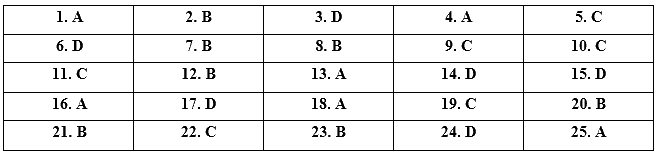
1. A
Kiến thức: Phát âm “-c”
Giải thích:
A. official /əˈfɪʃl/
B. climate /ˈklaɪmət/
C. campus /ˈkæmpəs/
D. occasion /əˈkeɪʒn/
Phần gạch chân đáp án A được phát âm là /ʃ/, còn lại là /k/
Chọn A.
2. B
Kiến thức: Phát âm “-ed”
Giải thích:
A. destroyed /dɪˈstrɔɪd/
B. erupted /ɪˈrʌptɪd/
C. received /rɪˈsiːvd/
D. claimed /kleɪmd/
Quy tắc:
Cách phát âm đuôi “-ed”:
- /t/: khi động từ có phát âm kết thúc là /s/, /f/, /p/, /ʃ/, /tʃ/, /k/ và /s/.
- /id/: khi động từ có phát âm kết thúc là /t/ hay /d/
- /d/: với những trường hợp còn lại
Phần gạch chân đáp án B được phát âm là /ɪd/, còn lại là /d/
Chọn B.
3. D
Kiến thức: Đại từ
Giải thích:
A. else: thêm vào hoặc ngoài cái đã được đề cập
B. others = other + N(số nhiều): những cái khác
C. person: cá nhân
D. other + N(số nhiều): những cái khác
=> each other: lẫn nhau
Have you ever stopped to wonder why people give each (3) other eggs at Easter?
Tạm dịch: Bạn đã bao giờ dừng lại để tự hỏi tại sao mọi người cho nhau trứng vào lễ Phục sinh?
Chọn D.
4. A
Kiến thức: Liên từ
Giải thích:
A. and: và
B. but S + V: nhưng
C. however S + V: tuy nhiên
D. although S + V: mặc dù
In some parts of the world, the rabbit leaves large numbers of eggs (another symbol of new life) in the garden (4) and children have to find as many as they can.
Tạm dịch: Ở một số nơi trên thế giới, thỏ để lại số lượng lớn trứng (một biểu tượng khác của cuộc sống mới) trong vườn và trẻ em phải tìm càng nhiều càng tốt.
Chọn A.
5. C
Kiến thức: Cụm động từ
Giải thích:
A. carry (v): mang, vác
B. get (v): có được, lấy được
C. look (v): nhìn, quan sát
D. take (v): cầm, nắm
=> look after: chăm sóc
=> take after: trông giống
At Easter, children have to be independent and (5) look after themselves.
Tạm dịch: Vào lễ Phục sinh, trẻ phải tự lập và tự chăm sóc bản thân.
Chọn C.
Dịch bài đọc:
Bạn đã bao giờ dừng lại để tự hỏi tại sao mọi người cho nhau trứng vào lễ Phục sinh? Lễ hội Phục sinh của Kitô giáo kỷ niệm sự trở lại của Chúa Giêsu Kitô từ cõi chết, nhưng lễ hội thực sự được đặt theo tên của nữ thần mặt trời, Eastre, người có tên được lấy từ phương Đông nơi bà lớn lên. Vào thời rất xa xưa, lễ Phục sinh là một lễ kỷ niệm rằng mùa đông đã kết thúc và một cuộc sống mới sắp bắt đầu. Nhờ có số lượng thỏ con mà nó sinh ra nên thỏ là biểu tượng của sự sống. Ở một số nơi trên thế giới, thỏ để lại số lượng lớn trứng (một biểu tượng khác của cuộc sống mới) trong vườn và trẻ em phải tìm càng nhiều càng tốt. Điều này rất giống Giáng sinh khi ông già Noel để lại quà cho từng trẻ em. Vào lễ Phục sinh, trẻ phải tự lập và tự chăm sóc bản thân. Theo cách này, việc săn lùng trứng Phục sinh đại diện cho nhu cầu của những người trẻ tuổi đi ra thế giới và tự tạo ra vận may.
6. D
Kiến thức: Sự hòa hợp giữa chủ ngữ và động từ
Giải thích:
A, as well as B + V(chia theo A)
Dấu hiệu: động từ phải chia theo chủ ngữ là ngôi ba số ít “he”
Sửa: are => is
Tạm dịch: Mike, cũng như các bạn cùng lớp, rất hào hứng với chuyến đi về quê vào tuần tới.
Chọn D.
7. B
Kiến thức: Đại từ quan hệ
Giải thích:
Trong mệnh đề quan hệ:
- which + S +V/ V…: cái mà …( thay thế cho danh từ chỉ vật)
- who+ S +V/ V: người mà … (thay thế cho danh từ chỉ người)
Dấu hiệu: “a kind of storm” (một loại bão) là danh từ chỉ vật
Sửa: who => which
Tạm dịch: Bão to là một loại bão chỉ xảy ra ở vùng nhiệt đới.
Chọn B.
8. B
Kiến thức: Trọng âm từ có 2 âm tiết
Giải thích:
A. modern /ˈmɑːdərn/
B. prefer /prɪˈfɜːr/
C. hobby /ˈhɑːbi/
D. village /ˈvɪlɪdʒ/
Quy tắc:
- Những động từ có 2 âm tiết trọng âm thường rơi vào âm tiết thứ hai.
- Những danh từ, tính từ có 2 âm tiết trọng âm thường rơi vào âm tiết thứ nhất.
Trọng âm đáp án B rơi vào âm tiết thứ hai, còn lại là âm thứ nhất.
Chọn B.
9. C
Kiến thức: Trọng âm từ có 2, 3 âm tiết
Giải thích:
A. volcanic /vɑːlˈkænɪk/
B. disaster/dɪˈzæstər/
C. separate /ˈseprət/
D. addition /əˈdɪʃn/
Quy tắc: Những từ có tận cùng là đuôi “-ion”, “-ic” trọng âm rơi vào âm tiết đứng ngay trước nó.
Trọng âm đáp án C rơi vào âm tiết thứ nhất, còn lại là âm thứ hai.
Chọn C.
10. C
Kiến thức: Từ trái nghĩa
Giải thích:
badly (adv): kém, xấu, tệ
A. hard (adv): chăm chỉ
B. carelessly (adv): bất cẩn
C. well (adv): tốt
D. quickly (adv): nhanh chóng
=> badly (adv): kém, xấu, tệ >< well (adv): tốt
Tạm dịch: Sarah đã không vui vì cô làm bài kém.
Chọn C.
11. C
Kiến thức: Giới từ
Giải thích:
wear out: hao mòn
Tạm dịch: Vào thế kỷ 19, công nhân yêu thích vải jean vì nó không dễ bị mòn.
Chọn C.
12. B
Kiến thức: Giới từ
Giải thích:
next to: cạnh, bên cạnh
Tạm dịch: Cậu bé ngồi cạnh tôi trong lớp được gọi là Bob.
Chọn B.
13. A
Kiến thức: Đọc hiểu
Giải thích: Theo đoạn văn, phát biểu nào sau đây là ĐÚNG?
A. Luyện tập thường xuyên là cách tốt nhất để cải thiện kỹ năng tiếng Anh.
B. Tiếng Anh là ngôn ngữ phổ biến nhất trên thế giới.
C. Tiếng Anh được nhiều người nói hơn tiếng Trung Quốc.
D. Bạn không bao giờ nên nói tiếng Anh với chính mình.
Thông tin: The best way to improve the four skills: speaking, listening, reading, and writing is to practice regularly.
Tạm dịch: Cách tốt nhất để cải thiện bốn kỹ năng: nói, nghe, đọc và viết là luyện tập thường xuyên.
Chọn A.
14. D
Kiến thức: Đọc hiểu
Giải thích: Từ “it” trong đoạn 1 thay thế cho?
A. thành công
B. đọc sách
C. Trung Quốc
D. Tiếng Anh
Thông tin: In Vietnam, more and more people are studying English and they consider it a key to success.
Tạm dịch: Tại Việt Nam, ngày càng có nhiều người học tiếng Anh và họ coi đó là chìa khóa thành công.
Chọn D.
15. D
Kiến thức: Đọc hiểu
Giải thích: Có bao nhiêu kỹ năng được đề cập trong đoạn 2?
A. 5
B. 3
C.2
D. 4
Thông tin: The best way to improve the four skills: speaking, listening, reading, and writing is to practice regularly.
Tạm dịch: Cách tốt nhất để cải thiện bốn kỹ năng: nói, nghe, đọc và viết là luyện tập thường xuyên.
Chọn D.
16. A
Kiến thức: Đọc hiểu
Giải thích: Đoạn văn chủ yếu nói về _______.
A. học tiếng anh hiệu quả
B. người học tiếng anh ở việt nam
C. cách đọc sách, nghe radio và xem phim
D. mắc lỗi khi học tiếng Anh
Thông tin: - However, not everyone knows how to learn English effectively.
- The best way to improve the four skills: speaking, listening, reading, and writing is to practice regularly.
Tạm dịch: - Tuy nhiên, không phải ai cũng biết cách học tiếng Anh hiệu quả.
- Cách tốt nhất để cải thiện bốn kỹ năng: nói, nghe, đọc và viết là luyện tập thường xuyên.
Chọn A.
17. D
Kiến thức: Đọc hiểu
Giải thích: Theo đoạn văn, một cách tốt để sửa chữa sai lầm của bạn là ______.
A. ngừng học tiếng Anh
B. đọc sách tiếng anh nhiều
C. tránh nói tiếng Anh
D. luyện nói tiếng Anh nhiều
Thông tin: Practicing speaking a lot is a good way to correct your mistakes.
Tạm dịch: Thực hành nói nhiều là một cách tốt để sửa chữa sai lầm của bạn.
Chọn D.
Dịch bài đọc:
Tiếng Anh là một trong những ngôn ngữ phổ biến nhất trên thế giới. Số lượng người nói tiếng Anh nhiều thứ hai chỉ sau người nói sau tiếng Trung Quốc. Tại Việt Nam, ngày càng có nhiều người học tiếng Anh và họ coi đó là chìa khóa thành công. Tuy nhiên, không phải ai cũng biết cách học tiếng Anh hiệu quả.
Cách tốt nhất để cải thiện bốn kỹ năng: nói, nghe, đọc và viết là luyện tập thường xuyên. Bạn nên tận dụng mọi cơ hội để nói tiếng Anh với bạn bè trong lớp hoặc tại các câu lạc bộ nói tiếng Anh hoặc chính mình trước gương. Học thuộc lòng tất cả các từ không giúp ích nhiều nếu bạn không đọc nhiều vì bạn sẽ dễ dàng quên những gì bạn đã học. Đọc sách, nghe radio và xem phim là những cách tốt hơn để ghi nhớ từ. Bên cạnh đó, người học tiếng Anh không nên quá ngại ngùng vì mắc lỗi là điều không thể tránh khỏi khi học ngoại ngữ. Thực hành nói nhiều là một cách tốt để sửa chữa sai lầm của bạn.
18. A
Kiến thức: to V/Ving
Giải thích: suggest + Ving: gợi ý, đề nghị làm gì
Tạm dịch: Bạn anh ấy gợi ý việc đi tập thể dục sau giờ làm việc.
Chọn A.
19. C
Kiến thức: Từ loại
Giải thích:
A. Science (n): khoa học
B. Scientific (adj): thuộc khoa học
C. Scientists (n): nhà khoa học
D. Scientifically (adv): liên quan đến khoa học
Vì vị trí cần điền là chủ ngữ, sau chủ ngữ là động từ “to be” chia ở dạng số nhiều “are” => danh từ số nhiều là từ loại cần điền
Tạm dịch: Các nhà khoa học đang cố gắng phát triển một loại vắc-xin chống lại căn bệnh này.
Chọn C.
20. B
Kiến thức: Ngôn ngữ giao tiếp
Giải thích:
Antia: “Bạn có phiền không nếu mình mượn từ điển của bạn, Mary?”
Mary: “___________”
A. Vâng, làm ơn.
B. Không, cứ lấy đi.
C. Không, cảm ơn.
D. Có phiền, nó đây.
Các phản hồi A, C, D không phù hợp với ngữ cảnh
Chọn B.
21. B
Kiến thức: Câu bị động
Giải thích:
Câu bị động thì hiện tại hoàn thành: S + has/have + been Ved/V3.
Dấu hiệu: “since last month” (từ tháng trước)
Tạm dịch: Một khách sạn mới đã được xây dựng gần nhà của chúng tôi từ tháng trước.
Chọn B.
22. C
Kiến thức: Liên từ
Giải thích:
but + S + V: nhưng
so + S + V: vì vậy, vì thế
because + S + V: bởi vì
although/ though + S + V: mặc dù
Tạm dịch: Daisy đến muộn, nhưng cô ấy đã hoàn thành công việc sớm hơn những người khác.
= Daisy hoàn thành công việc của mình sớm hơn những người khác mặc dù cô đến muộn.
A. Daisy đến muộn, vì vậy cô ấy đã hoàn thành công việc của mình sớm hơn những người khác.
B. Daisy hoàn thành công việc của mình sớm hơn những người khác vì cô đến muộn.
D. sai vì trong 1 câu dùng 2 liên từ “though” (mặc dù) và “but”
Chọn C.
23. B
Kiến thức: So sánh hơn nhất
Giải thích:
So sánh hơn nhất: S + to be + the + adj-est/ most adj + N.
Tạm dịch: Anh tôi cao hơn bất kỳ học sinh nào trong lớp.
= Anh trai tôi là học sinh cao nhất trong lớp.
A. sai ở “taller”
C. sai ở “most tall”
D. sai ở “most tallest”
Chọn B.
24. D
Kiến thức: Câu điều kiện loại 1
Giải thích:
Câu điều kiện loại 1 được dùng để nói về một sự việc có thể xảy ra ở hiện tại hoặc tương lai nếu có một điều kiện nào đó.
Công thức: If S + V(s/es), S + will + V(nguyên thể).
Tạm dịch: Nhanh lên hoặc bạn sẽ bỏ lỡ xe buýt.
= Nếu bạn không nhanh lên, bạn sẽ bỏ lỡ xe buýt.
A. Nếu bạn nhanh, bạn sẽ bỏ lỡ xe buýt. => sai về nghĩa
B. sai ở thì trong hai vế
C. Bạn sẽ không lỡ chuyến buýt nếu bạn không nhanh.=> sai về nghĩa
Chọn D.
25. A
Kiến thức: Câu tường thuật
Giải thích:
Câu trực tiếp: “How + do/does + S + V?” S1 asked S2.
Câu tường thuật: S1 asked S2 how + S + Ved.
do you do => he went
Tạm dịch: "Làm thế nào để em đi học vào những ngày mưa, Kevin?" Cô giáo nói.
= Giáo viên hỏi Kevin làm thế nào anh ấy đến được trường vào những ngày mưa.
B. sai ở “you”
C. sai ở “do you go”
D. sai ở “goes”
Chọn A.
-------HẾT-------
Đề thi vào 10 môn Anh Hải Phòng năm 2020
Đề bài
Mark letter A, B, C or D to indicate the word whose main stress position is placed differently from that of the others in each group.
Question 26.
A. cover
B. predict
C. behave
D. replace
Question 27.
A. slavery
B. charity
C. invention
D. dynamite
Mark letter A, B, C or D to indicate the correct preposition or adverb particle that completes the sentences.
Question 28. It was my first flight, so I was very nervous when the plane took _____.
A. back
B. off
C. after
D. away
Question 29. Mr. Smith’s sense of humor distinguishes him _____ others.
A. by
B. from
C. between
D. with
Mark letter A, B, C or D to indicate the correct word or phrase to complete each of the sentences.
Question 30. Judy’s car _____ by the mechanic next week.
A. is going to repair
B. will be repaired
C. was repaired
D. is repaired
Question 31. We usually watch the news on TV because it is very _____.
A. inform
B. informal
C. informative
D. information
Question 32. Peter’s father asked him not to spend too much time _____ computer games.
A. played
B. playing
C. to play
D. play
Question 33. Mary: “That’s a marvelous drawing, Laura.” - Laura: “_____.”
A. That’s very kind of you to say so
B. That’s a good idea
C. Well done
D. I’m sorry
Read the following passage and mark letter A, B, C or D to indicate the correct answer to each of the questions that follow.
Solar energy is a long lasting source of energy which can be used almost anywhere. To generate solar energy, we only need solar cells and the sun. Solar cells can easily be installed on house roofs, so no new space is needed and each user can quietly generate their own energy. Compared to other renewable sources, it also possess many advantages. Wind and water power rely on turbines which are noisy, expensive and easy to break down. Solar cells are totally silent and non-polluting. As they have no moving parts, they require little maintenance and have a long lifetime.
However, solar energy also has some disadvantages. We can only generate solar energy during daytime because the system depends on sunlight. Besides, solar cells require large area to work effectively. The main disadvantage of solar energy is that it costs about twice as much as traditional sources such as coal, oil, and gas. This is because solar cells are expensive. Scientists are hoping that the costs of solar cells will reduce as more and more people see the advantages of this environmentally friendly source of energy.
Question 34. What is NOT mentioned as an advantage of solar cells?
A. They cost little to produce.
B. They are non-polluting.
C. They operate quietly.
D. They require little maintenance.
Question 35. Which of the following is NOT a traditional source of energy?
A. coal
B. oil
C. gas
D. solar energy
Question 36. What does the passage primarily discuss?
A. Advantages and disadvantages of solar energy.
B. The cost of solar energy.
C. Solar energy as an alternative for fossil fuels.
D. Solar energy's advantages over other sources of energy.
Question 37. What does the word ‘they’ in the first paragraph refer to?
A. other renewable resources
B. solar energy users
C. advantages
D. solar cells
Question 38. Which of the following is the MAIN disadvantage of solar energy mentioned in the passage?
A. Solar cells require large areas to operate.
B. It depends on sunlight.
C. It is expensive.
D. It is unfriendly to the environment.
Mark letter A, B, C or D to indicate the sentence that is closet in meaning to the given one.
Question 39. She doesn’t have enough money now, but she wants to buy a house in Vinhomes.
A. If she has enough money now, she wants to buy a house in Vinhomes.
B. If she had enough money now, she will buy a house in Vinhomes.
C. If she has enough money now, she will buy a house in Vinhomes.
D. If she had enough money now, she would buy a house in Vinhomes.
Question 40. Jane worked hard, so she passed the final exam.
A. Jane worked hard, but she didn’t pass the final exam.
B. Because Jane worked hard, she passed the final exam.
C. Jane worked hard, because she passed the final exam.
D. Although Jane worked hard, she didn’t pass the final exam.
Question 41. “Can I borrow your dictionary?” John asked me.
A. John asked me to borrow his dictionary.
B. John asked me whether I could borrow his dictionary.
C. John asked me whether he could borrow my dictionary.
D. John asked me whether he could borrow your dictionary.
Question 42. David drives more carefully than Carlos does.
A. Carlos doesn’t drive as carefully as David does.
B. Carlos drives as carefully as David does.
C. David is a less careful driver than Carlos.
D. Carlos is a more careful driver than David.
Mark letter A, B, C or D to indicate the part that is incorrect.
Question 43. Do you know the first man whom landed on the moon?
A. know
B. the
C. whom
D. landed
Question 44. Mrs. Linda, along with her husband, have been to Hanoi capital twice.
A. twice
B. to
C. have
D. With
Read the following passage and mark letter A, B, C or D to indicate the correct word that best completes each of the numbered blanks from 45 to 47.
Clothes can tell a lot about person. Some people like very colorful clothes (45) _____ they want everyone to look at them and they want to be the center of attention. Other people like to wear nice clothes, but their clothes are not (46) _____ or fancy. They do not want people to look at them. Clothes today are very different from the clothes of the 19th century. One difference is the way they look. For example, in the 19th century, all women wore blouses with long skirts. But today, women do not always wear blouses with long skirts. Sometimes they wear short skirts. Sometimes they wear pants. Another difference between the 19th century and today is the (47) _____. In the 19th century, clothes were made only from natural kinds of cloth. They were made from cotton, wool, silk. But today, there are many kinds of man-made cloth. A lot of clothes are now made from nylon, rayon or polyester.
Question 45.
A. because of
B. because
C. but
D. so
Question 46.
A. colorful
B. coloring
C. colorfully
D. color
Question 47.
A. clothe
B. clothing
C. clothes
D. cloth
Mark letter A, B, C or D to indicate the word SIMILAR in meaning to the underlined word.
Question 48. Talking with friends is a common way of relaxing at recess.
A. popular
B. easy
C. unpopular
D. interesting
Mark letter A, B, C or D to indicate the word whose underlined part is pronounced differently from that of the others in each group.
Question 49.
A. walks
B. pens
C. nuts
D. lamps
Question 50.
A. natural
B. manage
C. prepare
D. damage
------ THE END -------
Đáp án
HƯỚNG DẪN GIẢI
Thực hiện: Ban Chuyên môn Loigiaihay.com
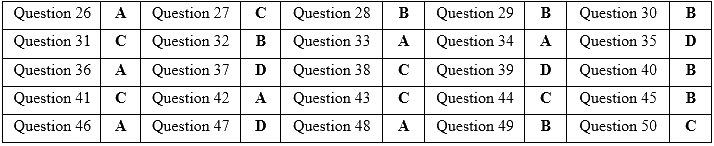
Question 26. A
Kiến thức: Trọng âm từ có 2 âm tiết
Giải thích:
A. cover /ˈkʌvər/
B. predict /prɪˈdɪkt/
C. behave /bɪˈheɪv/
D. replace /rɪˈpleɪs/
Quy tắc:
- Những động từ có 2 âm tiết thường có trọng âm rơi vào âm tiết thứ hai.
- Những danh từ, tính từ có 2 âm tiết thường có trọng âm rơi vào âm tiết thứ nhất.
Trọng âm đáp án A rơi vào âm tiết thứ nhất, còn lại là âm thứ hai.
Chọn A
Question 27. C
Kiến thức: Trọng âm từ có 3 âm tiết
Giải thích:
A. slavery /ˈsleɪvəri/
B. charity /ˈtʃærəti/
C. invention /ɪnˈvenʃn/
D. dynamite /ˈdaɪnəmaɪt/
Quy tắc:
- Từ có tận cùng là đuôi “-ion”, “-ity” có trọng âm rơi vào âm đứng ngay trước nó.
- Từ có tận cùng là đuôi “-ite” có trọng âm rơi vào âm đứng cách nó một âm.
Trọng âm đáp án C rơi vào âm tiết thứ hai, còn lại là âm thứ nhất.
Chọn C
Question 28. B
Kiến thức: Cụm từ
Giải thích:
take back: thu hồi (một tuyên bố)
take off: cởi đồ/ cất cánh
take after: trông giống
take away: đem đi
Tạm dịch: Đó là chuyến bay đầu tiên của tôi, vì vậy tôi rất lo lắng khi máy bay cất cánh.
Chọn B
Question 29. B
Kiến thức: Giới từ
Giải thích: distinguish A from B: phân biệt A với B
Tạm dịch: Sự hài hước của Smith phân biệt anh ta với những người khác.
Chọn B
Question 30. B
Kiến thức: Câu bị động
Giải thích:
Dấu hiệu: “by the mechanic” (bởi người thợ cơ khí) => câu bị động
“next week” (tuần tới) => động từ chia ở thì tương lai đơn
Dạng bị động của thì tương lai đơn: S + will be + P2 + by O
Tạm dịch: Xe ô tô của Judy sẽ được sửa chữa bởi người thợ sửa xe vào tuần tới.
Chọn B
Question 31. C
Kiến thức: Từ loại
Giải thích:
Chỗ trống cần điền một tính từ, đứng sau “very”
A. inform (v): báo tin, cho biết
B. informal (adj): thân mật, không nghi thức
C. informative (adj): cung cấp nhiều tin tức
D. information (n): thông tin
Tạm dịch: Chúng tôi thường xem tin tức trên TV vì nó cung cấp rất nhiều thông tin.
Chọn C
Question 32. B
Kiến thức: “to V/V_ing”
Giải thích: spend + time/money + (on) + V_ing: dành bao nhiêu thời gian/tiền làm việc gì
Tạm dịch: Bố của Peter yêu cầu anh ấy không dành quá nhiều thời gian vào việc chơi điện tử.
Chọn B
Question 33. A
Kiến thức: Ngôn ngữ giao tiếp
Giải thích:
Mary: “Đó là một bức vẽ tuyệt vời Laura ơi.”
Laura: “_____.”
A. Bạn thật là tử tế khi nói vậy
B. Đó là một ý tưởng tốt
C. Làm tốt lắm
D. Tôi xin lỗi
Các phản hồi B, C, D không phù hợp về nghĩa
Chọn A
Question 34. A
Kiến thức: Đọc hiểu
Giải thích: Điều gì KHÔNG được đề cập là một lợi thế của tế bào quang điện?
A. Chúng tốn ít chi phí để sản xuất.
B. Chúng không gây ô nhiễm.
C. Chúng hoạt động một cách lặng lẽ.
D. Chúng ít yêu cầu bảo dưỡng.
Thông tin: Solar cells are totally silent and non-polluting. As they have no moving parts, they require little maintenance and have a long lifetime.
Tạm dịch: Tế bào quang điện hoàn toàn không phát ra tiếng ồn và không gây ô nhiễm. Vì chúng không có bộ phận chuyển động, chúng yêu cầu rất ít sự bảo dưỡng và có tuổi thọ dài.
Chọn A
Question 35. D
Kiến thức: Đọc hiểu
Giải thích: Điều nào sau đây KHÔNG phải là nguồn năng lượng truyền thống?
A. than
B. dầu
C. khí ga
D. năng lượng mặt trời
Thông tin: The main disadvantage of solar energy is that it costs about twice as much as traditional sources such as coal, oil, and gas.
Tạm dịch: Nhược điểm chính của năng lượng mặt trời là chi phí đắt gấp đôi so với các nguồn năng lượng truyền thống như than, đá và khí ga.
Chọn D
Question 36. A
Kiến thức: Đọc hiểu
Giải thích: Đoạn văn chủ yếu thảo luận về vấn đề gì?
A. Ưu điểm và nhược điểm của năng lượng mặt trời.
B. Chi phí năng lượng mặt trời.
C. Năng lượng mặt trời thay thế cho nhiên liệu hóa thạch.
D. Lợi thế của năng lượng mặt trời so với các nguồn năng lượng khác.
Đoạn 1: Nói về ưu điểm của việc sử dụng năng lượng mặt trời
Đoạn 2: Nói về nhược điểm của việc sử dụng năng lượng mặt trời
Chọn A
Question 37. D
Kiến thức: Đọc hiểu
Giải thích: Từ ‘they’ trong đoạn thứ nhất thay thế cho?
A. các tài nguyên tái tạo khác
B. người sử dụng năng lượng mặt trời
C. lợi thế
D. tế bào quang điện
Thông tin: Solar cells are totally silent and non-polluting. As they have no moving parts, they require little maintenance and have a long lifetime.
Tạm dịch: Tế bào quang điện hoàn toàn không phát ra tiếng ồn và không gây ô nhiễm. Vì chúng không có bộ phận chuyển động, chúng yêu cầu rất ít sự bảo trì và có tuổi thọ dài.
Chọn D
Question 38. C
Kiến thức: Đọc hiểu
Giải thích: Điều nào sau đây là nhược điểm CHÍNH của năng lượng mặt trời được đề cập trong đoạn văn?
A. Tế bào quang điện đòi hỏi diện tích lớn để hoạt động.
B. Nó phụ thuộc vào ánh sáng mặt trời.
C. Nó đắt tiền.
D. Nó không thân thiện với môi trường.
Thông tin: The main disadvantage of solar energy is that it costs about twice as much as traditional sources such as coal, oil, and gas.
Tạm dịch: Nhược điểm chính của năng lượng mặt trời là chi phí đắt gấp đôi so với các nguồn năng lượng truyền thống như than, đá và khí ga.
Chọn C
Dịch bài đọc:
Năng lượng mặt trời là một nguồn năng lượng lâu dài có thể được sử dụng ở hầu hết mọi nơi. Để tạo ra năng lượng mặt trời, chúng ta chỉ cần tế bào quang điện và mặt trời. Tế bào quang điện có thể được lắp đặt dễ dàng trên mái nhà, vì vậy không cần một không gian mới và mỗi người dùng có thể lặng lẽ tự tạo ra nguồn năng lượng cho chính mình. So với các nguồn tái tạo khác, nó cũng sở hữu nhiều lợi thế. Năng lượng gió và nước dựa vào các tua-bin ồn ào, đắt tiền và dễ hỏng. Tế bào quang điện hoàn toàn không phát ra tiếng ồn và không gây ô nhiễm. Vì chúng không có bộ phận chuyển động, chúng yêu cầu rất ít sự bảo trì và có tuổi thọ dài.
Tuy nhiên, năng lượng mặt trời cũng có một số nhược điểm. Chúng ta chỉ có thể tạo ra năng lượng mặt trời vào ban ngày vì hệ thống phụ thuộc vào ánh sáng mặt trời. Bên cạnh đó, tế bào quang điện đòi hỏi diện tích lớn để hoạt động hiệu quả. Nhược điểm chính của năng lượng mặt trời là chi phí đắt gấp đôi so với các nguồn năng lượng truyền thống như than, đá và khí ga. Điều này là do tế bào quang điện rất đắt tiền. Các nhà khoa học đang hy vọng rằng chi phí của tế bào quang điện sẽ giảm khi ngày càng nhiều người nhìn thấy những lợi thế của nguồn năng lượng thân thiện với môi trường này.
Question 39. D
Kiến thức: Câu điều kiện loại 2
Giải thích:
- Câu điều kiện loại 2: Diễn tả một điều kiện trái với hiện tại dẫn đến một kết quả trái với hiện tại.
- Công thức: S + were/ V_ed/V2, S + would/could + V (nguyên thể)
Tạm dịch: Bây giờ cô ấy không có đủ tiền, nhưng cô ấy muốn mua một ngôi nhà ở Vinhomes.
A. Nếu bây giờ cô ấy có đủ tiền, cô ấy muốn mua nhà ở Vinhomes. => sai nghĩa
B. Sai công thức
C. Nếu bây giờ cô ấy có đủ tiền, cô ấy sẽ mua một ngôi nhà ở Vinhomes. => sai thì
D. Nếu bây giờ cô ấy có đủ tiền, cô ấy sẽ mua một ngôi nhà ở Vinhomes.
Chọn D
Question 40. B
Kiến thức: Mệnh đề chỉ nguyên nhân – kết quả
Giải thích:
Because + S + V: vì, bởi vì
so + S + V: vì vậy
Tạm dịch: Jane học tập chăm chỉ, vì vậy cô đã vượt qua kỳ thi cuối kỳ.
A. Jane học tập chăm chỉ, nhưng cô ấy đã không vượt qua kỳ thi cuối kỳ. => sai về nghĩa
B. Vì Jane học tập chăm chỉ, cô đã vượt qua kỳ thi cuối kỳ.
C. Jane học tập chăm chỉ, vì cô đã vượt qua kỳ thi cuối kỳ. => sai về nghĩa
D. Mặc dù Jane làm việc chăm chỉ nhưng cô ấy không vượt qua kỳ thi cuối kỳ. => sai về nghĩa
Chọn B
Question 41. C
Kiến thức: Câu gián tiếp
Giải thích:
Công thức tường thuật câu hỏi “Yes/ No”: S1 asked S2 if/ whether + S1 + could + V(nguyên thể)
I => he
your => my
Tạm dịch: “Tôi có thể mượn từ điển của bạn không?” John hỏi tôi.
A. John đã yêu cầu tôi mượn từ điển của anh ấy. => không phù hợp về nghĩa
B. John đã hỏi tôi liệu tôi có thể mượn từ điển của anh ấy không. => không phù hợp về nghĩa
C. John đã hỏi tôi liệu anh ấy có thể mượn từ điển của tôi không.
D. John đã hỏi tôi liệu anh ấy có thể mượn từ điển của bạn không. => không phù hợp về nghĩa
Chọn C
Question 42. A
Kiến thức: So sánh hơn, so sánh bằng
Giải thích:
- Công thức so sánh hơn của trạng từ dài: S + V + more + adv (dài) + than + S + V
- Công thức so sánh bằng của trạng từ dài: S + V + as + adv + as + S + V
Tạm dịch: David lái xe cẩn thận hơn Carlos.
A. Carlos không lái xe cẩn thận như David.
B. Carlos lái xe cẩn thận như David. => sai về nghĩa
C. David là một người lái xe ít cẩn thận hơn Carlos. => sai về nghĩa
D. Carlos là một người lái xe cẩn thận hơn David. => sai về nghĩa
Chọn A
Question 43. C
Kiến thức: Đại từ quan hệ
Giải thích:
Trọng mệnh đề quan hệ:
- who + V / S + V => thay thế cho một danh từ chỉ người; đóng vai trò chủ ngữ/ tân ngữ của mệnh đề quan hệ
- whom + S + V => thay thế cho một danh từ chỉ người; đóng vai trò tân ngữ của mệnh đề quan hệ
“the first man” (người đàn ông đầu tiên) là từ chỉ người
“landed” (đặt chân) là động từ của mệnh đề quan hệ
Sửa: whom => who
Tạm dịch: Bạn có biết người đàn ông đầu tiên đặt chân lên mặt trăng không?
Chọn C
Question 44. C
Kiến thức: Sự hòa hợp giữa chủ ngữ và động từ
Giải thích: N1, along with N2, + V (chia theo N1)
Sửa: have => has
Tạm dịch: Bà Linda, cùng với chồng, đã đến thủ đô Hà Nội hai lần.
Chọn C
Question 45. B
Kiến thức: Liên từ
Giải thích:
A. because of + N/V_ing: bởi vì
B. because + S + V: bởi vì
C. but + S + V: nhưng
D. so + S + V: vì vậy
Some people like very colorful clothes (45) because they want everyone to look at them and they want to be the center of attention.
Tạm dịch: Một số người thích quần áo rất sặc sỡ vì họ muốn mọi người nhìn vào họ và họ muốn trở thành trung tâm của sự chú ý.
Chọn B
Question 46. A
Kiến thức: Từ loại
Giải thích:
A. colorful (adj): nhiều màu sắc
B. coloring (n): màu, thuốc màu
C. colorfully (adv): nhiều màu sắc
D. color (n): màu sắc
“fancy” (có trang trí) là tính từ,
A or B (A, B cùng là một loại từ)
=> chỗ trống cần điền là một tính từ
Other people like to wear nice clothes, but their clothes are not (46) colorful or fancy.
Tạm dịch: Những người khác thích mặc quần áo đẹp, nhưng quần áo của họ không có màu sắc hoặc trang trí sặc sỡ.
Chọn A
Question 47. D
Kiến thức: Từ loại
Giải thích:
A. clothe (v): mặc quần áo
B. clothing (n): quần áo
C. clothes (n): quần áo
D. cloth (n): vải
Sau mạo từ “the” cần một danh từ.
Another difference between the 19th century and today is the (47) cloth.
Tạm dịch: Một sự khác biệt khác giữa thế kỷ 19 và ngày nay là vải.
Chọn D
Dịch bài đọc:
Quần áo có thể nói rất nhiều về con người. Một số người thích quần áo rất sặc sỡ vì họ muốn mọi người nhìn vào họ và họ muốn trở thành trung tâm của sự chú ý. Những người khác thích mặc quần áo đẹp, nhưng quần áo của họ không có màu sắc hoặc trang trí sặc sỡ. Họ không muốn mọi người nhìn vào họ. Quần áo ngày nay rất khác với quần áo của thế kỷ 19. Một sự khác biệt là cách họ nhìn. Ví dụ, vào thế kỷ 19, tất cả phụ nữ đều mặc áo cánh với váy dài. Nhưng ngày nay, phụ nữ không phải lúc nào cũng mặc áo cánh với váy dài. Đôi khi họ mặc váy ngắn. Thỉnh thoảng họ mặc quần. Một sự khác biệt khác giữa thế kỷ 19 và ngày nay là vải. Vào thế kỷ 19, quần áo chỉ được làm từ các loại vải tự nhiên. Chúng được làm từ bông, len, lụa. Nhưng ngày nay, có nhiều loại vải nhân tạo. Rất nhiều quần áo bây giờ được làm từ nylon, rayon hoặc polyester.
Question 48. A
Kiến thức: Từ đồng nghĩa
Giải thích:
common (adj): chung, phổ biến
A. popular (adj): phổ biến, nổi tiếng
B. easy (adj): dễ dàng
C. unpopular (adj): không phổ biến
D. interesting (adj): thú vị
=> common (adj) = popular (adj): phổ biến
Tạm dịch: Nói chuyện với bạn bè là một cách thư giãn phổ biến lúc nghỉ ngơi.
Chọn A
Question 49. B
Kiến thức: Phát âm “-s”
Giải thích:
A. walks /wɔːks/
B. pens /penz/
C. nuts /nʌts/
D. lamps /læmps/
Quy tắc:
Cách phát âm đuôi “s”:
+ phát âm là /s/ khi từ tận cùng bằng các âm vô thanh: /θ/, /f/, /k/, /p/, /t/
+ phát âm là /z/ khi tận cùng bằng các âm còn lại
Phần gạch chân đáp án B phát âm là /z/, còn lại là /s/
Chọn B
Question 50. C
Kiến thức: Phát âm “a”
Giải thích:
A. natural /ˈnætʃrəl/
B. manage /ˈmænɪdʒ/
C. prepare /prɪˈpeə(r)/
D. damage /ˈdæmɪdʒ/
Phần gạch chân đáp án C phát âm là /e/, còn lại là /æ/
Chọn C
---------HẾT--------
Luyện trắc nghiệm Toán lớp 1 Lớp LOP9
Học đi đôi với hành! Làm ngay các bộ đề trắc nghiệm chấm điểm tức thì, có đáp án chi tiết giúp ghi nhớ kiến thức sâu và chuẩn bị tốt cho các bài kiểm tra.
Học tập & ôn luyện trên ứng dụng Tri Thức Hub
Tải ứng dụng Tri Thức Hub trên điện thoại hoặc máy tính bảng (hỗ trợ Android & iOS) để làm bài kiểm tra, luyện tập và lưu tiến độ học tập!