
Tiếng Anh 12 Unit 8 Getting Started
Bài 1
At a rescue centre
(Tại một trung tâm cứu hộ)
1. Listen and read.
(Nghe và đọc.)
Ms Smith: Welcome to the Endangered Primate Rescue Centre! If you have any questions during the tour, don't hesitate to ask me.
Mark: I've just seen a monkey in the enclosure. So are primates just monkeys, Ms Smith?
Ms Smith: No, primates are a group of mammals that includes not just monkeys, but also humans and apes.
Mark: What's the difference between apes and monkeys?
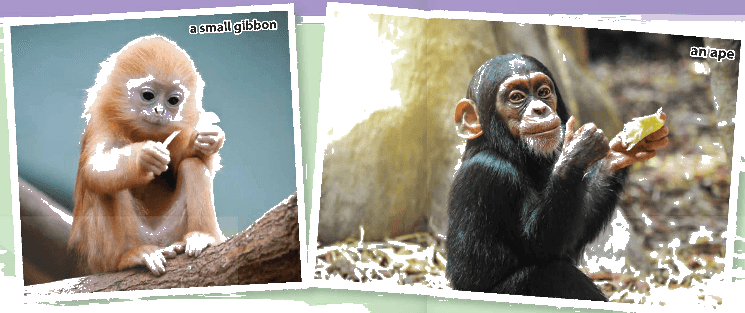
Ms Smith: Well, apes don't have tails and are larger than monkeys. Their brains are also larger. They're as good at using tools as they're at learning sign language.
Mai: So how many primates live here?
Ms Smith: The centre is home to more than 170 primates representing 14 species. They're housed in large enclosures.
Mark: I can hear some sounds. Is someone singing?
Ms Smith: We're close to the gibbons' enclosure, and the male and female gibbons are singing. Gibbons are the smallest of the apes, and all seven species are regarded as threatened. In fact, five of them are listed as critically endangered.
Mai: What is the main threat to gibbons?
Ms Smith: It's habitat loss due to deforestation and illegal hunting. Poachers make a big profit out of selling gibbons as pets and for making traditional medicine and food.
Mai: So we can help gibbons if we stop keeping them as pets.
Ms Smith: That's right. Now let me show you Derek, the gibbon we rescued last week. He was locked in a cage for two years as an illegal pet.
Mai: Oh no, he's so thin.
Ms Smith: Yes. Gibbons can become ill or weak unless they're fed the right type of food. After examining Derek, our veterinarian also found head injuries. So we'll give him a suitable diet and monitor him for several weeks before we release him into the national park.
Phương pháp giải:
Tạm dịch:
Cô Smith: Chào mừng các em đến với Trung tâm Cứu hộ linh trưởng có nguy cơ tuyệt chủng! Nếu bạn có bất kỳ câu hỏi nào trong chuyến tham quan, đừng ngần ngại hỏi cô.
Mark: Em vừa nhìn thấy một con khỉ trong chuồng. Vậy linh trưởng chỉ là khỉ thôi phải không cô Smith?
Cô Smith: Không, linh trưởng là một nhóm động vật có vú không chỉ bao gồm khỉ mà còn cả con người và vượn người.
Mark: Sự khác biệt giữa vượn và khỉ là gì ạ?
Cô Smith: À, vượn không có đuôi và to hơn khỉ. Bộ não của chúng cũng lớn hơn. Chúng giỏi sử dụng các công cụ cũng như học ngôn ngữ ký hiệu.
Mai: Vậy có bao nhiêu loài linh trưởng sống ở đây?
Cô Smith: Trung tâm là nơi sinh sống của hơn 170 loài linh trưởng đại diện cho 14 loài. Chúng được đặt trong những rào lớn.
Mark: Em có thể nghe thấy một số âm thanh. Có ai đang hót không ạ?
Cô Smith: Chúng ta đang ở gần chuồng vượn, vượn đực và vượn cái đang hót. Vượn là loài vượn nhỏ nhất và cả bảy loài đều được coi là bị đe dọa. Trên thực tế, 5 trong số chúng được liệt vào danh sách cực kỳ nguy cấp.
Mai: Mối đe dọa chính đối với vượn là gì ạ?
Cô Smith: Đó là sự mất môi trường sống do nạn phá rừng và săn bắt trái phép. Những kẻ săn trộm kiếm được lợi nhuận lớn khi bán vượn làm thú cưng, làm thuốc và thực phẩm truyền thống.
Mai: Vậy chúng ta có thể giúp đỡ vượn nếu chúng ta ngừng nuôi chúng làm thú cưng ạ.
Cô Smith: Đúng vậy. Bây giờ hãy để cô giới thiệu Derek, con vượn mà trung tâm đã giải cứu tuần trước. Anh ta bị nhốt trong lồng suốt hai năm với tư cách là thú cưng bất hợp pháp.
Mai: Ôi không, chú ấy gầy quá.
Cô Smith: Đúng vậy. Vượn có thể bị bệnh hoặc yếu nếu không được cho ăn đúng loại thức ăn. Sau khi kiểm tra Derek, bác sĩ thú y cũng phát hiện vết thương ở đầu. Vì vậy, chúng tôi sẽ cung cấp cho nó một chế độ ăn phù hợp và theo dõi nó trong vài tuần trước khi thả nó về vườn quốc gia.
Bài 2
2. Read the conversation again and decide whether the statements are true (T) or false (F).
(Đọc lại đoạn hội thoại và quyết định xem các câu phát biểu là đúng (T) hay sai (F).)
|
|
T |
F |
|
1. Humans belong to the same group of mammals as apes and monkeys. |
|
|
|
2. Apes can learn sign language but can't use tools. |
|
|
|
3. Gibbons are endangered because they are the smallest of the apes. |
|
|
|
4. Derek's owner kept him in a cage and gave him the wrong type of food. |
|
|
Lời giải chi tiết:
|
1. T |
2. F |
3. F |
4. T |
1. T
Humans belong to the same group of mammals as apes and monkeys.
(Con người thuộc cùng nhóm động vật có vú như vượn và khỉ.)
Thông tin: …primates are a group of mammals that includes not just monkeys, but also humans and apes.
(…linh trưởng là một nhóm động vật có vú không chỉ bao gồm khỉ mà còn cả con người và vượn người.)
2. F
Apes can learn sign language but can't use tools.
(Khỉ có thể học ngôn ngữ ký hiệu nhưng không thể sử dụng công cụ.)
Thông tin: They're as good at using tools as they're at learning sign language.
(Chúng giỏi sử dụng các công cụ cũng như học ngôn ngữ ký hiệu.)
3. F
Gibbons are endangered because they are the smallest of the apes.
(Vượn đang bị đe dọa vì chúng là loài vượn nhỏ nhất.)
Thông tin:
Mai: What is the main threat to gibbons?
(Mối đe dọa chính đối với vượn là gì ạ?)
Ms Smith: It's habitat loss due to deforestation and illegal hunting. Poachers make a big profit out of selling gibbons as pets and for making traditional medicine and food.
(Đó là sự mất môi trường sống do nạn phá rừng và săn bắt trái phép. Những kẻ săn trộm kiếm được lợi nhuận lớn khi bán vượn làm thú cưng, làm thuốc và thực phẩm truyền thống.)
4. T
Derek's owner kept him in a cage and gave him the wrong type of food.
(Người chủ của Derek đã nhốt anh ta trong lồng và cho anh ta ăn nhầm loại thức ăn.)
Thông tin: He was locked in a cage for two years as an illegal pet. …Gibbons can become ill or weak unless they're fed the right type of food.
(Anh ta bị nhốt trong lồng suốt hai năm với tư cách là thú cưng bất hợp pháp… Vượn có thể bị bệnh hoặc yếu nếu không được cho ăn đúng loại thức ăn.)
Bài 3
3. Match the words and phrases with their meanings.
(Ghép các từ/cụm từ với nghĩa của chúng.)
|
1. threatened species |
a. to watch and check something carefully over a period of time |
|
2. critically endangered species |
b. plants and animals that are in danger of disappearing |
|
3. monitor |
c. to let someone go free after having kept them somewhere |
|
4. release |
d. plants and animals that are likely to become endangered in the near future |
Lời giải chi tiết:
1 - d. threatened species: plants and animals that are likely to become endangered in the near future
(loài bị đe dọa: thực vật và động vật có khả năng bị đe dọa trong tương lai gần)
2 - b. critically endangered species: plants and animals that are in danger of disappearing
(loài cực kỳ nguy cấp: thực vật và động vật có nguy cơ biến mấ)
3 - a. monitor: to watch and check something carefully over a period of time
(giám sát: xem và kiểm tra một cái gì đó một cách cẩn thận trong một khoảng thời gian)
4 - c. release: to let someone go free after having kept them somewhere
(trả tự do: để ai đó được tự do sau khi đã giữ họ ở đâu đó)
Bài 4
4. Complete the following sentences using the information from 1.
(Hoàn thành các câu sau sử dụng thông tin từ bài 1.)
1. _____, don't hesitate to ask.
2. Apes are as good at using tools _____.
3. We can help gibbons _____.
4. _____ unless they're fed the right type of food.
Lời giải chi tiết:
1. If you have any questions during the tour, don't hesitate to ask.
(Nếu bạn có bất kỳ câu hỏi nào trong chuyến tham quan, đừng ngần ngại hỏi.)
2. Apes are as good at using tools as they're at learning sign language.
(Khỉ sử dụng công cụ giỏi cũng như học ngôn ngữ ký hiệu.)
3. We can help gibbons if we stop keeping them as pets.
(Chúng ta có thể giúp đỡ vượn nếu chúng ta ngừng nuôi chúng làm thú cưng.)
4. Gibbons can become ill or weak unless they're fed the right type of food.
(Vượn có thể bị bệnh hoặc yếu nếu không được cho ăn đúng loại thức ăn.)
Trắc nghiệm ôn tập bài học
Cùng củng cố kiến thức với 15 câu hỏi dưới đây. Chọn “Làm bài ngay” để bắt đầu trả lời và chấm điểm.
Câu 1
According to Ms Smith in the conversation, primates are a group of mammals that includes _____.- A.monkeys, apes, and humans
- B.apes, monkeys, and birds
- C.only monkeys and gibbons
- D.only humans and monkeys
- A.
Câu 2
In the context of the rescue centre, what does the word 'enclosure' mean?- A.an open forest where animals live without human care
- B.a clinic where sick animals receive medical operations
- C.a small vehicle used for transporting wild animals
- D.a fenced or closed area where animals are kept
- A.
Câu 3
According to the conversation, what is one major difference between apes and monkeys?- A.Monkeys have larger brains than apes.
- B.Apes do not have tails and are larger than monkeys.
- C.Apes have long tails used for swinging in trees.
- D.Monkeys can learn sign language while apes cannot.
- A.
Câu 4
Fill in the blank with the correct conjunction: 'Gibbons can become ill or weak _____ they're fed the right type of food.'- A.although
- B.because
- C.unless
- D.if
- A.
Câu 5
Which of the following words has the primary stress placed differently from the other three?- A.primate
- B.diet
- C.mammal
- D.release
- A.
Câu 6
Based on Ms Smith's statement, how many species are represented by the primates living in the rescue centre?- A.7 species
- B.5 species
- C.170 species
- D.14 species
- A.
Câu 7
In the conversation, what does the word 'poachers' mean?- A.people who hunt or catch wild animals illegally
- B.veterinarians who take care of rescued wildlife
- C.people who protect endangered species in reserves
- D.tourists who visit national parks without guides
- A.
Câu 8
Why was Derek the gibbon in such poor health when the rescue team found him?- A.He was abandoned in the national park without any food.
- B.He was infected with a deadly virus spread by other primates.
- C.He had been locked in a cage as an illegal pet without a proper diet.
- D.He was attacked by poachers while searching for food in the wild.
- A.
Câu 9
Choose the correct preposition to complete the sentence: 'The Endangered Primate Rescue Centre is home _____ more than 170 primates.'- A.to
- B.at
- C.for
- D.with
- A.
Câu 10
Complete Ms Smith's greeting to the students during the tour: 'Welcome to the Endangered Primate Rescue Centre! If you have any questions during the tour, _____.'- A.don't interrupt other visitors
- B.don't hesitate to ask me
- C.please keep quiet and wait until the end
- D.you must ask the tour guide outside
- A.
Câu 11
According to Ms Smith, what is the main threat leading to the endangerment of gibbons?- A.Natural disasters such as forest fires and floods
- B.Severe competition for food with other ape species
- C.Habitat loss due to deforestation and illegal hunting
- D.Extreme climate change affecting their reproduction
- A.
Câu 12
In the sentence 'So we'll give him a suitable diet and monitor him for several weeks', the word 'monitor' is closest in meaning to _____.- A.observe
- B.punish
- C.capture
- D.display
- A.
Câu 13
Complete the sentence comparing the abilities of apes: 'They're as good at using tools _____ they're at learning sign language.'- A.so
- B.as
- C.like
- D.than
- A.
Câu 14
Which of the following words has the primary stress placed on the second syllable?- A.gibbon
- B.illegal
- C.profit
- D.threatened
- A.
Câu 15
What plan does the rescue centre have for Derek before releasing him back into the national park?- A.Train him to learn sign language alongside other gibbons
- B.Keep him in a large enclosure permanently for tourists to see
- C.Provide him with a suitable diet and monitor him for several weeks
- D.Release him immediately to rejoin his family in the forest
- A.
Học tập & ôn luyện trên ứng dụng Tri Thức Hub
Tải ứng dụng Tri Thức Hub trên điện thoại hoặc máy tính bảng (hỗ trợ Android & iOS) để làm bài kiểm tra, luyện tập và lưu tiến độ học tập!